
Sari Madu Sedana: Kele Kele Honey in Balangan, Bali
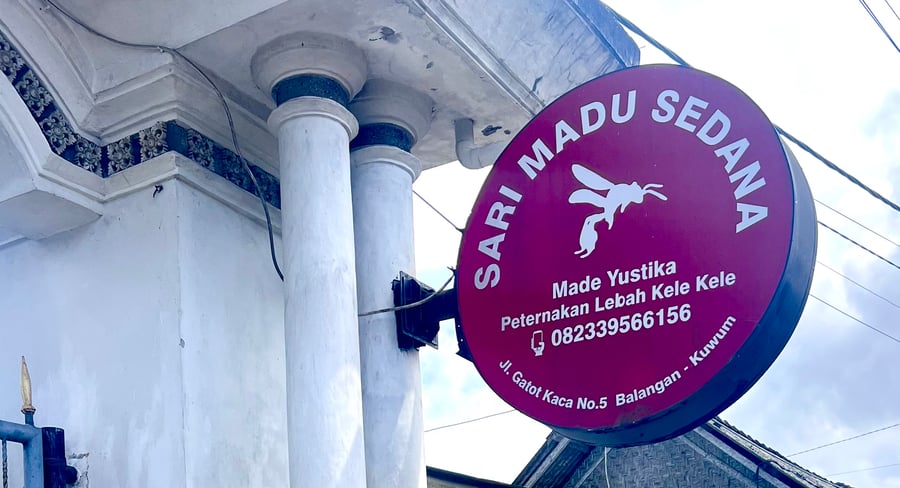
The sign is hard to miss: Sari Madu Sedana. Underneath, smaller: Peternakan Lebah Kele Kele -- Kele Kele Bee Farm. The address is Jl. Galot Kaca No. 5, in Balangan-Kuwum, a residential lane in the village of Kumbanyabahan, south Bali. Nothing about the entrance -- white-painted gate columns, a carved stone altar out front -- hints at what is stacked and hanging in the compound behind it.
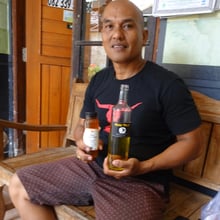
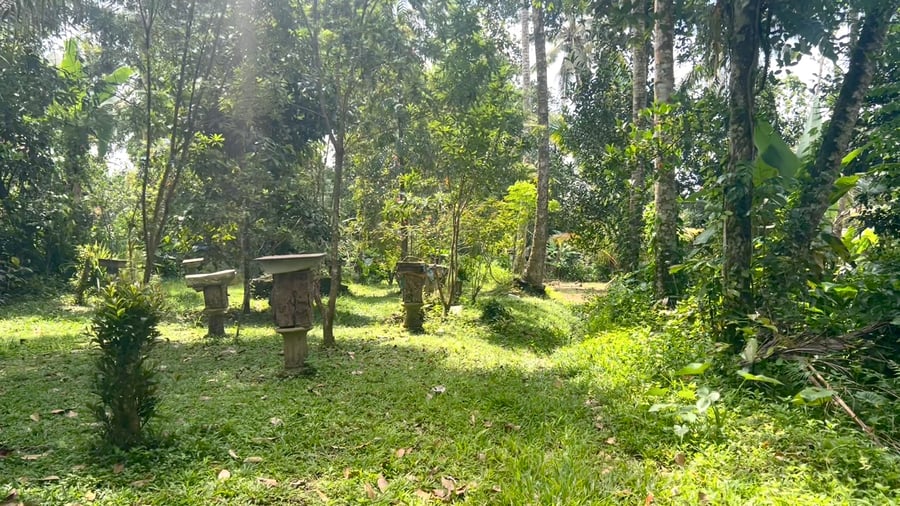
Made Yustika has been keeping stingless bees at this address for fifteen years. The yard is open, unfenced, and hives are everywhere: bamboo tubes wedged into frames, wooden boxes on concrete pedestals, ceramic jars sealed with propolis resin. His operation sits inside a broader network of fourteen member beekeepers across the village, running a combined 800 hives. All of it started, he will tell you without any particular drama, as a hobby.
Made keeps multiple species of stingless bees across 35 hives. Two dominate the honey making.
The first is the Itama (Heterotrigona itama), originally sourced from Sumatra. These are the workhorses. A single Itama colony, given four to five months and reasonable weather, fills roughly one liter of honey. The hive boxes are purpose-built to match their scale -- the honey pots inside are large enough that Made extracts using a small dynamo syringe, drawing honey directly from the pots without opening or destroying the brood structure below.
The second is the Lipecep (Tetragonula laeviceps, also called Laisib locally) -- the original Balinese bee. It is tiny, closer in size to a fruit fly than to a honeybee, and it lives naturally inside bamboo stems in the island's remaining forest. A Lipecep colony takes two full years to produce a harvestable amount of honey, and when it does, you might get 100 milliliters. Maybe. The honey pots are so small that extracting them means squeezing the entire comb by hand -- which destroys it. Rebuilding the comb takes another year. The math on Lipecep honey is punishing, and the price reflects that.
Made opened one of the Lipecep hives so we could look inside. The queen was there -- visible once your eyes adjusted to the scale. Smaller than you expect, sitting quietly in the brood cluster. Made explained the succession: a stingless bee queen lives roughly three years, and when she stops being productive, the colony starts raising a replacement. You can see it happening in the comb -- a single egg, noticeably larger than the worker eggs around it, fed by the workers into a future queen. No queen cells today. This queen is still good.
The honey pots in the Lipecep comb are tiny propolis-sealed spheres, each holding a fraction of what you would find in a conventional honeybee frame. Above the brood, the honey. Below, the eggs. The colony functions here, in its managed box, exactly as it would inside a bamboo stem found in the forest. That transfer -- split the bamboo carefully, move the comb into the box, make sure the queen comes with it -- is how Made builds his stock of this species.
The Itama hive Made opened next was a different scale entirely. The honey pots were fat, propolis-sealed, noticeably amber through the resin coating. He tilted the frame to show the underside -- honey practically everywhere. The bees were getting agitated. Stingless bees cannot sting in the conventional sense, but they bite, and they are drawn instinctively to dark openings, which means ears and nostrils if you are not careful. Small, purposeful, surprisingly determined little bites.
The dynamo extraction is what makes the economics of the Itama work. Pull the honey directly from the pots with a syringe, leave the brood structure intact, and two months later the colony is largely refilled. Compare that to the Lipecep: squeeze the comb by hand, wait a year for the bees to collect enough resin to rebuild the structure, then wait another full year for the honey volume to accumulate again. The Itama's productivity comes not only from the bee's biology but from being able to harvest repeatedly without setting the colony back to zero each time.
In a good season -- consistent flowering, no extended dry stretch -- a single Itama colony can yield between 500 milliliters and nearly one liter every four to five months. Twice a year, if the weather holds.
Madu kele kele is sour. Not gently tart the way some honeys are -- genuinely, prominently sour, with a resinous edge and almost no sweetness on the front palate. Both species produce it, though the Lipecep honey runs more acidic than the Itama. The bees forage on everything available. In the compound, Made keeps bunga AMP (Air Mata Pengantin) planted specifically for them -- a local flowering plant that blooms continuously regardless of rain or drought. Santos flowers too. The colony does not wait for a single dominant nectar source; it takes what is there.
What makes this honey genuinely unusual is what else it contains. Because stingless bees store propolis, bee pollen, and royal jelly within the same comb structure as the honey, and because the Lipecep harvest involves squeezing the comb rather than syringe extraction, all three end up combined in the jar. Not as added ingredients -- as a natural consequence of how the bee builds and how the honey is taken. Propolis. Bee pollen. Royal jelly. One product. The royal jelly settles to the bottom when the honey is chilled, forming a pale crystalline layer. It has no sweetness on its own. Made passed a chilled jar around. It is thick, almost gel-like, and completely unsweetened -- nothing like sugar, which would dissolve and not return. Royal jelly does not dissolve. It separates and holds its character.
Sitting with three different bottles from the same apiary makes the color question unavoidable. The honeys range from pale amber to deep mahogany red, and the instinct is to assume the darker ones are older. That is wrong. The color is determined by harvest timing within the colony cycle and by whether the hive box is old or new -- not by how long the honey has been stored. Made cannot always predict which box will produce which color. The flowers change, the timing shifts, the colony responds. He describes it simply as alam -- nature -- and leaves it there. Sometimes a box produces white honey. He cannot explain that either.
Tasting all three side by side is worth doing slowly. The dark Itama honey from the old box hits with a strong floral note right at the front, then turns light on the tongue before finishing dry, with a distinct bitter edge that appears only after you swallow. The medium honey from a newer box has the same floral opening but quieter, not as sour, with a fine granular texture on the tongue and no bitter aftertaste -- though the first contact in the throat is sharp. The Lipecep honey, from the native Balinese bee, is the mildest of the three: almost powdery on the tongue, no bitterness at all, still clearly flavored. All three are different. Quite different. And they all came from the same lane in Kumbanyabahan.
The arak appeared near the end of the visit. Arak is Bali's traditional distilled spirit -- usually made from palm sap or rice -- but Made's version is built on two ingredients that you would not expect to find in the same bottle: stingless bee honey and edible swiftlet nest (sarang walet). The nest is the same fibrous, cup-shaped material made from swiftlet saliva that commands extraordinary prices in Chinese cuisine and traditional medicine markets across Asia. Here it goes into a fermentation jar with the honey, sits for three months, and is then distilled into arak.
The Balinese government now issues licenses for traditional arak production, and Made has one. The product is called Arak Walet -- the swiftlet is even on the label. A bottle costs 100,000 rupiah, roughly five US dollars. The color is a striking, clear yellow-green -- not the amber you might expect from honey. Made was specific about this: the fermentation chemistry produces the color, not the honey. Use a darker honey and it comes out the same shade. It tastes like a high-quality liqueur -- smooth, with a warm finish and no bitterness. He does not sell it anywhere except here. He makes what he makes, in the quantities available. If you find it, buy it.
Made has been teaching beekeeping for eight years. University students from Australia and Germany have made the trip to Kumbanyabahan -- Germany being a particularly long journey to learn about a bee that does not exist there. Some institutions send students to him; others invite him to come and teach on campus. Either way he covers the same material: the biology of stingless bees, species differences, hive management, how to transfer a wild colony from a bamboo stem to a managed box without losing the queen.
He has government certification on the wall. Framed certificates from agricultural programs. A photograph of a student group posing with the hives, one of them holding what appears to be a python -- a visitor from Cambodia that someone brought along, apparently.
The broader network is a village-level collective: fourteen beekeeping members in Kumbanyabahan, connected to a wider umbrella of 22 farmer organizations across the area. Eight hundred hives in total. The compound stays open. In fifteen years, not a single hive has been stolen. Not one. Made attributes this, without drama, to the community model -- everyone in the neighborhood is involved, everyone has a stake. He knows that in some countries beekeepers park their hives fifty miles from the nearest house specifically to prevent theft. Here the hives are at the end of a residential lane, and nobody touches them.
He started with a hobby. It became an education program, a nature protection effort, and a quiet commercial operation, roughly in that order. The honey is the point -- but it is not the only point.