New Zealand Honey
Jump to Regional Travel and Honey Pages
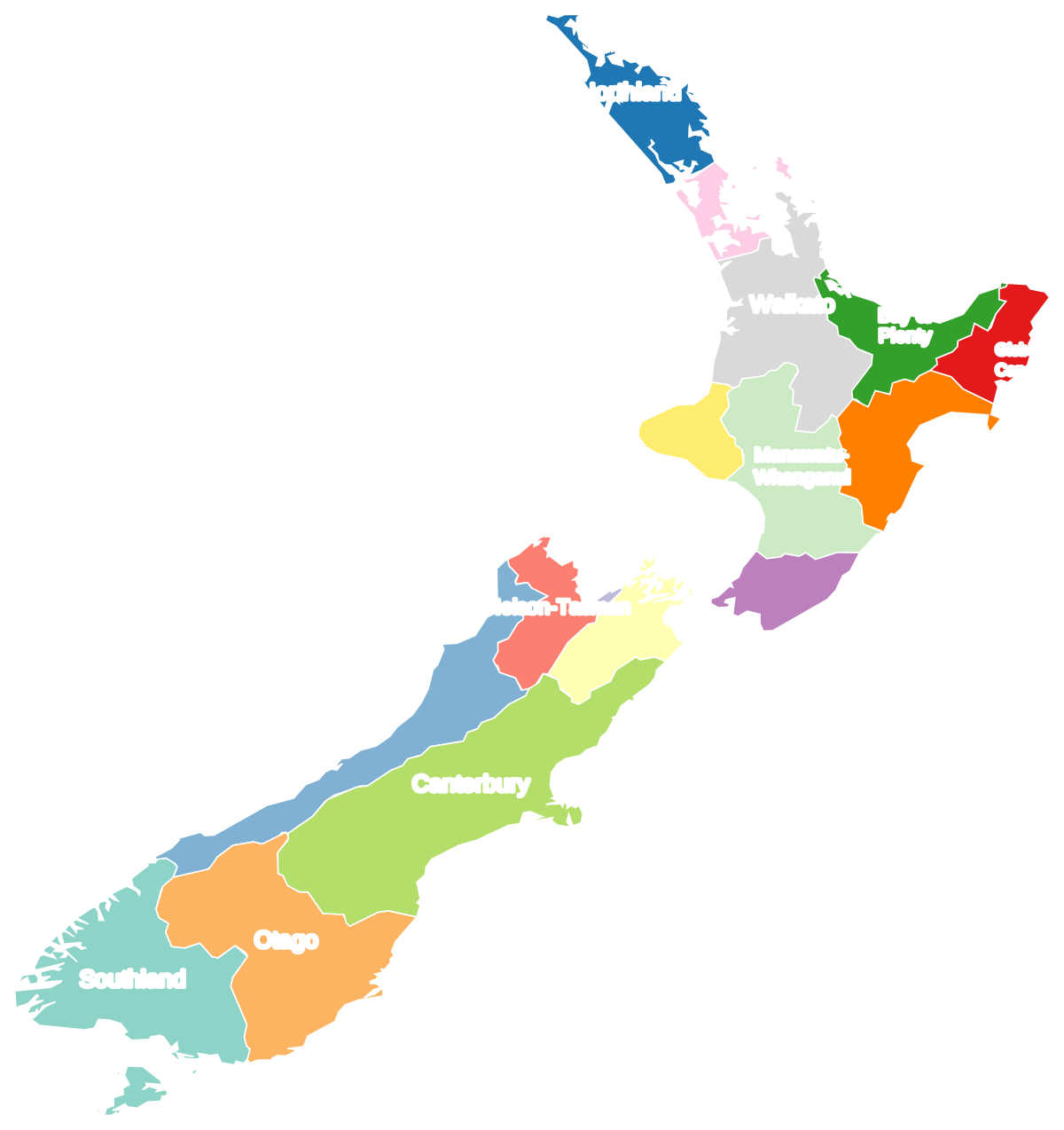
New Zealand is the above-water part of a mostly submerged continent, Zealandia, which broke from Gondwana around eighty million years ago. It has been isolated ever since: Australia lies two thousand kilometres west across the Tasman Sea, and nothing but ocean lies south until Antarctica. The two main islands run sixteen hundred kilometres from a subtropical north to a cool-temperate south, and the Southern Alps intercept the westerly rain – over seven metres a year falls on the West Coast, about six hundred millimetres on the Canterbury plains an hour to the east. Eighty million years of isolation produced a flora in which four out of five native trees, ferns and flowering plants grow nowhere else on Earth. Polynesian voyagers reached the islands around 1300; other than Antarctica, this was the last major landmass humans settled.
None of that flora ever became honey, because nothing here could make it. New Zealand’s twenty-eight native bee species – ngaro huruhuru to Māori – are solitary: small, furry, ground-nesting, storing no honey worth taking. But the flora was rich in nectar, and Māori harvested its sweetness by name. Wai kōrari, the flax-flower nectar tapped into gourds – “one plant will produce nearly half a pint,” a missionary recorded in 1847. Kāuru, the sugar baked out of cabbage-tree stems in earth ovens that left their names on the map: Temuka is Te Umu Kaha, “the strong ovens.” Wai pūhou, a drink strained with great care from the petals of the poisonous tutu. To say New Zealand had no honey before 1839 is true only in the narrowest sense. It had a sweet-foods economy with its own names, tools and trade – everything but the bee.
Half a pint from a flax plant: the sweet foods of Aotearoa
Wai kōrari was gathered mostly by children, who picked flax flowers and tapped them against the inside of a gourd; a big plant could give up to 250 millilitres. The drink was taken on its own or mixed with water, and its sweetness became a standard of comparison -- the saying "me te wai kōrari" means "like the honey of the flax flower."
Kāuru was South Island work. The stems and roots of young cabbage trees were dug shortly before flowering, when richest in sugar, and baked for hours in great earth ovens called umu tī, which partly crystallised the sugar. Travellers carried the baked root and let flax nectar drip down it as a portable sweet -- unu-wai-kōrari, "drink the flax water." The practice ended within a few years of colonisation, when fires destroyed the kāuru plains.
Wai pūhou demanded the most care. Every part of the tutu plant is poisonous except the fleshy petals, so the dark juice was strained through toetoe flower heads to keep back the deadly seeds. In the Ngāi Tahu telling, visitors could judge a household by its wai pūhou -- offering a jug that had stood too long was an insult.
And nectar was drunk straight from the flowers. William Cotton, watching in 1842, wrote: "The flowers of the plants abound with honey, which the natives frequently suck. The bees will do more effectively for them with their small proboscis what the natives now do for themselves with their large mouths."

The bee arrived at a mission station. In March 1839 Mary Bumby, sister of a Methodist missionary, brought two hives ashore at Mangungu on the Hokianga Harbour – probably the first honeybees in New Zealand. A year later the mission diary records “a little maiden honey.” The bee’s great promoter followed: William Cotton, chaplain to the first bishop, who arrived in 1842 and in 1849 printed Ko Ngā Pī – “The Bees” – the first book in te reo Māori about beekeeping. Māori wove hives from flax as readily as kete, caught swarms as the bees went feral through the bush, and by the 1860s were selling honey in quantity – by common account, the country’s first commercial beekeepers. Not everyone welcomed the newcomer: rangatira called the honeybee “the white man’s fly,” and by 1874 were blaming it publicly for declines in native birds – an ecological observation the colonists dismissed.
Two hives, a treaty, and a nine-year-old's first taste of honey
The two hives probably came aboard in Hobart rather than from England -- the ship James stopped in Tasmania on the way out, and hive exports from the Australian colonies were already established. Mary Bumby landed in the Hokianga on 13 March 1839 and joined the Mangungu Mission on the 19th, the date now used to mark the bees' arrival.
The next summer, Mangungu hosted the largest single signing of the Treaty of Waitangi: some three thousand Māori gathered on 12 February 1840, with Mary Bumby as host -- her brother was away in Australia. Whether her honey was served that day is an unproven theory. As one beekeeper-historian puts it, she had the means, the motive, and the opportunity; no diary says so.
The first taste on record belongs to a child. Marianne Hobbs, aged nine, recalled it in a bee journal more than fifty years later: "We tasted for the first time in our lives real honey in the comb, which Miss Bumby kindly sent to us."
Cotton's own shipboard hives never made it -- lost and plundered on the voyage out. He learned te reo from a Māori deckhand, and his Ko Ngā Pī was translated in full into English only around 2022, by the Hokianga translator Joy Ngaropo-Hau, who found his Māori imperfect but his intent plain in the title: the bees, and the customs for caring for them, for their honey and their wax.
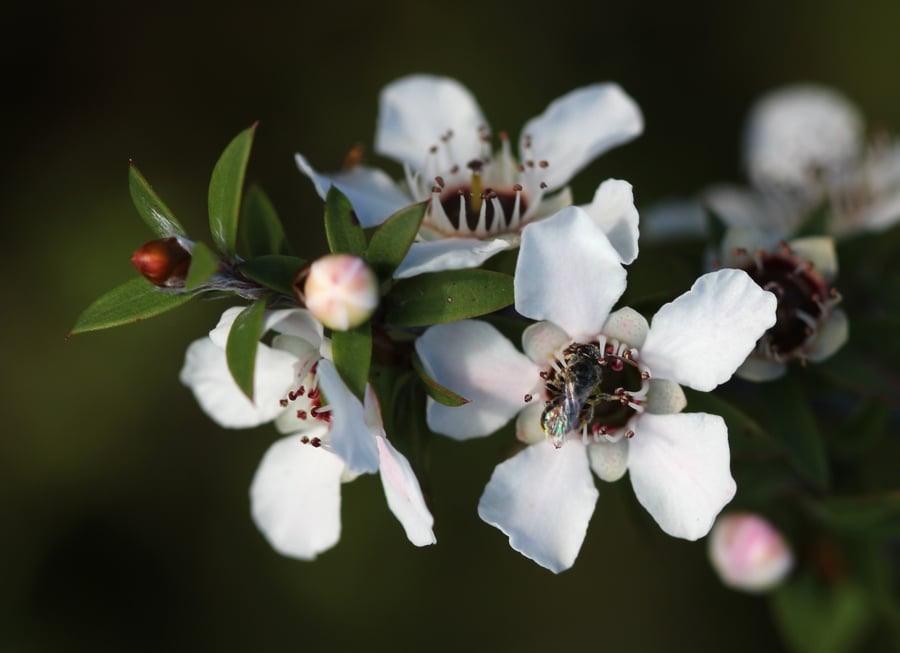
The bee found a nectar landscape no honeybee had ever worked, and out of the endemic four-fifths came honeys that exist nowhere else. Mānuka – a pioneer scrub farmers once cleared as a nuisance – carried a nectar chemistry unlike any other and became the foundation of a trade in which a single jar can sell for thousands of dollars. Rewarewa, the New Zealand honeysuckle, gives a dark, malty honey; southern rātā flowers well every third year and spectacularly every seventh; tāwari, the lone species of what was once the country’s only endemic plant family, gives a honey the industry describes as white chocolate melting off the tongue. The strangest crop is not from a flower at all: across about a million hectares of South Island beech forest, a native scale insect drinks the sap and exudes the surplus, and the bees gather it – honeydew, amber and slow to crystallise, first shipped to Europe in 1970, and by 1980-81 almost all of it bound for Germany. The settlers added a flora of their own: white clover, sown for sheep country, became the plain table honey of the nation; thyme, carried in by gold miners as a kitchen herb, now covers the old tailings of Central Otago; vipers bugloss covers the dry hills of Marlborough and Otago in summer. New Zealand honey comes from both floras – the endemic and the introduced, side by side.
An insect's sugar: how the beech honeydew crop works
The producer is a scale insect, Ultracoelostoma, that lives inside the bark of black and mountain beech in the eastern foothills and of red beech on the West Coast. It drinks the tree's sap and exudes the surplus sugar through a fine tube, where it hangs as a droplet. A heavily infested forest carries millions of these threads; one Nelson Lakes study estimated 3,500 to 4,500 kilograms of honeydew, dry weight, per hectare a year in 1999-2001.
The forest runs on it. Tūī, kākā, bellbirds and native bats feed on the droplets all year, and in winter, when nectar is scarce, honeydew is the energy source that carries them through. At their late-1980s peak, introduced wasps took more than 90 per cent of the honeydew for months of the year in the forests they had invaded.
The honey is unlike any floral crop: amber, with an electrical conductivity a Canterbury packer puts at around ten times that of flower honeys, and slow to crystallise. Of ten New Zealand honeys tested at Lincoln University it tied with thyme for the highest phenol levels, and some have described its flavour as Christmas cake.
Germany was its chief buyer by 1980-81 and still in 2020-21 -- honeydew honeys hold an established place on the German table.
The industry today is living through the aftermath of a boom. Between 2013 and 2019, as mānuka prices climbed, registered hives doubled from 452,000 to a peak of 918,026; by early 2026 the count had fallen back to about 501,000, and the surplus honey of the boom years has only recently cleared. Yet 2025 set a record: NZ$450 million of honey exported, more than in any peak year, from far fewer hives – led by retail-pack mānuka to the United States, where sales grew by half in a single year. Varroa has been in the country since 2000; feral colonies have been extremely rare ever since, the mite remains the leading cause of losses in managed hives, and the winter of 2025 was the worst varroa year the national survey has recorded. The industry reorganised in June 2026, when Apiculture New Zealand voted to become Honey and Bees New Zealand. Some eight thousand registered beekeepers keep bees here, from two-hive hobbyists to Māori trusts and family firms running tens of thousands of hives.
918,026 hives at the peak: the mānuka boom by the numbers
The climb was steep. Registered hives rose from 452,018 in 2013 to 918,026 in 2019 -- a doubling in six years, driven by mānuka prices. Production peaked at 27,000 tonnes in 2020, the biggest crop New Zealand has recorded.
The correction was steeper. A wet 2023 season produced just 12,000 tonnes, the weakest crop since 2012, on top of a national surplus estimated at 30,000 to 50,000 tonnes; for several seasons bulk bush honey sold below the cost of producing it, and hive numbers fell by more than 40 per cent from the peak.
The turn came on value rather than volume. By 2026 the surplus had largely cleared and prices to beekeepers were rising again, and 2025 set the export record: NZ$450 million, led by retail-pack mānuka to the United States, which climbed 54 per cent in a year to become the largest single market.
Behind the prices sits label arithmetic. Honey exported as mānuka must pass the government's five-attribute science definition -- four nectar chemicals plus a DNA test for mānuka pollen -- and the industry's UMF grading layers four more measures on top: potency, authenticity, shelf life and freshness. Few foods anywhere carry this much verification per jar.
A large proportion of the mānuka the boom was built on grows on Māori-owned land, and Māori trusts and incorporations now run some of the industry’s most distinctive operations. In Ruatāhuna, inside the Te Urewera forest, the Tūhoe Tuawhenua Trust turned its people’s tradition of wild honey-gathering – te nanao miere, climbing forest trees for feral hives, photographed as far back as the 1930s – into Manawa Honey NZ, whose rewarewa was judged the best-tasting honey in the world at the 2021 Black Jar contest. On the East Coast, Ngāti Porou landholdings control mānuka country the big honey companies seek out, and the iwi opened its own extraction plant at Te Araroa in 2024; on the Whanganui River, the Ātihau-Whanganui Incorporation runs about three thousand hives on ancestral land. The word itself is contested. Mānuka is te reo Māori, and when New Zealand producers tried to trademark “manuka honey” against Australian producers of Leptospermum honey, the case turned partly on whether any one association could own a Māori word. New Zealand’s own trademark office declined the mark in 2023, and the Māori claim continues in other jurisdictions – as the chair of the Mānuka Charitable Trust put it, the role of kaitiaki, guardians, “is not contested.”
Te nanao miere: from climbing rope to world title
The Tūhoe Tuawhenua Trust holds nine thousand hectares of bush-clad land around Ruatāhuna, deep in Te Urewera. Its stated vision is "Kia tau te iwi me te whenua" -- people and the land in thriving harmony.
Honey became a revered food in Ruatāhuna soon after the bee arrived in the north, and the trust's own account describes ancestors gathering wild honey from hives high in forest trees -- te nanao miere. Photographs from around the 1930s show the climbs, and a trustee still demonstrates the rope method on film.
The trust founded Manawa Honey NZ in 2013 to create work in Ruatāhuna and get honey back into local diets. In 2021 its rewarewa honey won the Black Jar International Honey Tasting Contest outright -- judged the best- tasting honey in the world, with chief beekeeper Hekenoa Te Kurapa's name on the trophy. The company is B Corp certified and opened its own production plant on site in 2025.
Groups can visit: Manawa runs tastings and tours on its own country -- the honey, the hives, the river and the bush -- the only Māori-owned honey tour experience we found anywhere in New Zealand.
The trans-Tasman tussle over a word
In 2015, with roughly six million dollars of government backing, New Zealand producers applied to register "manuka honey" as a certification mark -- a label only New Zealand honey could carry, on the argument that mānuka is a Māori word for a New Zealand tree.
The refusals came in sequence: the United Kingdom in December 2021, then New Zealand's own Intellectual Property Office in May 2023, in a decision that called the case "a trans-Tasman tussle of extraordinary proportions." The ruling weighed tikanga, kaitiakitanga and the Wai 262 report directly -- and still found the term descriptive: no one association could own it, Māori producers outside the association included.
The claim has not ended. The Mānuka Charitable Trust, the national Māori voice on the taonga species, filed fresh applications from 2024; the United States suspended its examination in July 2026 on the same descriptiveness objection, and Australia deferred acceptance. At home the term stays free for any honest trader, and the government's science definition does the certifying in practice.
One wrinkle kept the fight honest from the start: Leptospermum scoparium grows natively on both sides of the Tasman, and the Australian industry harvests its own Leptospermum honeys under the same name.
Honeys New Zealand Is Known By
- Mānuka – the honey buyers abroad know New Zealand by, graded on nectar chemistry and defended as a name: the trade mark offices of Britain in 2021 and of New Zealand itself in May 2023 both declined to reserve it for New Zealand honey alone.
- Rewarewa – from the bird-pollinated flowers of the New Zealand honeysuckle, and winner of the grand prize at the 2021 Black Jar International Honey Tasting Contest in Asheville, North Carolina, where every entry is tasted from a black jar so that colour and clarity count for nothing.
- Beech honeydew – from no flower at all: scale insects living in the bark of black, mountain and red beech in the South Island drink the sap and exude the surplus as hanging droplets the bees collect, and New Zealand counts the result as a category of its own in its export statistics.
- Thyme honey – made on ground the gold rush left behind: common thyme escaped miners’ gardens in Central Otago in the 1860s and, since neither sheep nor rabbits will eat it, spread over the dry schist hills and the old mining tailings, where a botanist recorded it covering acres near Ophir by 1927.
- Pōhutukawa – gathered in the few weeks around Christmas when the coastal tree is in crimson flower along the northern shores and islands, and it comes out near-white; the beekeeper Mike Stuckey, who takes hives to the Rangitoto Island trees, told New Zealand Geographic it is the whitest honey in the world.
- Clover – the honey the New Zealand season is worked around: white clover sown through the pastures of both islands gives up most of a district’s crop in the two or three weeks after mid-December, and the government’s beekeeper price tables graded the national crop by its name, as light clover type, through to 2019-20.
History and Tradition
The industry the two hives started grew in step with the country’s institutions. Feral colonies filled the North Island bush within a decade of 1839, and by the 1860s Māori were selling honey in quantity. Moveable-frame hives arrived in 1878, and the government took bees seriously early: New Zealand has had American foulbrood control law since 1906, and it remains one of the few countries where the disease is managed by inspection and burning rather than antibiotics, which are illegal in beekeeping here.
The modern industry has two scientific turning points. In the early 1970s, beech honeydew from the South Island began flowing to Europe. Then in 1981 Peter Molan at the University of Waikato began documenting an unusual antibacterial activity in mānuka honey. That finding took two decades to become an industry: the UMF grading system was founded in 1998, the varroa mite arrived in 2000 and ended the feral era, and through the 2010s mānuka prices rebuilt the whole shape of New Zealand beekeeping around one six-week bloom.
The boom peaked in 2019 at 918,026 registered hives, and the correction that followed cut the count nearly in half. The institutions have kept adjusting: a new bee biosecurity agency took over foulbrood management in 2025, and in June 2026 the national body Apiculture New Zealand voted to reform itself as Honey and Bees New Zealand.
Quality and Standards
New Zealand honey is verified at a level few foods anywhere match, and the reasons are specific. The first is a poison. In parts of the North Island, bees gather honeydew made by passionvine hoppers feeding on tutu – the same plant Māori strained so carefully for wai pūhou – and that honeydew can carry tutin, a neurotoxin. Contaminated comb honey poisoned twenty-two people on the Coromandel in 2008, and New Zealand responded with the world’s only tutin limits in honey: 0.7 milligrams per kilogram, with tighter testing for comb honey and controls on late-season harvests in risk areas. The last fatal case was in 1917; the rules exist so there is never another.
The second reason is disease law. American foulbrood has been managed by statute since 1906, and New Zealand remains one of the few countries where antibiotics in beekeeping are illegal: confirmed cases are burned, hives and all. A dedicated agency has run the national elimination plan since 2025, funded by beekeeper levies, with the stated goal of driving the disease toward zero. The rule has teeth – one large South Island producer was ordered to burn more than ten thousand hives in 2024.
The third is the mānuka export definition. Since 2018, honey leaving the country labelled mānuka must pass a five-attribute science test – four nectar chemicals and a DNA marker for mānuka pollen – at an MPI-recognised laboratory. The definition applies to exports only, and it functions in practice as the certification the trademark cases never delivered. On top of it sits the industry’s own UMF grading, which measures potency, authenticity, shelf life and freshness in one label, and the simpler MGO number used by other brands.
Export assurance runs through the Animal Products Act: processors and packers operate registered Risk Management Programmes with independent verification, beekeepers complete harvest declarations for every export consignment, and official certification traces each batch. Organic honey for export is certified by one of exactly two MPI-recognised agencies, BioGro or AsureQuality. None of this guarantees a delicious jar – but it does mean that what the label on a New Zealand honey says, someone has had to prove.
Specialty Retailers
- J. Friend and Co (Christchurch, est. 2008). The country’s single-varietal standard-setter: raw honeys never blended across region, vintage or beekeeper, every jar naming its varietal, year and beekeeper, with tasting notes and cheese pairings. Widely credited with pioneering New Zealand’s single-varietal honey culture.
- Arataki Honey Visitor Centre (Havelock North, company est. 1944). Free entry at one of the Southern Hemisphere’s largest beekeeping enterprises: a self-serve tasting bar of about a dozen native and pastoral varietals, live observation hives, and a shop visitors consistently rate among Hawke’s Bay’s best stops.
- Huka Honey Hive (Taupō). The largest artisan honey selection in the country under one roof, with free honey, mead and liqueur tastings beside Huka Falls; reviewers single out the ginger mead and the honey ice cream.
- The Honey Centre (Warkworth, est. 1992). A beehive-shaped shop and cafe on the drive north from Auckland, with a floor-to-ceiling living bee wall and around twenty honeys open for tasting.
- Buzzstop (Queenstown). The only spin-your-own-honey experience found in New Zealand: uncap, spin, filter and bottle a jar from the frame, with mānuka tasting sessions alongside.
- Otago Farmers Market (Dunedin, every Saturday since 2003). The country’s benchmark farmers market for honey stalls, with beekeepers selling single-district honeys – one of them supplies full honeycomb frames to Dunedin hotel breakfast buffets.
Competition Record
- Black Jar International Honey Tasting Contest 2021 – Manawa Honey NZ (Ruatāhuna), Rewarewa: judged best-tasting honey in the world; chief beekeeper Hekenoa Te Kurapa.
- Apiculture NZ National Honey Competition 2023 (the most recent running) – Supreme Award: Jarved Allan, The Manuka Collective (Timaru), his third consecutive supreme title.
- London International Honey Awards 2025 – twelve golds and platinums to New Zealand honeys, including Mount Somers Manuka UMF 15+ (Platinum, and third in the global creamy-honey top ten) and Haddrell’s UMF 25+ (Platinum).
- London International Honey Awards 2025 – Primal by Nature UMF 15+ (Platinum); PURITI UMF 10+ and 20+ (Gold); Egmont Manuka UMF 23 (Platinum).
- Outstanding NZ Food Producer Awards 2026 – golds to TranzAlpine Honey (three awards, including organic mānuka MGO1000+ for the second consecutive year), Sweetree Honey (Marokopa Spring), and Woodland’s Organic Honey (three golds).
- Outstanding NZ Food Producer Awards 2026 – Drink Champion: Mon’s Flavors Golden Honey (Rotorua), built on Raglan rewarewa honey.
Illustrative Links
- New Zealand’s native plants – The Department of Conservation on the flora this honey landscape stands on: 80% of trees, ferns and flowering plants found only here. (Department of Conservation)
- How many New Zealand plants are endemic? – The Plant Conservation Network’s precise figures: 1,984 endemic taxa, 82.2% of the flora. (New Zealand Plant Conservation Network)
- The Honey Landscape research programme – Manaaki Whenua’s national mānuka research – including the statement that a large proportion of natural mānuka grows on Māori-owned land. (Manaaki Whenua Landcare Research)
- New Zealand’s honey varietals – The national industry body’s guide to the varietals, from mānuka and clover to honeydew and thyme. (Honey and Bees New Zealand (formerly ApiNZ))
- Tutin in honey: the rules – The industry body’s plain-language page on the toxin, the passionvine hopper, and the compliance regime. (Honey and Bees New Zealand (formerly ApiNZ))
- The American Foulbrood elimination programme – The national management agency: the burn-not-treat rule, current case statistics, and the plan to drive the disease toward zero. (NZ Bee Health and Biosecurity Trust)
- The UMF grading system – The UMF Honey Association’s four-factor grading – potency, authenticity, shelf life, freshness – and its licensed brands. (UMF Honey Association)
- The mānuka honey trademark decision, 2023 – The full IPONZ ruling – the trans-Tasman tussle in the tribunal’s own words, with the tikanga and Wai 262 reasoning. (PDF, Intellectual Property Office of New Zealand)
- The honeydew ecosystem – How the beech scale insect feeds the forest – tūī, kākā, bellbirds and bats – and what invading wasps take from it. (Science Learning Hub)
- Manawa Honey NZ: our story, our kaupapa – The Tūhoe Tuawhenua Trust’s own telling of te nanao miere and the honey company it became. (Manawa Honey NZ)
See also
Further Reading
- Practical Beekeeping in New Zealand: The Definitive Guide – Andrew Matheson and Murray Reid (Exisle, 5th ed., 2018): five editions of the standard national manual, by a former IBRA director and the country’s former apicultural services manager.
- Manuka: The Biography of an Extraordinary Honey – Cliff Van Eaton (Exisle, 2014): the story of how an unwanted scrub honey became the world’s most valuable, from the Molan laboratory to the export boom; World Beekeeping Awards silver medallist.
- Ko Nga Pi – William Cotton (St John’s College Press, 1849): the first book about bees and beekeeping printed in te reo Māori, translated in full into English only in the 2020s.
Sources
23 Sources - Click here to display
- Department of Conservation. New Zealand native plants. doc.govt.nz
- New Zealand Plant Conservation Network. New Zealand plants FAQ. nzpcn.org.nz
- GNS Science. Our geological origins. gns.cri.nz
- Wilmshurst, J. M., Anderson, A. J., Higham, T. F. G., and Worthy, T. H. (2008). Dating the late prehistoric dispersal of Polynesians to New Zealand using the commensal Pacific rat. PNAS 105(22).
- Ministry for Primary Industries. Apiculture monitoring reports and data, 2019-2025. mpi.govt.nz
- Ministry for Primary Industries. Food Standard: Tutin in Honey 2016, and Compliance Guide. mpi.govt.nz
- Ministry for Primary Industries. Mānuka honey science definition: criteria for identifying mānuka honey. mpi.govt.nz
- New Zealand Colony Loss Survey 2025. Manaaki Whenua Landcare Research for MPI.
- Manuka Honey Appellation Society Inc v Australian Manuka Honey Association Ltd [2023] NZIPOTM 19 (22 May 2023).
- Howlett, B. (2024). Forty-one species: a current count of indigenous and exotic bee species in Aotearoa - New Zealand. The Weta 57:51-60.
- Donovan, B. J. (2007). Apoidea (Insecta: Hymenoptera). Fauna of New Zealand 57.
- Dimitrov, D. (2024). Māori Beekeepers: Reframing New Zealand's Apiculture Narratives. The Journal of Pacific Studies 44.
- Te Rūnanga o Ngāi Tahu. He Aitaka a Tāne: The tutu paradox; Wharariki. Te Karaka. ngaitahu.iwi.nz
- Manatū Taonga Ministry for Culture and Heritage. Mary Bumby brings the first honey bees to New Zealand. nzhistory.govt.nz
- Te Ara -- The Encyclopedia of New Zealand: Beekeeping; Te ngahere -- forest lore; Te mahi kai. teara.govt.nz
- Te Aka Māori Dictionary: mīere, pī, ngaro huruhuru. maoridictionary.co.nz
- Sopow, S. L. et al. (2017). Tuberolachnus salignus, the giant willow aphid, in New Zealand. Agricultural and Forest Entomology. doi:10.1111/afe.12211
- Astwood, K., Lee, B., and Manley-Harris, M. (1998). Oligosaccharides in New Zealand honeydew honey. Journal of Agricultural and Food Chemistry 46(12):4958-4962.
- Food Standards Australia New Zealand. Proposal P1009: Maximum limits for tutin in honey, approval report (2014).
- New Zealand Medical Journal 131(1473) (2018). Poisoning due to tutin in honey: a report of an outbreak in New Zealand.
- de Lange, P. J. (2014). A revision of the New Zealand Kunzea ericoides complex. PhytoKeys 40. https://doi.org/10.3897/phytokeys.40.7973
- Newsroom (3 March 2025). Sticky business for honey producers in beehive boom comedown. newsroom.co.nz
- Apiarist's Advocate (2026). Industry reporting on the Honey and Bees New Zealand restructure, export records, and honey prices. apiaristsadvocate.com