
Acacia Honey (Black Locust)
The Story
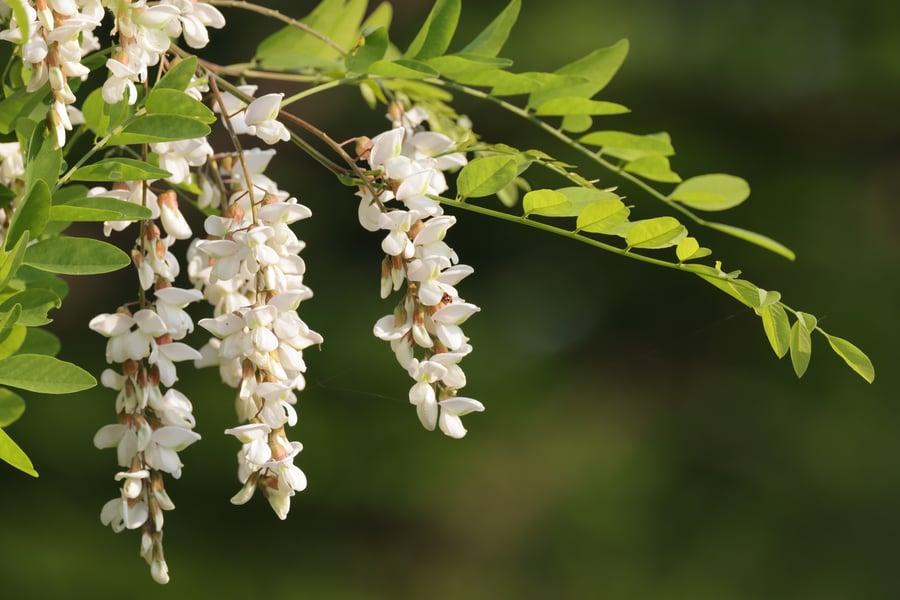
Acacia honey comes from a tree planted for other reasons. The black locust (Robinia pseudoacacia) is North American, and its plantations and shelterbelts, from the Hungarian plains to the Kuban, Shaanxi and Korea, are now where a large spring honey crop is taken.
The honey is sold under the tree’s old name, false acacia, cut short to acacia. It has no link to the true acacias of Africa, Arabia and South Asia, whose honeys are sold under the same word.
Pale, slow to crystallise and faint in scent, it is used to sweeten without adding a taste of its own. It comes from a short spring flow that frost and rain can end in any year.
Characteristics
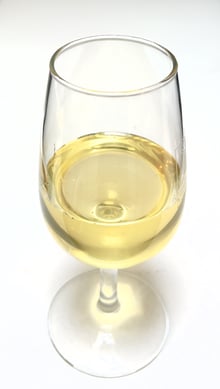
Very pale, from almost colourless to pale straw yellow, clear and liquid, with a faint floral scent and a sweet, mild taste that fades quickly. It stays liquid for months: Switzerland’s federal researchers say it usually stays liquid for more than a year, Italy’s national sheet that it never crystallises completely, and Hungarian beekeeping literature puts it at three to four years. When it does crystallise, the crystals are fine and the honey clouds rather than hardens, and a German bee institute notes that rapeseed honey left in the combs seeds crystals, so the honey can cloud within a few months of harvest.
Click to Display — The Details: botanical origin, sensory profile, pairings, health and what gives it its character
Botanical Name: Black locust (Robinia pseudoacacia)
Botanical Family: Fabaceae
Bee Species: 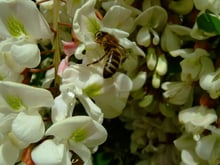
The Western honey bee (Apis mellifera) makes the honey wherever it is sold. The nectar of a fresh flower sits behind a tripping mechanism that a honey bee is often too weak to work, so carpenter bees and bumble bees visit the fresh flowers on the first day, and the honey bees’ main collection begins only at full bloom and as the flowers start to wilt; from then a colony’s daily weight gain keeps rising for about eight days.
Slovenia’s protected Slovenski med, which lists acacia honey first among its types, may be made only by the Carniolan bee (Apis mellifera carnica).
Color:
Almost colourless to pale straw yellow, in some honeys with a faint green tint
Flavor Profile:
Sweet and mild, with weak acidity and no bitterness
Tasting Notes:
The taste is sweet and the finish short. The International Honey Commission gives its aftertaste as short, and Italy’s national sheet describes it as little persistent; the Lunigiana designation adds that it leaves no aftertaste. The body is liquid and clear.
What aroma there is comes most in the mouth. The Iberian reference guide for single-flower honeys finds floury notes best in retronasal smell, and Croatia’s Zagorje specification names vanilla, acacia flower, virgin comb and fresh butter. Vanilla recurs in the registered descriptions of Alsace, Varese, Lunigiana and Zagorje, and Italy’s sheet adds cooked pear.
Aroma:
Faint and floral: acacia blossom, vanilla, fresh wax and cooked pear
Defining Compounds:
Its sugars define it. In the International Honey Commission’s descriptive sheet, built from 715 samples, it holds 42.7 grams of fructose and 26.5 of glucose per 100 grams, a ratio of 1.61, and the sheet puts its liquidity down to that high fructose. European Union honey law allows it up to 10 grams of sucrose per 100 grams, where most honeys are held to 5. Laboratories recognise it by the pattern the sheet sets out: low electrical conductivity, colour, acidity, enzymes, proline and glucose, against high fructose and sucrose.
Two flavonoid markers come from the nectar, so a laboratory can confirm the tree without counting pollen. Kaempferol rhamnosides were found in every acacia honey analysed in a 2008 study and in none of the other floral honeys its authors had analysed, the first time such compounds were found in honey; acacetin was specific to robinia honey in a 2021 Romanian study that proposed it as a marker. China’s draft acacia honey standard of 2025 uses robinin, another compound from the tree, as a mark of authenticity.
Fraud has been caught with other tests. A 2020 study found mannose, never reported in acacia honey, in Chinese honeys sold as acacia that had passed pollen analysis, a sign of added syrup, and a Chinese study built a test for rapeseed honey, which its authors say is commonly passed off as acacia. In an enquiry published in 2019, France’s fraud authority found an acacia honey bought in Belgium with 13 percent cane or corn sugar added.
Forage Origin: 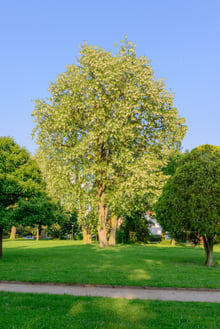
Black locust (Robinia pseudoacacia) is a fast-growing tree of the pea family, native to two separate areas of the eastern United States, the Appalachians and the Ozark-Ouachita uplands, and now planted or wild on every continent but Antarctica. It grows 10 to 35 metres tall and carries hanging clusters of white, strongly scented flowers between late April and June. Europe, China, Korea and Japan planted it for posts, vineyard stakes, fuel and mine timber, and to hold sand, spoil and eroding slopes; a 2017 review put its plantations outside the native range at more than 30,000 square kilometres in 35 countries, an area about the size of Belgium.
The tree gives much nectar and little pollen. Hungarian studies found that about three quarters of the nectar bees collect from it ends up as surplus honey. The flow is best on warm, humid, windless days above 25 degrees C after nights near 15; below 20 degrees good foraging cannot be expected, cold north winds stop the flow, and a late frost can end it before it starts.
Because the pollen is under-represented, a laboratory cannot expect a high pollen count in it. The International Honey Commission’s sheet gives a mean of 28 percent Robinia pollen, with limits of 7 and 60 percent, and standards set their floors low: 5 percent in the Hungarian Food Code’s guideline for quality-marked honey where the fructose to glucose ratio is at least 1.55, 7 in Russia’s standard and 30 in Bulgaria’s.
The name acacia is the tree’s own old name, not a relationship. Early botanists called it the American acacia and later the false acacia, the name the Codex Alimentarius and European Union honey law still use, and Bulgarian, Russian and Georgian call it white acacia. The true acacias of Africa, Arabia and South Asia (Acacia, Vachellia, Senegalia) are different trees. Honey locust (Gleditsia triacanthos) is a separate tree whose nectar seldom gives a surplus; pagoda tree honey (Styphnolobium japonicum) is sold apart from acacia honey in China; and gyalogakác (false indigo, Amorpha fruticosa) flowers with the black locust in Hungary and gives a honey of its own.
Honeys sold as acacia from other trees sit on some of the same shelves. In Tanzania and Kenya acacia honey comes from the savanna’s true acacias; in South Africa’s Northern Cape it most likely comes from swarthaak (black thorn, Senegalia mellifera); in Saudi Arabia the honeys sold under the Arabic names of two thorn trees, talh (طلح) and samr (سمر), come from Acacia gerrardii and A. tortilis, while talh in Sudan is Acacia seyal; Indonesian, Malaysian, Vietnamese and Brazilian acacia honey comes from plantation Acacia mangium, a fast-growing wattle, and its hybrids; in Pakistan producers sell the honey of two local thorn trees, phulai (پھلائی, Acacia modesta) and kikar (کیکر, A. nilotica), as acacia honey, and black locust honey there as robinia honey; Uruguay’s winter acacia honey is probably from Acacia longifolia, an Australian wattle; Argentina’s acacia negra names honey locust or Acacia melanoxylon, the Australian blackwood; the yellow acacia of the Altai and Kazakhstan is Caragana, the Siberian pea shrub; and Azerbaijan’s Hirkan acacia honey comes from the silk tree (Albizia julibrissin). An Omani study warned that buyers in the Middle East can confuse the two kinds and proposed naming each honey for its own tree.
Where the tree spreads, the law decides whether it can be planted again, and so how much acacia forage there will be. It is not on the European Union’s list of invasive species of Union concern, which a 2017 review attributes to the lack of a full risk assessment and to pressure from some member states, and it is not on the lists of the EPPO. Germany lists it for management and has required a permit to plant it in the open countryside since 2020; Hungary’s Constitutional Court in 2024 struck down an emergency rule that let acacia regrow in protected forests; Japan’s 2026 alien species list names it an industrially important species to be managed, with no substitute yet for beekeeping; Minnesota has listed it as a restricted noxious weed since 2017; South Africa lists it in category 1b; and Ukraine banned it from forest regeneration for about five months in 2023.
Pairings:
Sources give its mildness as the reason to use it. Italy’s honey observatory names it the most suitable honey for sweetening drinks, yoghurt and fruit without changing their taste, and producers from Bulgaria to Hungary put it in tea, on bread and butter and on yoghurt.
With cheese, an Italian producer offers it with fresh goat’s- or cow’s-milk ricotta. For blue cheese, Piedmont’s beekeepers’ association pairs it with gorgonzola, while a Hungarian training book finds that Roquefort drowns it. An Italian pairing table adds pecorino piccante and primo sale.
As an ingredient it goes where only a light honey flavour is wanted: gelato, fruit salad and panna cotta, a honeycomb tart with ricotta and lemon in recipes published by Korea’s Rural Development Administration, and, a Hungarian forestry journal wrote in 1917, fine honey wine, for which pure acacia honey was the best.
Health Uses:
In Russian folk medicine acacia honey, diluted in warm water, was used as eye drops and for the stomach, Russia’s beekeeping journal records.
Origin Story
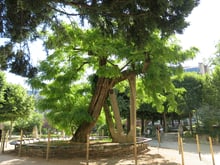
The tree reached Europe from North America in the early seventeenth century. The National Museum of Natural History in Paris says Jean Robin brought it to the Île de la Cité and that his son Vespasien planted a sucker of it in the Jardin royal des plantes in 1636, and places a tree of about 1601 still living in the square René-Viviani; Linnaeus named the genus Robinia for Jean Robin in 1753. Ernyey’s study of 1927 rejected the date of 1601 and concluded there were probably several independent introductions.
Its spread was a planting history. It reached Berlin in 1672 and Hungary in 1710, and Hungary made its first robinia plantation in 1750, 290 hectares around the fortress of Komárom. On the Hungarian sands a “black locust mania” of the early nineteenth century became a policy after the forest law of 1898. Romania began planting it at scale on degraded land in 1852, the Kuban on its shelterbelts from the 1960s and 1970s. Qingdao’s gazetteer records that Germans first brought it to Qingdao after 1898, and Japan’s 2026 alien species list dates its arrival there to 1875.
The honey took its name later. The Budapest newspaper Egyetértés advertised akáczméz (acacia honey) in 1889, and in 1900 the national beekeepers' association was selling the year’s acacia honey by post. A. I. Root’s ABC of Bee Culture of 1880 valued the crop highly but reckoned on it “perhaps one year in five.” The Soviet honey standard of 1987 gave white acacia honey its own column.
Cultural Context
Hungary treats the tree and the honey as its own. In May 2014 the national committee added Magyar akácméz (Hungarian acacia honey) to the Hungarikum collection together with the Hungarian acacia tree, two months after Hungary had blocked the draft European Union regulation on invasive species; an ecology review calls the tree Hungary’s unofficial national tree.
Elsewhere it is honoured and opposed at once. In 2020 it was Germany’s Tree of the Year and Austria’s Alien Species of the Year, and Paris counts the robinia of the square René-Viviani as the city’s oldest tree.
Acacia is a competition class of its own in several countries. At Italy’s Tre Gocce d’Oro it was the most-entered single-flower honey in 2025, with 208 samples, and the Hungarian beekeepers’ national contest, which judges acacia honey as a category of its own, received 373 honeys that year. Russia’s beekeeping journal once noted that white acacia honey is so clear that a narrow jar of it can look empty.
Harvest & Forage
The bloom moves south to north and uphill. In Hungary it comes in the middle or end of May, in Germany, Slovakia and Poland in early or mid June; in China it runs from late April in Henan and the Guanzhong plain north to Liaoning; in Korea it moves from the south to the north. On any one site it lasts about ten days, up to twenty on Croatia’s Zagorje hills by that designation’s account, and beekeepers follow it, moving hives north or uphill to take a second flow.
The crop depends on the weather. Late frost, cold north winds and rain in the bloom each end the flow, and the record is uneven. France’s acacia share of the national crop ran from 1 percent in 2021 to 15.2 percent in 2025; in the north of Italy the 2019 acacia crop was “totalmente azzerata,” wiped out; and Korea took 3,456 tonnes in 2018, 50,544 in 2019 and 2,322 in 2020. In 2025 Romania’s beekeepers' association reported no acacia honey at all, Moldova’s none clean after two frosts, and a beekeepers’ society at Stara Zagora in Bulgaria a failed crop after a cold spring. The bloom has also moved earlier, by 3 to 8 days in Hungary between 1851 and 1994, and the gap between regions that beekeepers follow is shrinking, Hungarian researchers write, often to a few days.
Other flowers in bloom at the same time change the honey. Rapeseed flowers with the black locust across central and eastern Europe and turns up in many acacia honeys; in Hungary a rape-contaminated lot can be sold only as multifloral. False indigo is common along the Tisza, and a Hungarian study found a lot sold as acacia there whose pollen was mostly false indigo; in Ukraine the national beekeeping institute found false indigo and honey locust in lots sold as acacia. Italy’s agricultural research council reads manna ash and false indigo pollen as the mark of north-east Italian acacia, and honey locust is part of the expected pollen in Lombardy and Emilia-Romagna; in central Shanxi pagoda tree pollen runs through the acacia honey. Flanders’ beekeepers’ federation says acacia honey there is usually mixed with linden honey. European Commission guidance reads the law’s “mainly” from one flower as almost entirely.
Beekeepers keep the crop clean by timing. Italy’s beekeepers’ union advises putting on and taking off supers so as to isolate the robinia flow; the Zagorje specification forbids feeding and varroa treatment during the flow and asks for as little smoke as possible, because the faint honey takes up its smell.
Beekeeping Context
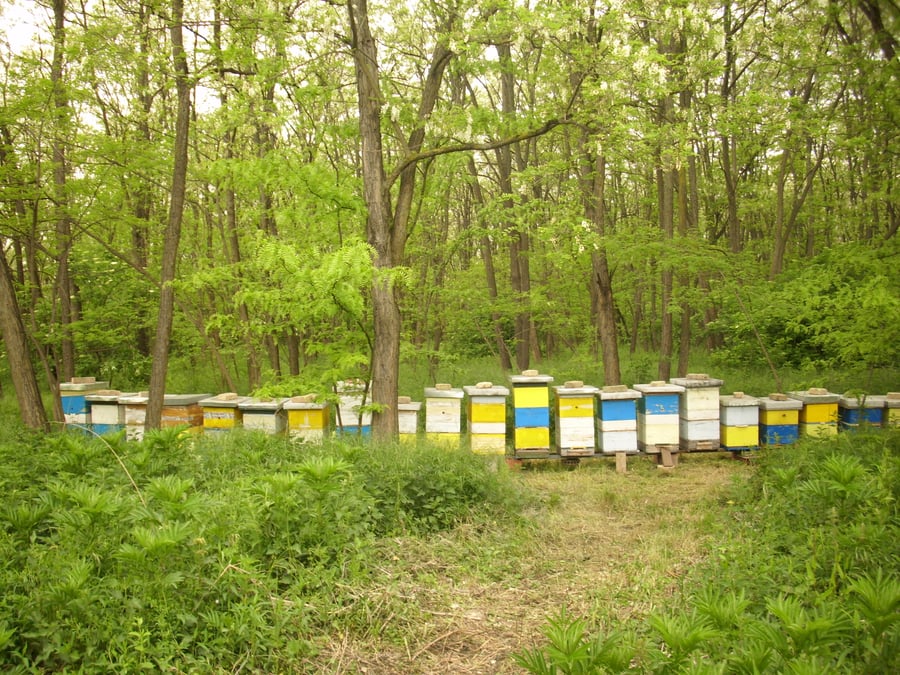
Acacia honey comes from forests and shelterbelts that people planted, and much of it from hives moved to them. Hungary’s robinia covers 463,235 hectares, 24.6 percent of its forest (2025); Romania had about 250,000 hectares (2022); in the Kuban, where robinia is the main tree of 127,300 hectares of shelterbelts, acacia gives 45 to 50 percent of the honey, Russia’s beekeeping journal wrote in 2009. Ukraine’s shelterbelts, planted 60 to 80 years ago, are now cut for firewood, and each one felled takes acacia forage with it. Korea in 2026 raised its nectar-forest planting to 4,000 hectares a year with more species. In Shaanxi, beekeepers moved nearly 800,000 colonies to the acacia in 2024, the China Bee Products Association estimated.
Source Regions
See all 29 countries
- Austria, the east – Robinia pseudoacacia: acacia honey (Akazienhonig), from a tree common in the east of the country.
- Azerbaijan, Zaqatala – Robinia pseudoacacia: acacia honey (akasiya balı), shown by a Zaqatala beekeeper at the 2021 national honey fair.
- Belgium, Wallonia and Flanders – Robinia pseudoacacia: acacia honey (miel d’acacia, acaciahoning), a flow Walloon beekeepers move hives for; pure acacia comes only some years.
- Bulgaria, Kazanlak and Stara Zagora – Robinia pseudoacacia: acacia honey (акациев мед), defined in law by at least 30 percent white acacia pollen.
- China, Shaanxi, Shanxi and Gansu – Robinia pseudoacacia: acacia honey (洋槐蜜), with geographical indications at Yushe, Qinshui and Yongshou.
- Croatia, the north and Istria – Robinia pseudoacacia: acacia honey (bagremov med), one of Istarski med’s protected types; Zagorje’s honey is a regional variant below.
- Czechia, South Moravia – Robinia pseudoacacia: acacia honey (akátový med), often labelled honey from an acacia area, since naming the plant needs laboratory proof.
- France, Burgundy to the Landes – Robinia pseudoacacia: acacia honey (miel d’acacia), 15.2 percent of the 2025 crop, 3.9 of 2024’s; a protected Alsace type.
- Georgia, most regions – Robinia pseudoacacia: acacia honey (აკაციის თაფლი), one of four types in the Machakhela Honey indication.
- Germany, Brandenburg – Robinia pseudoacacia: acacia honey (Robinienhonig or Akazienhonig, equal names in the German food code); Brandenburg producers print Robinienhonig.
- Greece, western Macedonia – Robinia pseudoacacia: acacia honey (μέλι ακακίας), sold as single-flower by some houses; a regional press report called it not monofloral (2019).
- Hungary, the Great Plain and the Nyírség – Robinia pseudoacacia: acacia honey (akácméz), a Hungarikum; 12,000 to 15,000 tonnes a normal year (OMME estimate, 2026).
- Italy, the Prealps and Tuscany – Robinia pseudoacacia: acacia honey (miele di acacia), with three protected designations: Varesino, Lunigiana and Dolomiti Bellunesi.
- Japan, Hokkaido, Akita and Nagano – Robinia pseudoacacia: acacia honey (アカシアはちみつ), 80 to 90 percent of the honey in Nagano and Akita (2026).
- Moldova, the Codrii – Robinia pseudoacacia: acacia honey (miere de salcâm), with its own column in the national honey rules; frost took the 2025 crop.
- North Macedonia, nationwide – Robinia pseudoacacia: acacia honey (багремов мед), with meadow honey the country’s most produced honey, a 2023 state textbook says.
- Pakistan, Gilgit-Baltistan and Chitral – Robinia pseudoacacia: sold as robinia honey (روبنیا شہد), an April to June highland flow; Pakistani acacia honey is phulai (پھلائی).
- Poland, the west and Roztocze – Robinia pseudoacacia: acacia honey (miód akacjowy); Akacjowy miód cedyński is a listed traditional product (2013).
- Romania, Oltenia and the Carei plain – Robinia pseudoacacia: acacia honey (miere de salcâm), from about 250,000 hectares of robinia (2022); none harvested in 2025.
- Russia, the Kuban – Robinia pseudoacacia: white acacia honey (мёд белой акации), 45 to 50 percent of the Kuban’s honey (Pchelovodstvo, 2009).
- Serbia, Vojvodina and the Deliblato Sands – Robinia pseudoacacia: acacia honey (bagremov med), with sunflower the main flow.
- Slovakia, the south and south-west – Robinia pseudoacacia: acacia honey (agátový med), from about 35,000 hectares of robinia (2024), with its own competition class.
- Slovenia, nationwide – Robinia pseudoacacia: acacia honey (akacijev med), about a third of the country’s honey (2016), sold under the protected Slovenski med.
- South Korea, south to north – Robinia pseudoacacia: acacia honey (아카시아꿀), 2,322 to 50,544 tonnes a year in 2018 to 2020 (Kim et al.).
- Spain, the Basque Country – Robinia pseudoacacia: acacia honey (miel de acacia), the Iberian monofloral guide’s only acacia zone; a Eusko Label class since 2001.
- Switzerland, Ticino – Robinia pseudoacacia: acacia honey (miele di acacia, Akazienhonig), Ticino’s most important spring honey, Swiss federal researchers say.
- Turkey, the Black Sea and Marmara – Robinia pseudoacacia: acacia honey (akasya balı), defined in the Turkish Food Codex at 15 percent Robinia pollen.
- Ukraine, the north and centre – Robinia pseudoacacia: acacia honey (акацієвий мед), from old shelterbelts; the national beekeeping institute found southern lots the least typical.
- United States, the Appalachians and the Northeast – Robinia pseudoacacia: black locust honey or locust honey, from the tree’s native range, a minor, sporadic crop.
Regional Variants
- Zagorje acacia honey (Zagorski bagremov med) – Robinia pseudoacacia – Croatia, Hrvatsko zagorje: an EU protected designation of origin since 2022, with more than 27 percent black locust pollen; its specification credits hill stands blooming up to twenty days and no rapeseed pollen in sixteen years of testing.
Translations
See all 30 Translations
- miel d’acacia – French
- miele di acacia – Italian
- miele di robinia – Italian, the name of the national descriptive sheet
- Akazienhonig – German
- Robinienhonig – German, an equal legal name, used by producers in Brandenburg
- acaciahoning – Dutch
- miel de acacia – Spanish
- mel d’acàcia – Catalan
- miód akacjowy – Polish
- akátový med – Czech
- agátový med – Slovak
- akácméz – Hungarian
- miere de salcâm – Romanian
- акациев мед (akatsiev med) – Bulgarian
- bagremov med – Serbian, Croatian and Bosnian
- med od bagrema – Croatian
- akacijev med – Slovenian
- багремов мед (bagremov med) – Macedonian
- μέλι ακακίας (méli akakías) – Greek
- акацієвий мед (akatsiievyi med) – Ukrainian
- мёд белой акации (myod beloi akatsii) – Russian, white acacia honey
- akasya balı – Turkish
- აკაციის თაფლი (akatsiis tapli) – Georgian
- akasiya balı – Azerbaijani
- روبنیا شہد (robinia shahad) – Urdu, the name it is sold under in Pakistan
- 洋槐蜜 (yánghuái mì) – Chinese
- 刺槐蜂蜜 (cìhuái fēngmì) – Chinese, the name in China’s industry honey standard
- 아카시아꿀 (akasia kkul) – Korean
- 아까시꿀 (akkasi kkul) – Korean, the standard name, which the government promotes
- アカシアはちみつ (akashia hachimitsu) – Japanese
Certifications
 Zagorski bagremov med PDO – Protects acacia honey from Hrvatsko zagorje, with more than 27 percent black locust pollen, made by certified producers. (Croatian translated to English
 )
- Miele Varesino PDO – Protects the acacia honey of the province of Varese, with more than 25 percent robinia in its nectar spectrum. (Italian translated to English
- Miele della Lunigiana PDO – Protects the honeys of Lunigiana in Tuscany, acacia honey among them. (Italian translated to English
- Miele delle Dolomiti Bellunesi PDO – Protects the honeys of the Belluno province, an acacia type among them with more than 15 percent robinia pollen.
- Istarski med PDO – Protects the honeys of Istria in Croatia and Slovenia, acacia honey among its seven types. (Croatian translated to English
 Slovenski med PGI – Protects Slovenian honey made by the Carniolan bee, acacia honey first among its types.
- Miel d’Alsace PGI – Protects the honeys of Alsace, acacia honey one of its six types. (French translated to English
 Yushe acacia honey geographical indication – China’s protected acacia honey of Yushe county, Shanxi, listed by the Ministry of Agriculture in 2010. (Chinese translated to English
 - Qinshui acacia honey geographical indication – China’s protected acacia honey of Qinshui county, Shanxi, harvested from 8 to 23 May. (Chinese translated to English
- Machakhela Honey geographical indication – Georgia’s protected honey of the Machakhela valley, acacia honey from Robinia one of its four types. (PDF)
Hungarikum: Hungarian acacia honey – Hungary’s national listing of Hungarian acacia honey, together with the Hungarian acacia tree, since 2014.