
Nougat
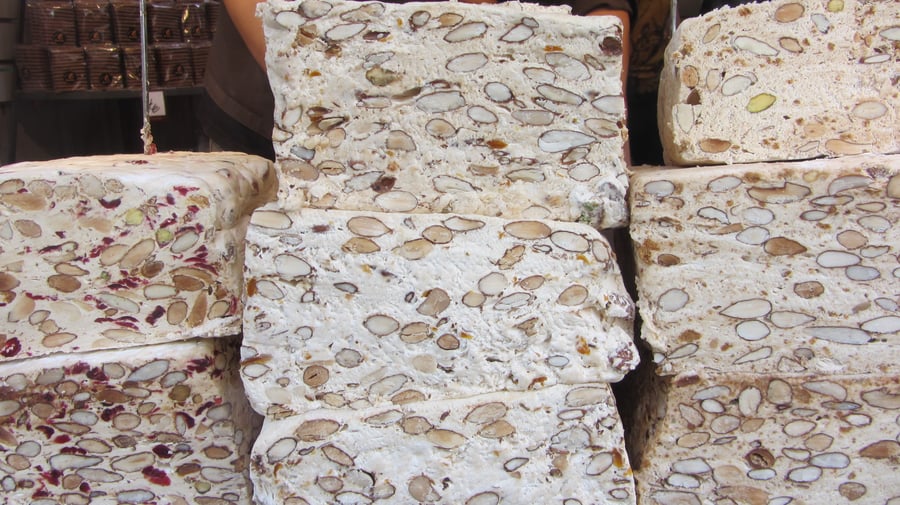
Enjoyed for centuries, Nougat is a classic confection made from honey, egg whites and almonds. Many countries claim parentage to this traditional delight. Variations are found in Italy, France, Spain and the Middle East, but its actual origins are obscure. Some trace it back to the Romans in the ancient writings of the Roman epicure, Apicius from 1st-century AD, whose name was given to the ancient cookbook, De Re Coquinaria, compiled around the 4th century AD. This describes a nut custard made of honey, walnuts and eggs. Or perhaps more likely, the Arabs, whose medieval cookbooks already bound nuts (almonds, pistachios, walnuts) with honey or sugar. A recipe with egg whites, called Hulwa, very similar to that of nougat and sweetened with honey, sugar or fruit syrup, is cited in the 15th-century eastern Islamic cookbook of Ibn al-Mabrad.
Recipe: Hulwa by Ibn al-Mabrad
While there are literally dozens of variations, perhaps hundreds, they generally fall into soft and hard versions. This being adjusted by the ingredients and length of cooking time. There is even an American nougat-like candy called divinity fudge, made with egg whites, sugar and corn syrup.
Italy Nougat: Called Torrone in Italian, it is said to have been first created in Cremona, Lombardy for a wedding celebration of aristocrats in the 15th century. It was created in the shape of the bell tower of the Cremona cathedral, the Torrazzo – Cremona’s own explanation of the name Torrone, which dictionaries trace to the Latin torrere, to toast. The yearly Torrone Festival is held in Cremona. Found throughout Italy, noteworthy nougats are from Asti and Alba in Piedmont (made with hazelnuts, hard or soft), Benevento, the Abruzzi and Calabria. Sicily makes a sesame or almond and honey version with an Arabic name, called “cubaita,” and the city of Caltanissetta a honey, almond and pistachio torrone, and Sardinia’s version is traditionally made with local honey and no sugar.
Recipe:
Sardinian nougat recipe
Sicilian Nougat Torrone - “Cubbarda e Minnulata”
Torrone morbido Video and recipe
France Nougat: Made in the Provence region since at least the sixteenth century. The name comes from the Old Provençal ’noga,’ nut. A Provence legend says the name comes from ’tu nous gâtes,’ or, ‘you spoil us.’ There are two types, the traditional crunchy black nougat made without eggs and the white nougat, soft or hard, such as the famous Nougat de Montélimar, a PGI since November 2024, made with at least 30% almonds, or 28% almonds and 2% pistachios, and with honey as a quarter of the sweetening. Its rules name no kind of honey, and the makers’ own group notes that the ingredients need not come from Montélimar. The Label Rouge nougat granted in November 2022, the first confectionery with that label, allows only Provence PGI lavender honey, and at Sault the Boyer house’s white nougat is 30% Provence lavender honey. The black and white nougats are part of the thirteen traditional desserts of a Provence Christmas.
Recipe:
Nougat de Montelimar (use lavender honey)
Black Nougat
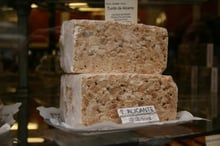
Spain Nougat: Known as Turrón or Torró in Spain. It is believed to have been introduced by Arab and Jewish settlers, but has been made in Jijona (Xixona in Valencian) for more than 500 years. Produced primarily for the Christmas season, the two primary types are Jijona and Alicante. Both have PGI (Protected Geographical Indication). Turrón de Alicante is made of toasted almonds, pure honey, sugar and egg whites, and has a white color and a hard crunchy texture.
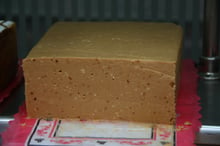
Turrón Jijona is produced by milling and heating Turrón de Alicante to produce a smooth paste with a texture similar to peanut butter and a whitish brown color. The Turrón Museum in Jijona is dedicated to preserving the technological heritage of the production of Turrón and the history of this important economic product.
Making Turrón de Jijona video - English
An English-language video showing how Turrón de Jijona is made.
Recipe: Spanish nougat - Alicante and Jijona
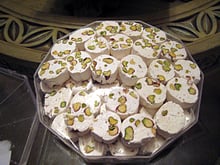
Iran (Persian) Nougat: A very popular candy, Gaz (گز) is the traditional name of Persian nougat originating from the city of Esfahan, located in the central plateau of Iran. The primary difference between this nougat and European kinds is the source of the sweetness. It comes from gaz-angebin, which translates to “gaz honey”: a sweet white manna left by a tiny insect on a wild spiny shrub, Astragalus adscendens, in the Zagros mountains to the west of the city. As the harvest has fallen, other mannas and sugar syrups have taken much of its place. Other ingredients include sugar, pistachio or almond kernels, rosewater and egg whites.