Brush Box Honey
The Story
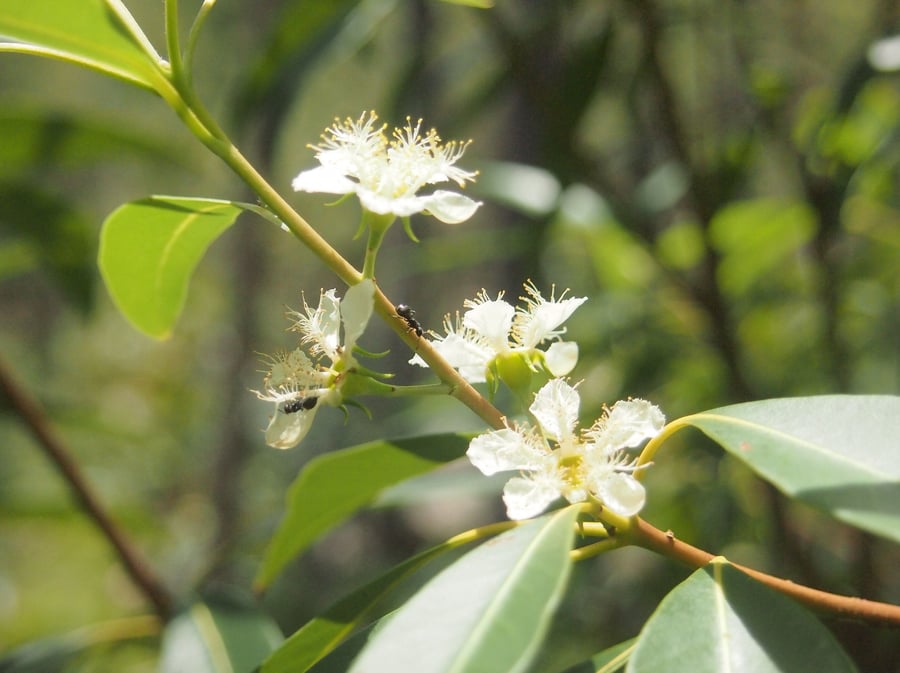
Brush box is a honey made from a tree that grows among the eucalypts but is not one of them. The source, Lophostemon confertus, belongs to the same family as the gums – Myrtaceae – but carries soft, brush-like stamens instead of the lidded flowers that give eucalypts their name. That botanical distance shows up in the jar. Brush box honey tastes of star anise and grapefruit, a warm aromatic spice that no gum honey produces.
The harder fact about brush box is its scarcity, and the scarcity has two separate causes. The tree flowers every year but yields a surplus worth extracting only every two to three years, and sometimes every three to four; beekeepers describe waiting out long gaps between crops. On top of that, the productive stands grow mostly on public land – state forest and national park in coastal Queensland and northern New South Wales – so a given year’s honey depends not only on whether the tree flows but on whether beekeepers can place hives where it grows. A honey that is hard to get for botanical reasons is, here, also hard to get for reasons of access and policy.
Brush box also resists the standard test for what it claims to be. The pollen-counting method that authenticates monofloral honey in Europe does not work on Australian honeys, so brush box is known by its flavour and by the beekeeper who watched the trees flower – not by a laboratory threshold.
Characteristics
Brush box honey runs from extra white through light to a warm medium amber depending on the season and the strength of the flow. The aroma carries a distinct star-anise spice with a grapefruit lift; the flavour follows the nose, the spice more pronounced on the palate than in the jar, finishing sweet and clean without eucalyptus sharpness. Its defining physical behaviour is fast crystallisation: it granulates quickly to a firm, sometimes tough candy with a fine white grain. This is a sign of purity, not spoilage, and gentle warming returns it to liquid. The texture shift changes the eating experience without altering the flavour.
Click to Display — The Details: botanical origin, sensory profile, pairings, health and what gives it its character
Botanical Name: Brush box (Lophostemon confertus)
Botanical Family: Myrtaceae
Bee Species:
Apis mellifera, the introduced European honey bee, which carries all commercial brush box production. The tree is also visited by native Australian bees including the stingless Tetragonula carbonaria, but the named single-source honey is a managed-hive crop.
Color:
extra white to light amber, deepening to warm amber
Flavor Profile:
spicy, aromatic, citrus – star anise and grapefruit
Tasting Notes:
The spice is the signature and the hardest part to place. Beekeepers reach for a cluster of comparisons rather than one word: star anise, liquorice, Chinese five spice, even Sambuca. None lands exactly, which is part of the honey’s character – the aromatic note is warm and rounded rather than sharp or peppery, and it sits under a clear grapefruit-citrus brightness. The finish is clean and sweet. Sold young it pours as a pale liquid; left on the shelf it sets firm, and the spice reads differently through the granulated texture than it does in the liquid.
Aroma:
warm spice, star anise, a lift of citrus
Defining Compounds:
The distinctive aroma has a documented chemical basis. A study fingerprinting the volatile fractions of Australian honeys found that brush box is characterised by unusual C9 and C10 norisoprenoids – the compound class behind the warm, hard-to-place spice that separates it from eucalypt honeys. Norisoprenoids are the same broad family responsible for aromatic notes in many fruits and flowers, which is consistent with the honey reading as spiced and aromatic rather than simply sweet.
Forage Origin:
Brush box honey comes from the nectar of Lophostemon confertus, an evergreen tree in the family Myrtaceae and one of four species in the small genus Lophostemon, three of them endemic to Australia. It is not a eucalypt. The flowers are small and white, borne in clusters of three to eight, with the frilly, brush-like stamens that separate Lophostemon from the lidded buds of Eucalyptus – the feature the common name records. The tree grows along the coast and ranges from the Moreton Bay area in Queensland south to Port Stephens in New South Wales, from near sea level to about 600 metres, in rainforest and wet-sclerophyll margins where it often stands as an emergent above the canopy. Production crosses the Queensland-New South Wales border; the honey is filed here under Queensland, but the productive country is shared.
Two points of identity matter to a buyer. First, the same tree is one of Australia’s most widely planted street trees, known in cultivation as “Brisbane box” or “Queensland box” – so the name attaches, for most people, to a municipal shade tree rather than to a honey. Second, brush box shares both its old botanical name and its summer harvest window with watergum (Tristaniopsis laurina), a related tree once placed with it in the genus Tristania. Beekeepers working coastal forest in summer may take both, and the two are easy to conflate in casual labelling. Brush box also tends to yield poorly on low coastal flats and best on the ranges, so where the hives sit changes what ends up in the jar.
Pairings:
The star-anise-and-citrus profile suits places where a warm spiced sweetness is wanted without heavy eucalyptus character: stirred into black or chai tea, spooned over thick yoghurt or fresh ricotta, or drizzled on poached stone fruit and pear. Once crystallised it spreads firmly, which makes it good on warm toast or crumpets where the grain melts. As a finishing honey its aromatic lift carries better raw than cooked.
Origin Story
Lophostemon confertus was first described in 1812 by the Scottish botanist Robert Brown, working from specimens collected on the Hunter River in New South Wales. Brown named it Tristania conferta; it was moved to the genus Lophostemon in 1982. The tree has long carried a double life in Australia – a hard, durable timber once used for flooring and bridge decking, and a major honey tree – and it appears in the apicultural record as a recognised “short budding” nectar source, listed by beekeepers among the trees that may yield a summer crop.
Commercial honey production in Queensland dates to the 1860s, with Italian bees, and to the movable-frame hive in the 1870s. Brush box has been part of the named single-floral trade since the era when Australian honey was graded and sold by floral type, and it has kept a quiet reputation as a “First Grade” or “Queen’s table” honey – a connoisseur’s variety rather than a supermarket staple. That standing was confirmed in competition in 2015, when Mount Warning Honey of Byrrill Creek, in the New South Wales Tweed Valley, entered its brush box in the light-colour liquid class at the Sydney Royal National Honey Show – Australia’s premier apiculture competition, first judged in 1888 – and took a silver medal on debut, scoring 84 out of 100.
Harvest & Forage
Brush box flowers from roughly December into January, in the warm, wet early summer of the subtropical coast. But flowering and cropping are not the same thing: the tree blossoms every year, while beekeepers typically take a honey crop from it only every two to three years, with some accounts stretching to three or four. When it does flow well, it flows generously – recorded yields range from about 27 to 135 kilograms per colony in a good season – which is why beekeepers wait for it. The honey is also strongly site-dependent: brush box yields poorly on low coastal country and far better on the ranges, so the productive crop comes from hives placed in the hills.
Maintaining a clean monofloral crop turns on timing and placement. The summer window overlaps with watergum (Tristaniopsis laurina), so hives worked in mixed coastal forest can take both; a single-source brush box crop depends on the beekeeper knowing the stand and the sequence of what is in flower. Over the longer term, the crop has become less reliable: experienced Queensland apiarists document flowering shifting earlier with warming and the multi-year cropping rhythm widening, alongside the loss of mature nectar trees to clearing.
Beekeeping Context
Brush box is a honey of migratory commercial apiaries working public land. The largest and most productive stands grow inside state forests and national parks in coastal Queensland and northern New South Wales – a submission to the Australian parliament’s honey bee industry inquiry noted that extensive brush box stands “exist only on State land” – so commercial beekeepers depend on apiary-site access to these reserves to reach the flow at all. This makes the honey unusually exposed to land-management policy: access to national-park apiary sites has been repeatedly contested, and arrangements covering many Queensland sites came up for renewal at the end of 2024. A honey already rationed by the tree’s own rhythm is further rationed by whether hives are permitted where the tree grows.
The honey reaches buyers chiefly through direct-from-beekeeper sales – farm gate, markets, and online – rather than through bulk packing, which suits a crop that is small, irregular, and sold on its single-source character.