Queensland Honey
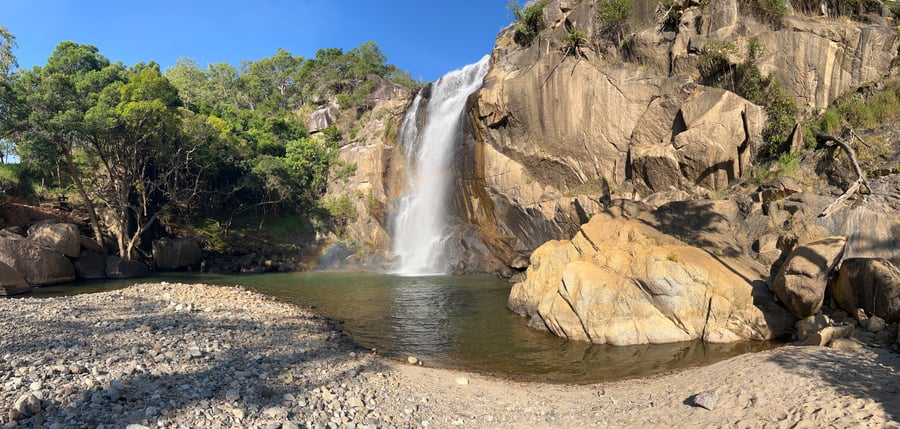
Drive north out of Cairns and the road runs out of country before it runs out of road. The Daintree is the oldest tropical rainforest on earth still standing – a hundred and eighty million years, older than the eucalypts – and here it grows right down to the sand. You can stand on a beach at Cape Tribulation with the reef a short boat ride offshore and the rainforest at your back, the only place in the world two World Heritage areas meet at the tideline. Cassowaries cross the road. The trees behind you are living fossils.
That is one Queensland. There are several. The state runs two thousand kilometres from the monsoon tropics to the temperate south, and most of it is nothing like the postcard. Behind the coastal ranges the rainforest gives way to open eucalypt forest, then to brigalow scrub and basalt downs, then to the channel country out west where the rivers run inland and vanish into the desert in a good year. A few hours from the reef you are in cattle country, in towns built around one wide street, where the light is harder and the trees are silver-leaved and the nearest beach is a day away. Queenslanders treat these as one place. The traveler quickly learns they are not.
What rewards the traveler here is range – the willingness to go past the obvious. The sand islands off the southeast, K’gari (Fraser Island) the largest, are dunes so old they have grown their own rainforest, with creeks running clear over white sand and a heathland called wallum that flowers in the cool months when nothing else does. The Atherton Tableland sits cool and green above the tropical coast, dairy farms and crater lakes an hour from the heat. And in all of it, on the flowering trees – the bloodwoods, the ironbarks, the rainforest giants, the wallum banksia named for the country it grows in – the bees are working. Queensland’s honey is as various as its country, and it is found the same way the country is: by going a little further than you meant to.
Food
Queensland’s food map is really two maps. On the tropical coast and the Atherton Tableland behind Cairns, the volcanic red soil and high-altitude warmth grow things that grow almost nowhere else in the country – Australia’s oldest and largest coffee plantations, tropical-fruit orchards, and farmhouse cheese and chocolate makers strung along a one-hour drive from the heat of the coast. Then there is the Granite Belt, eight hundred metres up on the New England border, cold enough for frost and snow, where every apple grown in Queensland comes from and where the cellar doors, cideries, and cool-climate vineyards cluster around Stanthorpe. The honey follows the same split: pale tropical-orchard and rainforest honeys in the north, cool-country granite honeys in the far south.
Where to eat your way through both Queenslands
On the Atherton Tableland, the drive itself is the meal. Skybury, near Mareeba, is described as Australia's oldest commercial coffee plantation, its Bourbon Arabica grown since 1987 on the sandy, well-drained tableland soils behind Cairns. Gallo Dairyland near Atherton hand-makes cheese and Swiss-style chocolate on a working dairy with a cafe looking out over the paddocks. Mungalli Creek Dairy, one of the region's biodynamic farms, sits above the Johnstone River gorge with Queensland's highest mountain, Bartle Frere, behind it. Between them are waterfalls, crater lakes, and roadside stands of mango, avocado, and home-made ice cream.
On the Granite Belt, two and a half hours from Brisbane, Stanthorpe is apple country -- all of Queensland's apples grow here, marked by the Big Apple on the highway. Sutton's Juice Factory, Cidery and Cafe is a working orchard where David and Ros Sutton press varietal apple juice and cider and bake the apple pies the region is known for, all in an old packing shed beside the New England Highway. Stanthorpe Cheese, ten minutes north at Thulimbah, is the highest and coldest dairy-farm cheese shop in the state, its cheeses changing with the seasons and the frost. Jamworks turns the district's surplus fruit into eighty-odd jams, relishes, and sauces.
Running underneath both is the native-ingredient thread that Brisbane's cooks have pulled into the open: finger lime, lemon myrtle, macadamia (a Queensland native before it was a Hawaiian crop), and the bunya nut from the ranges. These are the flavours that make a Queensland plate taste like nowhere else -- and the plants behind several of them are the same trees the bees work.
Culture
The oldest continuing culture on the Queensland coast is also, as it happens, a honey culture. The Quandamooka People have lived on Minjerribah (North Stradbroke Island) and the islands of Moreton Bay for more than twenty-five thousand years, and sugarbag – the honey of native stingless bees – sits in their traditional record of Country alongside dugong, mudcrab, and oyster. That culture is not in a museum case. Each year the Quandamooka Festival fills Minjerribah with dance, weaving, and bush-food workshops timed to the whale migration, and a new arts centre, QUAMPI, now anchors it year-round on the island foreshore. Inland and on the Gold Coast, the bee turns up again and again in living practice – in Dreaming stories, in carved hives, in the revival of native-bee keeping on Country.
Culture you can stand inside
QUAMPI, Minjerribah. The Quandamooka Arts and Culture Centre opened in 2025 on the foreshore at Gumpi (Dunwich), built from rammed earth, shells, and native timbers and named for the local pearl oyster. It holds a regional-standard gallery of Quandamooka art, a cafe, and workshop spaces, and it is the year-round home of the Quandamooka Arts and Culture Centre, QUAMPI (Minjerribah / North Stradbroke Island). The annual Quandamooka Festival, held here in the cooler months, opens with a smoking ceremony and Welcome to Country and runs dance, music, weaving, film, and bush-tucker sessions led by Traditional Owners.
The Bunya Gathering, Bunya Mountains. Every few years, when the bunya pines mast heavily, Aboriginal peoples once travelled great distances to the ranges north-west of Brisbane to feast on the fist-sized cones, trade, and settle business -- one of the largest regular gatherings on the continent. The mountains are now a national park, and the bunya remains a living cultural tree, not a relic.
The bee in the story. On the Gold Coast, the Kombumerri people and Griffith University built a carved figure of the Dreaming ancestor Jabreen whose head is a working hive of native Tetragonula bees -- the bees fly in and out through his mouth. In the Dreaming, Jabreen gorged on sugarbag and lay down to become the headland at Burleigh, Jellurgal -- "little bee's nest" in Yugambeh. It is a literal illustration of how close the honey sits to culture here: not a product, but part of lore, medicine, and Country.
GOMA's free Asia-Pacific Triennial, and the mural laneway at its doorstep
The Gallery of Modern Art, South Brisbane. On the river at South Bank, GOMA is Australia's largest gallery of modern and contemporary art, and entry is free. Its Asia Pacific Triennial -- the only major exhibition anywhere devoted to the art of Asia, the Pacific and Australia -- has run free every edition since 1993, and is the show to time a visit around; between triennials the permanent collection and a rotating program fill both GOMA and the older Queensland Art Gallery beside it.
Fish Lane and the painted city. The laneway that starts at GOMA's Grey Street corner, Fish Lane, has become a free open-air gallery threading South Brisbane into West End -- large-scale murals by Fintan Magee and Sofles, rotating vitrines, and The Timeline, a ground-level text work by writer Ellen van Neerven and BlakLash Creative. It is the visible edge of the Brisbane Street Art Festival, which over a decade has left more than 300 murals across the city's suburbs; the walls stay up, and the self-guided walking loops are free.
Natural History
Queensland’s natural history is built on extremes of age and scale. The Wet Tropics rainforest behind Cairns is the oldest surviving tropical rainforest on earth, and it runs down to a coast where the Great Barrier Reef sits just offshore. South of that, the sand islands of the southeast – K’gari the largest – are dunes old enough to have grown their own rainforest, with creeks running clear over white sand. Inland, the country turns geological: the sandstone gorges of the central highlands, and one of the longest lava flows ever produced by a single volcano, now a system of caves you can walk into. These are not scenic stops so much as different chapters of deep time, and the forests across all of them are what the bees depend on.
Four landscapes worth the drive
The Wet Tropics and the reef, Far North. Drive north of Cairns to where the Daintree rainforest meets the sand at Cape Tribulation and the reef lies a short boat ride offshore -- the tideline where two World Heritage areas meet. The reef now bleaches in the warming summers -- most extensively on record in 2024 -- though it still holds substantial living coral. Cassowaries cross the road; the trees are living fossils older than the eucalypts.
Carnarvon Gorge, central highlands. Hidden in the ranges about 720 km north-west of Brisbane, Carnarvon Gorge, Carnarvon National Park (Queensland Parks and Wildlife Service) cuts towering white sandstone cliffs and vibrantly coloured side gorges. The Art Gallery and Cathedral Cave walks reach some of the most significant Aboriginal rock-art stencil sites in eastern Australia. The Traditional Owners ask that visitors walk the country with care.
Undara lava tubes, Gulf Savannah. About 300 km south-west of Cairns, Undara Volcanic National Park (Queensland Parks and Wildlife Service) preserves the remains of one of the longest lava flows on earth from a single volcano. Where the surface cooled and the molten rock drained away, it left hollow tubes -- now caves whose cool, moist mouths shelter pockets of rainforest in dry savanna. This is Ewamian country.
K'gari (Fraser Island), Fraser Coast. The largest sand island in the world, layered dunes carrying tall rainforest, perched freshwater lakes, and the wallum heath that opens the page. Reached by ferry from the mainland; a four-wheel-drive landscape with no sealed roads.
Built Heritage
The buildings worth crossing the state for were mostly raised on gold and grand ambition. When gold was struck at Charters Towers in 1871, the inland town grew so fast and so rich that it ran its own stock exchange with a direct line to London and called itself, without irony, “The World.” That confidence is still standing: a centre full of ornate Victorian banks, arcades, and a surviving gold battery, frozen at the turn of the twentieth century. Further north, the port of Cooktown carries the older and more complicated history of first contact on the Endeavour River; and on the rainforest edge near Innisfail, a Spanish immigrant spent the 1930s building a castle. None of it is reconstruction. It is the real thing, still in use.
Where the history is still standing
Charters Towers, North Queensland. Arguably the state's most architecturally impressive inland city, 136 km south-west of Townsville. The goldfield was the richest in Queensland -- over 200 tonnes of gold between 1872 and 1917 -- and the wealth built the grand streetscape that survives on Mosman and Gill streets. The National-Trust-listed Stock Exchange Arcade and the Venus Gold Battery, one of Australia's oldest surviving ore-crushing mills, both run guided tours.
Cooktown, Cape York. Established in 1873 as the port for the Palmer River goldfields, with surviving nineteenth-century buildings including the former hospital designed by colonial architect F. D. G. Stanley. North of town, Reconciliation Rocks on the Endeavour River marks the site of an early recorded act of reconciliation between Aboriginal people and Europeans, in 1770 -- now on the Queensland Heritage Register.
Paronella Park, Cassowary Coast. Beside Mena Creek Falls south of Innisfail, the Spanish immigrant José Paronella built a castle, ballroom, tennis courts, and bridges through the 1930s and wrapped them in 7,500 tropical trees, now grown into rainforest. State and National Heritage listed; Paronella Park (Mena Creek, near Innisfail) runs day and night tours of the ruins.
I want to dig deeper
Enough of the overview. If one thing on this page has pulled at you – the rainforest, the cool-country produce, the deep First Nations connection to Country – Queensland rewards committing to it rather than skimming. Four experiences below each carry a journey of their own, at whatever pace you choose: a day, a week, or longer.
The Tropical North loop: rainforest, reef, and the Tableland
Base in Cairns or Port Douglas and give it a week. North to the Daintree and Cape Tribulation, where the rainforest meets the reef; a reef day offshore; then up onto the Atherton Tableland for the waterfall circuit, the coffee plantations around Mareeba, and the cheese and chocolate makers. The loop threads two World Heritage areas, Queensland's highest mountains, and its tropical food country in a single arc, and the rainforest honeys -- pale, multifloral, unlike any eucalypt honey -- belong to exactly this ground.
A shorter version is a long weekend on the Tableland alone, cool and green an hour above the coast. A longer version pushes north toward Cooktown, or inland to the Undara lava tubes and the Gulf.
The Granite Belt: cool-climate produce and the cellar-door trail
Two and a half hours from Brisbane and a different climate entirely -- eight hundred metres up, cold winters, the only part of Queensland that gets frost and the occasional snow. The Granite Belt is the state's orchard and vineyard country: apples, stone fruit, strawberries, cool-climate wine, cider, cheese, and preserves, mostly from families who have farmed the same granite soil for generations. A weekend does the cellar doors, the apple farms around Stanthorpe, and the granite landscape of Girraween. It is also distinctive honey country -- the cool granite flora gives honeys you will not find in the tropical north.
Quandamooka Country: Minjerribah and the islands of Moreton Bay
A ferry from Cleveland, twenty-five minutes east of Brisbane, reaches Minjerribah (North Stradbroke Island) -- sand-island beaches, freshwater lakes, and a culture more than twenty-five thousand years deep. Time a visit to the Quandamooka Festival in the cooler months, when the whales are migrating past Point Lookout and the island fills with dance, weaving, and bush-food workshops led by Traditional Owners, and visit QUAMPI, the new Quandamooka arts centre. This is also where Queensland's native-bee story is most alive: sugarbag is part of Quandamooka Country, and the contemporary revival of stingless-bee keeping is happening here on the island.
The old telegraph line to the Tip of Australia, and the ferry to Thursday Island
The Old Telegraph Track is the original overland telegraph line, cut through Cape York in the 1880s and, until 1986, the only road to the top of the continent. Even the way north to it -- the Peninsula Developmental Road through Cooktown, the Laura rock-art country, and the frontier town of Coen -- is dirt and corrugations that need a four-wheel-drive; the Track itself, with its legendary creek crossings at Palm Creek, Gunshot, and the bottomless Nolan's Brook, is a genuine challenge, best left to experienced drivers in a high-clearance 4WD with recovery gear, ideally in convoy and self-sufficient for days beyond phone range. It ends at the Jardine River ferry -- the one legal crossing, and your Northern Peninsula Area permit -- and the walk out to Pajinka, the northernmost point of mainland Australia. Swimming holes at Fruit Bat and Eliot Falls break the drive.
The telegraph line did not stop at the Tip -- it ran on to Thursday Island, and so can you, on the ferry across from Seisia. The Torres Strait is a different Australia again: not mainland Aboriginal country but the islands of the Torres Strait Islander people, whose Ailan Kastom -- Island Custom, with its own languages, dance, and art -- anchors life across the strait. On Thursday Island, the Gab Titui Cultural Centre shows Islander art and history and you can meet the artists; Green Hill Fort, built in the 1890s and on the Commonwealth Heritage List, looks out over the pearling waters that once drew Japanese, Malay, and Pacific divers, whose descendants and graves are here still. The island runs year-round by air too, via Horn Island, without the drive.
The Honey of Queensland
A state that runs from monsoon rainforest to frosted granite, whose trees flower on their own multi-year schedule and whose beekeepers have always followed the bloom rather than fought it, does not produce one honey. It produces dozens, and they taste of where they come from. The pale honeys of the inland boxes; the ironbarks – mild, but a family of species, each shaded by its country and what flowers alongside it; the rainforest multiflorals of the Wet Tropics that no eucalypt can imitate; brush box with its startling note of star anise; the cool-country honeys of the Granite Belt; jellybush, the Australian cousin of manuka, carrying the same antibacterial punch. And beneath all of it, older than any of it, the sugarbag of the native stingless bees – a different honey from a different insect, stored not in wax comb but in little resin pots, tangy and thin and prized for tens of thousands of years. Queensland honey is not a product. It is a map of the country, and the way to read it is to follow it.
Sugarbag: the honey that was here first
Long before the European honey bee arrived, the honey of Queensland was sugarbag -- the honey of native stingless bees, tiny black insects about four millimetres long that do not sting. Two genera produce it: Tetragonula, which builds thick-walled storage pots of dark cerumen, and Austroplebeia, which builds thinner-walled pots. Both pots are made of the same material -- cerumen, a mix of the bees' own wax and plant resin -- and the honey's flavour, typically tangy and resinous with citrus and eucalypt notes, owes as much to local floral sources as to the bee. Tetragonula carbonaria and T. hockingsi are the best storers, kept today in hollow-log and box hives from the Gold Coast hinterland to Cape York.
It is a genuinely different product from ordinary honey, not a floral variety of it. Sugarbag is wetter, less sweet, and marked by a rare sugar, trehalulose -- low-glycaemic and tooth-friendly -- that can make up a substantial share of its sugars. The difference is enough that Australia gave it its own legal standard in 2024 (FSANZ Standard 2.8.3, Native bee honey), separate from the standard for European honey bee honey.
The deepest place to meet it is Quandamooka Country, the islands of Moreton Bay, where sugarbag sits in a food tradition tens of thousands of years old and a contemporary revival of stingless-bee keeping is underway. (HoneyTraveler's national sugarbag entry covers the product across Australia; this hub treats the Queensland species and the places to find them.)
What the bees are working when they aren't making honey
Not every plant a Queensland bee visits makes honey. Some of the hardest-worked plants in the state yield almost no nectar at all -- the bees are after their pollen, the protein that builds the brood and the colony. They never become a honey you can buy, but they are part of the honey story, because they are what keeps the hive strong between the nectar flows.
The she-oaks (Casuarina and Allocasuarina) are the strangest of them: wind-pollinated trees that make no nectar and do not need insects at all, yet bees gather their pollen in such quantity that the rust-coloured husks pile up at the hive entrance. The wattles (Acacia) are pollen plants too, and so is the grass-tree (Xanthorrhoea) -- the one near-exception, bearing a little nectar that makes a dark, bitter honey beekeepers leave on the hive, though its flower spike was historically soaked by Aboriginal people for a sweet drink. None of these is a honey. All of them are why there is honey.
The Honey Road
One itinerary. The honey is the reason to go. Everything else happens along the way.
Brisbane -- year-round (city gateway)
Start in the city, where you find out what exists before you go looking for it. At the Northey Street Organic Markets on a Sunday morning, Honey Hunters Australia (Brisbane, Northey Street markets) sells single-origin grey ironbark cut from Queensland's state forests and jellybush -- the Australian manuka -- alongside it. It is the fastest way to taste the range of what the state's forests produce before you drive out to where they grow.
Eumundi, Sunshine Coast -- Wednesday and Saturday (market stall)
An hour and a half north, the hinterland village of Eumundi holds one of Australia's great artisan markets twice a week, and local honey is among the stalls -- a few steps from the buskers and the food carts at the Original Eumundi Markets. Eumundi sits on the road north through the wallum country toward Gympie and the K'gari ferry, so the honey folds into the drive.
Kuranda, Tropical North -- year-round (field stop)
In the rainforest village above Cairns, on the edge of the Atherton Tableland loop, Honey House Kuranda (7 Therwine St, Kuranda) has sold small-harvest raw honey since 1959 -- including the Wet Tropics rainforest multiflorals that taste like no eucalypt honey, and Australian-grown jellybush. The shop sits in exactly the country that makes the honey.
Granite Belt -- autumn through spring (field stop)
Two and a half hours from Brisbane, the cool granite country around Stanthorpe produces honeys you will not find in the tropical north -- the cool-climate flora gives them a different character entirely. Combine a honey stop with the apple farms, cellar doors, and cheese makers; the produce trail and the honey share the same roads.
Reading the country -- before or after
Queensland's honey has been mapped tree by tree for over a century. The Queensland Beekeepers' Association keeps the reference, S. T. Blake and C. Roff's "Honey Flora of Queensland" (Queensland Beekeepers' Association) -- out of print, kept in the truck, and still the way a Queensland beekeeper knows what will be flowering where, and when.
Getting Here
Queensland has two front doors, and which you use depends on which Queensland you came for. Brisbane, in the southeast, is the gateway to the Granite Belt (two and a half hours southwest by road), the Sunshine Coast and Cooloola (under two hours north), and the Moreton Bay islands – Minjerribah is a 25-minute ferry from Cleveland, itself a half-hour east of the city. Cairns, 1,700 km north, is the gateway to the Wet Tropics: the Daintree and Cape Tribulation up the coast, the Atherton Tableland an hour inland, and the reef offshore. The two are a two-hour flight apart, and almost nothing about them is the same.
Distances inland are long and the country is empty between towns – Charters Towers is a two-hour drive west of Townsville, Carnarvon Gorge the better part of a day from anywhere, the Undara lava tubes three hours southwest of Cairns. A car is essential outside the cities, and a four-wheel-drive for K’gari and the sand country. Time of year matters more than in the south: the tropical north has a wet season (roughly November to April) when rivers flood and some roads close, while the same months are the warm peak in the southeast. The Granite Belt, alone in Queensland, has a true cold winter.
Seasonal Events Not to Miss
Several of the state’s best festivals sit right on the honey map. Queensland’s remote events can shift or be postponed – wet-season flooding and rising costs both take a toll – so confirm dates with the organiser before you book.
In the cool months, the Quandamooka Festival, on Minjerribah (Quandamooka Yoolooburrabee Aboriginal Corporation) fills North Stradbroke Island with Kunjiel (traditional dance), music, weaving, bush food, and markets over a weekend timed to the whale migration past Point Lookout. It is held at the new QUAMPI arts centre at Dunwich, tickets are free, and it is the single best way to meet Quandamooka culture – and the sugarbag tradition – on Country.
Deep in Cape York, the biennial Laura Quinkan Indigenous Dance Festival (Ang-Gnarra Aboriginal Corporation, Laura) is the state’s longest-running Aboriginal cultural gathering – dance troupes from across the Cape and the Torres Strait converging on Quinkan Country, whose sandstone galleries hold some of the oldest and most significant rock art on earth, National Heritage listed and ranked by UNESCO among the world’s finest. Held in winter on the festival grounds south of Laura, it is the real thing, not a tourist revue – though recent editions have been disrupted, so check it is running before you plan around it.
In late summer, the biennial Stanthorpe Apple & Grape Harvest Festival (Granite Belt, Southern Downs) runs ten days of grape-crushing, street parades, long lunches, and the produce of Queensland’s cool high country – the same orchards and cellar doors the Food section sends you to, at their seasonal peak. And in spring, the Toowoomba Carnival of Flowers (Toowoomba, Darling Downs), Australia’s longest-running floral festival, blooms across the Garden City on the edge of the Great Dividing Range through September – the same spring flush that wakes the hives.
Queenslanders are serious about live music, and the two festivals locals love most happen to sit right in the Sunshine Coast honey country. Over the days between Christmas and New Year, the Woodford Folk Festival (Woodfordia, near Woodford) turns a 500-acre property in the hinterland into a temporary town of more than 2,000 musicians and performers and well over 100,000 people – the largest gathering of artists in the country, on Jinibara Country, running since 1987. Then in late August, the Gympie Music Muster (Amamoor Creek State Forest, near Gympie) draws thousands into a state forest an hour north for four days of country, blues, and roots – a volunteer-run charity event going since 1982 that has handed more than twenty million dollars back to local community groups. Both sit in the wallum-and-hardwood hinterland the Honey Road runs through; you could time a honey trip around either. Smaller but much loved, Island Vibe – a soul, reggae, and world-music festival born on Minjerribah in 2006 – carries the same island-summer spirit as the Quandamooka thread above.
The hinterland also holds Queensland’s deep electronic and bush-doof tradition, and two festivals carry it. Earth Frequency Festival – grown from a small landcare party into the state’s longest-running electronic music festival, now past its twentieth year – returns each October to Woodfordia, the same Moreton Bay hinterland parkland that hosts Woodford. Its sibling in spirit, Rabbits Eat Lettuce, is the Easter bush doof, running since 2008 – a moveable feast that has changed sites at short notice, so confirm the location before you book.
Two more belong on any honey traveller’s radar because they open the parts of Queensland this page keeps insisting on – the deep tropical north and the outback. In July, the Cairns Indigenous Art Fair (Gimuy / Cairns) gathers Queensland’s First Nations artists, dancers, and designers at the Tanks Arts Centre in the Cairns Botanic Gardens – Australia’s premier First Nations-led art fair, running since 2009, and the Wet Tropics counterpart to the Quandamooka and Laura gatherings. And in August, deep in the western mining country, the Mount Isa Mines Rodeo (Buchanan Park, Mount Isa) fills the red-dirt arena for three days as the largest rodeo in the Southern Hemisphere, running since 1959 – the outback at full voice, and the one event that takes you into the channel-country Queensland the opening of this page promised was out there.
Where to Buy Honey
The honey is best bought close to where it is made, and the Honey Road above is the fuller guide. Region by region:
In Brisbane, the Honey Hunters Australia stall at the Northey Street Organic Markets (Sunday mornings, inner-north Brisbane) carries single-origin Queensland forest honeys, including grey ironbark and jellybush, and is the easiest place in the south to taste the range before heading out.
On the Gold Coast, Superbee Honeyworld, opposite the Currumbin Wildlife Sanctuary, is a free honey attraction with live bee shows and a tasting bar – though its range is sourced from across Australia, not Queensland alone.
On the Sunshine Coast, the honey turns up in the markets and up in the range: local honey among the stalls at the famous Eumundi Markets (Wednesday and Saturday); a Live Bee Show and honey tasting at the Ginger Factory at Yandina; and Maleny Honey, a fixed-apiary Maleny producer sold in town at the Maple Street Co-op and the IGA.
In Tropical North Queensland, the shopfront at Honey House Kuranda (7 Therwine Street, Kuranda) has sold small-harvest raw rainforest honey since 1959, with a tasting bar and an observation hive; down in the city, Rusty’s Markets (Friday to Sunday) carries tableland and rainforest honeys among its produce stalls.
For native stingless-bee honey (sugarbag), the surest route is direct from a keeper or at a regional market; supply is small and seasonal, and the Quandamooka revival on Minjerribah is the most meaningful place to encounter it. To understand what you are buying before you buy it, the Queensland Beekeepers’ Association keeps the standard flora reference, “Honey Flora of Queensland” (Queensland Beekeepers’ Association).