Jelly Bush (Australian Manuka) Honey
The Story
Jelly bush is the honey Australian beekeepers used to avoid. It set to a stiff jelly inside the comb, gummed up the extractor, and tasted dark and strong when most buyers wanted pale and mild – so apiarists kept their hives away from the Leptospermum, and the honey that did get made was spurned, buried in holes, or fed to cattle. The same honey now sells around the world as Australian manuka, at medicinal-honey prices, for exactly the chemistry that was once ignored.
What changed was the discovery of what the honey carries. The nectar of some Leptospermum species is unusually rich in dihydroxyacetone, which converts as the honey matures into methylglyoxal – the compound behind the strong antibacterial activity that made New Zealand manuka famous. When Australian honeys were finally tested against that standard, the best jelly bush from northern New South Wales and southern Queensland matched or exceeded New Zealand manuka outright. That single fact set off a trans-Tasman fight over a Māori word that neither country can quite claim cleanly.
The irony runs deep. New Zealand manuka comes from one plant, Leptospermum scoparium. Australia is the homeland of the genus – around eighty Leptospermum species, many of them more active than the single New Zealand one – and the botanical evidence suggests scoparium itself originated in Australia and drifted across the Tasman within the last twenty million years. The honey New Zealand built a billion-dollar name on grows, in its wider family, from an Australian tree.
Characteristics
Jelly bush runs medium to dark amber, darker and stronger-tasting than common table honey. Its defining physical trait is its viscosity: the honey is so thick it can set to a jelly-like mass in the comb, making it slow and difficult to extract – the property that gave it both its name and its century of neglect. The active fraction is measured as methylglyoxal (MGO); the higher the figure on the jar, the stronger the antibacterial activity. That activity is unusually variable. Two hives on the same coastal heath, even two trees of the same species, can yield honey of very different strength, and a dry spring can flatten activity that was high the year before. The reasons are still not fully understood; researchers call it the honey’s x-factor.
Click to Display — The Details: botanical origin, sensory profile, pairings, health and what gives it its character
Botanical Name: Jelly bush (Leptospermum polygalifolium)
Botanical Family: Myrtaceae
Bee Species:
Apis mellifera, the introduced European honey bee, which carries all commercial jelly bush production. The Leptospermum plant is also visited by native Australian stingless bees, but that sugarbag honey is a separate product; named jelly bush honey is a managed-hive crop.
Color:
medium to dark amber
Flavor Profile:
strong, malty, a distinct tang
Tasting Notes:
Jelly bush is not a delicate honey, and was never sold as one. The flavour is most often compared to paperbark honey carried further – a strong malt depth with a tang that lingers, more savoury and resinous than floral. Producers who like it call it the connoisseur’s end of the spectrum; the strength that put off mid-century buyers is the same strength that signals a high-activity honey now. Active grades carry an edge that some describe as almost medicinal. The honey is thick in the comb to the point of setting like jelly, which is where the name comes from, and some producers note it stays liquid in the jar longer than New Zealand manuka before it grains.
Aroma:
warm, resinous, herbal
Defining Compounds:
The honey’s activity rests on a specific chemical pathway. Nectar from active Leptospermum carries dihydroxyacetone (DHA), which converts non-enzymatically into methylglyoxal (MGO) as the honey matures – so a young honey reads high in DHA and low in MGO, and the MGO climbs over the following months. This is why jelly bush, like manuka, is graded by MGO and often improves with age. A third marker, leptosperin, is found across Leptospermum honeys and is used to confirm authenticity. The species can also be told apart by flavonoid fingerprint: jelly bush is marked by myricetin where New Zealand manuka is marked by chrysin, which is how a laboratory distinguishes the two even when their MGO is similar.
Forage Origin:
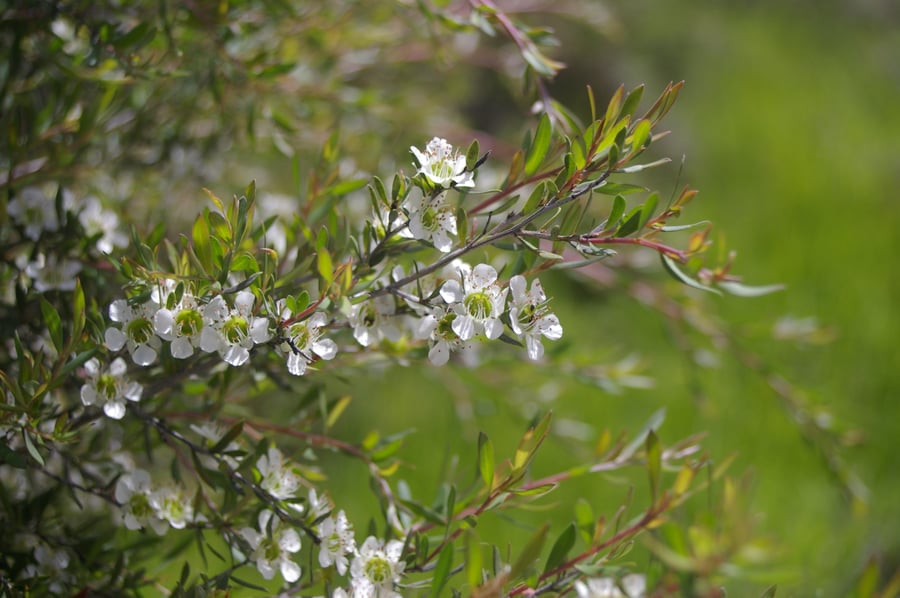
Jelly bush honey comes primarily from the nectar of Leptospermum polygalifolium – known as jellybush, tantoon, or yellow tea-tree – a shrub or small tree in the family Myrtaceae. It grows down the eastern seaboard from the south coast of New South Wales to Cape York in Queensland, on sandstone and basalt soils, from coastal heath up into the ranges, flowering white in spring and early summer (earlier in the north). The activity heartland sits in the New South Wales Northern Rivers and southeast Queensland, including Byfield and Stradbroke Island, where the strongest honeys have been recorded.
The wider identity question matters to a buyer. “Australian manuka” on a label is not one plant. Australia has around eighty Leptospermum species, all but three of them native, and several besides polygalifolium yield active honey – L. liversidgei, L. speciosum, and L. whitei among them. New Zealand manuka, by contrast, is a single species, L. scoparium. So a jar of Australian manuka is honey from somewhere in a large and variable genus, identified by its chemistry rather than by one flower. Jelly bush – polygalifolium – is the species most consistently behind it, and the name the honey carried before the manuka label arrived.
Pairings:
The strong, malty profile stands up to assertive partners rather than delicate ones. It suits dark toast, sharp aged cheese, and strong black tea, and a small amount carries a long way. High-activity grades, with their medicinal edge, are usually taken by the spoonful or stirred into warm (not hot) water rather than used in cooking, where heat both wastes the activity and flattens the flavour. For everyday eating, a lower-activity jelly bush behaves like a robust dark honey.
Health Uses:
Jelly bush belongs to the small group of honeys, with New Zealand manuka, that show strong non-peroxide antibacterial activity – antibacterial action that does not depend on the hydrogen peroxide common to all honey, and that survives in the body where peroxide activity does not. The active compound is methylglyoxal, formed as nectar dihydroxyacetone converts during maturation, and laboratory testing has measured it in active jelly bush at levels matching or exceeding New Zealand manuka. Medical-grade Leptospermum honey is used in registered wound dressings.
What that means for an ordinary jar is narrower than the marketing around it. The demonstrated activity is antibacterial, shown in the laboratory and in wound care; the honey is not a treatment for internal illness, and a supermarket jar is not a medicine. Activity also varies enormously between batches, which is the whole point of the MGO rating – a low number means little measured activity. The honey’s traditional and demonstrated strengths are real and specific; they are not a general health claim.
Origin Story
The name jelly bush comes straight from the people who worked it: local beekeepers naming the plant for the thick, jelly-like honey their bees made from it, honey so viscous it could break wooden frames and clog an extractor. For most of the twentieth century that made it a nuisance crop. Beekeepers knew which stands of Leptospermum to keep their hives away from, and honey that came in dark, strong, and half-set was not worth the effort to recover.
“Manuka” itself is an older Australian word than the marketing suggests. It appears in Tasmanian newspapers and place names from the 1880s – Manuka Creek, Manuka Rivulet – and a Tasmanian House of Assembly report used it for Leptospermum in 1882. The New South Wales Department of Agriculture’s 1985 “Honey and Pollen Flora” recorded manuka as a common name for the genus. The commercial turn came in the mid-1990s: Capilano, Australia’s largest honey packer, began researching the wound-healing properties of Leptospermum honey in 1995, registered the Medihoney trademark in 1996, and by 2002 had put “Australian Manuka” on supermarket shelves in the United Kingdom. The honey nobody wanted had become a product worth naming.
Cultural Context
The deeper Australian claim is botanical and ancient. The genus Leptospermum carries fire-adaptive traits – woody lignotubers and seed held in the canopy until fire – that point to an origin in fire-prone Australia rather than temperate New Zealand, and the evidence suggests L. scoparium itself reached New Zealand by long-distance dispersal across the Tasman within the last twenty million years. The plant at the heart of New Zealand’s manuka identity is, on this reading, an Australian emigrant.
A separate and older thread belongs to Aboriginal Australians, who used the leaves of tea-tree and related Leptospermum plants medicinally long before European settlement, and who have harvested honey from native stingless bees for tens of thousands of years. That deep history is real, but it should not be folded into this honey’s story without care: jelly bush honey as sold is a European-honeybee product, made only since bees were introduced from the 1820s. The Indigenous connection is to the plant and to native-bee honey – not to the monofloral jelly bush crop in the jar.
Harvest & Forage
Jelly bush is a spring and early-summer honey, taken when the coastal heath and tea-tree flower; the window opens earlier in the tropical north. The crop’s defining difficulty for the beekeeper is the same one that named it – the honey’s viscosity makes it slow and awkward to extract, and high-activity batches set firm. The greater uncertainty is activity itself. Because antibacterial strength depends on nectar dihydroxyacetone that varies from tree to tree and season to season, a beekeeper cannot know the grade of a crop until it is tested; a flush during a dry spring can come in low even from a stand that tested high the year before. Producers send samples to specialist laboratories for an MGO rating, and that number, not the volume of the crop, sets its value.
Beekeeping Context
The modern jelly bush industry was built on research, mostly out of the University of the Sunshine Coast and the University of Technology Sydney, and on a national survey of hundreds of honey samples funded through Australia’s rural research corporation between 2014 and 2019. That work mapped which Leptospermum species and which regions produced active honey, and gave beekeepers a guide to what they had. It also set off a small plantation movement: growers establishing stands of known high-activity species, sometimes at undisclosed locations, betting on medicinal honey as a crop in its own right.
Production reaches buyers largely through specialist and direct sales, graded and priced by MGO rating rather than sold as bulk table honey. The honey’s commercial identity is inseparable from the naming dispute around it – whether it can be called manuka at all is, for an Australian producer, a live question of market access, not just terminology.