Prickly Box Honey
The Story
Prickly box is the thornbush of Tasmania’s dry east. Spiny and unpalatable, it is a shrub browsing stock leave alone, and it persists in some of the oldest farmed country in Australia – roadsides, rocky rises and paddock edges from the Coal River Valley to Bruny Island and up the east coast. Mainland apiary literature lists it as a filler plant for poor seasons. Tasmanian beekeepers bottle it under its own name, and in 2015 a Hobart apiary’s jar of prickly box beat the same house’s leatherwood to a national produce award.
Open a jar and it is confectionery – caramel-sweet, with the almond edge tasters keep comparing to marzipan – golden in the glass, fragrant. It candies almost as soon as it is bottled, so producers sell it as a creamy soft set – smooth, dense, made for a hot crumpet rather than a honey dipper.
The crop is a midsummer event. The bloom opens in the weeks around Christmas, and the flow depends on rain: a wet midsummer brings a crop, a drought year brings none. Beekeepers in the east take prickly box before the hives are trucked west for the leatherwood season.
Characteristics
Prickly box honey candies almost as soon as it is bottled – high in glucose by one producer’s account – and it is usually sold as a creamy soft set. An unprepared jar sets firm; gentle warming brings it back to liquid. The single-flower character comes from placement: hives set in bursaria country for the midsummer flow.
Click to Display — The Details: botanical origin, sensory profile, and its regional identity
Botanical Name: Prickly box (Bursaria spinosa)
Botanical Family: Pittosporaceae
Bee Species:
The honey is made by the western honey bee, Apis mellifera. Prickly box is natively worked by beetles and wasps, and its blossom is so attractive to honey bees that Tasmanian researchers, watching hives placed beside carrot seed crops, found the bees working the bursaria instead. Native bees work it too.
Color:
golden to light amber
Flavor Profile:
butterscotch and nutty caramel with a marzipan edge; a clean, short finish
Tasting Notes:
Each house describes the same honey a little differently: Blue Hills finds overtones of marzipan, Wellington Apiary a nutty caramel that is less sweet than most honeys, Miellerie a warm butterscotch. Tasters split on intensity – some find it delicate and mild, others rich – which producers put down to season, since the flow swings with the summer rain. One Huon Valley producer calls it the favourite of customers who find leatherwood “a bit too much” – quieter, confectionery rather than floral spice.
Aroma:
perfumed and floral; the fragrance is the trait tasters keep singling out
Forage Origin:
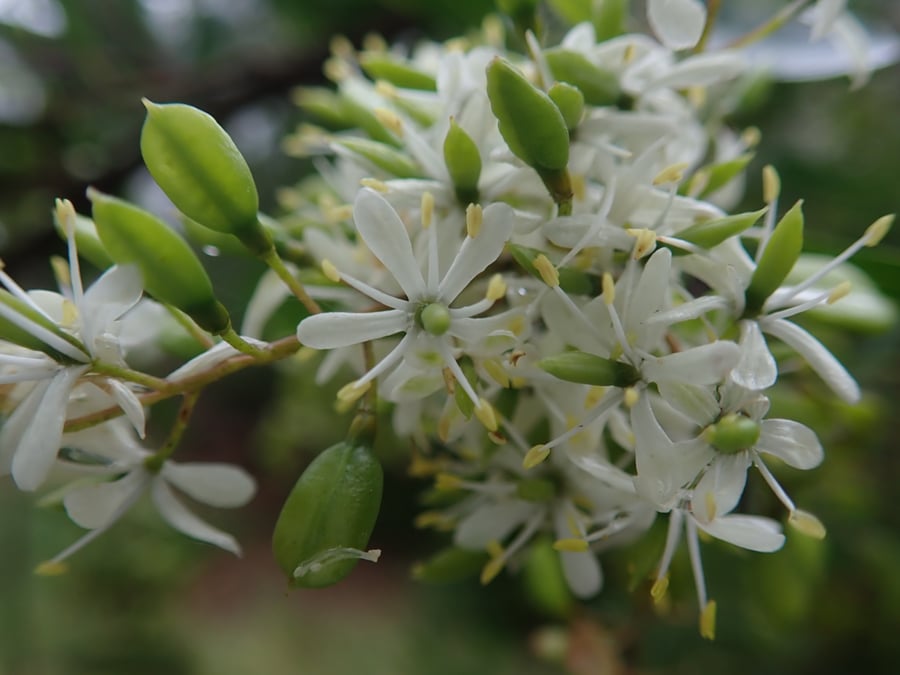
Bursaria spinosa is a spiny shrub of Tasmania’s dry country – open woodland, grassland and rocky rises from near sea level to about 800 metres, across the east and midlands but not the wet west or the highlands. It is the only bursaria in Tasmania. The small white flowers open in sweet-scented, pyramid-shaped sprays in midsummer, and the flat, purse-shaped seed capsules that follow give the genus its name, from the Latin bursa. The stands are long-lived and hard to kill: a shrub that lives decades, resprouts after fire, and spreads by root as much as by seed, so that a thicket is often one plant.
“Prickly box” is the Tasmanian name, and the box is for the small glossy leaves, like European box hedging – the shrub was never a timber tree. On the mainland the same plant is sweet bursaria or blackthorn. Its Christmas-time bloom also earns it the name Christmas bush in Tasmania and South Australia – but a Tasmanian jar labelled Christmas Bush honey is usually a different plant altogether, the native mint bush Prostanthera lasianthos – only the botanical name on the label separates them.
Pairings:
Producers put it on cheese boards and hot buttered toast, and in tea and coffee, where the caramel comes through. A Hobart restaurant once paired Bruny Island prickly box with the island’s oysters – honey, lemon and olive oil over the shells – because the bees work the scrub that skirts the oyster bay. It has been churned into ice cream, brewed into a saison, and fermented as the base honey of a Tasmanian meadery; at the 2015 awards dinner it was served as honey cream on quince crumble tarts at Bennelong, in the Sydney Opera House.
Origin Story
Honey bees reached Tasmania in 1831, presented to Governor Arthur and set in the Government Gardens, where the first hive threw thirteen swarms the following year. The shrub was already there: described from Port Jackson specimens in 1797, it grew across the dry east long before the sheep came.
For most of its history prickly box was a working flow rather than a label – one of the “usual sources” in the trade’s own crop reports, taken with clover ahead of the leatherwood season. The varietal jars are the artisan era’s work. By 2007 a French-born beekeeper at Woodbridge was bottling prickly box beside his leatherwood; in 2008 a Huon Valley family’s jar took one of only two golds awarded at the Sydney Royal Fine Food Show; and in 2015 Wellington Apiary’s prickly box from the Coal River hills won a national delicious. Produce Award, beating the same apiary’s leatherwood.
Cultural Context
The open grassy woodland where prickly box thrives is an Aboriginal landscape: Palawa fire kept this country open for millennia, burning that held the grassland and brought on fresh growth for kangaroo. The parklike ground the first colonial painters recorded is what that burning made – John Glover, painting these woodlands from his farm at Mills Plains in the 1830s, noted in his own catalogue that a carriage could be driven almost anywhere through the trees, as in an English park. His country is walkable today at Patterdale, and Australia’s richest landscape art prize carries his name at Evandale each March. Since 2017, Aboriginal rangers and University of Tasmania researchers have brought cultural burning back to Midlands grasslands.
Harvest & Forage
The bloom opens in the weeks around Christmas – the flora records put flowering in November and December, and it runs late in a cold year. Rain decides the crop: the shrubs yield nectar after midsummer rain, and in a drought summer the flow fails altogether. Producers call the yields ephemeral and the honey highly seasonal; Antonia O’Brien of Wellington Apiary counts drought and irregular flowering among the reasons single-flower honey is hard work. For the short window it flowers, hives go onto the warm hills where the shrub is thick – the Coal River Valley, the D’Entrecasteaux Channel, Bruny Island and the east coast.
Beekeeping Context
The state government names prickly box first among the varieties after leatherwood and manuka; the last full apiary census ranked it the state’s fourth-largest honey resource, behind leatherwood, the clover and blackberry pastures, and blue gum; and it has an entry class of its own in the Tasmanian Honey Awards. At least nine Tasmanian apiaries bottle it under its own name, from the north-west coast to Bruny Island. In Hobart retail it sells at or a little above leatherwood, jar for jar, and well under manuka.
Named Producers
Blue Hills Honey – Mawbanna, north-west Tasmania. Family apiary since 1955, third and fourth generation; prickly box a core line beside leatherwood and manuka, sold from their interpretation centre and cafe. https://bluehillshoney.com/products/prickly-box/
Wellington Apiary – Hobart, hives in the Coal River Valley. Cold-extracted, unheated; their prickly box won the delicious. Produce Award in 2015. https://www.wellingtonapiary.com/portfolio/prickly-box/
Miellerie – Woodbridge. Founded 2005 by French-born beekeeper Yves Ginat, sold in 2025 with Yves advising; all honeys sold crystallised in the French style. https://www.miellerie.com.au/
The Honey Pot and Bruny Island Honey – Huonville and Great Bay, Bruny Island. The Wright family’s 900 hives; labels it Sweet Bursaria (Prickly Box); a 2008 Sydney Royal gold medallist. https://thehoney-pot.com/product/prickly-box-honey
Heritage Honey – Moonah, with a Salamanca Market stall every Saturday. Sells prickly box straight and as a soft set. https://heritagehoney.com.au/product/prickly-box
Source Regions
- Bursaria spinosa – Australia – Victoria: one Melbourne-district apiary bottles a Victorian prickly box under the Tasmanian name, robust with butterscotch notes; elsewhere on the mainland the plant is a support source for beekeepers, not a varietal.
Festivals and Fairs
Honey Bee Festival – New Norfolk, each April on the Esplanade. The Derwent Valley Beekeepers Association’s festival, with honey tasting and the Tasmanian Honey Awards, where prickly box is an entry class of its own. https://dvba.org.au/honey-bee-festival/
Honey and Hive Festival – Heybridge, north-west coast, November. Honey tastings and competitions, glass-fronted hives, live hive inspections.