Victoria Honey
On the cooled lava of an old volcano in Victoria’s far southwest, a Gunditjmara guide walks you out along stone channels cut by hand into the rock. This is Budj Bim, and the channels are eel traps – weirs and dams engineered to hold and harvest kooyang, the short-finned eel, and worked for at least six thousand years. In 2019 it became the first place in Australia inscribed on the World Heritage List purely for its Aboriginal cultural significance, and the guided walk out to the weir on Tae Rak is the plainest way to read that engineering straight off the ground.
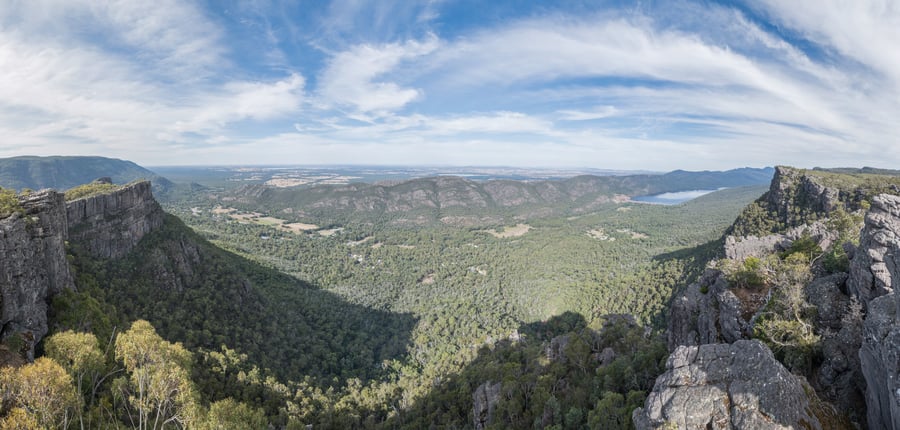
The rest of the state sorts itself by height. On the northern floodplain the Murray spills into the largest river red gum forest in Australia, where the trees stand five hundred years old; two kilometres higher, the same Great Dividing Range thins to treeless herbfield above the snow line on Mount Bogong, at 1,986 metres the highest ground in the state. You could stand in both on the same day. In between lie the goldfields, where the box-ironbark forest grew back on the very ground the diggers turned over.
Along the south coast the Great Ocean Road runs to the Twelve Apostles – seven limestone stacks, the name outrunning the count, that the Southern Ocean is cutting from a wall of cliff. One fell in 2005, another in 2009, and headlands standing today will be stacks tomorrow. Further south the granite of Wilsons Promontory, the southernmost tip of the mainland, was joined to Tasmania by dry land until the seas rose ten thousand years ago. In the west, the sandstone shelters of Gariwerd hold the densest concentration of rock art in the state, painted over more than twenty thousand years. High in the Alps, for thousands of years, Aboriginal groups gathered each summer to feast on the bogong moths that once sheltered by the billion in the high-country rock.
And through all of it, quietly, run the bees. The forests that cover the state are overwhelmingly eucalypts, and eucalypts are what Victorian honey is made from. The honey changes with the rock and the rainfall – red gum off the Murray, box and ironbark from the goldfields, a spare, strong honey off the alpine tops. But in Victoria that is the last thing you notice, not the first.
Food
Ride the Pedal to Produce trail out of Milawa and the northeast comes to you flat and slow: a sealed rail-trail arm of the Murray to Mountains path, the alpine tops blue on the horizon, linking a cheese room, a mustard maker, a family apiary and half a dozen cellar doors close enough to fill a basket between them. At the centre is Brown Brothers, planted in 1889 and still running what was Australia’s first winery restaurant – shared plates and estate wine, the dining room open to the kitchen garden. Milawa was the first district in Australia named a gourmet region, in 1994, and the honey here is not off in a specialist shop of its own; it is sold at the cheese counter on the same trail. Victoria’s table runs much wider – Melbourne’s laneways and its market, the mineral-springs kitchens of Daylesford – but Milawa is the place where the food and the honey share a road.
The Milawa gourmet trail, producer by producer
The winery at the centre of the district was planted in 1889 and still runs a cellar door and a hatted restaurant, its menu built garden-to-plate down to an infused oil pressed from kitchen offcuts. A few minutes away, the cheese company was founded in 1988 in the town’s former butter factory and is now run by the founders’ daughter, Ceridwen Brown; every wheel is made and washed by hand, and two of them – Milawa Blue, a soft homage to Gorgonzola Dolce, and the washed-rind King River Gold – anchor most local boards. Around them are a mustard maker working since 1982, known for a three-seed mustard and a tomato-chilli jam, plus olive, trout and smallgoods producers; the long-running Milawa bakery closed in 2025, and the cheese room now carries a local sourdough in its place. The family apiary’s honey – ironbark, red gum, mountain harvest – is stocked at that same cheese counter, though the apiary’s own shed is closed to the public.
The King Valley opening to the south carries a strong Italian migrant history and a run of prosecco makers along a road of converted tobacco kilns; Glenrowan, where Ned Kelly made his last stand, is a few minutes away. The whole district sits about three hours northeast of Melbourne, in the foothills below the alpine resorts.
Melbourne's table and the mineral-springs kitchens of Daylesford
Melbourne is the food city, and its plainest pleasure is a coffee taken standing in a bluestone laneway – Degraves Street or Centre Place – in the city that made the flat white a standard. A few minutes’ walk away, the Queen Victoria Market has sold produce for more than a hundred and forty years: hot jam doughnuts from the van with the queue outside it, borek and shucked oysters in the deli hall, and, among the stalls, a raw stringybark honey from the Grampians. The city keeps its own honey too, and it is the counterpoint to everything else on this page – where the rest of the state’s honey is single-tree and rural, Melbourne’s is rooftop and polyfloral. On Lygon Street, Bee Sustainable pours local honey by weight into your own jar, and collectives like Honey Fingers make a honey that tastes of a whole suburb’s gardens rather than one flower. The city carries its culture as plainly as its coffee: the National Gallery of Victoria is free and the most-visited gallery in the country, Melbourne has more live-music venues per head than any city on earth, and in 2008 it became the second UNESCO City of Literature in the world.
Ninety minutes northwest, Daylesford and Hepburn Springs sit on the largest concentration of mineral springs in Australia – roughly four-fifths of the country’s – and the fizzing water still runs free from the pumps in the heritage reserve. The town built a food culture to match: the Lake House, on the water, is widely credited as the place that invented Australian destination dining, growing much of what it serves on its own farm, and the Sunday market fills with the produce the spa country runs on.
Culture
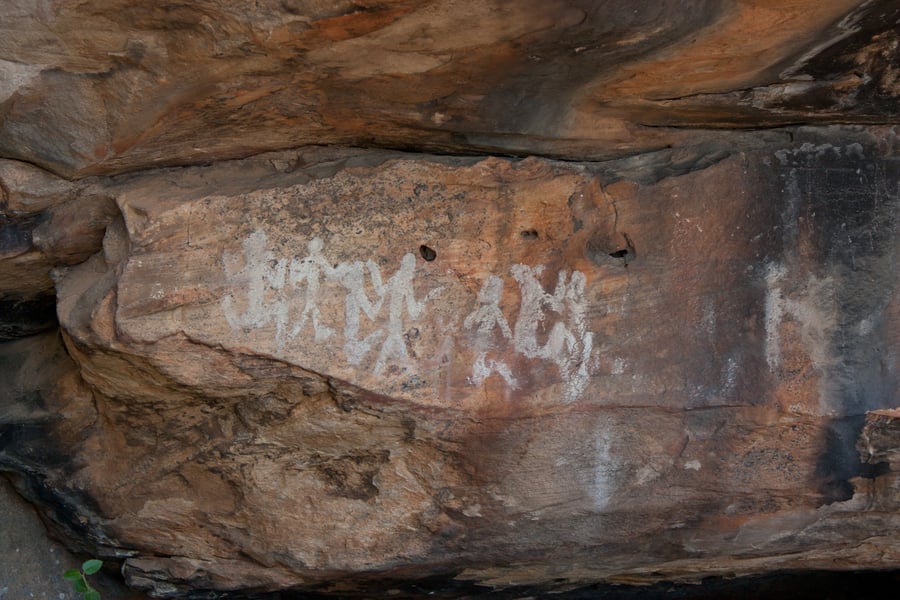
A hundred metres from a car park near Stawell, in a sandstone shelter behind protective mesh, is the only known painting of Bunjil – the creator spirit of southeastern Australia – flanked by his two dingoes. It is one of five rock-art shelters open to visitors in Gariwerd, the sandstone ranges of the Jardwadjali and Djab Wurrung peoples, which hold most of Victoria’s rock art – roughly eighty to ninety per cent of it – painted over more than twenty thousand years; at Gulgurn Manja, a short walk off the northern range, the wall carries painted hand prints, some of them children’s. The gold rush layered its own cultures over the country, and nowhere more than Bendigo, which drew one of colonial Australia’s largest Chinese communities and still winds a 125-metre imperial dragon through its streets each Easter.
Rock art, the six seasons, a Chinese dragon, and a moth feast in the mountains
Gariwerd is National Heritage listed for its art and for the continuing connection of its Traditional Owners; its shelters carry hand stencils, animal tracks and figures whose meanings are held by the Djab Wurrung and Jardwadjali. Around 140 to 200 sites are recorded, but only five are open to the public, a deliberate choice of protection over access. The people of Gariwerd keep a calendar of six seasons rather than four; one of them, gwangal maronn, from late March to June, is named as the season of sunrises, bees and flocking birds. The bees it names are native ones – the European honey bee did not reach the colonies until the 1820s – so it is a season named for bees, not a record of honey. The same culture has a living, contemporary home too: the Aboriginal-owned Koorie Heritage Trust on Federation Square in Melbourne, where a guided walk along the Birrarung and rotating shows of new Koorie work carry the line from the Gariwerd shelters into the present.
In Bendigo, the gold rush drew a large Chinese community whose dragon-dancing tradition dates to the 1870s; the Golden Dragon Museum now holds the retired Sun Loong and its successor Dai Gum Loong, the “Big Gold Dragon,” at about 125 metres the longest imperial parade dragon in the world, walked through the streets each Easter. High in the Alps, for thousands of years, Aboriginal groups from many clans gathered each summer to feast on the bogong moths – rich in fat – that once aestivated by the billion in the high-country rock, in intertribal gatherings unique to the alps. It is a feast of moths, not honey; and the moth itself has since crashed, listed as endangered in 2021 after successive failed migrations.
The goldfields kept a creative afterlife as well. Castlemaine has become one of the state’s densest arts towns, and tiny Clunes – the site of Victoria’s first registered gold in 1850 – turns its heritage streetscape over to sixty booksellers each May as an Australian Booktown.
The open-air galleries: painted silos, a mural town, and Melbourne's laneways
Out in the Wimmera-Mallee wheat country, thirty-metre grain silos have been turned into portraits. The Silo Art Trail began at Brim in 2016 and now runs a several-hundred-kilometre loop of them – a weathered farmer’s face at Patchewollock, the elders of the local Aboriginal community at Sheep Hills – with the empty wheatbelt and its big bleached skies as the gallery between stops. Warracknabeal, where Nick Cave was born, sits in the same country.
In the northeast, Benalla has done the same thing at walking pace: roughly ninety-five murals across its walls, its laneways and even the underground car park, most of them inside a couple of hours on foot – the same town whose self-serve honey gate sits on the Honey Road below.
Melbourne keeps its art on the street too. The bluestone laneways off the coffee run – Hosier Lane, AC/DC Lane, Duckboard Place with its surviving Banksy rat – are an outdoor gallery repainted week to week; a short walk through the city turns up Larry La Trobe, the bronze larrikin dog outside the Town Hall, the giant granite Public Purse slumped in the Bourke Street Mall, and Deborah Halpern’s mosaic Angel by the river. Duck through the 1870 Royal Arcade, the country’s oldest, to catch Gog and Magog strike the hour, then cross to the cranked glass-and-zinc faces of Federation Square, a building Melburnians have argued about since the day it opened.
Natural History
Stand at the edge of the Barmah forest where the Murray, pinched to a fifth of its width at a natural choke, spills sideways into red gums five hundred years old – then drive south and climb the Staircase Spur until the trees give out and you step onto the bare, treeless summit of Mount Bogong at 1,986 metres. Same state, same day: the floodplain and the roof of Victoria are two ends of one climb, and the forest sorts itself by height all the way up. The interior is uplift; the west is fire, the youngest volcanic field on the continent; the south is water and time, a limestone coast the Southern Ocean is actively demolishing. Four ways of making one small state.
The elevation axis: floodplain red gum to alpine snow gum
The interior sorts itself by height, and so does its forest. On the floodplain, Barmah and its New South Wales twin form the largest river red gum forest in Australia – and, the tree growing nowhere else, on earth: a Ramsar wetland where the trees depend on the Murray’s floods, and where the river itself can run backwards when the Goulburn floods against a fault-line choke in the channel. Above the floodplain, the auriferous belt of central Victoria carries box and ironbark. The foothills bring messmate, manna gum and stringybark. Higher again, in the 646,000-hectare Alpine National Park, the trees zone cleanly by altitude: alpine ash to about 1,300 metres, then snow gum – the most cold-tolerant eucalypt on the continent – to roughly 1,800 metres, then only herbfield on the treeless tops. The honey a beekeeper can take rises and thins along exactly this gradient, red gum at the bottom, a spare high-country honey near the top.
Fire, sea and stone: the volcanic plains, the eroding coast, the granite and the karst
The western plains are the youngest ground in the state. The Newer Volcanics Province holds more than four hundred vents, and Budj Bim – the volcano formerly called Mount Eccles – erupted around thirty-seven thousand years ago, sending a lava flow more than fifty kilometres to the sea, damming the drainage into wetlands and leaving the crater lake of Lake Surprise. On that lava flow the Gunditjmara built one of the world’s oldest and largest aquaculture systems, engineering channels and weirs to harvest kooyang, the short-finned eel; in 2019 it became the first place in Australia inscribed on the World Heritage List purely for its Aboriginal cultural significance.
The south coast is where the state is coming apart fastest. The Twelve Apostles are stacks of Port Campbell limestone, laid down on a shallow sea floor between fourteen and nine million years ago, lifted out of the ocean by tectonic compression, and then – only in the last few thousand years, as post-glacial seas rose – cut off from the cliff line by the waves. It is, in the words of the national heritage listing, the definitive place in Australia to watch limestone coastal erosion at work: a stack fell in 2005, another in 2009, seven stand today, and headlands standing now will be stacks tomorrow. Behind the cliffs rise the cool, wet forests of the Otway Ranges, the state’s rainforest end.
The far corners hold the oldest rock a visitor is likely to stand on. Wilsons Promontory, the southernmost point of the mainland, is a Devonian granite batholith of tors and cliffs, joined to Tasmania by a land bridge until the seas rose about ten thousand years ago. In the far east, the Buchan caves are dissolved out of Devonian limestone – the largest cave system in the state, guided by lamplight at a constant seventeen degrees – and Gunaikurnai Country, co-managed today.
The walks and the wildlife: Squeaky Beach, the Pinnacle, the penguins and the koalas
Along the Great Ocean Road the payoff at the Twelve Apostles is the eighty-six steps down at Gibson Steps to the beach, where the stacks that look modest from the clifftop stand towering over you at sea level. Further west at Kennett River, wild koalas doze in the roadside manna gums, king parrots land on outstretched hands, and a gully lights up with glow-worms after dark.
At the southern tip of the mainland, Wilsons Promontory keeps Squeaky Beach – named Australia’s best beach in 2024, the first Victorian beach ever to top the list, its white quartz sand squeaking underfoot between granite tors – and the climb up Mount Oberon for the view back over Tidal River, where wombats graze the clearings at dusk. (The long walk out to Sealers Cove is closed while its boardwalk is rebuilt.)
West of the goldfields, the sandstone Grampians give the Pinnacle, a rock ledge reached through the clefts of the Grand Canyon and Silent Street; the range is reopening in stages after the 2024-25 fires, so it is worth checking what is open before you go. And on Phillip Island, at dusk, little penguins ride the surf ashore and cross Summerland Beach to their burrows in their hundreds, close enough at the underground viewing to pass at eye level.
Built Heritage
Walk into Maldon and you are in the streetscape the National Trust named the country’s first notable town: weatherboard and stone shopfronts barely changed since the 1860s. Beechworth kept its whole gold-rush precinct in honey-gold granite, including the courthouse where Ned Kelly stood committal in 1880 – you can stand in the dock where he stood. The rush of the 1850s, one of the largest anywhere, left central Victoria a chain of towns – Bendigo, Castlemaine, Maldon, Beechworth – that never quite modernised away their beginnings, and the whole landscape now sits on Australia’s Tentative List for World Heritage. On the Murray, Echuca preserves the other half of the boom: the largest inland port in the country, its wharf three storeys tall and built entirely of river red gum, and the world’s largest working fleet of paddle steamers.
The outlaw who became the country's most famous painting -- and a Booker novel
Ned Kelly is where Victorian history turns into Australian art. In 1946 and 1947 the painter Sidney Nolan made his Ned Kelly series in the farmhouse dining room at Heide, on the Birrarung at Bulleen – flat, bleached landscapes with the outlaw reduced to a black helmet-slot against the sky, now among the most recognised images in the country (most of the series hangs at the National Gallery of Australia in Canberra). Half a century later those same paintings sent Peter Carey back to the Jerilderie Letter, Kelly’s own furious voice, and out of it came True History of the Kelly Gang, which won the Booker Prize in 2001. The paint and the prose both end where this hub does – at Glenrowan.
The gold towns, the red-gum port, and one tree that did both jobs
The box-ironbark forest of the goldfields grew back on the very ground the diggers turned over. Most of it was felled in the rush for firewood and mine timber; but cut off at the base, each old eucalypt regrew from its underground rootstock as a clump of coppice trunks, so what a beekeeper works today is largely regrowth from a hundred and seventy years ago – the same trees the diggers cut, standing again. Echuca tells the same story in timber. The town became Australia’s largest inland port in the 1870s, and its wharf – three storeys tall to meet a ten-metre seasonal swing in the river, once more than three hundred metres long – was built entirely from river red gum, milled in eight local sawmills from the floodplain forest. The paddle steamers were red gum too; the fleet still includes the oldest wooden-hulled steamer running anywhere, built in 1866. The wharf, the boats, the goldfields forest and the honeys of both country are, in the end, the same handful of eucalypts.
Ballarat's loud gold: Sovereign Hill's diggings and the flag from the Eureka rebellion
If the box-ironbark towns are the quiet version of the gold story, Ballarat, on the western goldfields, is the loud one. At Sovereign Hill, a recreated 1850s township built over real mine workings, you can pan the creek for colour, watch a bar of gold poured, and walk the diggings underground by lamplight. A few streets away is the harder history: in 1854 the Ballarat miners, taxed by an expensive licence and policed hard, threw up a stockade at Eureka and fought the troops in a short, bloody rebellion; their blue-and-white flag, remembered as a root of Australian democracy, hangs today at the Eureka Centre. The Art Gallery of Ballarat, the oldest regional gallery in the country, is a few streets from both.
I want to dig deeper
Some of Victoria rewards more than a drive-past. Four runs stand out for the traveller who wants to feel the country rather than pass it: the central goldfields, above ground and below; the Great Ocean Road and its collapsing coast; the Murray by red-gum paddle steamer; and the Gunditjmara eel country of the far southwest. Each is a place to give real days to.
Underground at Central Deborah, the Gibson Steps descent under the Twelve Apostles, the red-gum Murray, and the Budj Bim eel channels
The central goldfields, above ground and below – steam-train days vary by season, so check before you go. Ride the volunteer-run steam train from Castlemaine to Maldon, an 1884 branch line that runs fifty minutes through the box-ironbark and sets you down in a gold town for lunch, and walk the intact streetscapes of Maldon, Castlemaine and Bendigo. Then go under. At Bendigo’s Central Deborah – a real gold mine, not a replica, that gave up more than nine hundred kilograms of gold – you descend sixty-one metres to Level 2 and follow a guide, hard-hatted, through a honeycomb of tunnels at a constant fourteen degrees; the deeper tours, the aptly named Nine Levels of Darkness among them, go further down still. The through-line is underfoot the whole time: the rush stripped the box-ironbark forest for firewood and mine timber, but cut off at the base each old eucalypt regrew from its rootstock as a clump of coppice trunks, so the honey forest a beekeeper works today is a gold-rush artefact – the same trees the diggers felled, standing again over the towns gold built.
The Great Ocean Road and the Shipwreck Coast. Drive the coast road west through the surf towns to Port Campbell, and at the Twelve Apostles take the eighty-six steps down at Gibson Steps to the beach, where the limestone stacks that look modest from the clifftop stand towering over you at sea level. This is a coast you can watch coming apart – one stack fell in 2005, another in 2009, seven stand today, and the headlands behind them are the stacks of the future. Behind the cliffs rise the cool, wet Otway Ranges, the state’s rainforest end.
The Murray by red-gum paddle steamer. From the restored three-storey wharf at Echuca – Australia’s largest inland port in the 1870s, built entirely of river red gum – an hour on a wood-fired paddle steamer drifts past the red gums that built it, the same tree whose nectar becomes the Murray’s pale, quick-setting honey. It is the gateway to Barmah, the largest river red gum forest in the country.
Gunditjmara eel country – guided walks Wednesday to Sunday. In the far southwest, a Gunditjmara guide walks you along the stone eel channels cut into the Budj Bim lava flow – the working evidence of an aquaculture system six thousand years old, read straight off the rock, on the first place in Australia World Heritage-listed for its Aboriginal culture alone.
The Honey of Victoria
Victoria has no single flagship honey, and that is the point: its honey is a range read up a mountain and out to the plains. River red gum, pale and quick to set, comes off the Murray corridor. The goldfields yield the workhorse eucalypt honeys – grey box, red box, yellow box and the ironbarks – from the box-ironbark forest. The foothills and the northeast give messmate, manna gum and a prized red stringybark; the high country gives a spare, strong honey off the subalpine gums; the dry Mallee in the northwest and the wet Otways in the south stand at opposite ends of the state’s weather and its forest honeys alike. Introduced flowers add the settled-farm counterpoint – the blue Salvation Jane of the northern plains, canola, clover. Yellow box, one of the country’s most prized table honeys, is produced widely across the state and appears among Victoria’s honeys below.
The Honey Road
The state’s honey can be followed the way its trees are arranged. Start on the Murray at Echuca, the gateway to the red gum country, where the same tree that makes the corridor’s pale honey built the port – and where a third-generation beekeeping family’s cafe on the Murray Esplanade sells its certified-organic raw honey beside the paddle steamers. Move south into the goldfields, where the box-ironbark towns – Maldon, Castlemaine, Bendigo – sit in the honey forest: at Castlemaine, the McDonald family’s sixth-generation farm shop and self-serve honey shack sell the goldfields varietals near their source, and in the gold-rush main street of Beechworth, the Beechworth Honey shop pours a free tasting of more than forty single-varietal honeys beside a working hive, open every day. Carry on into the northeast, to the Milawa gourmet trail, where the local honey is sold beside the cheese and the wine under the alpine tops; the producer’s own shed at Milawa is not open to the public, so taste it on the trail and at the cheese room rather than at the gate.
The road ends in the city, where it turns urban. On Lygon Street in Melbourne, a Brunswick honey shop pours local honey by weight into your own jar – the state’s rooftop, polyfloral counterpoint to its single-tree forests – and apiaries on the city’s northern fringe run suited hive tours through the flowering months for anyone who wants to stand over an open hive. It is a road you could drive in three days, tasting the whole elevation of the state along the way. Behind the drive sits one of the country’s biggest beekeeping states – more than twelve thousand registered beekeepers, second only to New South Wales – working a box-ironbark belt that Parks Victoria calls the state’s most significant nectar country, most of it regrowth from the goldfields.
Getting Here
Melbourne is the gateway, and a car is essential once you leave the city. The goldfields, Bendigo and Castlemaine, are under two hours northwest; Echuca and the Murray are about two and a half hours north; the Milawa food district is about three hours northeast, and the Alps four to five hours beyond it. The Great Ocean Road and the Twelve Apostles are three to four hours southwest along the coast; Budj Bim and the western volcanic plains a little further west again; Wilsons Promontory about two and a half hours southeast; and the Buchan caves are a long haul into the far east of Gippsland. The Murray and the Mallee are most comfortable in the cooler months, the Alps split into summer walking and winter snow, and the goldfields, coast and food country reward a visit at any time of year.
Seasonal Events Not to Miss
The high country hosts the Kangaroo Hoppet at Falls Creek on the last Saturday of August – the only international cross-country ski race in the southern hemisphere, drawing more than a thousand starters. At Easter, Bendigo winds its imperial dragon Dai Gum Loong through the streets in a parade the Chinese community has kept since the 1870s. In November the Beechworth Honey shop runs Pollinate, a month of bees, flowers and food built around the honey house. And on the Murray, Echuca’s winter blues festival fills the historic port precinct and its paddle steamers with music. Dates shift year to year, so confirm each with the organiser before you plan around it.
Where to Buy Honey
The single best counter is in Beechworth, where the Beechworth Honey shop offers a free daily tasting of more than forty varietals in a gold-rush main street – bearing in mind that the house sources nationally, so it is the place to taste the country’s honeys rather than a guarantee of local provenance. Closer to Melbourne, Pure Peninsula Honey runs a walk-in honey farm at Moorooduc on the Mornington Peninsula, open seven days with a glass observation hive, free tastings and honey ice-cream. For honey grown and worked in the state, the box-ironbark goldfields are the country to buy near the source: at Castlemaine the McDonald family’s farm shop and self-serve honey shack sell the central-forest varietals, and the Milawa gourmet trail sells the local family apiary’s honey alongside the cheese, though the apiary’s own shed is closed to the public. On the Murray, the Beekeeper’s Table at Echuca pours certified-organic honey in its riverside cafe; at Benalla, Broken River Apiaries keeps a self-serve farm gate open around the clock; and on the Bellarine, Wattle Grove Honey runs a little farm shop with tastings. In Melbourne itself, Bee Sustainable on Lygon Street sells local honey by weight, and the Queen Victoria Market carries a Grampians stringybark among its stalls. Down in South Gippsland, Blue Tree Honey Farm at Dumbalk pairs a glass viewing hive with a farm-shop cafe – check its seasonal hours before the drive. And a producer like VicHoney will post organic honey to travellers who never leave the city.