Blueberry Honey (Miel de bleuet)
The Story
The hives travel at night, because bees fly by day, and in blueberry country that means trucks on the highway in the small hours each spring. On the night of 19 June 1989 one of them, carrying hives from Victoriaville to the fields around Lac Saint-Jean, swerved near Sainte-Jeanne-d’Arc and shed 150 hives across route 169; the police closed the road under bees covering 400 metres of it. The trucks still run every year, in far greater numbers, because blueberry growers rent bees for the fruit: the flower needs insect visits to set a berry, and growers on the wild barrens of Quebec and the Maritimes and on the farm rows of British Columbia’s Fraser Valley hire tens of thousands of colonies each spring.
Blueberry honey is what the beekeeper keeps from that deal. A hive standing in the bloom for three weeks gathers a few kilos of it, a fraction of a full season’s crop, and the growers’ fee, not the honey, is what pays for the trip. The jar is amber and lightly fruity, with a tart edge at the finish. What it does not carry is the taste of the berry, because honey is made from nectar, and nectar has neither the fruit’s flavour nor its scent. The plant that gives the honey in spring gives the berries in August, and the two share the plant’s sugars and its vitamin B3.
Two plants stand behind one jar name. In the east the honey comes off the wild lowbush blueberry, a shin-high shrub of sandy barrens that is never planted; in the west it comes off the cultivated highbush blueberry, a taller bush grown in rows. The label on both coasts says the same thing: blueberry honey.
Characteristics
An amber honey, pale to dark depending on the year and the site. The scent is where the fruit shows: mildly fruity on opening, while the taste is honey first – sweet, lightly fruity, with a small tart edge at the finish and a round, buttery feel. It carries none of the berry’s own flavour, and producers in Quebec and British Columbia state that plainly on their own pages. In the jar it behaves like most Canadian honeys: liquid at harvest, and crystallising over the months to a spreadable grain, which is why producers on both coasts sell it creamed as well as liquid.
Click to Display — The Details: botanical origin, sensory profile, pairings, health and what gives it its character
Nectar Contributors:
- Primary: Wild lowbush blueberry (Vaccinium angustifolium)
- Secondary: Highbush blueberry (Vaccinium corymbosum)
- Supporting: Velvetleaf blueberry (Vaccinium myrtilloides)
- Background: Spring forest and field flowers within flight range, varying by site (Multiple species, undocumented)
Bee Species:
Western honey bee (Apis mellifera). Managed bumblebees and alfalfa leafcutter bees work the same fields for pollination, and neither produces a harvestable honey.
Color:
Pale amber to dark amber, varying by year and site
Flavor Profile:
Fruity but subtle, honey-sweet, with a slightly tart finish
Tasting Notes:
Mélissa Girard, one of three Canadians accredited on Italy’s national register of honey sensory experts, places it at the warm end of Quebec’s range: “plus chaud, plus rond, plus caramel” – warmer, rounder, more caramel – against the lighter summer honeys. Fraser Valley producers describe their own in the same register: mildly sweet with a hint of brown sugar, or golden, sweet and fruity, in their words.
Aroma:
Mild and lightly fruity – the fruit shows more in the scent than in the taste
Defining Compounds:
Vitamin B3 (niacin). The berry and the honey get it from the same plant: the fruit is rich in the vitamin, and the honey is identified in the laboratory by its B3 content – the authenticity marker a McGill laboratory published in 2024 from jars bought in Montreal, one that, in the laboratory’s own account, holds up through the filtering and processing that defeat pollen analysis. On the sugar side it is an ordinary honey: the one Canadian series to measure it found its fructose-to-glucose ratio indistinguishable from clover’s and buckwheat’s, and found the jars unusually rich in two enzymes, glucose oxidase and catalase, a second handle for telling the honey apart.
Forage Origin:
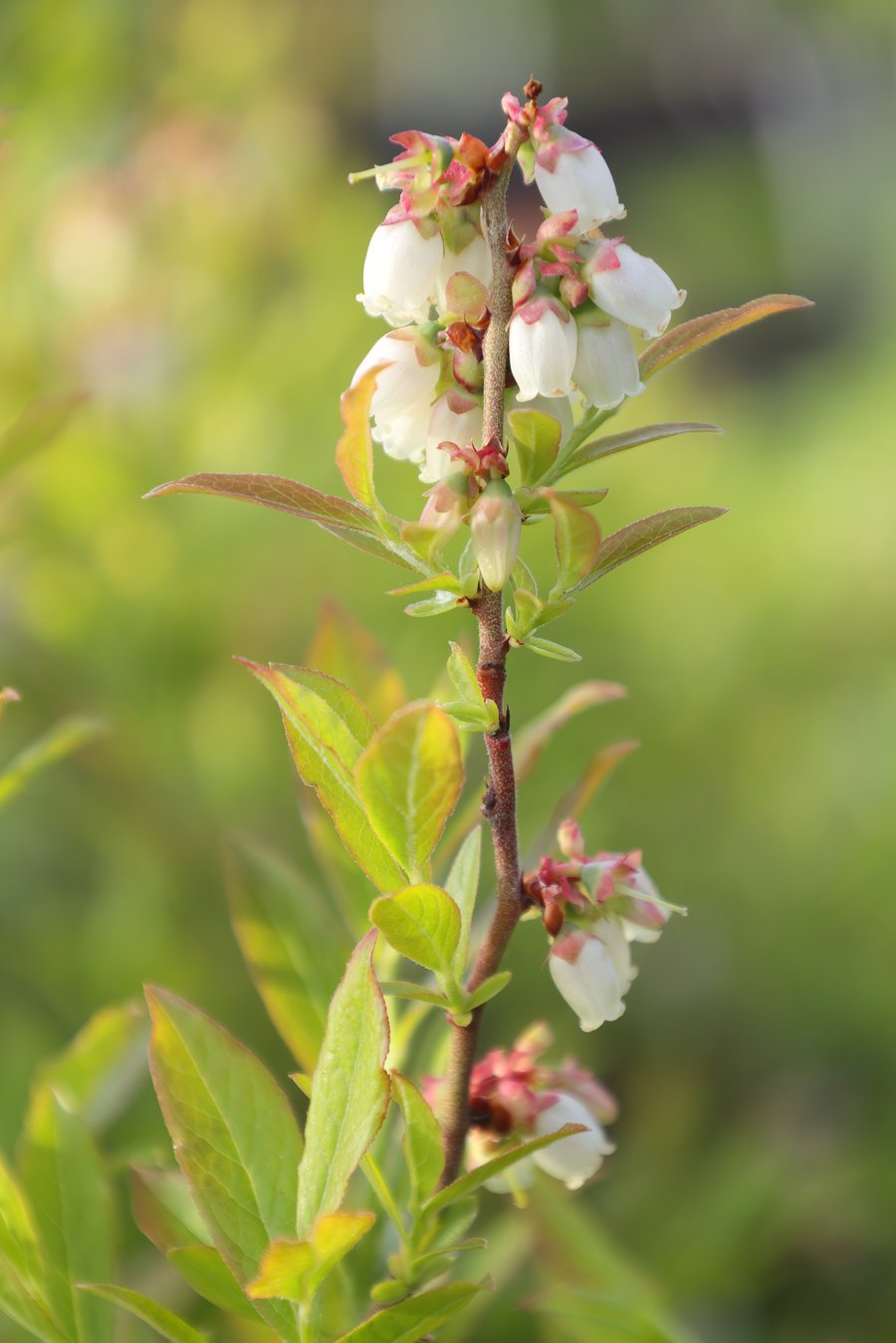
Primary: wild lowbush blueberry (bleuet nain, Vaccinium angustifolium, Ericaceae). In France the word bleuet names the cornflower, Centaurea cyanus, an unrelated plant and a different honey; in Quebec it is the blueberry. A shin-high shrub of acid, sandy, well-drained ground, native to northeastern North America, and never planted: it spreads by rhizome, and a commercial field is wild stock the grower encourages – forest cleared, soil left alone, the stand cut to the ground every second year so the next year’s stems flower heavily. It grows on the sandy outwash the glaciers left, which is why the fields are called barrens. In 2025 Quebec cultivated 32,425 hectares of it, New Brunswick 17,042, Nova Scotia 15,738 and Prince Edward Island 4,852. The flowers open in late May or June, white and urn-shaped, and the bloom in any one field runs about three weeks. The flower cannot set fruit with its own pollen; the pollen is too heavy and sticky for wind to move; and the anthers release it only when the flower is vibrated, which bumblebees do and honey bees cannot. A honey bee visits for the nectar, and that nectar is this honey. Maritime and Quebec labels call it wild blueberry or blueberry blossom honey, and the beekeepers who truck hives to Lac Saint-Jean, the Lac in the region’s own shorthand, sell theirs as miel de bleuetière, the honey of the field their hives stood in.
Secondary: highbush blueberry (Vaccinium corymbosum, Ericaceae). The blueberry of the supermarket: a planted bush, grown in rows, on farms rather than barrens. British Columbia grows nearly nine tenths of Canada’s highbush crop, 27,008 acres at the 2021 census, concentrated in the Fraser Valley, and the growers’ own survey puts one variety, Duke, on 44 percent of that ground, so one variety’s calendar sets the week the hives go in. The bloom runs from late April to late May, a month ahead of the barrens in the east. The plant can set some fruit with its own pollen but sets far more with bees, and on some varieties honey bees reach the nectar through the side of the flower rather than its mouth. Fraser Valley jars say blueberry or blueberry blossom honey, the plant’s common name and nothing more, and their makers describe it in the same words as the eastern houses.
Supporting: velvetleaf blueberry (airelle fausse-myrtille, Vaccinium myrtilloides, Ericaceae). The second species of the eastern fields, told apart by its downy stems. Its flowers open a few days behind the lowbush, which stretches the bloom across the weeks the hives stand in the fields.
Background: spring forest and field flowers within flight range, varying by site (multiple species, undocumented). Whatever else blooms while the hives stand on the contract enters the same combs. One Lac-Saint-Jean house says so outright on its own page, naming the June forest flowers beside the blueberry; in the Fraser Valley the beekeepers’ own flow calendars put dandelion in bloom alongside the blueberry, with blackberry coming a month after the hives are pulled.
Pairings:
To enjoy the plant’s two crops at once, serve one with the other: the honey over fresh blueberries, or both over yogurt or pancakes. Quebec cookbooks have called for miel de bleuets by name since at least 2004, and it reaches restaurant tables the same way: an inn in the Mauricie serves a brown butter made with a relative’s blueberry honey on its sourdough. The infused version, miel au bleuet or blueberry-infused honey, is honey with fruit added: one word apart on the label, a different product in the jar, and sold on both coasts.
Origin Story
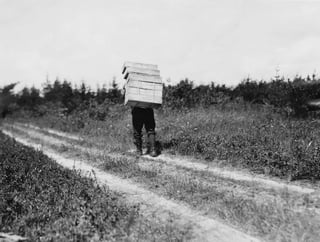
The government found the honey before the trade named it. For the season of 1916 F.W.L. Sladen, the Dominion Apiarist, set colonies from the Central Experimental Farm on a sandy barren at Kazubazua in the Gatineau valley and weighed what came in: sixty to seventy pounds of blueberry honey per colony at the end of May, “of an amber color and peculiar, though not disagreeable, flavor”. By 1920 Frank Pellett’s American Honey Plants was quoting Sladen on blueberry as a surplus source in Nova Scotia, and quoting W.J. Sheppard, British Columbia’s chief inspector of apiaries, on a third, wild species he reported as of importance there. All of it was wild-gathered honey, decades before anyone paid a beekeeper to bring hives to a blueberry field.
The fields came in the east on burned ground. A land-clearing fire lit at Saint-Félicien on 18 May 1870 was driven by wind the next morning across the west side of Lac Saint-Jean in half an hour, and the blueberry, already in the soil, took the cleared ground; the province began leasing land for communal blueberry fields in the early 1960s. Rented pollination arrived in both halves of the country at once. By 1960 more than half of all Nova Scotia’s colonies were out on pollination, and a lowbush blueberry newsletter was already pricing hives by the acre; in 1959 British Columbia’s apiary branch was counting colonies rented into blueberries among its crops, and a trial there in 1963 harvested 4,698 pounds of berries an acre with honey bees against 2,604 without. In Quebec the rental system became an industry in the early 2000s. Beekeepers and packers named the honey for the practice: by 2003 the packer Miel Labonté was explaining on television that the bees are simply trucked to the blueberry fields and the result is “never 100 percent pure, but predominantly blueberry”. The name on the jar describes where the hive stood in spring.
Cultural Context
The people of Saguenay-Lac-Saint-Jean are called les Bleuets, a nickname the region has made its own, and Dolbeau-Mistassini, which calls itself the world capital of the wild blueberry, has held the Festival du Bleuet since 1961. In the language of the Pekuakamiulnuatsh of Mashteuiatsh, on the lake’s shore, the berry is minish, “little fruits like pearls”, gathered by families for their own tables and as income. In Nova Scotia the town of Oxford calls itself the Wild Blueberry Capital of Canada and has run a harvest festival in the last two weeks of August since 1988; the Mi’kmaq word for the berry is pguman. In the Fraser Valley many of the six hundred or so growers are Indo-Canadian families. The honey is the recent arrival in all of these cultures: it dates from the rented hives, and it is sold beside the fruit, at farm stands around Lac Saint-Jean, at the Grand Marché de Québec where a Lac producer’s kiosk carries its own, and at the Fraser Valley farm shops that sell the berries.
Harvest & Forage
What ends up in the jar is set by the contract window. Hives go into the fields as the bloom opens – Quebec’s growers’ guide says when about a fifth of the flowers are out, British Columbia’s production guide at five to ten percent, one to four hives an acre – and stay about three weeks. In the Fraser Valley that is late April to late May; in the Lac and the Maritimes, late May into June. No rule fixes a minimum: Quebec’s beekeepers’ association states that no pollen-percentage standard stands behind a floral name. The province’s reserved-designations board floated miel de bleuetière as a candidate for official recognition in 2010, and the honey is still sold on the producer’s word. Pollen analysis under-reports blueberry besides: honey produced deliberately on the crop failed pollen confirmation in five of eight reference lots at the Deschambault research station. One Beauce beekeeper whose hives make the trip puts the three-week take at seven to nine kilos a hive, against a provincial average of about thirty-one kilos for a full season. Extraction comes when the hives leave; some houses bottle the harvest under its own name, others fold it into a spring or summer honey.
Beekeeping Context
The hives move at night, loaded after dusk when the day’s foragers are back inside and unloaded before dawn; Saint-Hyacinthe to Albanel is a six-hour run. In 2024 Quebec growers rented 29,407 colonies for blueberry pollination at an average of about $200 each, and blueberry and cranberry together take 93.5 percent of all colonies rented in the province, so the pollination calendar, not the honey flow, sets where a Quebec hive stands in June. New Brunswick keeps 10,615 colonies of its own and brought in 30,342 for the 2025 bloom; in the last year the origins were published, most came from Ontario, then British Columbia and Quebec. Nova Scotia sent 19,009 of its 30,203 colonies to the blueberries in 2025 and now admits out-of-province colonies under a capped permit. The provincial apiarists’ 2023 averages were about $160 a colony in Nova Scotia and $157 to $200 in New Brunswick, and New Brunswick’s own beekeepers supply about a quarter of the colonies its growers rent, a share the province’s 2024 to 2029 pollination strategy aims to lift by raising their number from 9,500 colonies to 17,000. In British Columbia the commercial beekeepers’ association’s 2024 contract template starts at $200 a colony, and by that year three quarters of the province’s colonies were out on pollination contract. The honey is a small part of the deal: Raphaël Vacher of Alma, president of Quebec’s beekeepers' association, harvests “très peu” of it, very little – it sells for more, he says, but the rental fee is what pays – and the weeks in the fields cost the colonies. Researchers at Université Laval documented the toll: colonies come out of the blueberry fields in poorer health than they went in. A British Columbia study of more than two hundred colonies found European foulbrood higher after blueberry pollination in most, though not all, of the operations it followed. Beekeepers move their hives to more varied bloom the day the contract ends.
Named Producers
- Miel des Ruisseaux – Alma, Lac-Saint-Jean-Est. Several hundred colonies; miel de bleuet from a 110 ml jar to a 3 kg pail; the Économusée de l’apiculteur, with guided visits, tastings and an observation hive since 2015, and a permanent stall at the Grand Marché de Québec. Sizes come and go through the year; check before travelling.
- Miel Picard – Normandin, on the upper Lac. Family production since 1929; miel de bleuetière in 250 g and 1 kg, with a page that says plainly what is inside: mainly blueberry nectar and the June forest flowers beside it. The small jar sells through; check the shop.
- Miel Boréal – La Doré. Sold, in its words, raw, unpasteurized and unfiltered; miel de bleuet is the first of its three yearly harvests, taken at the end of June, in formats from 160 g to 3 kg. A first harvest sells through the year; check what is left.
- Le Miel d’Émilie (Ruchers D.J.F.) – Saint-Sylvestre, Lotbinière. The Doyon family’s hives, about 2,500 of them, travel to the Lac each June; its miel de bleuetière is graded Canada No. 1, certified Aliments du Québec, kosher pareve, and distributed through Metro groceries across the province; which stores carry it varies, so check the shelf near you.
- Intermiel – Mirabel, Basses-Laurentides. Hives rented to blueberry and cranberry growers each spring; miel de bleuet from 150 g to 3 kg at the farm shop and online. Sizes come and go; check before travelling.
- Miel Dubreuil – Saint-Dominique, Montérégie. Founded by Lucien Dubreuil in 1930; its miel de bleuetière is, in its own words, strictly produced in the blueberry fields of Saguenay-Lac-Saint-Jean. One harvest a year; check before travelling.
- Sunny Acres – Brule, Nova Scotia. Wild blueberry blossom honey liquid and creamed, and a blueberry hot honey, from a house with more than twenty years on the North Shore; own shop online. Sizes sell out in turn; what is there depends on the week.
- Van Dyk’s By Nature – Caledonia, Queens County, Nova Scotia. A wild blueberry farm that, in its own words, enlists thousands of honeybees each year when the wild blooms emerge, and bottles a 300 g wild blueberry blossom honey, sold in the farm’s gift box on its own site and as a single jar through Nova Scotia stockists; which stockist has it depends on the week.
- Miellerie Charlo Honeyhouse – Charlo, on New Brunswick’s Baie des Chaleurs. Eric and Chantal Neil’s apiary and honey house, open to visitors in season; blueberry honey in a 375 ml jar among its varietals. Summer hours; phone ahead.
- Canoe Cove Honey – Mount Stewart, Prince Edward Island. The Island’s blueberry creamed honey, made in the years the bloom allows it – in the producer’s words, depending on the year – and sold through Island stockists. Ask which honeys the season gave.
- Honeybee Centre – Surrey, Fraser Valley. Producer and packer with its own hives on Fraser Valley blueberry fields; blueberry honey is one of five single-crop honeys it names beside raspberry, cranberry, blackberry and pumpkin, described on its page as amber and mildly sweet with a hint of brown sugar. Each is a single spring flow; check the shop before travelling.
- Honeyview Farm – Aldergrove, Fraser Valley. A family apiary since 1973 whose bulk arm trades as Worker Bee Honey Company; its blueberry blossom honey is, in its own words, produced by its own colonies from blueberry blossom in the Fraser Valley, in jars from 160 g to a 5 kg pail and in bulk. What is in stock varies by size; check first.
- Jane’s Honey Bees – South Surrey. A family bee farm since 2001 keeping about 500 hives that forage from Richmond to Abbotsford; its blueberry honey is produced, in its words, in South Surrey when the bees forage primarily on blueberry flowers, a varietal it first brought to the Main Street farmers’ market in June 2011, and sold at Vancouver-area markets since. Check the market calendar.
- Chilliwack River Valley Natural Honey – Greendale, Chilliwack, since 1979. Farm store and a Granville Island stall; blueberry honey is one of the honeys it names, described by the house as golden, sweet and fruity. Whether it is on the shelf depends on the week; check before travelling.
Source Regions
- Canada, Quebec – Vaccinium angustifolium: wild blueberry honey (miel de bleuet, miel de bleuetière): 32,425 hectares under cultivation in 2025, most of it on the sandy plain around Lac Saint-Jean, where the jar is named for the field the hive stood in.
- Canada, New Brunswick – Vaccinium angustifolium: wild blueberry blossom honey: 17,042 hectares in 2025, pollinated largely by colonies trucked in from Ontario, British Columbia and Quebec, with a small home industry that bottles the honey by name.
- Canada, Nova Scotia – Vaccinium angustifolium: wild blueberry blossom honey: 15,738 hectares in 2025 and a beekeeping industry that sends most of its colonies to the bloom; liquid and creamed from the province’s own houses.
- Canada, Prince Edward Island – Vaccinium angustifolium: blueberry honey: 4,852 hectares in 2025; a creamed blueberry honey in the years the bloom allows.
- Canada, British Columbia – Vaccinium corymbosum: blueberry blossom honey: nearly nine tenths of Canada’s cultivated highbush acreage, concentrated in the Fraser Valley, a bloom a month ahead of the east, and honey from producers with their own hives on the farms.
Translations
- Miel de bleuet – French: the standard Quebec retail name
- Miel de bleuetière – French: honey of the bleuetière, the blueberry field; producers using this form name Saguenay-Lac-Saint-Jean as the place of harvest
- Miel de fleurs de bleuet – French: the blossom-first form of the same name
Festivals and Fairs
- Festival du Bleuet – Dolbeau-Mistassini, Quebec (late July into early August; 64th edition 29 July to 1 August 2026): the festival of the plant’s other crop, in the town that calls itself the world capital of the wild blueberry, with the giant blueberry pie at its centre; the region’s honey is on the stalls beside the fruit.
Certifications
 Aliments du Québec – provenance certification carried on individual producers’ blueberry honeys (Le Miel d’Émilie, Miel Dubreuil, Miel & Co, Naturoney, Ferme apicole Mékinac, De miel en Bleuets, Délices du Lac); it certifies Quebec origin, not floral content.