
New Zealand Beech Honeydew
The Story
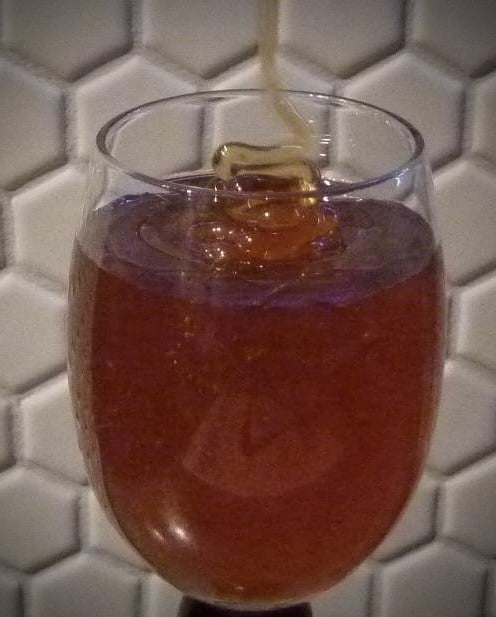
“At that early hour – about half-past six – one could already smell the honeydew.” Ngaio Marsh dated the morning herself: midsummer 1912, at a station in the foothills of the Southern Alps. Half a century later she called her autobiography Black Beech and Honeydew.
The smell comes from an insect. Two native scale insects live in the bark of South Island beech, feed on the tree’s sap and pass the surplus sugar out through a fine waxy thread, where it hangs as a droplet. Honey bees collect the droplets, and the honey they make is a honeydew honey, sold in New Zealand as Beech Honeydew.
What reaches the jar depends on the forest: which beeches carry the insect, the weather on the trunks and, in Nelson, the wasps. The insect lives mainly in the northern half of the South Island, and that is where the honey is made.
It became a table honey only in the late 1960s, after decades as food for the bees themselves.
Characteristics
An amber honey, with a strong, earthy aroma and an earthy flavour that producers describe with caramel. Airborne Honey, a Canterbury packer, reports an average of 87.6 mm on the Pfund scale, within the band its own colour scale calls amber, and says colour depends to some extent on area; in a 2010 thesis on ten New Zealand honeys, the mānuka was darker.
It is slow to crystallise and often stays liquid; Crozier wrote in 1981 that it “does not granulate.” Airborne tells it from flower honey by its electrical conductivity, “around 10 times the average for flower honeys”; a blend of the two reads in between.
Click to Display — The Details: honeydew source, sensory profile, and its regional identity
Honeydew Sources:
- Primary: Sooty beech scales (Ultracoelostoma assimile, U. brittini). Host: Black beech and mountain beech (Fuscospora solandri, F. cliffortioides), the eastern foothill forests of Canterbury and Nelson
- Secondary: Sooty beech scales (Ultracoelostoma spp.). Host: Red beech (Fuscospora fusca), the West Coast
- Supporting: Sooty beech scales (Ultracoelostoma spp.). Host: Red beech (Fuscospora fusca), the Nelson forests
- Supporting: Sooty beech scales (Ultracoelostoma spp.). Host: Hard beech (Fuscospora truncata)
Nectar Contributors:
- Background: Flower nectar from the surrounding bush and pasture, varying by site (Multiple species, undocumented)
Bee Species:
The western honey bee, Apis mellifera, in managed hives and in feral colonies. “Honeybees (Apis mellifera) collect the honeydew and transform it into honey,” Crozier wrote in 1981, and a Nelson study of the 1980s names feral honey bees among the insects using it (Moller and Tilley 1989).
Color:
Amber
Flavor Profile:
Earthy, with caramel and treacle notes, as the trade describes it
Tasting Notes:
Honey and Bees New Zealand, the industry body, describes New Zealand’s honeydew honey as “complex and treacly” and adds that “some have described its flavour as being like ‘Christmas cake’.” One South Island retailer lists “notes of maple, caramel and butterscotch” for a honeydew from the Southern Alps beech forests.
Aroma:
Strong and earthy, with hints of berries and caramel, as one Nelson producer describes it
Defining Compounds:
Minerals. Of ten New Zealand honeys collected in 2007 and analysed for a 2010 thesis, the honeydew sample had the most minerals and was the least acidic (Emmertz 2010). It was one sample.
Forage Origin: 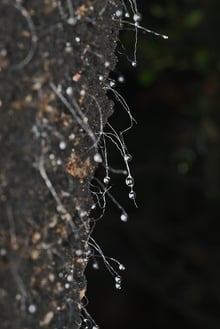
The honeydew is made by two scale insects, Ultracoelostoma assimile and U. brittini, the sooty beech scales, of the family Coelostomidiidae; the genus is found only in New Zealand (Gardner-Gee and Beggs 2009). The insect lives in the bark of trunk and branches. Its feeding stages, second- and third-instar females and second-instar males, push their mouthparts into the tree’s phloem and pass the excess sugar out in solution through a waxy anal tube, at whose tip it gathers as a droplet (Beggs et al. 2005; Dungan and Kelly 2003). Every female stage has been found in every month of the year (Wardhaugh and Didham 2006), so the sugar is on the trees in winter as in summer. How bees gather honeydew and turn it into honey is set out on Honeydew - Forest Honeys.
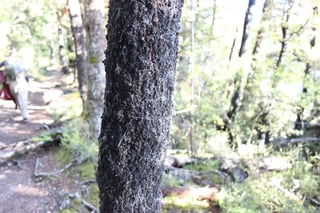
Spilt honeydew feeds a sooty mould that coats heavily infested trees and gives them, in the words of a 1981 forestry paper, “a fire-blackened appearance” (Crozier 1981).
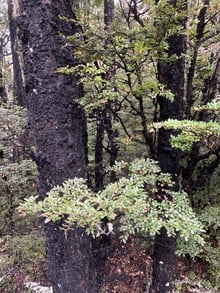
These are southern beeches, a separate lineage from the European beech, Fagus, and which of them carry the insect depends on the district. In the eastern foothill forests of Canterbury and Nelson the scale is densest on black beech (Fuscospora solandri, formerly Nothofagus solandri) and mountain beech (F. cliffortioides); a 2006 study suggested that mountain beech is “the optimal host species” (Wardhaugh and Didham 2006). At Lake Rotoroa in Nelson Lakes National Park, Beggs and colleagues estimated that the solandri beeches, black and mountain together, gave most of the honeydew and large red beech a small share (Beggs et al. 2005). On the West Coast, in a mixed stand east of Greymouth, the insect was “much more common on red beech” (F. fusca) than on black beech, but at about a hundredth of the density of Canterbury’s solandri beech forest (Kelly 1990). Hard beech (F. truncata) carries it lightly and silver beech (Lophozonia menziesii) rarely (Gaze and Clout 1983; Beggs 2001). Flora of New Zealand now places these beeches in Fuscospora and Lophozonia; older sources call them all Nothofagus.
The insect covers about a million hectares, some 15 per cent of New Zealand’s native forest today (Beggs 2001), mainly in the low to moderate rainfall country of the northern half of the South Island: on the West Coast north of Greymouth, and east of the main ranges north of Mount Somers (Crozier 1981). Bees reach part of it: a 2015 model for the Department of Conservation (DOC) and the Ministry for Primary Industries (MPI) put their share at well under half, set by terrain, other land uses and where roads and tracks run (MacIntyre and Hellstrom 2015).
The flow follows the weather. At Craigieburn in 1996, the warmth of the previous day explained most of the rise and fall in honeydew production (Dungan and Kelly 2003). Heavy rain washes the droplets off and breaks the wax tubes; hot, dry, windy weather concentrates the sugar and humid air dilutes it, so that in a Nelson study the droplets ranged from thin to thick syrup across the seasons (Gaze and Clout 1983). The scale thins with height and becomes uncommon above about 800 metres, and it is denser on the north side of the trunk; Crozier added that observations suggest more on solitary trees, at forest edges, on open ridges and stream banks and under an open canopy (Crozier 1981).
Where conditions suit it the quantity is large. At one site on Lake Rotoroa, studied from 1999 to 2001, researchers estimated several tonnes of honeydew, dry weight, per hectare a year, by their comparison at least ten times what dense aphids give in the Norway spruce forests of the Northern Hemisphere (Beggs et al. 2005).
Whether some jars also carry flower nectar is unsettled. Airborne Honey notes that “there are some areas that do produce darker honeydew. Whether this is due to local conditions or blends of lighter (non honeydew) honeys is uncertain.”
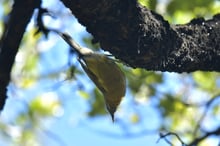
The bees share the droplets. Bellbirds and tūī, both native honeyeaters, were commoner in Nelson forests with more honeydew (Gaze and Clout 1983). Honeydew is “a key food source” for kākā, a native forest parrot, in the words of Beggs and colleagues, who concluded that the scale insects “have the potential to function as keystone species in these forests” (Beggs et al. 2005). DOC lists lizards, possums, rats, honeybees and wasps among the other animals recorded feeding on it.
Pairings:
Mountain Valley Honey suggests it as “the perfect complement for strong flavours, such as pears, apples and blue cheese,” and at breakfast with muesli or on toast. Other New Zealand sellers suggest eating it with soft cheeses such as brie and camembert, on a feta salad or roast pears or with aged cheddar, and taking it in coffee or tea; as an ingredient, they suggest it for marinades.
Origin Story
Beekeepers used beech honeydew long before people ate it. “Extensive use” was made of it in Canterbury “from the early days of commercial beekeeping,” a 1981 paper in the New Zealand Journal of Forestry records, as feed for the bees outside the nectar flows (Crozier 1981, citing Smellie 1949).
Crozier gave the reason it was slow to become a food: “Prejudice prevented its early use as a human food because it was considered to be derived from the excrement of an insect and has a stronger flavour than most floral honey.” He dated the change: “since 1968 the honeydew honey has gradually become accepted as a human food comparable to floral honey.”
Export followed. “The first trial shipment to Europe in 1970 was a success,” and in ten years the trade grew from a few trial shipments to 300 tonnes in 1980-81. By then “practically all” of it went to Germany, where it was blended with local forest honey; earlier it had also sold in England and Japan. New Zealand honeydew, Crozier explained, was “not dark enough in colour to be sold alongside the European product.” Comb honeydew had also sold “successfully” for several years. A 1972 government caucus inquiry into the honey industry had urged that, where honeydew could be collected in volume, “producers should be encouraged to develop the export market in this commodity.” Symes Apiaries of Staveley recalled in 2022 that from the 1970s three beekeepers together exported 100 tonnes a season to Germany in honey drums.
Crozier also recorded what it was called at home: “New Zealand beech honeydew honey, or Bush honey as it is known locally.” The name is used more loosely today, and at least one honey sold as bush honey is a blend that includes honeydew.
Since July 2018 Stats NZ has recorded honeydew honey under an export code of its own, “Honey; natural honey, honeydew”, which names no tree. Exports under it fell from more than 500 tonnes in 2020 to under 35 tonnes a year in 2024 and 2025, never more than about 4 per cent of the country’s honey exports by weight. Germany took most of it in 2020 and 2021 and none under the code from 2022 to 2025; Japan was the largest buyer in 2024 and 2025.
The national honey competition run by Apiculture New Zealand judged honeydew as a class of its own. In 2022 its head judge said the honeydew honeys in particular were of much higher quality that year.
Cultural Context
Ngaio Marsh returns to that morning of 1912 in the first chapter of Black Beech and Honeydew (Little, Brown, 1965): “In an agony of gratitude, I flung my arms round the nearest honeyed tree and hugged it.” She was fourteen.
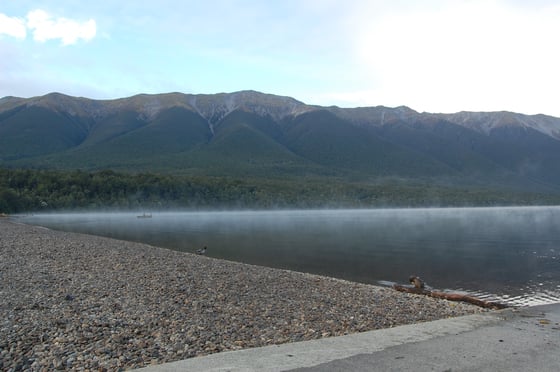
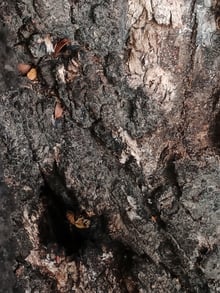
Department of Conservation (DOC) walks in three forests lead to beech where the honeydew can be seen on the trees. The Honeydew Walk at St Arnaud, in Nelson Lakes National Park, branches off the Bellbird Walk from the end of Kerr Bay Road and takes about 45 minutes. DOC describes the surface as “suitable for wheelchairs but would need someone to push on the steeper slopes.” Along it, DOC notes, “the blackened trunks and branches of most of the red and mountain beech trees along the walk are brought about by a small scale insect that buries itself within the bark of the tree.” DOC warns that wasps are particularly common from December until April.
In North Canterbury, Mount Thomas Forest Conservation Area lies in the foothills about 65 km from Christchurch, beech forest with scattered podocarp; from Oxford, Ashley Gorge Road leads to Glentui, and walks start at the Wooded Gully Picnic Area. “The honeydew is seen hanging from fine silvery threads protruding from the black fungus,” DOC writes. In 1981 the Ashley and Mount Thomas State Forests were the principal area used for honeydew honey production (Crozier 1981).
On the Arthur’s Pass road, the 20-minute Craigieburn Nature Walk from the Environment Centre passes beech carrying “a small insect which secretes honey dew.”
Te Papa, the national museum, writes of black beech forest that “the scent of honeydew, mouldering logs, and leaf litter is everywhere.”
Harvest & Forage
Because the scale feeds in every month, the flow runs through the year, and hives can be left on it in any season; weather and wasps determine what the bees take. The peaks differ by forest. In a Nelson study of 1979-80 the droplets peaked in September or October, in spring, with a minor peak in autumn (Gaze and Clout 1983); at Oxford, Crozier recorded “a distinct peak” in autumn and a low in midsummer (Crozier 1981).
Beekeepers have long moved hives to the forest for it. “Since the early days of commercial beekeeping, hives have been moved to beech forests in early autumn to allow bees to gather honeydew for winter stores,” Crozier wrote in 1981. “Since about 1968, however, some apiaries have been kept in or near beech forests throughout the year to produce surplus honeydew honey, particularly for export.” The movement continues: researchers chose Big Bush Conservation Area and Pelorus Bridge Scenic Reserve for a 2015-16 wasp-baiting study “because beekeepers place bee hives in beech forest areas on a seasonal basis to allow the bees to collect honeydew” (Edwards et al. 2018), and in 2022 Ashburton Apiaries was overwintering its pollination hives in dew areas, dew being the beekeepers’ word for honeydew (Apiarist’s Advocate, 2022). Beekeepers on public conservation land work as DOC concessionaires. To slow the spread of myrtle rust, a fungal disease of plants, DOC keeps North Island hives off conservation land in the South Island, and keeps hives from Golden Bay, Motueka, the Sounds and Marlborough South off conservation land elsewhere in the South Island.
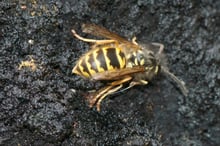
In Nelson the bees compete for the droplets with two European wasps, both accidentally introduced: the German wasp, first found near Hamilton in 1945 and thought to have arrived in crates of imported aircraft parts, and the common wasp, first collected in 1978, which was widespread in honeydew beech forest by 1989 (Department of Conservation; Manaaki Whenua; Markwell, Kelly and Duncan 1993).
The wasps’ effect shows in the seasons. In Nelson in the 1980s the drops were most plentiful in winter and spring and fewest in late summer and autumn, when the wasps were at their peak (Moller and Tilley 1989). At that peak wasps took more than 90 per cent of the honeydew from summer into autumn, and honey bees stopped feeding on it for three to four months of the year (Moller et al. 1991). By 1999-2001 there were about a third as many wasp nests in the forest (Beggs et al. 2005), and a later study of six sites over 19 years found no long-term rise or fall (MacIntyre and Hellstrom 2015). In Canterbury, on Mount Oxford, cold and rain held the bees back more than the wasps did, and the bees there may have been keeping wasp numbers down (Markwell, Kelly and Duncan 1993).
The tutin line of the Ministry for Primary Industries (MPI) runs between the honeydew districts. MPI applies its tutin rules to all honey, and treats hive sites in “the bottom two-thirds of the South Island (below 42 degrees south)” as low risk, a line “south of Westport on the West Coast and south of Cape Campbell on the East Coast.” The Canterbury foothill forests lie below it. The Nelson, Richmond Ranges and Buller forests lie above it.
Seasons differ, and the districts can diverge in the same year. MPI’s 2017 monitoring report called 2016/17 “a particularly good season for clover, other pasture species and honeydew” in Canterbury. In 2021/22 Ashburton Apiaries reported its dew season “bordering on” the worst in its 40 years, while Mountain Valley Honey in Nelson reported “an abundance of Beech Honeydew Honey” with fewer wasps and a lighter batch than in previous years. At the Lake Rotoroa site the second year of the 1999-2001 study gave about a fifth more than the first (Beggs et al. 2005). Symes Apiaries of Staveley recalled a poor season giving about half the dew of a good one, when rain washed it off the trees (Apiarist’s Advocate, 2022).
Beekeeping Context
In 1981 the crop came mainly from the eastern foothills: nearly 5,000 hives were licensed in the Ashley and Mount Thomas State Forests alone, with fewer in the Mt Hutt and Alford State Forests and the Hanmer and Craigieburn Forest Parks; available apiary sites, access and pollen sources set the limits (Crozier 1981). The crop took labour: Crozier reckoned an apiarist could look after a good many more hives on clover.
In Mid Canterbury the two crops were kept apart. In the 1960s and 1970s dew and clover supers were “kept separate to achieve low-colour, high export-grade, monofloral clover honey,” Symes Apiaries recalled in 2022.
Markwell, Kelly and Duncan (1993) found commercial hives “scarce” in the Nelson-Marlborough honeydew forests. Near the upper South Island beech forests, a beekeepers’ association survey reported in 2015 found hive losses to wasps higher than elsewhere (MacIntyre and Hellstrom 2015).
Named Producers
West Coast Wilderness Honey – Greymouth, Westland. A small family beekeeping business on the West Coast (Te Tai Poutini) that sells Beech Honeydew harvested from the beech forests of Westland. Check before travelling.
Mountain Valley Honey – Wakefield, Nelson-Tasman. Harvests Beech Honeydew Honey from beech forest in the Buller region; under new owners since December 2024. Check before travelling.
Nelson Honey – Motupiko, Tasman. A family-owned producer whose Honeydew Honey comes mainly from the Nelson Lakes area. Check before travelling.
Mt Lyford Honey – Mt Lyford, Waiau, North Canterbury. Sells its honeydew as Mountain Beech Honey and gives its source as the native black beech forests around Mt Lyford. Check before travelling.
J. Friend and Co – Christchurch. A packer that labels its Beechwood Honeydew with the beekeeper, the vintage and the place, Mount Thomas, Oxford. Check before travelling.
Coalgate Honey Co – Coalgate, Selwyn. Sells Beech Honey Dew from beech forest in the Canterbury foothills, raw and unpasteurised by its own account; a silver at the 2024 Outstanding Food Producer Awards. Check before travelling.
Southern Alps Honey – Staveley, Mid Canterbury. Sells Beech Honeydew sourced from beech forest in the sub-alpine country from Mount Hutt to Staveley. Check before travelling.
Ashburton Apiaries – Alford Forest Road, Ashburton, Mid Canterbury. A clover and honeydew producer with hives in the Mid Canterbury foothills; its own page, read in October 2026, describes an on-site shop. Check before travelling.
Translations
- 黒ブナの甘露蜜 (kuro-buna no kanromitsu) – Japanese, black beech honeydew, as an importer lists it
- 너도밤나무 감로꿀 (neodobamnamu gamnokkul) – Korean, beech honeydew, as an importer lists it