The Großvatertanne (grandfather fir), a silver fir near Freudenstadt in the Black Forest, August 2025.
Foresters in the Black Forest had an old word for it: Tannensterben,
fir death. In the 1970s the silver firs around Freudenstadt, where the
tree grows best, began to thin from the inside out, and nobody
could say why. In November 1981 Der Spiegel told West Germany that its
forests were dying, and the story opened in those woods, with a forest
director saying that hardly a fir was left unaffected. In 1983 Die Zeit
wrote that “the fir tree is taking its leave” of the Black Forest.
The alarm was called Waldsterben, forest death, and the fir was the
tree on the leaflets: “Today firs, tomorrow us.” In 1984
a forest farmer near Freudenstadt invited Chancellor Helmut Kohl to
see his dying firs, and Kohl came. The same year a printer in Kirchzarten made a
postcard of a Black Forest girl in a gas mask among dying firs, and the
mayor called it negative advertising for the Black Forest. Sulphur
dioxide from power stations was blamed; by the end of the decade the
power stations’ sulphur emissions had been cut by more than 70 percent,
and the firs were growing again. Whether the clean-air laws saved the
forest is argued to this day: the soil scientist who had given the
forests five years said they did, and a Freiburg forestry professor
said there had been no forest death to save them from.
Through those years Gerhard Liebig, at the state bee institute at
Hohenheim, was counting aphids on silver firs in Black Forest stands
that were visibly sick, because at the time about 60 percent of southern Germany’s
honey came out of the forest, most of it from the honeydew of spruce
and fir. His counts from 1977 to 1985 showed the sick firs carrying
aphid outbreaks no more and no less often than the healthy ones; what
changed was the timing: in the sick stands an outbreak came early, in
June, or late, in September, when the beekeepers could use it little
or not at all, and both shifts went as the stands recovered in the
1990s. He
counted for 37 years, and wrote late in life that he had lived through
“the hype” around Waldsterben on the spot. He died in May 2026.
The honey the bees make from those aphids is silver fir honeydew honey,
a honeydew honey:
the aphids draw the tree’s sap and pass the surplus sugar as sweet
drops on the needles and bark, and the bees collect the drops. It is
dark, resinous and malty, with a green glint, gathered in July and
August in the mountain forests of Europe from the Pyrenees to the
Carpathians, and not every year: a good fir year comes perhaps one in
three or four.
Characteristics
Liquid, the honey is dark brown to almost black, and against the light
it often shows a greenish glint (International Honey Commission;
Agroscope). It smells woody
and warm, of resin and malt, and tastes resinous and malty with a
balsamic note, medium in sweetness, low in acidity and free of
bitterness; Germany’s honey guidelines say it recalls prunes.
It is very thick, because its water content is low, and the finish is
medium and sometimes astringent. It crystallises slowly and differently
by country: the Vosges and Italian sheets describe a honey that often
never fully sets, half the Swiss samples were still liquid after a year
(Agroscope), and Polish and Slovak fir honeys set to a fine grain and
turn a lighter grey-green brown.
Click to Display — The Details: honeydew source, sensory profile, pairings, health and what gives it its character
Honeydew Sources:
Primary: Green-striped fir aphid (Cinara pectinatae). Host: Silver fir (Abies alba)
Secondary: Large black fir bark aphid (Cinara confinis). Host: Silver fir (Abies alba)
Supporting: Fir scale, a bud scale insect (Physokermes hemicryphus). Host: Silver fir (Abies alba), in the Dinaric forests of Slovenia and Croatia
Background: Spruce aphids (Cinara piceae, Cinara pilicornis). Host: Norway spruce (Picea abies), in the Italian and Swiss honeys sold under a fir name that covers spruce
Background: Spruce bud scales (Physokermes piceae, Physokermes hemicryphus). Host: Norway spruce (Picea abies), in the Italian and Swiss honeys sold under a fir name that covers spruce
Nectar Contributors:
Background: Flower nectar from the forest and its clearings, varying by site and year (Multiple species, undocumented)
Bee Species:
The western honey bee, Apis mellifera. The bees take the honeydew in
the early morning and the evening, when the air is damp, because on hot
days the drops dry and crystallise on the needles (Waldtrachtbeobachter
Süd).
Color:
Dark brown to almost black with a greenish glint when liquid; a lighter grey-green brown once crystallised
Flavor Profile:
Resinous and malty, balsamic and woody; medium sweetness, low acidity, no bitterness
Tasting Notes:
Unaapi’s tasters find the silver fir’s honeydew more intense than the
spruce’s, and the Bardejov specification describes its fir honey as
maslová (buttery).
Aroma:
Resin and malt, woody and warm, with caramel
Defining Compounds:
Minerals, read as electrical conductivity, are what separate a honeydew
honey from a flower honey in the laboratory, and Germany’s honey
guidelines hold fir to a higher bar than spruce: a Tannenhonig must
read at least 1.10 millisiemens per centimetre against 0.80 for spruce
(Leitsätze für Honig).
Sugars: less fructose and glucose than a flower honey, and the sugars
melezitose
and erlose, which the insects or the bees make from the sap, whose own
sugar is only sucrose (Shaaban and colleagues, 2021). The green-striped fir aphid’s
honeydew holds 15 to 30 percent sucrose and 15 to 30 percent
melezitose; the black spruce aphid’s reaches 60 percent melezitose,
which sets in the comb as miel-béton (cement honey) and is hard to
extract (Agroscope). That is why a fir year extracts while a spruce year
may not: in 1974 the Rheinfelden club logged plenty of fir honey beside
a spruce flow that could not be extracted because of melezitose. Low
glucose against water keeps fir honey liquid, and low water makes it
thick. In the laboratory no single marker separates fir honey from spruce
honey, only combined sugar, amino-acid and mineral profiles (Shaaban
and colleagues, 2021); the senses have the green glint against the
spruce honey’s red-brown (Agroscope; the Slovenian sheets), and the
beekeeper knows where the hives stood.
Forage Origin:
The silver fir (Abies alba) is a tree of the mountains of Europe,
mostly between about 500 and 2,000 metres. Its main range is central
Europe, the Swiss plateau, southern and eastern Germany, Czechia and
Austria, with large stands in the Pyrenees, the southern Alps and the
Carpathians and scattered ones in eastern France, the Massif Central
and the Apennines (European Atlas of Forest Tree Species). It grows
with beech and spruce and is cut for timber. Not every fir forest
gives honey: Greece’s silver firs are not worked as bee pasture, and in
Switzerland the honey is harvested everywhere but Ticino (Agroscope).
Photo: Anders Christian Albrecht, European Journal of Taxonomy 338 (2017), via Zenodo | CC BY 3.0
Green-striped fir aphids
Green-striped fir aphids (Cinara pectinatae) on a young silver fir, with a wood ant attending them.
Two aphids give the honeydew. The green-striped fir aphid (Cinara
pectinatae) feeds at the base of the needles on twigs one to four
years old (Slovenian Beekeepers’ Association). Its eggs winter on the needles; the first females hatch
between March and May, the colonies multiply in May and June while the
new shoots are growing, stall in June, collapse in July and August, and
the egg-laying generation appears in September and October
(waldtracht.info, the Baden-Württemberg honeydew observers’ site). It gives honeydew from the day it hatches, and its
flow comes mainly in July and August. The large black fir bark aphid
(Cinara confinis), so called here after its German name because it has
no settled English one, lives in colonies on the bark of the trunk and the
older branches, sometimes on the roots; its flows are irregular and
peak in August, and in a big year the undergrowth under the firs is
drenched in its brown, tea-coloured honeydew (Slovenian Beekeepers'
Association). In 1995 it joined the fir flow in Baden for the first
time in eighteen years of counts (Liebig).
Photo: Anders Christian Albrecht, European Journal of Taxonomy 338 (2017), via Zenodo | CC BY 3.0
Cinara confinis
A colony of the large black fir bark aphid (Cinara confinis) on the young trunk of a Siberian fir.
In the Dinaric forests of Slovenia and Croatia a third insect, the fir
scale (Physokermes hemicryphus), a
scale insect
of the buds, gives a short early flow of six to ten days, usually in
June, and a reddish honey; Croatia’s Goranski medun specification names
it the commonest source of the region’s honeydew.
The flow depends on the tree. As a rule the aphids multiply only while
the shoots are growing, so a mild November sets the next fir year up
and spring frosts hold the first females back (Waldtrachtbeobachter
Süd); beekeeping advisers add that warm sun and a wide swing between
day and night temperatures raise the flow of sap (Réussir Apiculture). The colonies collapse when the
phloem
sap loses its food value after the shoots stop growing, not because of
rain or cold; a heavy rain ends the harvest by washing the honeydew off
the needles. Why fir seldom yields two years running is read two ways:
Hohenheim’s observers find that the aphids’ enemies build up after a
collapse rather than causing it, while the Slovenian forecasting
service holds that their build-up is the reason.
Fir years are irregular. In Slovenia, Janez Rihar’s record of 49
seasons held 28 with a honeydew flow, 14 of which included the
green-striped fir aphid (Carter and Maslen, 1982), and the Slovenian Beekeepers’ Association now puts a good
fir year at about one in four; in Baden-Württemberg the observers’ two-
year rhythm of good and bad years blurs as soon as regions are compared
(Liebig). Runs of failed years are common.
Under EU rules a honey named for a plant comes wholly or mainly from it,
mainly meaning almost entirely in the European Commission’s reading,
and the Vosges appellation and Germany’s honey guidelines reserve the
fir name for silver fir, the German beekeepers’ federation giving a
fir-and-spruce mix its own double name, Tannen-/Fichtenhonig. In Italy
and Switzerland the same word, abete or Tanne, is used for silver fir,
spruce or a blend of the two, so a jar sold as fir honey there may also
hold spruce honeydew;
Ardennes and Styrian beekeepers sell under the fir word with no species
named, and Belgium and Austria are counted here on the word. Greece’s fir honey
comes from a different fir and a different insect (see Regional
Variants). The bees also bring in nectar from whatever flowers near the
hives: honeydew honeys carry pollen from nectarless plants and
Slovenia’s sheet sets no pollen share for fir honey, so the nectar in
the jar is present and unmeasured.
Pairings:
A honey for the table rather than the pot, in Unaapi’s words: eaten
with cheeses fresh and aged, grana (the hard Parmesan-type cheeses)
among them, though it also suits long, slow cooking; the Osservatorio
Nazionale Miele likewise lists it for the table.
Origin Story
In France the name was made by a court. On 25 April 1952 the court at
Nancy recognised Miel des Vosges-Montagne (Vosges mountain honey) as an
appellation of origin, under a law of 1919 that let the courts settle
such names. In 1990 France opened the
appellation d’origine contrôlée,
until then the wine system, to every farm and food product: names set
by law carried over as AOCs, but the nine names the courts had made, Vosges fir honey among them, had to qualify by 1
July 1995 or lapse. Only Nyons olive oil made the deadline. The
Lorraine beekeepers pressed their case through their deputies and
senators, Alsatian producers fought being drawn into the zone and the
map was redrawn, and on 30 July 1996 the honey became AOC Miel de sapin
des Vosges, the fir now in the name; it entered the EU register the
same year.
In Germany it became a forecast honey. The Rheinfelden beekeepers’ club
in Baden logged a very good forest and fir honey year in 1968, and from
the Hohenheim counts that began in the Black Forest in 1977 (see the
introduction) grew the forecasting that German fir beekeeping now runs
on (see Beekeeping Context).
In Poland it became an export. In the 1950s Western European buyers
wanted the conifer honeydew honey of the Carpathian foothills and paid
two to three times the price of nectar honeys for it; in 1967 more than
1,000 tonnes of forest honeydew honey were bought up in Podkarpacie,
and in 1969 a research station was set up at Boguchwała, near Rzeszów,
to forecast the honeydew flows and organise the beekeepers’ migrations
into the forests (Polish Ministry of Agriculture).
Photo: Anna.Massini, Wikimedia Commons | CC BY-SA 4.0
Camaldoli
Meadow and forest at the hermitage of Camaldoli in the Casentino, Tuscany, April 2024.
In Slovenia it is a national type: hojev med, fir honey, has its own
sensory sheet and limits in the Slovenski med protected geographical
indication. In Tuscany the honey’s official name on the
regional list of traditional products is Miele di melata di abete
toscano, with the synonym Manna d’abete, manna of the fir; it is made
above all in the upper Casentino and on the Amiata, and the Casentino’s
fir and beech forest was kept by the Camaldolese monks for more than
eight centuries. In Croatia the honey of Gorski kotar appears as
Goranski medun on the last page of Andro Perušić’s monograph Pčelinji
med of 1959, a mixed honeydew in which fir or spruce usually prevails.
Cultural Context
The honeydew is called manna in four languages. Tuscany’s official
synonym for the honey is Manna d’abete; the Vosges appellation’s
syndicate describes the July forest as distilling “la rosée de miel”,
honey dew, “véritable manne sucrée”, a true sweet manna; Slovene
beekeepers write of mana on the fir; and a Romanian jar reads Miere de
mană de brad, honey of fir manna. Croatian, German and Polish keep to
medna rosa, Honigtau and spadź (honey dew).
Fir honey is judged as a class of its own in the national honey
competitions of France and Italy: the Concours des Miels de France has
a sapin (fir) class, and the Osservatorio Nazionale Miele’s Tre Gocce d’Oro
guide a Melata di abete category that admits spruce as well as silver
fir.
Harvest & Forage
The fir flow runs from July into September. It starts in late June in
some years and, when the aphids multiply late, runs into October. In
Switzerland the harvest comes mainly in July and August (Agroscope), in
Italy from July to September (Unaapi), in Poland in July and August and
often September (Rybak-Chmielewska and colleagues, 2013), and in the
Vosges from July to October (Conseil départemental des Vosges, 2026).
The aphids build up during the shoot growth of May and June and the
flow runs while they peak, ending as the colonies collapse in July and
August. In some years a late multiplication of the green-striped fir
aphid gives a second flow in August or September, which spruce does not
do. Spruce flows a month earlier, in June and July, and the spruce
aphid’s honeydew can set in the comb (see Defining Compounds).
Photo: Sapin88, Wikimedia Commons | CC BY-SA 3.0
Fir and beech in the Vosges
Silver fir among beeches turning colour on a hillside at Le Tholy in the Vosges, October 2010.
The hives go up to the fir. The Vosges appellation’s syndicate
describes the time of the great
transhumances
that bring thousands of hives into the massif’s fir forests; in 2004
the Black Forest observers found only one ridge, between the Nagold and
the Enz, rich enough to make moving hives up worthwhile; the Bardejov
specification places the colonies deep in the fir forests of the Čergov
mountains.
In the Baden records a fir year has a weight. The Rheinfelden
beekeepers’ club logged 1976 as a honey year of the century, more than
50 kilograms per colony of forest and fir honey for its
migratory beekeepers, and up to 80 kilograms of fir honey per colony in
1995 from the black fir bark aphid. The Baden-Württemberg observers'
scale hives, hives standing on recording scales, registered a fir year in 2020 at 35 kilograms a hive on
average, “an absolute failed year” in 2021, and a good fir flow in
August 2025. Black Forest beekeepers had no forest honey at all from
1996 to 1998 (Liebig). In Poland the last fir harvests before a 2013
study of the honey were 2006 and 2007.
The honey comes off the hives when the flow ends, in August or
September, in the Vosges as late as October, and the Podkarpacie and
Bardejov specifications require it to be spun cold. Weather decides the
year: warm sun and cool nights raise the flow of sap, and a heavy rain
ends the harvest by washing the honeydew off the needles (see Forage
Origin).
Beekeeping Context
Photo: Brane Blokar, Wikimedia Commons | CC BY-SA 4.0
A fir of Kočevski Rog
A giant silver fir in the Kočevski Rog forest, Slovenia, August 2023.
Fir honey is a migratory, forecast-led crop, and it comes late. The
Slovenian Beekeepers’ Association notes that the fir flow arrives in
the last part of the season, when other forage for the bees is short,
and ranks the fir among the most important trees for Slovenian
beekeeping. Because a fir year cannot be promised, beekeepers and their
forecasting services count aphids before the hives move: branches beaten over a
cloth, sheets laid under the firs, winter eggs counted on the needles.
In Baden-Württemberg the state bee institute at Hohenheim began its
fir-flow research in September 1976, its counts in 1977 and an observer
network in 1987, by 2003 about a hundred beekeepers in eleven groups;
the work is carried on by Waldtrachtbeobachter Süd, an association
whose electronic hive scales report their weights by themselves and
which publishes a forecast each season.
Slovenia’s federation has run a honeydew observation and forecasting
service for more than a hundred years, starting each year by counting
the aphids’ winter eggs, and the French beekeeping development
associations count by beating branches from May.
Source Regions
Italy, Alps and Apennines – Abies alba: fir honeydew honey (melata di abete), a name that also covers spruce; sold in Tuscany as manna d’abete.
France, Vosges, Jura, Massif Central, Pyrenees – Abies alba: fir honey (miel de sapin); the Vosges massif’s is the AOP Miel de sapin des Vosges.
Spain, Catalan Pyrenees – Abies alba: fir honey (mel d’avet, miel de abeto), from the Alt Pirineu park; its producer reports years between harvests.
Belgium, Ardennes – fir, species unnamed: fir honey (miel de sapin), sold by its Ardennes producers as a honeydew honey under the fir word.
Germany, Black Forest, Swabian and Bavarian Forests – Abies alba: silver fir honey (Weißtannenhonig, Tannenhonig), which German honey guidelines define as fir alone.
Austria, Styria – fir, species unnamed: fir honey (Tannenhonig), sold under the fir word by beekeepers in the hills around Graz.
Switzerland, Jura, Plateau and Prealps – Abies alba: fir honey (Tannenhonig, miel de sapin), seldom silver fir alone; Tannenhonig covers spruce honeydew too.
Czechia, Šumava and Vysočina – Abies alba: fir honey (med jedlový), a honeydew honey of the Bohemian Forest foothills and the Bohemian-Moravian Highlands.
Slovakia, Čergov mountains – Abies alba: fir honeydew honey (medovicový med jedľový), the fir type of the Bardejovský med PDO.
Poland, Podkarpacie, the Bieszczady and the Beskid Wyspowy – Abies alba: fir honeydew honey (miód spadziowy jodłowy), protected in two PDOs.
Slovenia, Dinaric forests (Kočevski Rog) – Abies alba: silver fir honey (hojev med), a type with its own sensory sheet in the Slovenski med PGI.
Croatia, Gorski kotar – Abies alba: fir honey (jelov med), sold under Goranski medun, the region’s honeydew PDO, which admits spruce and broadleaf honeydew.
Romania, Carpathians – Abies: fir honeydew honey (miere de mană de brad), mană being the Romanian word for honeydew.
Greece, Mainalo and the Peloponnese – Abies cephalonica: Greek fir honey (μέλι ελάτης, meli elatis), from a different fir and insect; see Regional Variants.
Regional Variants
Photo: Thodoris K. Mavraganis, Wikimedia Commons | CC BY-SA 4.0
Mount Mainalo
Greek fir forest on Mount Mainalo in Arcadia, where the Vanilia honey is made.
Mainalo fir honey ‘Vanilia’ (Μέλι Ελάτης Μαινάλου Βανίλια, Meli Elatis Menalou Vanilia) – Abies cephalonica – Greece, Mount Mainalo, Arcadia: Greece’s fir honey comes from a different tree and a different insect: the Greek fir, and a bud scale insect, Physokermes hellenicus, described as a new species only in 2012, which a 2013 survey of fifteen Greek mountains found to be the one Physokermes scale on the Greek firs and the source of the Mainalo honeydew, not the Physokermes hemicryphus the older literature had named (Papanastasiou and colleagues, 2021). Its honeydew runs for about fourteen weeks from April, peaking from mid-May to late June, so the harvest comes a month or two before the silver fir’s. The honey is pale, pearl-amber, thick and buttery, with a mild resinous aroma, the opposite of the Vosges dark. Fir honeydew is 5 to 10 percent of Greek honey production (Hellenic Food Authority release, 3 June 2019). The name was protected in Greece in 1994 and in the EU in 1996, and six years of monitoring tied the fall in Mainalo’s Vanilia crop to a decline in the scale’s numbers on the mountain between 2013 and 2018.
Vosges fir honey (Miel de sapin des Vosges) – Abies alba – France, Vosges massif: a name made by a court in 1952 and remade by decree in 1996 (see Origin Story). The protected area is parts of five departments, Meurthe-et-Moselle, Moselle, Vosges, Haute-Saône and the Territoire de Belfort, and it follows the fir rather than the map: in February 2026 the agriculture ministry refused to extend it to the lowland Vosges because the appellation rests on the presence of the sapin noir, the black fir of the massif. The specification asks for a dark brown honey with greenish glints, balsamic and malted, free of bitterness, with a conductivity above 0.95 millisiemens per centimetre and a seal that breaks on opening. Every lot is analysed at the departmental laboratory and judged by a tasting jury before it is certified: in 2025, 94 lots, about 46 tonnes, were submitted and 32 tonnes were certified for 25 beekeepers, from a harvest that runs from July to October (Conseil départemental des Vosges).
Podkarpacie honeydew honey (Podkarpacki miód spadziowy) – Abies alba – Poland, Podkarpackie: the honey Western buyers paid double and treble for in the 1950s (see Origin Story), protected as a PDO since 2010 (Regulation (EU) No 710/2010). The single document sets silver fir honeydew at not less than 70 percent of the honey and admits spruce and Scots pine honeydew for the rest; the area covers seventeen forest districts and two national parks on the Carpathian foothills and in the Beskid Niski and the Bieszczady, where fifteen nature reserves protect fir stands. The honey is dark brown with greenish reflections to almost black before it crystallises, which it does to a medium and fine grain, with a spicy scent and a delicately sweet, resinous taste, and it is spun cold. It has been on Poland’s list of traditional products since February 2007 (Polish Ministry of Agriculture).
Bardejov honey, fir honeydew type (Bardejovský med, medovicový med jedľový) – Abies alba – Slovakia, Bardejov and the Čergov mountains: a fir honey with a protected name only since 2022, when Bardejovský med, or Med z Bardejova, entered the EU register (Regulation (EU) 2022/1672) covering three honeydew honeys, the fir honeydew honey first. It comes from forests that are about 70 percent fir, some 6,000 hectares of them, where the colonies stand deep among the trees through the flow; the specification names the green-striped fir aphid as its source and the Carniolan bee, Apis mellifera carnica, as the bee adapted to the honeydew flows. The honey is described as maslová (buttery), sets to very fine crystals and is extracted without heating.
Beskid Wyspowy honeydew honey (Miód spadziowy z Beskidu Wyspowego) – Abies alba – Poland, Beskid Wyspowy and the Beskid Myślenicki, Lesser Poland: a fir honey defined almost to the exclusion of every other honeydew. The specification requires silver fir honeydew to make up at least 95 percent of the honeydew in the honey, allows at most 5 percent from deciduous trees and admits no spruce or pine; it names the green-striped fir aphid as the producer and confines the bees to the Carniolan Dobra strain and its crosses, and it claims for the area the densest silver fir forests in Poland. The name was entered in the EU register as a PDO in August 2020.
Translations
Miel de sapin – French
Mel d’avet – Catalan
Miel de abeto – Spanish
Melata di abete – Italian
Tannenhonig – German, fir honey
Weißtannenhonig – German, silver fir honey
Med jedlový – Czech
Medovicový med jedľový – Slovak
Miód spadziowy jodłowy – Polish
Hojev med – Slovene
Jelov med – Croatian
Miere de mană de brad – Romanian
Festivals and Fairs
Foire aux miels d’Aiguilhe – Aiguilhe, Le Puy-en-Velay, Haute-Loire, France (first Sunday after 29 September; the 41st fair was held on 4 October 2026): the Velay’s autumn honey fair, organised with the Massif Central mountain-honey association and held since 1986 by the organisers’ account, with professional and amateur honey competitions devoted to mountain and fir honeys. (French translated to English )
Certifications
Miel de sapin des Vosges AOP – Recognised in 1996, the first honey appellation d’origine in France by INAO’s account, protecting the honeydew honey of the Vosges massif’s silver firs, harvested in parts of five departments; every lot passes a laboratory analysis and a tasting panel before it carries the name. (French translated to English )
Podkarpacki miód spadziowy PDO – The honeydew honey of Podkarpacie, at least 70 percent silver fir honeydew, registered as a PDO in 2010 and on Poland’s list of traditional products since 2007. (Polish translated to English )
Bardejovský med / Med z Bardejova PDO – Registered in 2022 by Regulation (EU) 2022/1672; the name covers three honeydew honeys of Bardejov, the fir honeydew honey first.
Slovenski med PGI – Slovenia’s national honey indication, registered in 2013, with hojev med, fir honey, as one of its types, held to its own sensory sheet and conductivity floor.
Kočevski gozdni med PDO – The forest honeys of Kočevje, registered in 2011, with fir honey as one of four types: dark grey-brown with a green sheen, tasting of caramel, resin and fresh conifer wood, with a conductivity of at least 0.95 millisiemens per centimetre.
Miel d’Alsace IGP – Alsace’s honey indication of six crus, miel de sapin among them, whose hives for fir honey must stand on the Alsatian side of the Vosges and Jura massifs. (French translated to English )
Miele delle Dolomiti Bellunesi DOP – The honeys of the Belluno Dolomites, registered in 2011; a 2024 amendment to the specification added a Melata di Abete, fir honeydew, typology (Masaf disciplinare, 2024).
Prodotti agroalimentari tradizionali, 26th revision – Italy’s 2026 list of traditional food products, a heritage register rather than a protected designation, names three fir honeydew honeys: Miele di melata di abete toscano (Manna d’abete), Miele di melata di abete calabrese and Miele friulano di melata di abete. (Italian translated to English )
Qualità Controllata (QC), Emilia-Romagna – The region’s quality mark for farms that follow its integrated-production rules; the honey rules list Miele di melata di abete, from Abies alba and Picea excelsa, among the QC honeys. (Italian translated to English )
Miód spadziowy z Beskidu Wyspowego PDO – Registered in August 2020; silver fir honeydew at least 95 percent of the honeydew, the rest from broadleaved trees only, produced by the green-striped fir aphid.
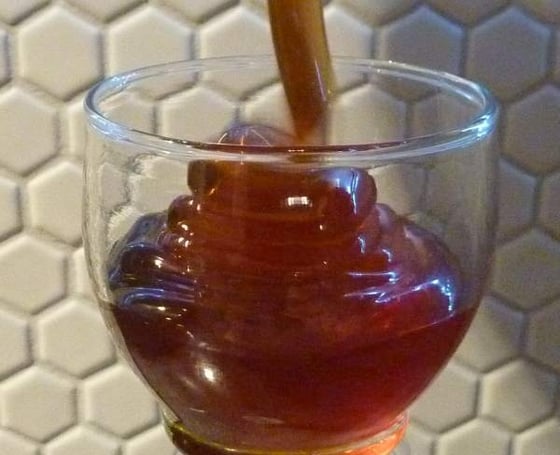
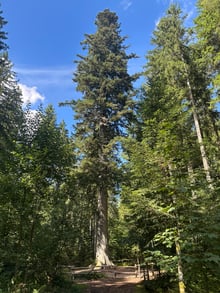
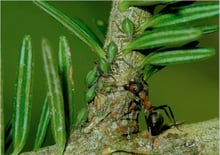
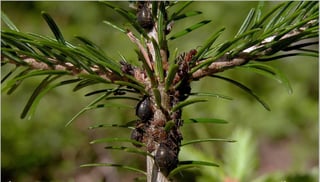
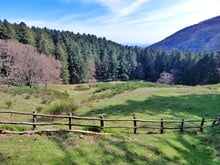
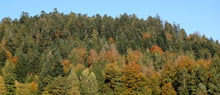
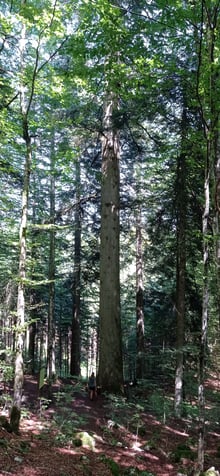
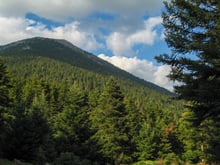 Photo: Thodoris K. Mavraganis, Wikimedia Commons | CC BY-SA 4.0Mount MainaloGreek fir forest on Mount Mainalo in Arcadia, where the Vanilia honey is made.
)
 Miel de sapin des Vosges AOP – Recognised in 1996, the first honey appellation d’origine in France by INAO’s account, protecting the honeydew honey of the Vosges massif’s silver firs, harvested in parts of five departments; every lot passes a laboratory analysis and a tasting panel before it carries the name. (French translated to English
  Slovenski med PGI – Slovenia’s national honey indication, registered in 2013, with hojev med, fir honey, as one of its types, held to its own sensory sheet and conductivity floor.
 Qualità Controllata (QC), Emilia-Romagna – The region’s quality mark for farms that follow its integrated-production rules; the honey rules list Miele di melata di abete, from Abies alba and Picea excelsa, among the QC honeys. (Italian translated to English