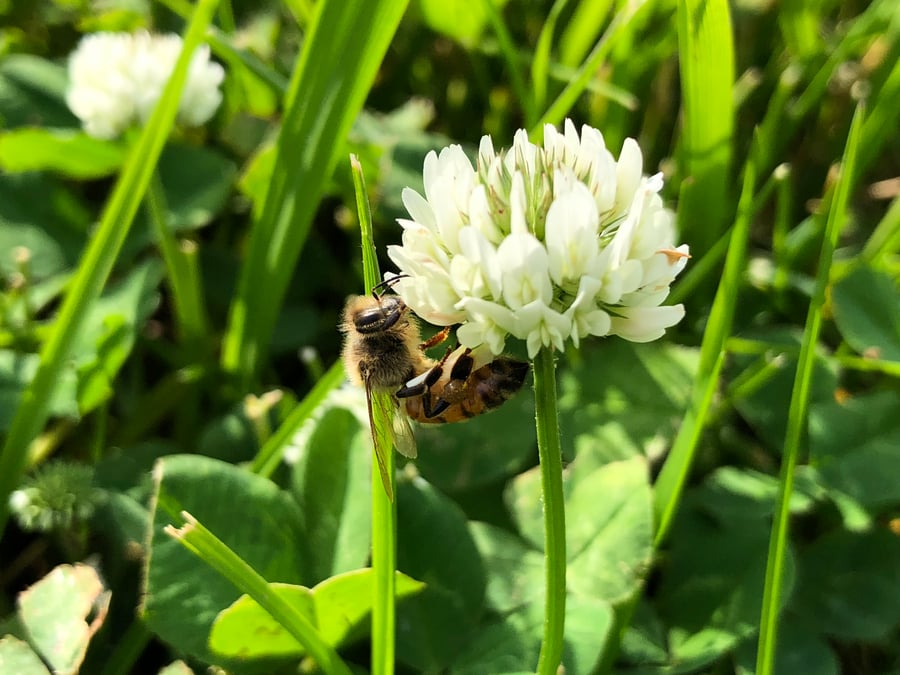
A honey bee at a white clover head in a lawn sward, Fairfax County, Virginia, in May 2021.
Farmers brought clover north as a fertiliser. Sown in the rotation it fed
cattle and put nitrogen back into worn ground, and the historian Thorkild
Kjærgaard calls the Danish agricultural revolution of 1750 to 1800, and its
European counterparts, a clover-driven
nitrogen revolution.
The bees got the rest of it. “It also gave honey as its expansion increased
the biological niche of the honeybee”, Kjærgaard writes. “Honey production
in northern Europe increased dramatically during the last decades of the
18th century and reached an unprecedented level in the 19th. Clover made
the Old World, which had always been so sour, a lot sweeter.”
Then settlers carried the plant out of the Old World, so the clover honey
of the Americas, Australasia and Japan is made on an introduced plant. What
that plant gives is a pale, mild honey that sets within weeks of the
extractor. Behind almost all of it is white clover, Trifolium repens, whose
florets are shallow enough for a honey bee to empty.
Characteristics
Photo: HoneyTraveler | CC BY-SA 4.0
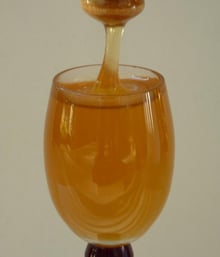
Clover honey in a glass
Clover honey in a glass, photographed for HoneyTraveler in 2011.
This is a pale honey, mild throughout, that does not stay liquid. It runs
water white to pale gold, and Airborne, a New Zealand packer grading its own
crop, puts about 80 per cent of its clover between 10 and 35 mm on the
Pfund scale. The nose is faint and floral, the flavour flowery and
faintly acid, with no bitterness and a short finish.
Then it granulates opaque white, every clover in the compiled international
data inside a month, because glucose, the less soluble of honey’s two main
sugars, is abundant in it; a comparison of processed clover and canola
honeys found storage temperature and moisture better predictors of when it
sets than floral source.
Click to Display — The Details: botanical origin, sensory profile, pairings, health and what gives it its character
Nectar Contributors:
Primary: White clover (Dutch clover) (Trifolium repens)
Background: Other clovers of the pasture mix, varying by country (Trifolium spp.)
Bee Species:
Western honey bee (Apis mellifera). Turkey’s honey communiqué scopes itself
to the species in terms – the standard covers honey produced by the honey
bee, Apis mellifera – and no source read in this round puts a Trifolium
honey on any other managed bee.
One measurement decides which clover the bee can use. The honey bee’s
tongue is 5.90 to 6.25 mm long and reaches about 7 mm into a flower tube;
the white clover calyx is 3 mm.
Color:
Very pale: water white to pale gold in the jar, opaque white once it sets; the shade depends on where the honey was made
Flavor Profile:
Weakly aromatic and flowery, medium in sweetness, faintly acid, with no perceptible bitterness and a short finish
Tasting Notes:
The accessory note is faint, and the bodies that describe it do not agree
on what it is. The Italian national register gives white clover honey a
note that recalls milk caramels; two Dutch beekeeper-sellers reach
independently for caramel, in a trade with no connection to the Italian
sensory school.
The Italian register is also where the clover species are described apart,
and they differ by a single word each on an otherwise identical
description: white clover a note of milk caramels, Egyptian clover a light
vegetal note, crimson clover a light toasted one.
Outside that lineage the registered descriptions are shorter. New Zealand’s
Bee Products Standards Council records the flavour as clean, mild, sweet
and delicate; an Argentine trained panel, publishing in 2013, called it
light, fruity and floral with low intensity, and put higher sweetness on
the eucalyptus side of its analysis rather than the clover side. One Quebec
house alone names a pleasant bitterness in the clover flower, and one Dutch
seller alone calls it the sweetest of the honeys; both are sales copy and
both stand against the sensory sheets.
Aroma:
Weak and delicate, floral, of white flowers; New Zealand’s standards council records the aroma of its own clover honey as herbal dry grass
Defining Compounds:
Three teams on three continents have looked for what is chemically peculiar
to clover honey, and they do not agree on a marker. In 2026 the Institute
of Apicultural Research at the Chinese Academy of Agricultural Sciences,
with Hebei University of Engineering, identified thirteen characteristic
compounds and singled out two, kaempferol-3-O-rhamnoside and
N1,N5,N10-tri-p-coumaroylspermidine, as showing strong botanical-origin
specificity. In the same year a New Zealand laboratory fingerprinting the
airborne compounds that carry smell retained three: benzaldehyde,
trans-linalool oxide and 3-methylpentan-1-ol, each with the highest median
abundance in clover among the honeys it tested.
One compound survives a change of species, of hemisphere and of method.
Benzaldehyde was consistently dominant in the New Zealand white-clover
samples, and a study of red clover honey, read at second hand inside a 2022
review, puts benzaldehyde among its major compounds beside lilac aldehyde
isomers and phenylacetaldehyde. There is no agreed marker, and the
International Honey Commission has no descriptive sheet for Trifolium honey
at all.
Forage Origin:
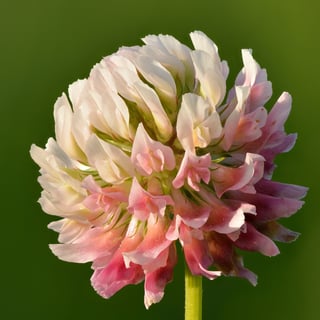
Photo: Ivar Leidus, Wikimedia Commons, cropped | CC BY-SA 4.0White clover (Trifolium repens)White clover, Trifolium repens, the main source of clover honey. Niitvälja, Estonia.
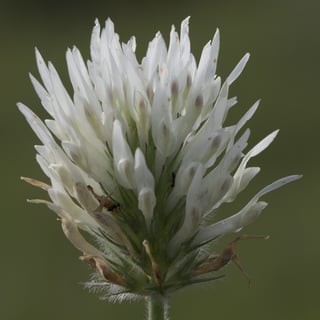
Photo: Ivar Leidus, Wikimedia Commons, cropped | CC BY-SA 4.0Alsike clover (Trifolium hybridum)Alsike clover, Trifolium hybridum, its florets white at the top and pink towards the base. Keila, Estonia.
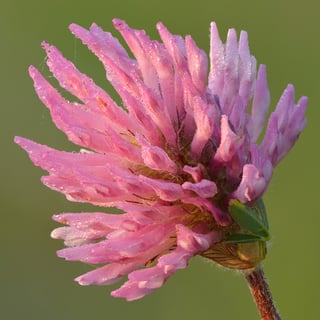
Photo: Zeynel Cebeci, Wikimedia Commons, cropped | CC BY-SA 4.0Berseem (Trifolium alexandrinum)Berseem, or Egyptian clover, Trifolium alexandrinum. Photographed in Adana, Turkey.
Photo: Ivar Leidus, Wikimedia Commons, cropped | CC BY-SA 4.0Red clover (Trifolium pratense)Red clover, Trifolium pratense. Niitvälja, Estonia.
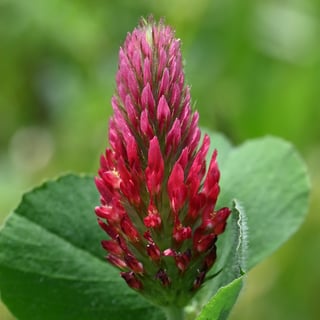
Photo: Krzysztof Ziarnek, Kenraiz, Wikimedia Commons, cropped | CC BY-SA 4.0Crimson clover (Trifolium incarnatum)Crimson clover, Trifolium incarnatum.
Photo: Krzysztof Ziarnek, Kenraiz, Wikimedia Commons, cropped | CC BY-SA 4.0Strawberry clover (Trifolium fragiferum)Strawberry clover, Trifolium fragiferum, in flower.
Primary: white clover (Dutch clover, Trifolium repens, Fabaceae). The bees
take nectar, secreted at the base of the ring of fused stamens behind a
calyx only 3 mm long, so, in the USDA pollination handbook’s words,
“the nectar is easily reached by most nectar-collecting bees”. The floret
trips when a bee forces its way in and springs the pollen-bearing anthers
up against it, which is why clover pollen is well represented in the honey.
White clover yields 0.05 to 0.4 mg of nectar in twenty-four hours at 25 to
52 per cent sugar, and that nectar is sucrose-dominant: the
hexoses in the jar are the bee’s work rather than the plant’s, and warm
nights shift the nectar’s own sugars toward them. Frank Pellett recorded in
1920 that the best crops follow a wet year, because in a wet year the
conditions “favor the rooting of thousands of new plants” that flower the
next summer.
Secondary: alsike clover (Trifolium hybridum, Fabaceae). “The flowers are
quite attractive to bees, especially honey bees, for the nectar and pollen”,
the same handbook records. Finland’s national beekeepers’ association says
white and alsike clover give a large honey crop, and a Russian beekeeping
portal’s yield tables put alsike at 100 to 130 kg of honey to the hectare.
Supporting: berseem (Egyptian clover, Trifolium alexandrinum, Fabaceae).
The winter fodder clover of the warm producing countries; the USDA
pollination handbook calls it “highly attractive to bees, which visit it
avidly for nectar and pollen” and names honey bees its primary pollinators.
Because it is cut two to five times a season for fodder, the honey comes
only from the fields left standing for seed.
Supporting: red clover (Trifolium pratense, Fabaceae). The nectar sits 7.5
to 12.4 mm down a tube 1.6 to 2.5 mm wide, against a honey-bee tongue that
reaches about 7 mm, so a surplus is uncommon and comes off the second
growth; the Russian trade’s own word for it is a supporting flow rather
than a crop.
Supporting: crimson clover (Trifolium incarnatum, Fabaceae). The USDA
pollination handbook reports three earlier writers rating it high as a honey
plant and calls the honey excellent itself, with the physical catch that
bees “have difficulty in forcing their mouth parts into the floret”. The
International Honey Commission records it rarely, in Italy, France and
eastern Europe.
Background: other clovers of the pasture mix, varying by country
(Trifolium spp., Fabaceae). The same handbook calls strawberry clover
(T. fragiferum) “extremely attractive to bees for both nectar and pollen”;
Persian clover or shaftal (T. resupinatum) yields little nectar per blossom.
Subterranean clover (T. subterraneum), the dominant annual pasture clover of
southern Australia and the Mediterranean, is considered self-fertilising and
is not a honey plant at all, so a paddock of clover there can give the
beekeeper nothing.
White clover’s native range runs from Macaronesia and north-west Africa
through Egypt to Zimbabwe and across Europe to Mongolia and the Himalaya;
everywhere else it was introduced. The honey comes both from clover sown in
pasture and from clover naturalised in pasture, verge, waste ground and
lawn: white clover, Pellett wrote, “establishes itself in pastures, along
roadsides and in waste places everywhere. It is a good lawn plant.”
In the International Honey Commission’s European classification of 2004,
white clover honey is
unifloral and medium in eleven country groups of northern and western
Europe, rare in Italy and Greece, abundant nowhere. The commission
publishes no correction for Trifolium in its table of over- and
under-represented pollens, so a clover count is read at face value, unlike
black locust at 7 to 60 per cent or chestnut above 86. The bar for the name
is then set nationally, and where a number exists at all it runs from 45 to
70 per cent: Germany 70 per cent across three genera, Turkey, New Zealand,
Poland and Argentina 45, and Russia, the European Union and the United
States no number.
Names that are not this plant. Sweet clover (Melilotus) and alfalfa or
lucerne (Medicago sativa) are separate genera inside the same tribe of the
pea family, the rank between family and genus, and both are sold under
their own names in almost every country that has them. Two markets fold
sweet clover in: German food law defines Kleehonig across Trifolium,
Melilotus and Lotus, so a German jar labelled Kleehonig may lawfully be
sweet-clover honey, and in the United States the National Honey Board’s
clover is made from “White Dutch, Red, Sweet, and White” clovers blended,
while one house names Melilotus officinalis by binomial on a jar labelled
Western Clover. Sainfoin (Onobrychis) is lupinella in Italy and esparceta
in Spain; Mexican clover or Florida pusley (Richardia scabra) is a
Rubiaceae and no legume at all – “the name clover is a misnomer”, as
Pellett put it in 1920 – and the Japanese honey sold as レンゲはちみつ
(renge hachimitsu) is Chinese milk vetch, Astragalus sinicus.
Speakers of six languages use the cognates differently. Turkish üçgül is
Trifolium while yonca is alfalfa, though speech uses yonca for both; in
Arabic the bare word for clover, برسيم (barsim), is Trifolium alexandrinum
while alfalfa is برسيم حجازي (barsim hijazi); Slovene medena detelja and
Czech sladký jetel mean Melilotus; in Greek the farmer’s word for alfalfa
is τριφύλλι (trifylli).
Pairings:
The one use every country states is bread, and the reason is physical
rather than a flavour affinity. Creamed by the seeding method E. J. Dyce
patented in 1935, the honey does not run off the slice and leaves fewer
sticky fingers, as a Dutch beekeeper-seller puts it; three Dutch sellers
file it as a spreading honey, a Japanese house recommends its clover jar
for bread and for fruit liqueurs, and the American promotion board says it
excels at the table and in the oven. Two houses on opposite sides of the
world reach for a butter: a Quebec house calls it velvety with the texture
of butter, and a Japanese one gives it a creamy viscosity like margarine.
Beyond bread the named partners are few: Dutch sellers put it in muesli,
yoghurt and quark, on pancakes and desserts, and with ice cream or fruit,
and one of them, alone in any language searched, puts it on a cheese board.
That thinness is a finding rather than an oversight. The United States
National Honey Board’s Honey Varietal Guide exists to give “preferred
pairing suggestions” for 21 varietals: buckwheat gets strong cheeses and
grapefruit, orange blossom gets custards, vanilla and chocolate, sage gets
veal and game. Clover is given a place, the table, and a job, the oven, and
no partner at all – in 2007 and again on the board’s current card nineteen
years later. No registered body in sixteen languages publishes one.
In a hot drink the answer depends on the form. Liquid clover honey in tea
is not in dispute anywhere; the creamed jar is, and the two sellers who
advise against it give the reason, that the firm structure suits it less
well, while a third recommends it.
The drink the honey is turned into is mead, where it is the neutral base of
record. The National Honey Board’s mead guide carries thirteen recipes and
names light clover honey in six of them, and the Beer Judge Certification
Program ran six clover batches against six yeasts so that the yeast was the
only variable.
Health Uses:
The honey carries a folk attribution, and the round found it in one place.
A Russian beekeeping portal credits clover honey with sweat-inducing,
diuretic, anti-inflammatory and antiseptic properties; a search across
eight languages found those actions attached to this honey nowhere outside
Slavic beekeeping writing. They are reported here as that tradition and as
nothing more.
They are also, exactly, the clover plant’s own medicinal profile. The 2022
review of clover-honey phytochemistry records red clover extracts taken
internally for skin complaints, gout, whooping cough and dry coughs. The
likeliest reading is that the plant’s reputation was carried across onto
the honey somewhere in the Slavic beekeeping literature.
Where the honey has been measured it sits low. The Instytut Włókien
Naturalnych i Roślin Zielarskich in Poznań, a Polish national research
institute, reported in 2021 that light honeys – rapeseed, acacia,
multiflower – showed weak or medium biological activity, and that the dark
honeys of high and late summer were stronger. Laboratories treat clover
honey accordingly: a New Zealand university food-science group explains that
it was in its study as “a widely available, low-value commercial benchmark”.
The only review of the phytochemistry of clover honeys states that no one
has compared the different clover honeys for their flavonoid content, the
plant compounds that carry the activity, so one clover honey cannot be told
from another on that ground.
Origin Story
Red clover supplies about 215 kg of nitrogen to the hectare against peas at
63, and that difference is what moved the plant across Europe.
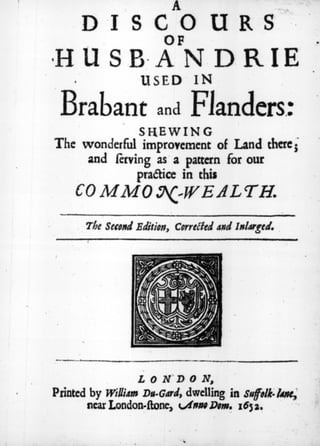
Sir Richard Weston, A Discours of Husbandrie (1652), via the Internet Archive, cropped | Public domain
Weston's Discours of Husbandrie, 1652
Title page of the 1652 second edition of Sir Richard Weston's account of husbandry in Brabant and Flanders.
The crop was domesticated probably at the beginning of the second
millennium in Moorish Andalusia, where Albertus Magnus described a field of
it before 1270, and it was carried north over the next four centuries:
Lombardy and the Netherlands by the mid-sixteenth century, France by 1583,
then Germany, Denmark from 1732, and Scandinavia after that. Clover seed
went from the Netherlands to England around 1620, and Sir Richard Weston
wrote his Flemish account after a sojourn in Ghent, Bruges and Antwerp in
1644. The English historian C. P. H. Chorley put the rise in European
agricultural production between 1750 and 1880 at about 175 per cent and
credited as much as two-thirds of it to nitrogen-fixing legumes, clover
above all; Kjærgaard, who reports the figure, calls the estimates very
rough and says the Danish case confirms them. In 1761 Philip Ernst Lüders,
founder of the royal Danish agricultural academy at Glücksburg, had already
written that clover would transform “our barren, northern country into a
new Canaan flowing with milk and honey”.
The honey may be inside the word as well. The etymology “half-heartedly
accepted by most modern authorities”, Anatoly Liberman writes, joins clover
to cleave, to adhere – “but perhaps clover is ‘sticky’ because its thick
juice is traditionally one of the main sources of honey”. He keeps his own
hedge on it: there is some reason to believe it, and a German etymological
dictionary dropped the connection when Elmar Seebold took it out.
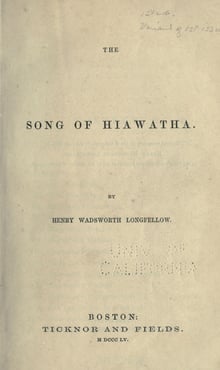
H. W. Longfellow, The Song of Hiawatha (1855), University of California copy, via the Internet Archive | Public domain
The Song of Hiawatha, 1855
Title page of the first edition of Longfellow's The Song of Hiawatha, Boston, 1855.
Settlers took the plant west. White clover, a USDA monograph records,
“apparently was included in the ‘hayloft seed’ that early colonists brought
with them to America”, and “it preceded the white man into new areas”
because its small seeds travel on wind, water, birds and grazing animals.
Henry Wadsworth Longfellow set the arrival to verse in The Song of Hiawatha
in 1855: “Wheresoe’er they move, before them / Swarms the stinging fly, the
Ahmo, / Swarms the bee, the honey-maker; / Wheresoe’er they tread, beneath
them / Springs a flower unknown among us, / Springs the White-man’s Foot in
blossom.” The lines pair the settlers’ honey bee with a flower that springs
where they walk. Which flower he had in mind is contested, the botanical
literature usually attaching that name to broadleaf plantain, and the poem
settles nothing. The Canadian half of the arrival, and the canola crop
the honey is made and sold beside there, belong to
Clover and Canola Honey.
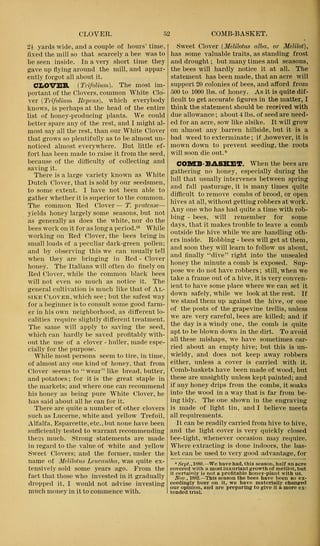
A. I. Root, The A B C of Bee Culture (1884), via the Internet Archive | Public domain
A. I. Root on clover honey, 1884
Page 52 of A. I. Root's The A B C of Bee Culture, 1884: the entry CLOVER (Trifolium) in the left-hand column, running on into sweet clover.
By the time the American trade wrote its own reference books the honey was
the measure of the rest. In 1884 A. I. Root’s cyclopaedia called it “the
great staple in the markets”; the 1923 edition went further. “In the
central and eastern States no other honey plant is so universally known as
white clover, and white clover honey is the honey par excellence – the
honey with which all other honeys are compared.”
That same book carries the earliest dated account of the retreat, and Root
and Root put the cause at lime rather than fertiliser: thirty or forty
years back a failure to get a crop of clover honey was almost unknown, and
now “intensive agriculture has tended to exclude white clover from
cultivated fields and to confine it to the roadsides, hedgerows, and
unploughed pastures”, on ground the farmers were calling clover-sick for
want of lime.
The larger fall came from the nitrogen the clover had been there to supply.
Fritz Haber worked out ammonia synthesis in 1909 and he and Carl Bosch
industrialised it by 1913; world fertiliser production went from four
million tonnes a year in 1940 to 150 million by 1990, “a development which
has made clover disappear from the fields of the globe”, in Kjærgaard’s
words. The American agronomic account adds the rest of the machinery: cheap
nitrogen first, then the shift to alfalfa, the corn and soybean
monoculture, the decoupling of livestock from the land, and
2,4-D for broadleaf weeds in mixed pasture. British grassland went
the same way, and a pasture cut or grazed before it flowers is not forage
at all, whatever is sown in the
ley.
Britain holds the only measurement of the retreat found inside the honey
rather than on the land. DNA work on 441 honey samples of 2017, compared
against a national survey of 1952, found white clover a major plant in
74 per cent of samples in 1952 and 31 per cent in 2017, and red clover down
from 5 per cent to 1; bramble and oilseed rape took the room. Even so,
white clover was still the second most foraged plant in 2017, which the
authors read as bees going out of their way to find it.
Public policy now pays for the opposite. England pays farmers 224 pounds
a hectare a year for a herbal ley carrying at least one grass, two legumes
and two herbs, on condition that the farmer minimises inorganic nitrogen,
which the scheme puts at usually no more than around 40 kg a hectare a
year. No source measures what that has done to any honey crop. Nor does
this history reach far outside its own quarter: the documented story of
clover honey is north-west European and North American, and no pre-modern
named clover honey was found anywhere else.
Cultural Context
What clover did to the look of a countryside is recorded at the same place
as the nitrogen arithmetic. “The white and the red clover fields gave new
colours, just as they gave new smells”, Kjærgaard writes; the romantic
nineteenth-century landscape “with its red, white and green fields, humming
bees and endless herds of cattle was created by clover”. In 1936 the
members of what Kjærgaard calls a Danish “national committee” declared
domesticated red clover a “national plant”.
New Zealand is where the clover and the bee had to be shipped in
separately. Honey bees were first introduced to the Hokianga in Northland
in 1839; four species of bumblebee followed from England in 1885 and 1906,
brought for the pollination and seed production of red clover, whose
flowers their longer tongues can reach and the honey bee’s cannot, though
honey bees pollinate the smaller white clover flowers perfectly well. It is
a seed story rather than a honey story, since no bumblebee makes a marketed
honey, and even the seed version is complicated: the USDA handbook records
35 honey-bee colonies beside a ten-acre New Zealand red clover field
providing 77 per cent of the pollinating insects in 1954.
The same fact reached the German countryside as a saying, which Pellett
printed in 1920 beside the mechanism: “There is a German country saying
that the honeybee was forbidden the red clover because she didn’t keep
Sunday. Beekeepers know that her tongue is a little too short for the honey
tube of the red clover flower and that she doesn’t waste time in trying to
get what is out of her reach.”
Where the honey is judged, it is usually judged as a colour, a form or a
quality band rather than as a flower. Italy is the exception: the
Osservatorio Nazionale Miele’s national competition, the Tre Gocce d’Oro,
judged Trifoglio and
Trifoglio alessandrino as classes of their own in its 2026 edition, out of
1,772 honeys entered by 616 beekeepers. The National Honey Show’s 2026
schedule runs to 51 pages and names one flower, heather. In January 2026
the Specialty Food Association gave a New Zealand
creamed clover honey a Gold award and one of the five Grand Honors of
that year’s show, Timeless Taste, a longevity award created for 2026 and
drawn from a pool of more than 1,200 entries.
Ireland's clover honey reaches the shelf as blossom honey
The Federation of Irish Beekeepers' Associations puts white clover first
in its list of Irish surplus crops and calls white clover honey the most
popular honey on the market, producing the finest sections of all honeys,
with Wexford, Waterford, Cork, Wicklow and Dublin named as its counties.
The jar rarely says so. "Bees work both plants at the same time, resulting
in a clover honey blended with some blackberry honey providing the main
surplus crop", the federation explains, "and many people prefer the blend
to pure clover honey."
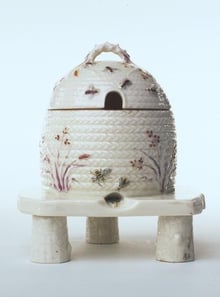
A Belleek honey-hive jar of about 1875, pot and lid on a stand, painted in the Grasses pattern with honey bees. National Museum of Ireland.
The clover shows up in the cupboard instead. The National Museum of
Ireland holds a Belleek honey-hive jar of about 1875, pot and lid on a
stand, heavy porcelain embossed with a plaited straw-rope pattern and
painted in Belleek's Grasses pattern, purple and brown grasses with black
and yellow bees; the museum records that pots of this shape were also made in
Belleek's Shamrock pattern, and that this jar and lid featured in the 1904
Belleek Pottery catalogue.
Harvest & Forage
Clover honey is not one season. In the northern temperate belt it is a
midsummer honey: white clover flowers June to September, red clover June to
August and alsike June to July, and Ireland’s national federation puts the
heaviest flows, depending on season and district, from mid-June to late
July, with a heavy yield running three or four weeks. German and French
producers give June and July for their own harvests. In New Zealand it is
compressed: a Canterbury packer writing about its own crop says the flow
usually starts about mid-December and finishes at the end of January, most
of it made in two or three weeks in any one area. In Egypt and the Nile-fed
plains of South Asia it inverts altogether, because berseem grows from
October to May and heads shortly after the first of the year.
What threatens a clean crop is whatever else is in bloom, and the
microscope does not report the neighbours evenly. In the International
Honey Commission’s table alfalfa pollen is under-represented and oilseed
rape over-represented, while Trifolium is absent and takes the plain rule,
so a jar at 45 per cent clover pollen may hold more alfalfa nectar than its
count suggests and less rape nectar. Seed growers knew the same problem
from the other side: bees leave alsike for sweet clover.
A clover-dominant pollen count is not by itself a clover honey, and the
Swiss measured it. Agroscope, the federal bee research centre, analysed 45
honeys carrying more than 60 per cent white clover pollen – mean 77 per
cent, maximum 95 – and found 38 of them
honeydew or blossom-honeydew mixtures and seven blossom honeys, not
one of which met the chemical specification for white clover honey. The
pollen count and the chemistry disagreed, and the institute trusted the
chemistry. The mechanism behind that in the north is that clover does not
flow alone.
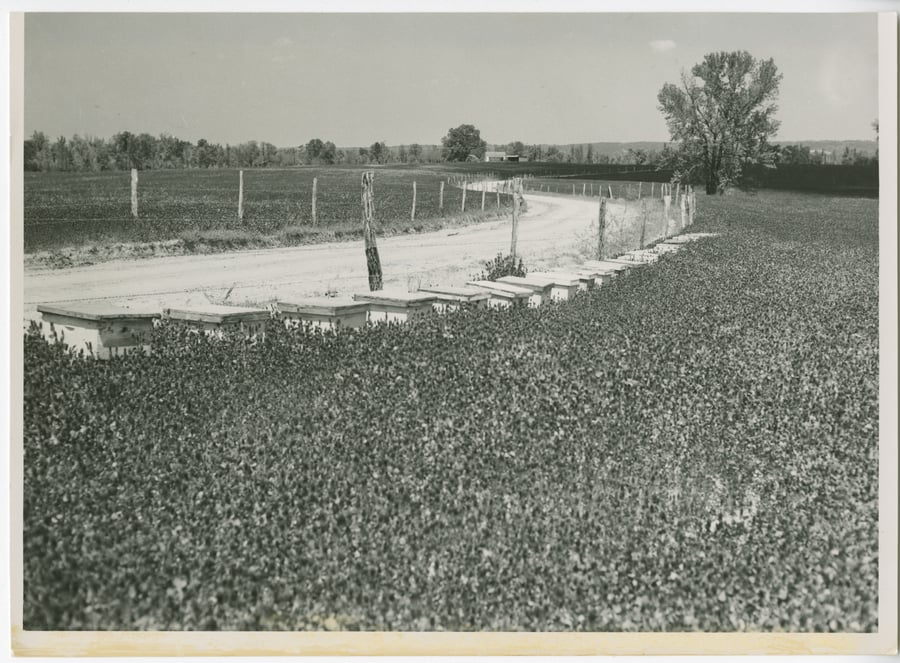
Leon J. Sisk, USDA Soil Conservation Service, via Wikimedia Commons | Public domain
Hives in crimson clover, Georgia, 1952
Beehives in a field of crimson clover in bloom near Evans, Georgia, in April 1952. USDA Soil Conservation Service photograph.
The beekeeper’s move against all this is timing, and in the fodder clovers
it is a matter of which fields are left to flower. A clover cut two to five
times for hay never blooms and yields nothing, so the honey comes from the
part of the crop standing for seed. Italy’s Osservatorio says it plainly:
pure clover honeys can be made where the plantings are wide, above all
where they are grown for seed. Two standard Egyptian apiculture textbooks
say the same of berseem, and the Egyptian trade name for the honey,
عسل النوارة (asal al-nawwara), means bloom honey.
The rest is moving hives, or not moving them. The Bingöl producers’ union
in Turkey took its clover harvest and then moved to the high pastures,
putting the honey on sale in mid-August; and a Norwegian beekeeper’s August
clover crop came from the colonies that did not go on that year’s heather
move.
Beekeeping Context
The plant and the bee need each other, and the seed trade is where that is
measured. White clover is largely to completely
self-incompatible, and the USDA pollination handbook calls the honey
bee its most important pollinator; honey bees are the primary pollinators
of berseem too.
The honey has retreated with the farming that grew it, and beekeepers say
so themselves. A Hessian beekeeper writes that clover honey is now only
rarely harvested in Germany, and that even his own operation cannot take it
every year; a Paris house says the French harvest is very rare because
production is so erratic; a Molise producer says his bees cannot make his
trifoglio alessandrino every year. The measured version comes from one
English county: white clover was the dominant pollen type in 36 per cent of
Worcestershire honeys in the 1950s and a secondary type in another 36 per
cent, and in the same county today it is present in just over half the
samples and dominant in none. The authors put that down to changes in
agricultural and garden lawn practice, which have made white clover a less
available source of nectar and pollen in the United Kingdom.
No jar law anywhere reads the word down to one species: New Zealand’s
standards council asks only that 45 per cent of the pollen be the
characterising species and names no species at all, the United States asks
only that the plant be the chief floral source and the Food and Drug
Administration’s labelling guidance puts no number on it, and Codex and the
European Union ask for “wholly or mainly”, a word the European Commission
has had power to put a number on since 2014. One government names the honey
outside its labelling law altogether: New Zealand’s Ministry for Primary
Industries graded the top pale class of the bulk crop Light (clover type) in
its apiculture monitoring report of 2017, which is a price class and not a
label. The world standard once went the other way on water: from 1987 until
the 2001 revision it allowed clover honey 23 per cent against 21 for most
honeys.
What the trade sells under the name follows from that. The United States
National Honey Board describes its clover honey as made from several types
of clover plant and often blended; Sioux Honey, which calls itself the
largest honey cooperative in the United States, says its flagship clover
line is derived from white and yellow sweet clovers, filtered and blended;
and a Canadian federal publication of 1993 gives the trade’s reason, that
clover honey “can easily be blended with inferior honey, which takes on its
desirable taste and aroma”. No institution counts honey by flower, so there
is no world figure for how much clover honey is made.
Source Regions
See all 31 countries
United States, the Northern Plains and Texas – Trifolium repens: clover honey, priced by colour class in the federal honey report’s rows of August 2026.
Canada, the Prairies to Quebec – Trifolium repens: clover honey (miel de trèfle), a prairie and eastern crop sold above all as a creamed jar.
New Zealand, South Island – Trifolium repens: clover honey, whose name the government price series uses to grade the top pale class of the crop.
Australia, Tasmania and Victoria – Trifolium repens and T. pratense: clover honey, a minor named varietal off sown pasture, sold by single-varietal houses.
United Kingdom, Wales and Scotland – Trifolium repens and T. pratense: clover honey, a survival rather than a staple, with one British-named jar in 2026.
Ireland, Wexford to Cork – Trifolium repens: clover honey, the main surplus crop, sold blended with blackberry as blossom honey.
France, the Morvan to the Pyrenees – Trifolium repens: clover honey (miel de trèfle), a rare and capricious harvest sold beside bramble.
Germany, Hesse and the Uckermark – Trifolium repens and T. pratense: clover honey (Kleehonig), now rarely harvested, and defined by the national food code.
Denmark, Møn and Jutland – Trifolium repens: clover honey (kløverhonning), taken where bees are hired for white-clover seed; most sells as summer honey.
Sweden, Falbygden and Gästrikland – Trifolium repens: clover honey (klöverhonung), a standard national varietal, sold origin-marked as Svensk klöverhonung.
Norway, Gudbrandsdalen and Trøndelag – Trifolium repens: clover honey (kløverhonning), a late-summer flow in some years and none in others.
Finland, North Karelia – Trifolium repens and T. hybridum: clover honey (apilahunaja), and white-clover pollen is in almost every Finnish honey sample analysed.
Poland, Masuria and Lesser Poland – Trifolium repens and T. pratense: clover honey (miód koniczynowy), a named varietal in the national standard, called scarce.
Slovakia, eastern Slovakia – Trifolium spp.: clover honey (ďatelinový med), a late-season unifloral spun after the main crop and little seen on the market.
Hungary – Trifolium pratense: clover honey (vöröshere méz, lóhere méz), one house’s Hungarian producer’s varietal, from a crop that is rare here.
Lithuania, Zarasai – Trifolium repens and T. pratense: clover honey (dobilų medus), sold straight from Lithuanian farms, including an organic white-clover line.
Latvia – Trifolium spp.: clover honey (āboliņa medus), from a named Latvian farm holding, on a Latvian specialty shop’s 2026 list.
Italy, Molise, Sardinia and Puglia – Trifolium alexandrinum and T. repens: clover honey (miele di trifoglio), with three register sheets and two judged competition classes.
Portugal, Alentejo and the Azores – Trifolium spp.: clover honey (mel de trevo), two producers’ own harvests sold seasonally in small quantities.
Argentina, Pampa húmeda – Trifolium repens: clover honey (miel de trébol), a named monofloral class in the national rule, sold as trébol blanco.
Chile, Osorno – Trifolium spp.: clover honey (miel de trébol), harvested from sown southern pasture by a long-established family firm, listed in 2026.
Russia, Bashkortostan – Trifolium spp.: clover honey (клеверный мёд, klevernyi myod), sold loose by weight in Moscow specialty shops from the 2026 crop.
Armenia – Trifolium spp.: clover honey (երեքնուկի մեղր, yereknuki meghr), one organic brand whose listing gives Armenia as the country of production.
Azerbaijan – Trifolium pratense: clover honey (yonca balı), named among the honeys sold at the agriculture ministry’s republic beekeeping fair.
Japan, Hokkaido and Aomori – Trifolium repens: clover honey (クローバーはちみつ, kuroba hachimitsu), a summer pasture crop on 2026 jars naming the prefecture.
Turkey, Bingöl and Muğla – Trifolium spp.: clover honey (üçgül balı), for which the food codex sets a 45 per cent pollen floor.
Israel, Galilee – Trifolium spp.: clover honey (דבש תלתן, dvash tiltan), graded by flower type in the honey board’s own visitors-centre record.
Egypt, the Nile Delta – Trifolium alexandrinum: berseem honey (عسل البرسيم, asal al-barsim), sold by houses that harvest their own from the berseem meadows.
Iran – Trifolium spp.: clover honey (عسل شبدر, asal-e shabdar), sold retail and in export lots by a house calling itself a direct national producer.
Pakistan, the Indus plains – Trifolium alexandrinum: berseem honey (برسیم ہنی, barsim hani), one of the floral types Pakistan markets its honey by.
India, Punjab – Trifolium alexandrinum: clover honey (berseem honey), sold by Indian houses under both names and extracted from the Punjab clover fields by May.
Regional Variants
Zeynel Cebeci, via Wikimedia Commons | CC BY-SA 4.0
Berseem in flower
A berseem flower head, Trifolium alexandrinum, photographed in Adana, Turkey.
Egyptian clover honey (miele di trifoglio alessandrino, عسل البرسيم / asal al-barsim) – Trifolium alexandrinum – Egypt, the Nile Delta, and Italy: the same plant at both ends of the Mediterranean, and the two trades have made different things of it. Berseem is Egypt’s winter fodder crop, cut two to five times a season, so the honey comes only from the fields left standing for seed, and the trade’s name for it, عسل النوارة (asal al-nawwara), means bloom honey. Egyptian houses sell their own harvest off the berseem meadows of the Delta, and the same honey travels east, marketed under the berseem name in Pakistan and India, where one jar prints both: Clover (Berseem) Raw Honey. In Italy the same honey is a rarity with a file behind it. The International Honey Commission lists Trifolium alexandrinum as a European unifloral source in its own right, in six languages, and finds it in Italy alone; the Albo Nazionale Mieli gives it a characterisation sheet; CONAPI counts it among ten principal Italian unifloral honeys and gives white clover none; and the Osservatorio Nazionale Miele judges it as a class of its own at the Tre Gocce d’Oro. A Molise producer says plainly that some years his bees cannot make it at all.
Ivar Leidus, via Wikimedia Commons | CC BY-SA 4.0
A bumblebee on red clover
A bumblebee working a red clover head, Trifolium pratense, its mouthparts in among the florets. Keila, Estonia.
Red clover honey (vöröshere méz, Rotklee-Honig) – Trifolium pratense – Hungary and the northern seed districts: the clover the honey bee can barely reach. Its nectar sits at the bottom of a tube 7.5 to 12.4 mm deep against a tongue that reaches about 7, so a crop of it depends on the margin closing. Every source that describes it names the same conditions: the second growth after the first hay cut; heat and drought on soil that still holds moisture; the nectar glands full at the peak of bloom; and long-tongued bees. Pellett wrote in 1920 that the surplus comes only from the second crop and in hot and dry seasons. The consequence is a ceiling: the Russian yield tables that put alsike at 100 to 130 kg of honey to the hectare put red clover at 25 to 30, and the trade’s own word for it is a supporting flow rather than a crop. The honey is a by-product of a seed field and a pollination contract and it fails in most years, which is why so few houses sell it under its own name. Hungary has the one house found selling it under its own name with the origin stated, and one Lithuanian honey has been analysed at 48 per cent red clover pollen. Sellers call it sharper and spicier than white clover honey and disagree about its colour.
Translations
See all 35 Translations
Miel de trèfle – French
Kleehonig, Kleeblütenhonig – German; both forms are lawful in the food code
Kløverhonning – Danish
Klöverhonung – Swedish; Svensk klöverhonung on origin-marked jars
Kløverhonning – Norwegian; hvitkløverhonning where the seller names the species
Apilahunaja – Finnish
Miód koniczynowy – Polish
Ďatelinový med – Slovak
Vöröshere méz, lóhere méz – Hungarian
Dobilų medus – Lithuanian; baltųjų dobilų medus for the white-clover form
Āboliņa medus – Latvian
Miele di trifoglio – Italian; at species level miele di trifoglio bianco, di trifoglio alessandrino and di trifoglio incarnato; Mele de Trivogiu in Sardinian
Mel de trevo – Portuguese
Miel de trébol – Spanish; Miel Trebol and the jar face Trebol Blanco in Argentina
Клеверный мёд (klevernyi myod) – Russian
երեքնուկի մեղր (yereknuki meghr) – Armenian
Yonca balı – Azerbaijani; Ağ yonca balı for the white-clover grade
クローバーはちみつ (kuroba hachimitsu) – Japanese; クローバー蜜 (kuroba mitsu) in the trade
Üçgül balı – Turkish
דבש תלתן (dvash tiltan) – Hebrew
عسل البرسيم (asal al-barsim) – Arabic
عسل شبدر (asal-e shabdar) – Persian
برسیم ہنی (barsim hani) – Urdu; Berseem Honey in Latin script on the jar
Klaverhoning – Dutch, a selling name rather than a producing one
Ristikumesi – Estonian
Jetelový med – Czech
Детелинов мед (detelinov med) – Bulgarian
Miere de trifoi – Romanian
Мед од детелине (med od deteline) – Serbian; med od djeteline in Croatian
Detelja med – Slovene
Smárahunang – Icelandic
Μέλι τριφυλλιού (meli trifylliou) – Greek
三叶草蜂蜜 (sanyecao fengmi) – Chinese; 三葉草蜂蜜 in traditional characters
클로버꿀 (keullobeo kkul) – Korean, on import listings
Хошоонгор (khoshoongor) – Mongolian
Certifications
Miel wallon PGI, Belgium – Approved by the European Commission on 12 February 2025, this Belgian protected geographical indication names miel de trèfle as one of nine monofloral types its specification permits under the designation, beside rape, fruit blossom, phacelia, dandelion, bramble, willow, lime and privet. It is a place name with clover inside it, not a designation of clover honey, and it is the nearest thing to one anywhere: no protected designation of origin or geographical indication is named for clover honey in any register searched. (French translated to English )
Deutsches Lebensmittelbuch, Leitsätze für Honig 3.1.1.3, Germany – The federal food code defines Kleeblütenhonig or Kleehonig as honey from the nectar of clover flowers of the genera Trifolium, Melilotus and/or Lotus, asks for at least 70 per cent clover pollen and caps the colour at 35 mm Pfund. The same code separates what the bees did from what the packer did: a two-plant flow taken in one period from one geographical origin may carry a double botanical name, while a packer’s blend must be labelled Mischung von. Carried unlinked: the code exists only as a German-language PDF, which is cited in sources.
Deutscher Imkerbund, Merkblatt 3.4, Germany – The national beekeepers’ federation, whose Gewährverschluss seal is a quality label of its own, defines Kleehonig in its December 2021 edition as honey from the nectar of clover flowers of the Trifolium species alone, at the same 70 per cent pollen floor. Federation and food code disagree about which genera the word covers, and both definitions are current. Carried unlinked: the sheet exists only as a German-language PDF, which is cited in sources.
Türk Gıda Kodeksi Bal Tebliği 2020/7, Türkiye – The ministry’s honey communiqué requires a honey whose label declares a botanical origin to match the pollen proportion set in its Ek-2, where üçgül (clover) carries a 45 per cent floor and is listed separately from yonca (alfalfa). The same instrument scopes itself to honey produced by Apis mellifera and asks that the sensory, physical, chemical and palynological characters match the named source. (Turkish translated to English )
UN API AMI, France – A guarantee mark deposited at the INPI in August 2023 by the beekeeping development association of Bourgogne-Franche-Comté. Its rules of use carry an exhaustive floral list naming trèfle among the monofloral honeys the mark certifies, and luzerne (alfalfa) separately; they require the beneficiary’s own harvest and extraction from at least 50 hives sited in the region’s communes, and forbid blending in-region honey with honey from outside. (French translated to English )
Resolución 274/95, Argentina – Miel de tréboles (Trifolium sp) is one of only four named monofloral classes in the national rule, beside citrus, eucalyptus and alfalfa, at a 45 per cent pollen floor. The drafting matters to a buyer: the class is named for Trifolium, but its 45 per cent is counted on the pollen of Melilotus, alfalfa and Lotus taken together, so an Argentine miel de tréboles is a wider thing than the name suggests. Carried unlinked: no live text of the resolution is recorded in this round.
PN-88/A-77626, Poland – The national varietal-honey standard names koniczynowe among the varietal honeys requiring at least 45 per cent predominant pollen, in the class the standard itself calls mniej znane, the less well known. Carried unlinked: the norm sits behind the standards body’s paywall and has never been read at source; the reader of record is the University of Life Sciences in Lublin.
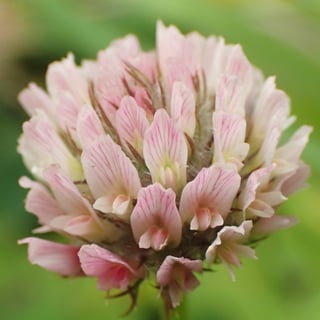
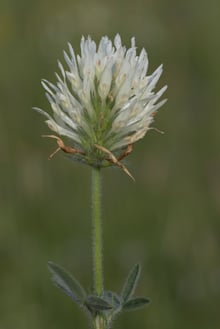 Zeynel Cebeci, via Wikimedia Commons | CC BY-SA 4.0Berseem in flowerA berseem flower head, Trifolium alexandrinum, photographed in Adana, Turkey.
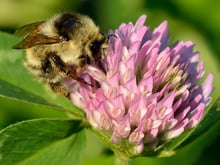 Ivar Leidus, via Wikimedia Commons | CC BY-SA 4.0A bumblebee on red cloverA bumblebee working a red clover head, Trifolium pratense, its mouthparts in among the florets. Keila, Estonia.
 Miel wallon PGI, Belgium – Approved by the European Commission on 12 February 2025, this Belgian protected geographical indication names miel de trèfle as one of nine monofloral types its specification permits under the designation, beside rape, fruit blossom, phacelia, dandelion, bramble, willow, lime and privet. It is a place name with clover inside it, not a designation of clover honey, and it is the nearest thing to one anywhere: no protected designation of origin or geographical indication is named for clover honey in any register searched. (French translated to English
 )
 UN API AMI, France – A guarantee mark deposited at the INPI in August 2023 by the beekeeping development association of Bourgogne-Franche-Comté. Its rules of use carry an exhaustive floral list naming trèfle among the monofloral honeys the mark certifies, and luzerne (alfalfa) separately; they require the beneficiary’s own harvest and extraction from at least 50 hives sited in the region’s communes, and forbid blending in-region honey with honey from outside. (French translated to English