Mangrove Honey
The Story
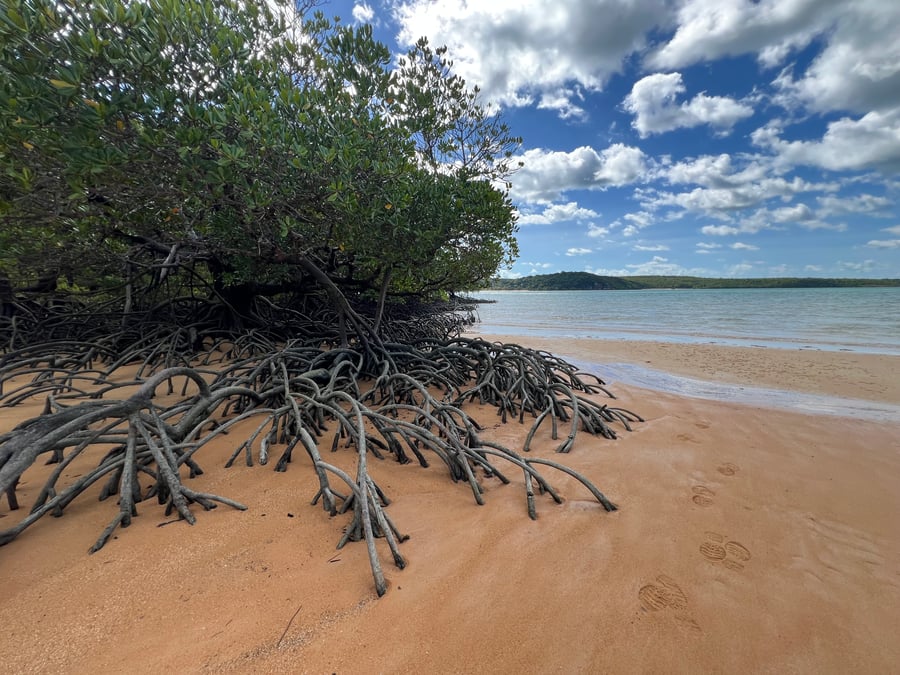
Mangroves grow where almost nothing else will – in salt water, on tidal mud, along the line where the land gives out and the sea begins. The bees that work their flowers make a honey that has carried a single name across four continents for well over a century, and yet no two jars of it need look alike. One can be water-clear, the palest honey in the world; another, from the same kind of tree a coastline away, can run almost black.
The split is not a flaw in the labelling. It is the honey telling you which mangroves fed it. Where bees work one species of grey or white mangrove on its own, the honey stays light, faintly saline, and delicate. Where they work a mixed tidal forest – several mangrove species flowering together, often beside coastal hardwoods – the honey darkens and gathers body. Frank Benton set mangrove down beside linden, white sage, and orange blossom in the United States Department of Agriculture’s first apicultural bulletin in 1896, naming it among the honeys a buyer could recognize on sight and taste. It has held that standing ever since, from the black-mangrove jars that make up most of Guyana’s national crop to the pale Avicennia honey of the Gulf of Mexico and the dark forest honey of the Sundarbans.
Characteristics
Mangrove honey is really two honeys under one name, and a buyer is helped most by knowing which is in the jar. The pale type, from a single Avicennia species, is light amber to almost water-clear, thin-bodied and slow to crystallize thanks to a high fructose share; its flavour is gently sweet and floral with a clean mineral-saline finish that tasters have likened to a fleur de sel. The dark type, from a mixed tidal forest, is reddish-brown to nearly black, fuller in body and more robust, sweet with a faintly spiced edge and a longer finish. Both carry the thread of sea air that marks the honey’s origin. Crystallization is generally slow; the darker grades, richer in minerals, can set more readily than the pale.
Click to Display — The Details: botanical origin, sensory profile, pairings, health and what gives it its character
Botanical Name: Mangrove (various genera)
Color:
pale gold to dark reddish-brown, according to the mangroves that produced it
Flavor Profile:
sweet with a saline edge; delicate in pale honeys, robust and faintly spiced in dark ones
Aroma:
warm and floral with a thread of sea air; marsh-grass and mineral notes in darker grades
Defining Compounds:
The chemistry below has been measured in mangrove honeys studied around the world, and describes the type at genus level – it is not a measurement of any one regional honey.
The aroma of pale Avicennia honey is shaped by a small set of dominant compounds, among them beta-damascenone, nonanal, and decanal, identified in the volatile profile of Cuban black-mangrove honey. Researchers proposing chemical markers to authenticate mangrove honey have pointed to a group of fatty acids – palmitoleic acid, n-hexadecanoic (palmitic) acid, and docosanoic acid – as candidates. Mangrove honeys also tend to carry elevated sodium and a raised mineral conductivity, consistent with the saline ground the bees forage, and the darker, multi-species honeys consistently test higher in polyphenols and antioxidant activity than the pale single-species crops – the general rule, across honeys, that darker means more mineral and more phenolic.
Forage Origin:
The substance the bees collect is floral nectar, taken from the blossoms of mangroves – the salt-tolerant trees and shrubs that colonize tropical and warm-temperate coastlines where fresh water, salt water, and tidal mud meet.
“Mangrove” names an ecological habit, not a single plant or family. The trees that carry the name belong to several unrelated genera: Avicennia (family Acanthaceae), the grey and black mangroves that dominate most named mangrove honeys; Rhizophora, Ceriops, and Bruguiera (family Rhizophoraceae), the stilt-rooted true mangroves of the tidal forest; Aegiceras (family Primulaceae); and Laguncularia and Sonneratia. The common names cross over confusingly from coast to coast – the same Avicennia that is the “white mangrove” of Australia is the “black mangrove” of the Americas – so the honey is best identified by the tree’s setting and the resulting colour rather than by a single binomial.
The colour of the honey tracks the makeup of the forage. A crop worked from one Avicennia species alone tends to be pale, from light amber down to water-clear, with a delicate, faintly saline character. A crop worked from a mixed tidal forest – several mangrove species in flower together, frequently alongside coastal hardwoods such as bloodwood, paperbark, or gum – darkens toward reddish-brown and carries more body. Where a dark, single-named “mangrove” honey can be cross-checked, the producer usually names the co-sources, which is the honest reading of a honey the colour of which its own makers attribute to more than mangrove alone.
Bees working mangrove flats also collect water and minerals from the saline mud: honey bees are documented gathering seawater for its sodium (Lau and Nieh 2016) and foraging seasonally at salty and mineral-rich soil (Bonoan et al. 2017). That this marine foraging passes measurably into the flavour of the honey is a claim made by producers rather than an established finding, and is best treated as the former.
Health Uses:
Across the coasts where it is gathered, mangrove honey is used in the same broad folk ways as other regional honeys – as a sweetener taken for general wellbeing and for soothing throats and coughs. The darker, multi-species grades are valued locally for being rich and strong-tasting, a quality buyers associate with their higher mineral and antioxidant content. These are traditional and customary uses, not medical claims.
Origin Story
Mangrove honey is one of the few honeys whose history has to be told in several places at once, because the same name means very different things depending on the coast.
In Guyana it is the national honey. The black mangrove, Avicennia germinans – known locally as courida – lines the country’s muddy Atlantic shore, and the honey taken from it has long made up the great majority of all the honey Guyana produces, a rare case of a whole national crop resting on a single tidal tree. Eva Crane, who surveyed beekeeping across the Guianas, recorded the dependence plainly.
On the Gulf coasts of Mexico and Belize the same genus yields the opposite kind of honey: a water-clear, faintly briny crop that confectioners and chefs prize for its rarity. In Florida, mangrove honey sits among the regional specialities of the south, gathered where the black mangrove flowers behind the beaches.
In the Sundarbans – the vast tidal forest shared by Bangladesh and India, the largest mangrove forest on earth – the honey is darker still, a robust forest honey drawn from several mangrove species flowering together and gathered, in places, by hunters who still climb into the forest for it. Along the East African coast, in Kenya and Tanzania, the grey mangrove yields its own characterized honey, studied for the chemical markers that distinguish it.
Across all these coasts the constant is the tree’s situation, not its botany. Mangrove is a habit rather than a family: the trees that share the name belong to genera as far apart as Avicennia, Rhizophora, and Aegiceras, united only by their ability to live in salt water at the edge of the tide.
Harvest & Forage
Mangrove flowering is brief and tide-driven, and the windows differ by coast. On the Gulf of Mexico the pale Avicennia crop is taken in late spring and early summer, the bloom triggered by spring tides and rising temperatures, with frames pulled soon after capping to keep the honey clear. In the Sundarbans the season is set as much by access as by bloom, the forest honey gathered on foot in a short window each year. In Guyana, Florida, East Africa, and the Australian tropics the bloom likewise falls in the warm months, often when little else is flowering, which is part of why a coastal apiary will work the mangroves at all.
The recurring problem for a clean monofloral crop is the mixed forest itself: where several mangrove species and coastal hardwoods flower together, the honey is a blend by nature, and a beekeeper who wants a pale single-species honey must site hives where one mangrove predominates and time the take to its bloom alone. Yields are limited everywhere by the narrow flowering window and the difficulty of working tidal ground.
Beekeeping Context
Mangrove honey is produced at every scale, from family apiaries to forest honey hunting. In Guyana and along the Gulf and Florida coasts it is a commercial crop taken by beekeepers who move hives to the mangroves for the bloom. In the Sundarbans a share of the honey is still taken by hunters who enter the tidal forest to cut wild comb, one of the last large honey-hunting traditions tied to a single forest. In East Africa and the Australian tropics it is gathered by coastal beekeepers working the grey mangrove where it lines estuaries and mudflats. What the settings share is marginal ground – land too salt and too tidal for other crops – which is part of why mangrove beekeeping is so often raised as a way to give a standing coastal forest an economic value worth protecting.
That protective argument rests on what a mangrove forest does beyond honey. Mangroves are among the most carbon-rich ecosystems on earth, holding large stores of “blue carbon” in their waterlogged soils; they buffer the coast behind them against storms, surges, and erosion; they filter the water flowing out to reef and seagrass; and their flooded roots are the nursery for much of the coastal fishery. A hive at the tideline is a small stake in all of that – one more reason, alongside the fishery and the carbon, to leave a mangrove stand standing.
Source Regions
- Avicennia germinans – Guyana – Atlantic coast: black mangrove, known locally as courida, long the mainstay of the national crop, dark and robust.
- Avicennia spp. – Mexico and Belize – Gulf and Caribbean coasts: pale, water-clear single-species honey, sold as miel de mangle (mangle, mangrove), prized for its delicacy and rarity.
- Avicennia germinans – United States – Florida: black mangrove honey gathered behind the southern beaches, a regional speciality of the south.
- Mixed mangrove forest – Bangladesh and India – Sundarbans: dark, robust forest honey from several mangrove species flowering together, the finest named for the khalisa flower (Aegiceras corniculatum), part of it still wild-gathered.
- Avicennia marina – Kenya and Tanzania – Indian Ocean coast: grey mangrove honey, asali ya mikoko, named for the mikoko mangroves of the coast and studied for the chemical markers that distinguish it.
- Avicennia marina – Gulf states: grey mangrove honey from the arid coastlines of the Arabian Peninsula.
- Avicennia marina – Australia – tropical and subtropical coasts: grey mangrove honey, light where single-species and darker where worked with coastal hardwoods.
Regional Variants
- Mixed mangrove forest – Sundarbans Mangrove Honey – Bangladesh and India: a dark, high-polyphenol forest honey from several mangrove species flowering together, gathered in part by traditional honey hunters in the world’s largest mangrove forest.
- Avicennia germinans – Florida Black Mangrove Honey – United States: a distinct single-species honey from the black mangrove of the Florida coast, a named speciality of the southern honey trade.
- Avicennia spp. – Mexican White Mangrove Honey – Mexico and Belize: a water-clear to light-amber single-species honey of unusual delicacy, sought by chefs and confectioners for its faint saline finish.