Spear thistle, Cirsium vulgare, in flower at Long Point on the north shore of Lake Erie, Ontario, in July.
What is thistle honey, exactly? Is it a species, a genus, or a label on a
jar? We decided it could be both: honey from a plant of the daisy family’s
thistle tribe,
Cardueae,
whatever the label says, and honey sold with the word thistle on the jar,
whatever the plant. That is how this page is organised: the thistle honey
most producers share first, then the distinct kinds that stand on their own.
Italy’s national honey observatory prints one sentence that tells a buyer
where this honey actually is: thistle honey is more frequent than it appears,
because it is often sold under the generic name millefiori, the Italian shelf
word for a wildflower blend.
What the thistles give a hive is nectar in quantity. Measured per flower head,
the common field thistles out-produce every plant in the mixes that are sown
for pollinators.
What no buyer can read off the jar is which thistle. Counting the pollen will
not name it, because under the microscope the pollen of the whole group
reports as a single type, and nobody has yet put DNA methods to the question.
Turkey’s thistle honey is a milk thistle, Italy’s is a Mediterranean
Galactites,
Michigan’s is a knapweed, and all three reach an English-speaking shelf as
thistle honey.
In Britain, the United States and Canada the plant behind that honey is one
the law treats as a weed.
Characteristics
Photo: HoneyTraveler | CC BY-SA 4.0
Canada thistle honey
Canada thistle honey poured into a glass.
Thistle honey is amber in the glass with a green cast that shows best in
direct light, and it sets to beige. The aroma is double: a floral, fruity half
and, at the same time, an animal one, which the Italian tasters reach for as
chrysanthemum, and behind it a fleeting note of preserved fish, salted anchovy
and salt cod, that most people catch on the first taste and not again. The
honey is moderately sweet with a weak to medium bitterness, a light
astringency after swallowing, and a medium persistence, the time the taste
stays. Crystals are fine; how quickly they form depends on which thistle gave
the nectar.
Click to Display — The Details: botanical origin, sensory profile, pairings, health and what gives it its character
Botanical Name: Thistles (tribe Cardueae)
Botanical Family: Asteraceae
Bee Species:
Thistle honey is the work of Apis mellifera, the Western honey bee, wherever
it is made. The
international and national standards that describe these honeys are written
for that bee and name no other, California’s state pest programme names honey
bees on yellow star-thistle, and Japan, which keeps Apis cerana japonica, the
Japanese honey bee, alongside the Western bee, records none of its thistle
honey from it. Searches in fifteen languages turned up no stingless-bee or
Apis dorsata (giant Asian honey bee) thistle honey anywhere.
Color:
Amber with a green cast in the liquid honey, clearest in direct sunlight; light brown to beige once it has set
Flavor Profile:
Moderately sweet, weakly to medium bitter, often with a salty sensation, and a light astringency that stays after swallowing
Tasting Notes:
The honey enters floral and fruity, and then an animal note arrives suddenly
and briefly. What Italy’s tasters reached for, on the national
characterisation sheet,
is preserved fish: salted anchovy, salt cod and
bottarga.
The sheet’s own caveat sits beside it: the sensation varies greatly from one
taster to another and is poorly reproducible, usually caught on the first
taste and gone on the second. Bitterness is weak to medium, a salty sensation
is often reported, and a light astringency stays after swallowing.
Hold the liquid honey up to direct sunlight, as the sheet directs, and the
green shows. A Polish cornflower-honey producer
gives the same test for a different thistle in a different country:
held to the light the jar reads dark yellow, and looked at from above in lower
light it is distinctly green. He tells buyers that if they cannot see it, the
jar is not cornflower honey.
These descriptions are Italian. The laboratory sensory work done elsewhere is
on the other thistles: one Turkish milk-thistle honey, German and Polish
cornflower honeys, and three Algerian milk thistles, one of which a tasting
panel placed with a rosemary honey among the Algerian varietals that matched
Polish honeys for acceptance. North America’s star thistle honeys have no
description above shop copy.
Aroma:
Floral and fruity on one side and animal on the other, of daisy and chrysanthemum, with a fleeting note of preserved fish, salted anchovy and salt cod
Defining Compounds:
A Cagliari and Sassari team analysing 23 Sardinian and one Sicilian sample
found an unusual compound they identified as
lumichrome,
at an average 29.4 milligrams per kilogram, alongside an unusually high 418.6
milligrams per kilogram of
phenyllactic acid,
and proposed the pair as markers for the botanical classification of unifloral
Galactites honey.
Both compounds turn up again in cornflower honey, with riboflavin, vitamin B2
itself, beside them.
A Polish sample set gave lumichrome at 4.7 to 10.0 milligrams per kilogram,
riboflavin at 1.9 to 2.7 and phenyllactic acid at 112.1 to 250.5, named as
typical of that honey type.
Each paper states its own result for its own plant, and no source states a
mechanism common to the two.
The smell of these honeys is carried by
terpenes,
and mostly by relatives of linalool, the compound behind the scent of lime and
citrus honeys. Sixteen of them were identified in New Zealand nodding thistle
honey, and in a Turkish milk-thistle honey
hotrienol
alone made up 47.5 per cent of everything the honey gave off. None of these compounds is
specific to thistles, since the same linalool derivatives dominate citrus and
Paliurus honeys. The chemical markers, like the pollen, identify the tribe and
not the species.
There is no European reference range for any thistle honey, so every figure
here is a national sheet’s or a single study’s.
Forage Origin:
Photo: Ivar Leidus, Wikimedia Commons | CC BY-SA 4.0
Honey bee on curled thistle
A honey bee working the florets of a curled thistle, Carduus crispus, in Keila, Estonia.
The bees take floral nectar from the florets of a thistle flower head. What
looks like one flower is a capitulum, a cluster of small tubular florets, and
nectar is measured over the whole cluster: in a four-city British survey
creeping thistle gave 2,609 micrograms
of nectar sugar per head over twenty-four hours, second of sixty-five species.
Photo: Robert Flogaus-Faust, Wikimedia Commons | CC BY 4.0
Galactites tomentosa in flower
Galactites tomentosa, the Mediterranean thistle behind most Italian cardo honey, in flower.
Six genera carry a honey sold under the one English word, and the literature
credits them unequally. Europe’s register of the species giving
unifloral
honey names seven thistle-tribe plants and ranks nearly all of them rare,
among them Galactites tomentosa, medium in Italy on the same scale, and
Cirsium arvense, the creeping thistle. Four genera it does not name at all:
Carduus, the nodding and curled thistles; Silybum, the milk thistle;
Onopordum, the cotton or Scotch thistle; and Cynara, the cardoon and
artichoke. The standard European bee-forage reference credits Carduus and
Galactites between them with a unifloral thistle honey, and lists Silybum,
Onopordum and Echinops, the globe thistles, as bee plants without making the
claim for them.
Italy is where the species question has been put on the record, and the answer
there is that nobody knows. The national characterisation sheet says most
unifloral cardo (thistle) honey is presumably produced by Galactites
tomentosa, but that other species, among them Carduus and Cirsium, probably
give unifloral crops too; the beekeepers’ union puts it more bluntly, that it
is not clear which species produce the monofloral honey, and the one Italian
house whose own product page prints a genus prints Carduus, not the
Galactites the sheet presumes. The reason the question stays
open is in the microscope: the sheet’s own caption calls what the analyst sees
Asteraceae type S, thistles and allied species, so the analyst reports a type
and the beekeeper supplies the species name. No study has yet applied
DNA metabarcoding
to tell thistle species apart in honey, although the method resolves species
in honey better than pollen counting does.
The Mediterranean plant is a spiny
biennial
of uncultivated ground, ruins and roadsides from sea level to 1,300 metres. The Italian sheet records that it is
most significantly present in areas that have been subject to fire, and that
the stands are often associated with intensive grazing: the crop comes off
burnt and grazed ground after a wet spring, not off ground left alone.
Away from the Mediterranean the thistles that carry a honey arrived with
agriculture. Creeping thistle reached North America in the 1600s in crop seed
and ship’s ballast and was listed as a
noxious weed
in at least twenty-nine American
states on a 2001 count. Yellow star-thistle reached California around 1850 by
way of South America and now infests over 14 million acres, and California’s
pest programme calls it an important late-season food source for honey bees
while reporting, in the same document, that honey bees account for about half
its
seed set.
New Zealand’s national honey exchange keeps nodding thistle as one of fifteen
trading grades and reports none of the variety currently available.
Three
biological control agents
were introduced against Carduus nutans in 1972, 1984 and 1990, and revisits to
118 release sites found mean density down about 79 per cent. The register
cannot definitively link that fall to biocontrol, but it records no change in
the control species over the same sites, which it reads as pointing to
biocontrol rather than to a change in land management; a peer-reviewed study
of seed predation finds the agents’ impact insufficient to
make the population decline. The plant is still there, and nobody has measured
the honey.
Several honeys carry a thistle name and no thistle. Sow thistle (Sonchus)
belongs with the chicories and its pollen is counted inside the dandelion
type. Sea holly and field eryngo
(Eryngium) are carrot-family plants, and the European register prints the
Italian name calcatreppola for field eryngo, which the same table also prints
for Centaurea solstitialis. The Arabic name is a thorn word, honey of the
thorn (عسل الشوك, ‘asal al-shawk), and the Levantine and Egyptian sellers who
name a plant name trees; Turkish diken balı (thorn honey) on the Datça coast
is Paliurus spina-christi, the Christ’s thorn, as is Georgia’s thorn honey;
and
teasel,
which made a real New York honey until the wool trade stopped buying teasel
heads, is not a thistle either.
Two jars show how far a name travels. A Saskatchewan farm listed a seasonal
Sow Thistle honey in the province’s 2019 producer list and jarred it in two
sizes; the jar listing now reads no longer available, and the same farm’s
2024 entry names Fall Wildflower in its place. An Egyptian brand prints
THISTLE BLOSSOM HONEY in English over an Arabic name that means the thorny
ones, on a jar whose nectar, by the brand’s own account, came from wild
Arabian thorn trees.
Photo: Nouha Latiri, Wikimedia Commons | CC BY-SA 4.0
Wild cardoon in flower
Wild cardoon, Cynara cardunculus, in flower near Zaghouan, Tunisia. The cultivated plant is cut before it flowers.
One naming fault runs the other way: the Slow Food Ark of Taste, Slow Food’s
catalogue of foods it judges at risk, lists the Sardinian honey in English as
cardoon honey, where the Italian sources behind it name Galactites, Carduus
and Cirsium, and the cultivated
cardoon
is cut before it flowers. Milk thistle, for its part, is grown as a seed crop for silymarin,
the liver extract, which is in the seed and not in the honey.
Pairings:
Two Italian registers state a pairing for this honey and they point the same
way. Sardinia’s own sheet calls it an excellent sweetener for milk and for
ricotta. Campania’s sheet gives fresh ricotta, or sweetening a strong black
tea.
The national beekeepers’ union offers it against cheese, and does so
conditionally: bloomy-rind cheeses, the soft white-crusted kind, could be
matched with floral honeys such as citrus, thyme or thistle, where the cheese
is not excessively fatty.
Across the producing countries sellers describe the same four uses over and
over: cheese, tea or coffee, bread or toast, and yogurt. The American jar is a
mild, light honey sold as an everyday sweetener; the Italian one is a
bitter-finishing honey sold against cheese.
Health Uses:
The one traditional use on record sits on a government’s own sheet.
Sardinia’s register, last updated in April 2021, describes its cardo honey as
sweet but slightly pungent and intense for the presence of iron, and as
curative for the anaemic; the island’s thistle honey has since been measured
at 340 micrograms of iron per kilogram, the second of the four Sardinian
unifloral honeys analysed.
Beyond that sheet the record is of the plant rather than of the honey.
Searches in Italian, Turkish, Greek, Russian, English and Spanish return
present-day seller copy or the traditional medicine of the plant, and the
standard English herbal of 1931, which catalogues fourteen
thistles and every use its author could find, never mentions honey.
The honey is sold in Greece and Turkey on milk thistle’s liver reputation.
That reputation belongs to silymarin, and no analysis has found it in the
honey.
Origin Story
The plant is ancient and the honey is not. Four Roman authorities wrote out
what bees should be given, and between them they name upwards of fifty plants:
Virgil in the Georgics, his farming poem, Columella in his bee-pasture list,
Varro, and Pliny on the flowers bees use. Not one names a thistle.
Virgil’s carduus, the Latin word for thistle, occurs once in the whole poem,
as the weed bristling in a ruined cornfield, and Columella puts the honey of
garden and dunghill weeds last in his ranking without naming it.
What antiquity does record is the plant at table. Pliny writes with contempt
of the small plots of thistles near Carthage and Corduba, today’s Cordoba,
that returned six thousand
sesterces
a year, and of their being preserved in honey and vinegar so that a day might
not pass without thistles at table; the honey there is an ingredient. The one
milk-thistle-and-honey preparation in the ancient record is Dioscorides’, in
the standard ancient drug book, and it is medicine rather than food: the
juice of the root taken in honey-water, to make a patient vomit.
J. H. Thomas, The Canadian Bee-Keepers' Guide (1865), via Internet Archive | Public domain
The Canadian Bee-Keepers' Guide, 1865
J. H. Thomas, The Canadian Bee-Keepers' Guide (Toronto, 1865), page 22, naming the honeys of clover and Canada thistles among the most delicious.
A thistle honey enters the written record in the nineteenth century, in
Canada. J. H. Thomas’s Canadian Bee-Keepers’ Guide of 1865 lists the most
delicious honeys of the country as those gathered from sugar maple, linden or
basswood, fruit trees, and especially clover and Canada thistles.
The first priced and located record is American and fifty-three years later:
Pellett’s American Honey Plants of 1920 reports a beekeeper’s account in the
American Bee Journal of October 1918 that yellow star thistle furnished
one-third to one-half of Butte County’s honey crop, about sixty tons, and
that off that 1918 crop it was fetching two cents a pound more than light
amber alfalfa honey.
The legal history is older than either. Vermont enacted control legislation
against Canada thistle as early as 1795, and New York in 1831. Britain’s Weeds
Act 1959 names five injurious weeds, two of them thistles, and empowers a
minister to serve notice on an occupier to stop them spreading. The Act
compels nothing by itself; what it does is make a hive sited on thistle in
Britain a hive on forage that is a legal liability to the landowner.
Pellett’s book carries entries for Canada thistle, bull thistle, star
thistle, sow thistle and teasel, and no milk thistle at
all; Grieve’s Modern Herbal of 1931 catalogues fourteen thistles and every use
its author could find, and the words honey, nectar and bee do not appear once
in the chapter.
Cultural Context
A peer-reviewed review of everything people do with yellow star thistle found
its traditional uses, from medicine and food to fodder and brooms, reported
almost entirely in the plant’s native range, with nothing described for the
countries it has invaded except honey production in California, Argentina and
Australia.
Harvest & Forage
No single month range holds across this page. In the northern hemisphere the
thistle flows run from late spring to late summer and split by genus: the
Mediterranean Galactites crop is a spring honey, the Cirsium and Centaurea
crops are high-summer and late-summer honeys, and the milk thistles sit
between them.
Italy alone spans March to July. The national sheet gives flowering as May to
July; Sardinia’s own regional agency says the bees take the honey in April and
May; a Sicilian producer’s sheet prints flowering from March to May; and a
laboratory that determined the origin of 39 Sardinian thistle samples by
melissopalynology
describes them as produced in spring, summer and autumn. Those readings
locate rather than contradict: Sicily flowers early, Sardinia harvests in
April and May, and the national range is the envelope. Elsewhere the windows
are later. Creeping thistle runs July to October on a Polish jar that names
the plant, Michigan’s spotted knapweed comes in from late July, and the Greek
and Turkish houses put their milk-thistle harvest in July and August.
The thistle blooms into a crowded spring, and that is the chief threat to a
clean crop. The paper that characterised the Sardinian honey says so in terms:
the flowering period of Galactites is spring, when a lot of other flowering
species can interfere with unifloral production. Where the thistle does not
out-bloom its neighbours for long enough, the same plant becomes a named
component of a multifloral and no jar carries its name.
What a beekeeper does about that is choose the ground. A clean crop is taken
either by carrying hives onto the flow or by standing them where the thistle
already holds the ground: the Sardinian samples that fixed this honey’s
chemistry came off an area more than ninety per cent covered by Galactites,
and the Dutch crop came off a site whose vegetation was completely dominated
by curled thistle. The Sardinian laboratory then selected its reference honeys
by sensory evaluation and pollen analysis together, before any chemistry.
The pollen will not settle the label either. The harmonised European method
makes a honey unifloral when the plant’s pollen exceeds 45 per cent, and then
prints Carduus in its
under-represented column
at 5 to 25 per cent; the Italian sheet independently expects the same band
for cardo honey. The same table puts chestnut above eighty-six per cent, so
the count alone can neither confirm nor refute what a thistle jar says. Cornflower honey has a second reason: the
plant secretes nectar from
extrafloral nectaries
on its bracts as well as from its florets, so a bee can load nectar and no
pollen. None of the true thistles is reported to have them. Nor is there a
harmonised profile to test a thistle jar against: the International Honey
Commission, which writes the European honey methods, described fifteen
unifloral honeys and no thistle is among them; no thistle minimum appears in
the five national schemes a comparative study
tabulates, though a Polish table sets 45 per cent for cornflower honey; and
Sardinia’s own traditional-product sheet prints the national honey-law limits
and no thistle-specific value.
And the crop does not come every year. An Australian producer says so on its
own product page: thistle is an unreliable producer of honey and is only
released every few years, and a patch provides nectar when enough
springtime rain has fallen. Turkish houses say their bees make it only in dry
years. Thistle honey is an intermittent crop in much of its range, made in the
years the weather and the weed control allow, sold out after the harvest and
absent in between.
Beekeeping Context
A thistle crop is taken both ways. Germany’s one domestic thistle honey comes
off the firm’s own apiary site on the Baltic cliff coast at the Brodtener
Ufer, and the Dutch crop came off a standing site at the Oostvaardersplassen.
Against that, the Hérault producer’s thistle honey is made during the spring
transhumance
of his hives, and a Krasnoyarsk apiary moves a hundred kilometres to find an
unsprayed district.
A producer gets something for declaring the flower in one place only. Sardinia
gives it a government-written product name, a reserved section in the island’s
own competition, and a certificate stating the honey’s moisture, its
HMF
and its score from a tasting panel; and at Italy’s national honey
competition, the Tre Gocce d’Oro, the pollen of every sample entered under a
rare botanical name is read against the declaration before it can be ranked.
That is the one routine published check on a thistle-honey label found in
this research. Buyers do not pay more for the result: at one Sardinian seller, read in October 2026, a jar of
cardo is listed at what asphodel costs and under corbezzolo, the island’s
bitter strawberry-tree honey, on listings that print no crop year.
The competition record is Italian for the same reason. Cardo is a standing
category at the Tre Gocce d’Oro, judged every year since 1981, and the top
award goes out only when at least eight different producers have entered the
category; cardo cleared that floor in 2024 and again in 2026. At Sardinia’s
own regional contest in 2026 thistle honey took ten of the 65 certificates
awarded, behind asphodel and at double corbezzolo’s count. A Sardinian cardo
also took Il Miele del Sindaco in 2012, the national title Le Città del Miele
gives to the vintage honey that most carries its place of origin. Outside
Italy there is no class to enter: an American honey show divides extracted
honey into subclasses by colour grade, and Russia’s national competition runs
sixteen classes with no thistle among them.
What a thistle beekeeper argues about with a government is whether the plant
may flower. Michigan’s agriculture department put four options to the public
in February 2026 for releasing two weevils against spotted knapweed, ranging
from blanket approval to none at all, and as at October 2026 had announced no
decision. British
Columbia is the finished version of the same story: ten agents released
between 1970 and 1987, significant declines of diffuse knapweed at 14 of 15
monitored sites, and the beekeepers’ own association journal recording that
the knapweed had supplied the bees with plenty of nutritious pollen and
nectar, and that the invasive species council had then eradicated it with
biological controls. The province’s reports on that programme count rangeland,
recreation and erosion and never a honey crop.
What a beekeeper can act on is smaller and local. A British Columbia
noxious-weed programme agreed that, given GPS locations for the hives, it
would not spray
while nectar-producing weeds such as knapweed were in bloom.
Source Regions
Italy, Sardinia, Sicily and Campania – Galactites tomentosa with Carduus and Cirsium: thistle honey (miele di cardo), the type’s centre; the beekeepers’ union adds Calabria.
France, Hérault and Corsica – thistles, species unstated: thistle honey (miel de chardon), a spring transhumance honey on basalt soils and Corsican scrub.
Morocco, Rif, Souss and Essaouira – thistles, species unresolved: thistle honey (‘asal al-shawk), a named national type sold by argan-country cooperatives.
Algeria, the steppe – thistles, species unnamed: thistle honey (miel de chardon), sold by steppe and mountain houses.
Romania, the mountain zone and the Bărăgan – thistle-tribe plants: thistle honey (miere de ciulin), organic-certified and intermittent.
Netherlands, Flevoland – Carduus crispus: thistle honey (distelhoning), taken in August beside the Oostvaardersplassen and staying liquid unusually long.
Germany, the Baltic coast – thistles, species unstated: north German thistle honey (Norddeutscher Distelhonig), from one apiary at the Brodtener Ufer in high summer.
Japan, Hokkaido – Cirsium pendulum and C. kamtschaticum: thistle honey (azami hachimitsu), harvested July to August; the Hokkaido Thistle Honey page carries it in full.
Iran, the Zagros and the south – Cirsium haussknechtii and Echinops: midsummer thistle honey (asal-e khar-kivar) and late-winter globe-thistle honey (asal-e qanqal).
Israel, Golan Heights – Echinops and Carthamus: summer thistle honey (dvash kotzim), extracted at the foot of Mount Hermon at the end of July.
Argentina, Paraná Delta – Carduus acanthoides: thistle honey (miel de cardo), very pale and nearly two years to crystallise, much sold outside formal channels.
Australia, Victoria – thistles, species unstated: thistle honey, released only every few years after wet springs.
Canada, Ontario – thistles, species unstated: thistle honey, jarred and sold from a refillery bulk tank beside the farm’s clover and goldenrod.
Regional Variants
Photo: קרלוס הגדול (Karlos HaGadol), Wikimedia Commons | CC BY-SA 3.0
Honey bees on milk thistle
Two honey bees on a milk thistle head, Silybum marianum.
Milk thistle honey (deve dikeni balı, meli gaidouragkatho, miere de armurariu, miód ostropestowy, máriatövisméz) – Silybum marianum – Greece, Turkey, Spain, Hungary, Romania, Poland, Ukraine, China, Tunisia, Austria and Czechia, with milk-thistle lots in Algeria and Israel: light amber to bright golden-yellow, and the mildest honey in this group. Soft, floral, faintly herbal, fruity rather than bitter, fluid enough to spread straight from the jar and setting within weeks to a pale buttery cream. Greek sellers offer that quick even set as proof of purity. Nothing in it resembles the Italian cardo’s animal, salt-cured second aroma. It is a spring and early-summer crop around the Mediterranean and in Hungary; in Turkey the houses say the plant yields nectar only in parched years, so there is no harvest every season. It is sold as a named varietal in Greece, Turkey, Spain, Hungary and Romania; a Czech producer declares about 75 per cent milk-thistle nectar on a blossom honey, one made from flower nectar; an Israeli house sells it as made from gadilan flowers in the Land of Israel; and most of what China sells is Russian honey rather than its own. Milk thistle is a proven nectar plant, and the one laboratory study of jars labelled monofloral ranked this honey first of five for overall acceptability, but no pollen study has yet confirmed a pure milk-thistle honey. Three Algerian lots, from Tlemcen and Sidi Bel Abbès, are the only milk-thistle honeys measured in a laboratory in this research.
Photo: Harry Rose, Wikimedia Commons | CC BY 2.0
Yellow star thistle
Yellow star thistle, Centaurea solstitialis, with the straw-coloured spines that give it its name.
Yellow star thistle honey (star thistle, starthistle; miele di fiordaliso giallo) – Centaurea solstitialis – United States (California, Oregon) and Italy (Tuscany, Lazio, Puglia and Abruzzo): a pale, light-yellow honey with a yellow-green cast in the glass. California sells it as the sweetest thing on the shelf, candy-like, the varietal a Woodland house was founded on in the late 1970s. Italy’s own Osservatorio sheet describes the same species quite differently, with a weak, spiced aroma and a moderately bitter taste; that sheet names Tuscany, Lazio and Puglia and gives no months, and the July-August window is a Puglian seller’s. The colour and the green cast are what both sides agree on. In Puglia it stays creamy as it sets. The flow is high summer into autumn, after other plants have finished.
Photo: Joshua Mayer, Wikimedia Commons | CC BY-SA 2.0
Spotted knapweed
Spotted knapweed, Centaurea stoebe, the plant sold as star thistle in Michigan, on Washington Island, Wisconsin.
Spotted knapweed honey (sold as star thistle in Michigan, as knapweed blossom in British Columbia) – Centaurea stoebe, with C. diffusa in Canada
Photo: HoneyTraveler | CC BY-SA 4.0
Star thistle honey
Star thistle honey from the American Midwest.
– United States and Canada: light gold to light amber and distinctly mild. A slight floral taste with a hint of almonds, say the Vancouver sellers; baking spice and light caramel over a buttery texture, says the Okanagan; light and slightly zesty, says central Michigan. It is slow to set, sold liquid, whipped and creamed, and nothing in it finishes bitter. The flow is late July into late summer, when little else is yielding, which is why Michigan’s beekeepers lean on it and why the state calls spotted knapweed a crucial late-season nectar source. Michigan sells the most of it, from a 12 oz bear bottle to a 60 lb bucket, and turns it into mead, which is honey’s oldest use: a Michigan meadery’s Star Thistle Ambrosia won a gold at the 2019 Mazer Cup, the American mead competition, as a Benzie County paper reported. Mind the shelf word: star thistle also covers California’s yellow star thistle, a different plant in a different state.
Photo: Dinkum, Wikimedia Commons | CC0
Honey bee on cornflower
A honey bee on a cornflower, Centaurea cyanus.
Cornflower honey (Kornblumenhonig, miód bławatkowy, rudzupuķu medus, rugiagėlių medus, vasilkovyi myod) – Centaurea cyanus – Germany, Poland, Latvia, Lithuania and Belarus: bright greenish-yellow, intensely flavoured and finishing bitter, the one variant whose bitterness is established in a laboratory rather than claimed on a label. It is a summer honey off arable ground and the hardest of the seven to buy. Germany groups it with heather and fir as a honey of wide swings in yield, limited supply and high prices; Lithuanians call it their most prized honey and say sprayed fields have made it scarce. Germany sells it as a Sortenhonig, a named single-flower honey; the Polish beekeeping magazine Pasieka24 prints a 45 per cent cornflower-pollen minimum for it; and Latvian and Belarusian beekeepers take and sell their own crop, the Latvian under the national association’s gathered-in-Latvia mark. Counting pollen will not authenticate it: cornflower secretes nectar from glands on its bracts as well as inside the floret, so the pollen in the jar never matches the nectar that made it. Mind the name in two languages: the Polish chabrowy and the Russian vasilkovyi are both used over Centaurea scabiosa as well.
Photo: Ivar Leidus, Wikimedia Commons | CC BY-SA 4.0
Honey bee on creeping thistle
A honey bee on creeping thistle, Cirsium arvense, the Canada thistle of North America, in Keila, Estonia.
Creeping thistle honey (osotovyi myod, bodyakovyi myod, miód oset, Canada thistle honey) – Cirsium arvense – Russia, Belarus and Poland: golden-green, with an aroma Russian sellers call barely perceptible, high in fructose, and slower to set than the Mediterranean cardo, going lard-like in the cold and medium-grained at room temperature. Siberian sellers warn that it catches sharply at the throat, which no other thistle honey here does. The flow runs July to October, and British Columbia’s own nectar-plant bulletin grades the plant a major nectar producer in all three of the province’s regions. A Krasnoyarsk apiary sold a 2025 crop it called 99 per cent monofloral and placed second at Best Honey of Russia 2024; a Belarusian state forestry enterprise sells it; and a Polish shop names the plant on three jar sizes. The Russian jar word osot strictly means sow thistle, and the sellers say so themselves.
Photo: Javier Perez Montes, Wikimedia Commons | CC BY-SA 4.0
Scotch thistle
Scotch thistle, Onopordum acanthium, in flower in the Parque Regional del Sureste, Madrid.
Scotch thistle honey (med ot magareshki bodil) – Onopordum acanthium – Bulgaria and Australia (New South Wales): amber and dense, with a rich aroma, a pleasant light taste that one organic producer finds citrus-edged, and a fine crystallisation. The Australian jar reads differently: a summer honey, mild, with a smooth velvety finish. Bulgaria is where it is a trade. At least six farms take it off wild stands in the Vrachanski Balkan, the Ludogorie and Vidin province, several of them organic-certified, sell it declared 100 per cent in jars from 450 g up to 25 kg tins, and export it to Germany under the German thistle word. In Australia a single Harden-Murrumburrah house packs it in batches. The Bulgarian trade sells this honey hard as an aphrodisiac. Australian Scotch thistle covers two Onopordum species that hybridise in New South Wales, so the Latin name there is unproven.
Photo: Esin Üstün, Wikimedia Commons | CC BY 2.0
Safflower in flower
Safflower, Carthamus tinctorius, in flower in a crop in Turkey.
Safflower honey (hong hua mi, asal-e golrang, med saflorovyi) – Carthamus tinctorius – China (Yumin County, Tacheng Prefecture, Xinjiang), Mexico (Michoacán), Iran and Russia (Rostov oblast): the least sweet honey on the shelf, with a bitter edge that sellers in two countries name as the thing that makes it what it is – a Mexican house that stocks dozens of honeys calls it the least sweet of all of them, and an Iranian one says the bitterness shifts with the district and with how the crop is taken. It is light, amber to golden-yellow. Accounts of its scent disagree sharply, a national beekeeping journal calling it scentless where the shops call it aromatic, so no one aroma can be given as the honey’s; what is certain is that nothing in it turns animal, as the Italian cardo does. Alone on this page it comes off a sown oilseed taken between other flows, rather than off a weed, a roadside or a hillside, though Iran’s houses sell theirs off wild stands on the semi-arid plains. It has no standard and no pollen threshold this research could find, and what stands in their place is its own laboratory chemistry: safflomin A, also called hydroxysafflor yellow A, a pigment of the flower, with anhydroxysafflor yellow B and syringaldehyde, published as markers for telling a real jar from a faked one. No safflower jar read in this round carries the word thistle; it is on this page because the plant is one.
Translations
See all 44 Translations
Miele di cardo – Italian: thistle honey, the thistle tribe generally and in Sardinia Galactites tomentosa; the registered Sardinian form is Miele di cardo di Sardegna
Cardu pintu – Sardinian: the register’s synonym for the Sardinian thistle honey, literally painted thistle, for the white-veined leaf
Miel de chardon – French: thistle honey; the Corsican producer’s form is the plural, Miel de Chardons
Miel de cardo – Spanish: thistle honey, a tribe-wide trade word, read off the Fuendejalón jar
Distelhonig – German: thistle honey, one word; on the German market mostly the imported Italian honey
Distelhoning – Dutch: thistle honey; at the one Dutch producer, Carduus crispus, the kruldistel
Miód z ostu, miód oset – Polish: thistle honey; the jar names ostrożeń polny, Cirsium arvense
Miere de ciulin, miere de ciulini – Romanian: thistle honey; ciulin is a thistle-tribe plant in the Romanian honey trade
Мед от магарешки бодил (med ot magareshki bodil) – Bulgarian: cotton thistle honey, literally donkey-thistle honey; Onopordum acanthium
Осотовый мёд, бодяковый мёд (osotovyi myod, bodyakovyi myod) – Russian: thistle honey; Cirsium arvense, which Russian also calls розовый осот (rozovyi osot) and бодяк полевой (bodyak polevoi)
Будяковий мед (budyakovyi med) – Ukrainian: thistle honey; a honey-sorts classification word from one agricultural-university text, not a word read off a jar
Мед осотовый (med osotovyi) – Belarus, printed in Russian by the state forestry enterprise that sells it: thistle honey, Cirsium arvense
عسل الشوك (‘asal al-shawk) – Arabic, Morocco: thistle honey, literally honey of the thorn; the plant behind it is unresolved
عسل الشوكيات (‘asal al-shawkiyat) – Arabic, the plural form: honey of the thorny plants, used in Algeria and in Lebanon’s state typology, where it means thistle or mountain honey
تسنانت (tasnant, also written Tsenant) – Tachelhit, a Moroccan Berber language: thistle honey, on a brand’s own product title and at the Moroccan cooperatives directory
דבש קוצים (dvash kotzim) – Hebrew: thistle honey, literally honey of thorns; on the Golan jars Echinops and Carthamus
عسل خارکیوار (asal-e khar-kivar) – Persian: the Zagros thistle honey, a standing category at the house that sells it
عسل قنقال (asal-e qanqal) – Persian: globe-thistle honey, Echinops, also called شکرتیغال (shekar-tighal); a late-winter and spring crop of southern Iran
あざみはちみつ (azami hachimitsu) – Japanese: thistle honey, the Hokkaido monofloral
Μέλι γαϊδουράγκαθο (meli gaidouragkatho) – Greek: thistle honey, literally donkey-thorn honey; at the leading jar Silybum marianum, named by its Latin name. The one-word retail form is γαϊδουραγκαθόμελο (gaidouragkathomelo)
Deve dikeni balı – Turkish: thistle honey, literally camel-thorn honey; Silybum marianum, on the seller’s own botany
Miele di cardo mariano – Italian: milk thistle honey; a retail name in Italian rather than an Italian honey, since Italy produces no milk-thistle monofloral
Miel de chardon-Marie – French: milk thistle honey
Miel de cardo mariano – Spanish: milk thistle honey; a Spanish-language retail name for a Greek or Argentine honey, not a Spanish one
Mariendistelhonig – German: milk thistle honey
Máriatövisméz – Hungarian: milk thistle honey, the National Park Product trademark name
Med z květů ostropestřce, ostropestřcový med – Czech: honey from milk thistle flowers; the producer prints both forms
Miód z ostropestu, miód ostropestowy – Polish: milk thistle honey, from ostropest plamisty
Miere de armurariu – Romanian: milk thistle honey; armurariu is kept apart from ciulin by sellers who stock both
Miód bławatkowy, miód chabrowy – Polish: cornflower honey, from chaber bławatek; both forms are in trade use
Rudzupuķu medus – Latvian: cornflower honey
Rugiagėlių medus – Lithuanian: cornflower honey
Васильковый мёд (vasilkovyi myod) – Russian and Belarusian: cornflower honey; at the Siberian apiary the plant is Centaurea scabiosa, named in Latin on the panel, and not C. cyanus
Miele di fiordaliso giallo – Italian: yellow star thistle honey, Centaurea solstitialis, a separate Italian monofloral with its own Osservatorio sheet for Tuscany, Lazio and Puglia
Sterdistelhoning, gele sterdistelhoning – Dutch: star thistle honey; the jar names Centaurea solstitialis, on an Italian honey
Festivals and Fairs
Sagra del Miele – Montevecchio, a village in the comune of Guspini, Sud Sardegna, Italy (the last weekend of August; the 33rd edition ran 29-30 August 2026, and the organiser describes the fair as held between August and September). The fair is the ceremony of the regional honey competition whose first section is reserved for Sardinia’s most representative honeys, thistle among them, and ten of the 65 certificates awarded in 2026 were for thistle honey; the awarded honeys are given out to taste with bread and ricotta. It is held in the buildings of a disused lead-zinc mine inside the Parco Geominerario, Sardinia’s historical and environmental mining park. The comune and the Pro Loco, the town’s local events association, publish each year’s dates; no 2027 date was published as at October 2026. (Italian translated to English )
Certifications
Slow Food Ark of Taste, Cardoon honey (Italy, Sardinia) – the Slow Food Foundation for Biodiversity’s catalogue of foods judged at risk of disappearing. Its goal is to record a food as distinctive and at risk, and that is all it does: no production rule, no inspector, no mark on the jar. The English title mistranslates miele di cardo; the entry’s own text names Galactites, Carduus and Cirsium.
Nemzeti Parki Termék, máriatövisméz (Hungary) – the Hungarian state’s National Park Product trademark, whose goal is to tie a product to a protected landscape and to the park authority that manages it. It vouches for provenance, not composition: the honey comes from milk thistle growing in protected areas of the Kis-Sárrét district of the Körös-Maros National Park. (Hungarian translated to English )
Prodotto Agroalimentare Tradizionale, Miele di cardo - cardu pintu (Italy, Sardinia) – Italy’s register of traditional agri-food products, which the Ministry lists on a region’s proposal after twenty-five years of settled practice. It sits expressly outside the European protected-name system of PDO, PGI and TSG, and carries no control body, no logo and no enforceable rules. What it gives a buyer is a government-written description of what the honey should be.
Prodotto Agroalimentare Tradizionale, miele di cardo (Italy, Campania) – the same register, for the thistle honey of the Valle di Suessola and western Partenio. Its sheet is the only thistle-honey document met in this round that writes down a method: take the honey only once the bees have sealed seventy per cent of the cells, keep two kilometres around the apiary free of pesticide residues, and put it on sale no later than the autumn of the year after the harvest year. (Italian translated to English )
Prodotto Agroalimentare Tradizionale, Miele Ibleo (Italy, Sicily) – one entry on the same register covering five Hyblaean honeys together: thyme, citrus, thistle, eucalyptus and carob, for Siracusa, Catania, Ragusa and the Monti Iblei. Sicily’s thistle honey is recorded inside that group rather than registered alone, so the listing claims the place as much as the flower.
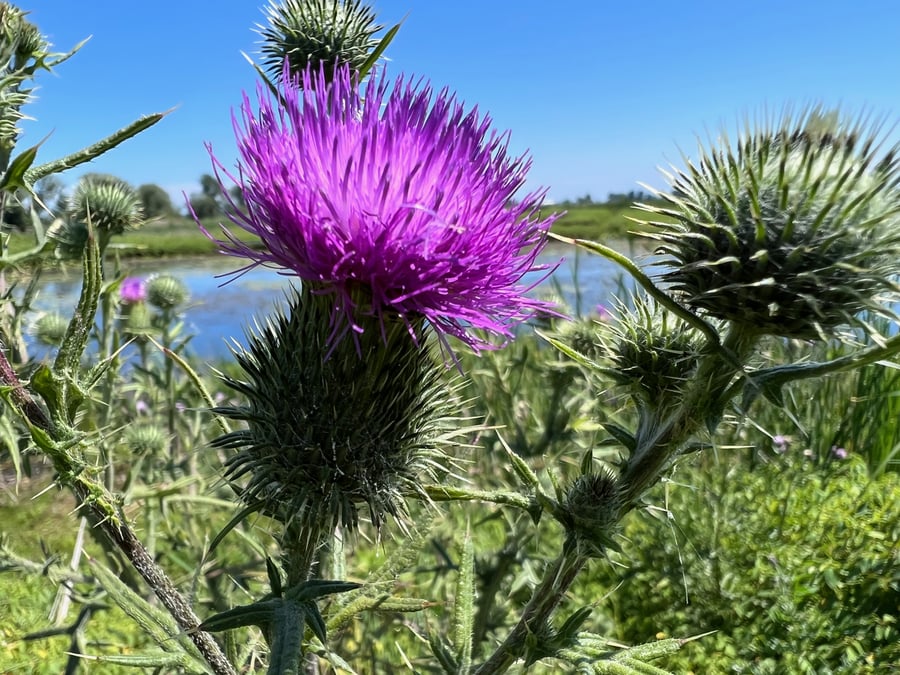
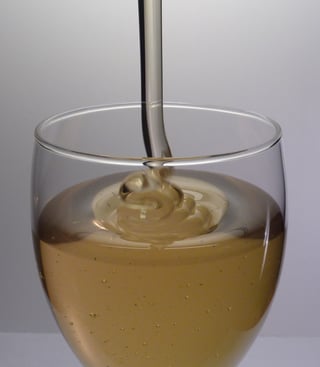
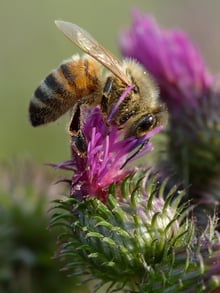
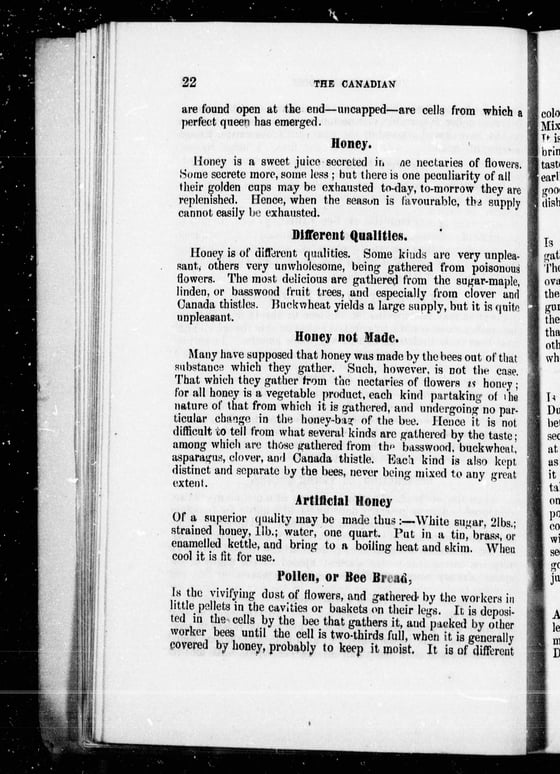
 Photo: קרלוס הגדול (Karlos HaGadol), Wikimedia Commons | CC BY-SA 3.0Honey bees on milk thistleTwo honey bees on a milk thistle head, Silybum marianum.
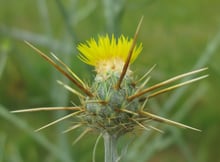 Photo: Harry Rose, Wikimedia Commons | CC BY 2.0Yellow star thistleYellow star thistle, Centaurea solstitialis, with the straw-coloured spines that give it its name.
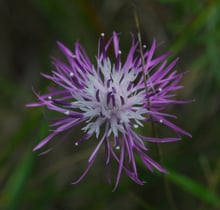 Photo: Joshua Mayer, Wikimedia Commons | CC BY-SA 2.0Spotted knapweedSpotted knapweed, Centaurea stoebe, the plant sold as star thistle in Michigan, on Washington Island, Wisconsin.
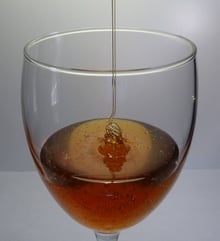 Photo: HoneyTraveler | CC BY-SA 4.0Star thistle honeyStar thistle honey from the American Midwest.
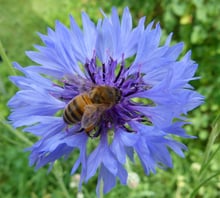 Photo: Dinkum, Wikimedia Commons | CC0Honey bee on cornflowerA honey bee on a cornflower, Centaurea cyanus.
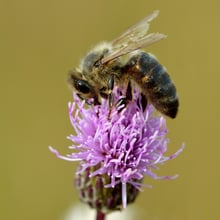 Photo: Ivar Leidus, Wikimedia Commons | CC BY-SA 4.0Honey bee on creeping thistleA honey bee on creeping thistle, Cirsium arvense, the Canada thistle of North America, in Keila, Estonia.
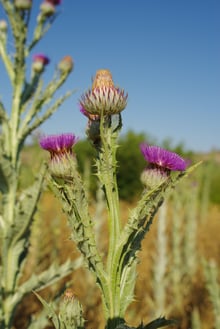 Photo: Javier Perez Montes, Wikimedia Commons | CC BY-SA 4.0Scotch thistleScotch thistle, Onopordum acanthium, in flower in the Parque Regional del Sureste, Madrid.
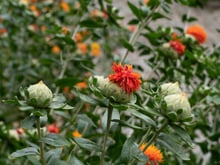 Photo: Esin Üstün, Wikimedia Commons | CC BY 2.0Safflower in flowerSafflower, Carthamus tinctorius, in flower in a crop in Turkey.
)
 Slow Food Ark of Taste, Cardoon honey (Italy, Sardinia) – the Slow Food Foundation for Biodiversity’s catalogue of foods judged at risk of disappearing. Its goal is to record a food as distinctive and at risk, and that is all it does: no production rule, no inspector, no mark on the jar. The English title mistranslates miele di cardo; the entry’s own text names Galactites, Carduus and Cirsium.
 Nemzeti Parki Termék, máriatövisméz (Hungary) – the Hungarian state’s National Park Product trademark, whose goal is to tie a product to a protected landscape and to the park authority that manages it. It vouches for provenance, not composition: the honey comes from milk thistle growing in protected areas of the Kis-Sárrét district of the Körös-Maros National Park. (Hungarian translated to English