Melaria Flor do Norte: A Honey House Above São Vicente, Madeira
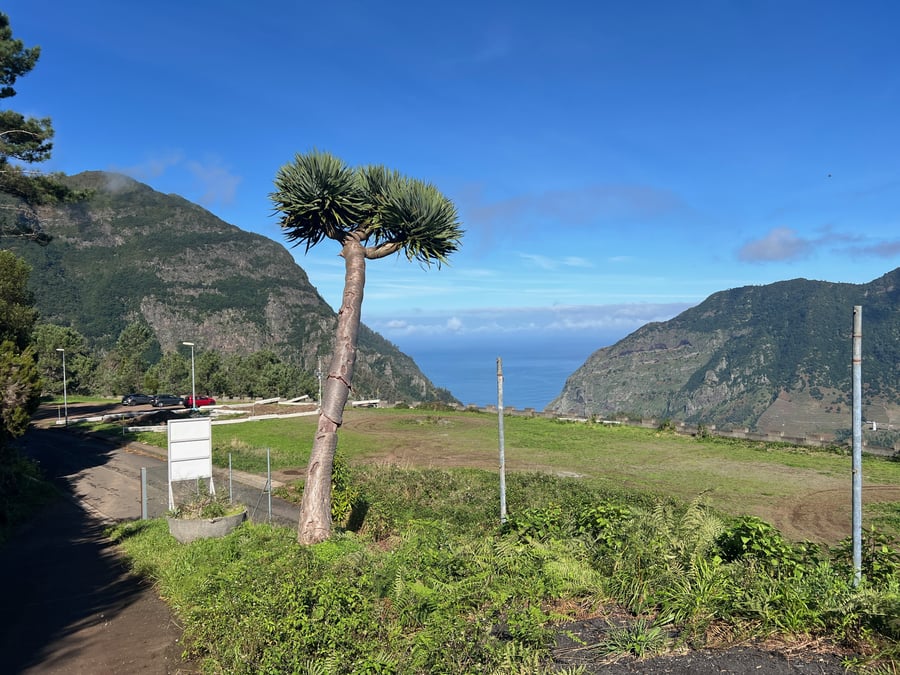
The sign for Melaria Flor do Norte stands beside a dragon tree on the lane at Ginjas, on Madeira’s north coast, and from it the valley runs down toward São Vicente and the sea.
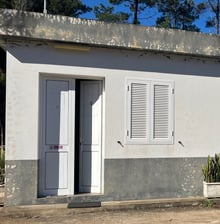
A melaria is a honey house, the place where honey is taken from the comb and put into jars. This one is a low white building with shutters, and its front room is the shop.
We walked in on a Tuesday in November without an appointment, and Monica, a partner in the business, met us there. Her husband, José Miguel Vieira, is the beekeeper named on the label. I asked if I could write about our conversation. “Yes,” she said, “but my conversation in English is not very good.”
The business began with José Miguel’s father in 2003 or 2004, as a hobby at home. The honey was extracted by hand in a garage until the work moved into this building in 2014 or 2015. The family now keeps between 300 and 350 hives around São Vicente.
The family takes two honeys a year, one light and one dark.
The honey the bees make over the winter is taken in spring, up to May, and there is only a little of it. It is light in colour, and Monica said it has more eucalyptus in it and crystallises quickly. The main crop comes off in September and October. It is made from many summer flowers, and it is dark. “The dark one, always it’s from the summer,” Monica said.
Both are sold as multifloral honey. “We don’t have a specific honey, it’s always multiflora,” she said, though eucalyptus is sometimes the main plant in winter.
One summer extraction was still to do when we visited, planned for the following weekend. That honey had been left in the hives on purpose, so the bees would have food if the rain was heavy. The 2026 crop was small. “I don’t have this year many production,” she said, and put it down to the weather.
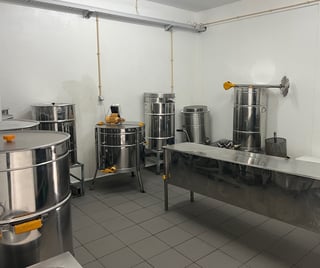
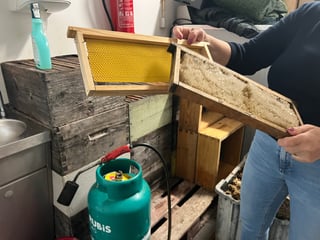
The honey is extracted and bottled without heating. The wax caps that seal the honey in the comb are cut from each frame of comb, and the frames are spun in a centrifuge, which throws the honey out of the comb. When the crop comes in, Monica and a colleague extract for about three days at a time, and the work lasts two months.
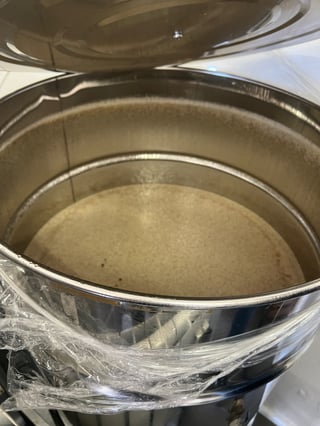
The honey then stands in a tank, where a crust forms on top. Monica explained it in Portuguese: “O mel faz a decantação das impurezas para cima. Por isso é que tem esta crosta.” In the honey the impurities settle upward, and that is why it has this crust. The clear honey is drawn from the bottom of the tank into a bottling machine that measures each fill.
The wax cut from the frames is melted down, and few people buy it. Bees build their comb on foundation, a thin sheet of wax fixed in the frame. To be made into new foundation, the wax would have to be shipped to the mainland, because Monica said there is no machine for it on the island. The family buys its foundation and its frames from the mainland.
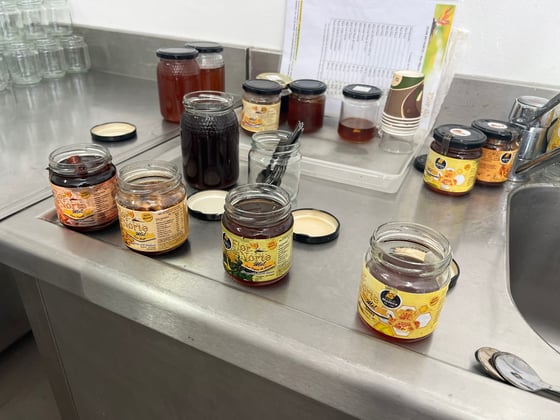
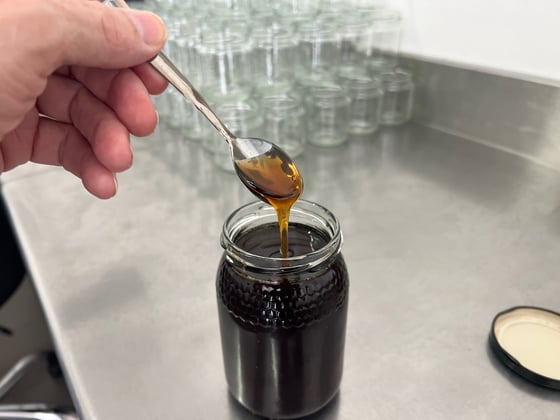
Monica set out jars and spoons, and we started with the plain honeys. The light winter honey was moderately sweet, with an aftertaste I liked. The dark summer honey was less sweet and much stronger, and its flavour stayed longer. Isabella and I both preferred it.
Three more jars held honey with something added. “First all the honey is pure, but then we add,” Monica said: laurel berries, walnuts or cinnamon sticks, left for three weeks to a month in whichever honey is on hand. “There are many laurel trees here,” she said of the berries.
I tried the laurel berry honey first. “Very intense,” Monica said, and Isabella called it “very heavy”. The walnut jar is so full of nuts that the honey is hard to taste by itself. Monica eats it with fresh cow’s-milk cheese. “I think all the cheese with honey it’s very good,” she said. Of the cinnamon honey she said, “It’s good to put on the coffee.”
I am not usually keen on flavoured honey, but none of these tasted artificial, and the cinnamon was the one we took home.
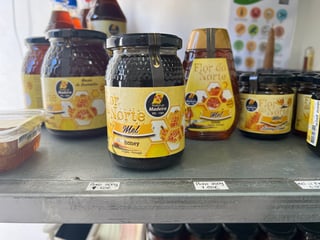
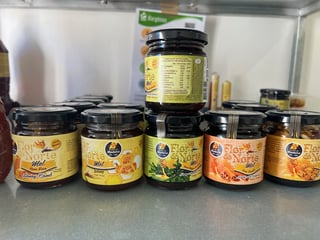
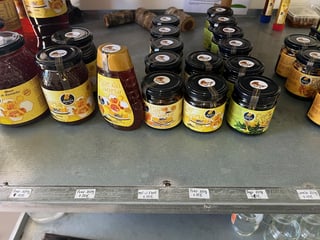
The shelf in the front room holds the plain honey, honey with a piece of comb, and the three honeys with additions.
The label carries the Produto da Madeira seal, the regional government’s mark for products of Madeira. The number on it, PD-1391, is his company’s entry in the mark’s register of producers, and the company’s name, which is his own, is on the back label.
In November 2026 the plain honey was 9.50 euros for 500 grams, 7.00 for 350 grams and 6.00 for 250 grams. A 250-gram jar with cinnamon was 6.40, with walnuts 6.50, and honey with a piece of comb 6.50. The smallest jars, 50 grams, started at 2.50.
We bought a jar of the dark summer honey and a jar of the cinnamon, 12.40 euros for the two.
In November 2026 the honey house’s contact page (Flor do Norte, São Vicente – Portuguese translated to English ) gave its hours as Monday to Friday from nine to six and Saturday from nine to three. The Madeira honey page gives the bus from Funchal, the honey museum at Lameiros and lunch in São Vicente.