
Honey Grevillea
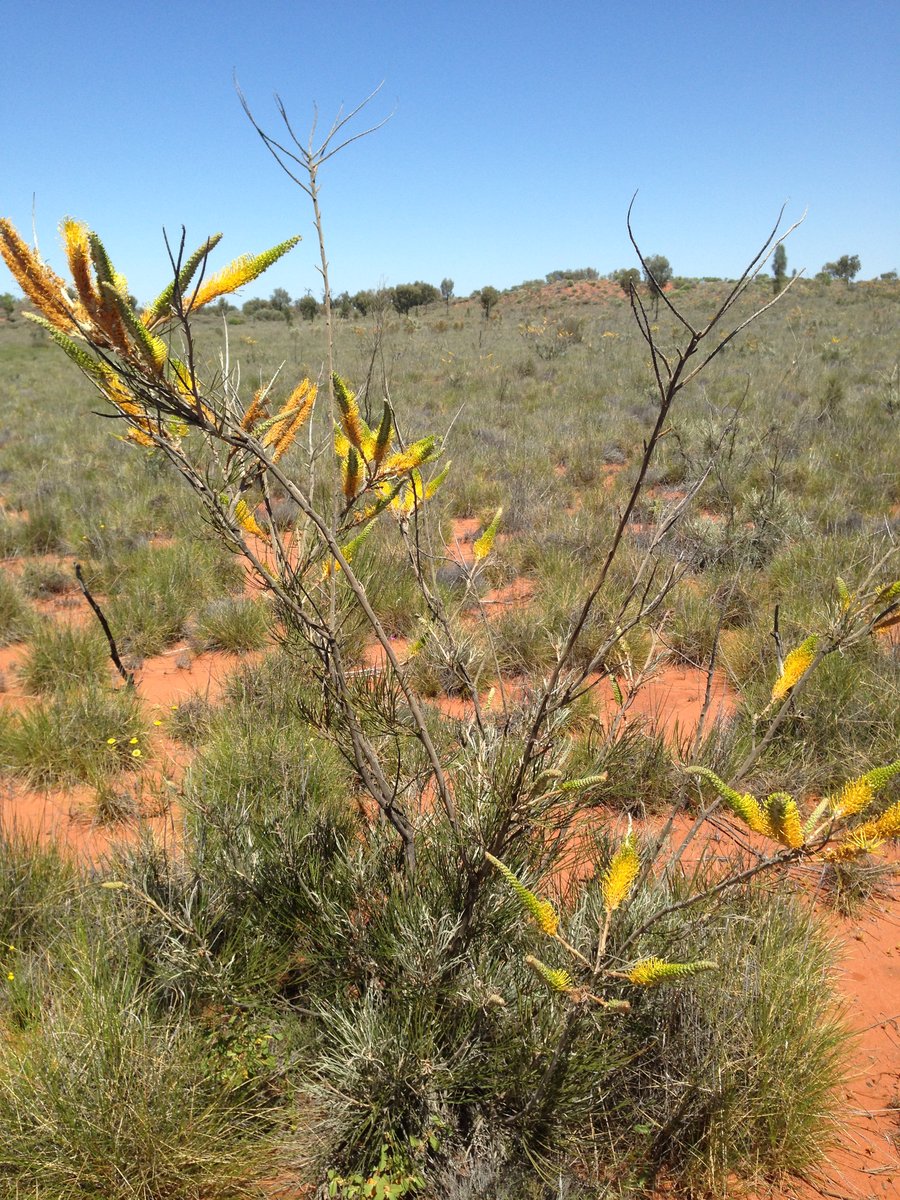
In the deserts of Central Australia, around and west of Uluṟu, live Aṉangu – the Pitjantjatjara- and Yankunytjatjara-speaking peoples of the Western Desert. To Aṉangu, sweet foods are a food class of their own: tjuratja. Gathering tjuratja was traditionally the work of women. The honey grevillea is the flower of that class – a desert shrub that holds its golden flower spikes clear of the foliage, each spike carrying nectar thick enough to suck on the spot, or to swirl through water in a billycan for a drink Aṉangu artists call honeywater. The plant’s recorded Pitjantjatjara names include kaliny-kalinypa – and sometimes simply tjuratja, the plant named for the food class it belongs to.
The flower has a Dreaming – a creation story held at a desert rockhole called Pukara – and desert artists paint it: canvases carrying the honey grevillea story hang in the Art Gallery of New South Wales, the Queensland Art Gallery, and the British Museum.
The same drink appears wherever a honey grevillea grows – in Kakadu, in the Kimberley, on Groote Eylandt, across the Centre. No one bottles it. The drink is made where the flowers are, in the weeks each community’s calendar names.
Tjuratja – the Sweet Foods
Aṉangu sort traditional food into named classes: kuka, the meat foods; mai, the plant foods; maku, the edible grubs; and tjuratja, the sweet foods. The bush-food guide for Uluṟu-Kata Tjuṯa National Park gives tjuratja two examples – honey grevillea nectar and tjaḻa, the honey ant – and the class also holds lerp, the sugary crust a sap-feeding insect builds on eucalyptus leaves. In this classification the nectar sucked from a flower and the honey dug from an ant nest are the same kind of food, and Pitjantjatjara has a second word beside the class name: wama, glossed in the Pitjantjatjara/Yankunytjatjara dictionary as nectar and other sweet substances. Desert artists’ texts join the two – tjuratja wama, the sweet nectar.
At Uluṟu the park’s plant guide, written with the traditional owners, states the practice plainly: the flowers hold thick, honey-like nectar that is sucked directly from the flower – a favourite treat for Aṉangu children – or soaked in water for a sweet, cordial-like drink. The artists’ accounts carry the technique: morning is the best time to gather, a flower struck against the palm leaves its nectar to be licked off, and flowers picked into a billycan of water make the drink they call honeywater, or bush cordial.
East of Aṉangu country, Arrernte gather the same sweetness under another name: ngkwarle, the honey-like foods, recorded by the Arrernte elder M.K. Turner in Arrernte Foods: Foods from Central Australia. Her grevillea entry is as plain as the practice itself: “Nectar shaken and eaten, or mixed with water to make a sweet drink.” The class holds corkwood nectar and bloodwood nectar beside the grevillea.
The Flower and Its Nectar
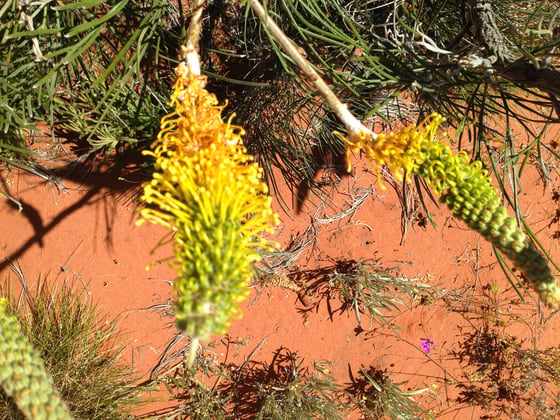
Grevillea is a genus of about 360 species, nearly all of them Australian, in the same Gondwanan family as the banksias and the proteas. Two of its desert shrubs share the name honey grevillea. The kaliny-kalinypa of Aṉangu country is Grevillea eriostachya – leafy at the base, its flowering stems standing clear of the foliage and carrying golden spikes, on spinifex sandplains and dunefields from Western Australia across the southwest of the Northern Territory into South Australia. Its close relative ultukunpa, Grevillea juncifolia, grows taller in the swales between the dunes and opens orange; the two are close enough that the Northern Territory Herbarium’s own factsheet notes they are occasionally confused. In the desert the bloom follows rain: the herbarium records flowers in almost any month, but the flush – and the nectar – comes after a good fall.
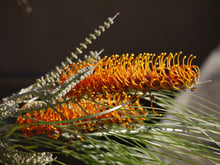
The drink’s northern carrier is a tree. Grevillea pteridifolia, the fern-leaved grevillea, grows to six metres in the open woodland that runs from the Kimberley across the Top End into Queensland, with silvery fern-cut leaves and orange spikes over twenty centimetres long that carry all their flowers on one side – another of its common names is golden toothbrush grevillea. In Kakadu it blooms from May to September, through the dry season.
These are bird flowers. Nectar-eating birds pollinate them, and the fern-leaved grevillea presents its nectar at the flower tips, in the open, where the University of Melbourne botanist Gregory Moore put it simply: grevilleas literally drip nectar. The nectar matters most in the dry season: field studies around Darwin found twenty-one bird species beyond the honeyeaters and lorikeets probing flowers in the cool months, with 85 per cent of those records on just two trees, the Darwin woollybutt and the fern-leaved grevillea – rated by the researchers as vital resources for dry-season survival. Even Torresian crows drink it.
None of this sweetness reaches a hive in any quantity. Australian beekeeping literature rates grevilleas as nectar-rich but too dilute for a honey flow – planted to attract birds, of little benefit to bees – so there is no Australian grevillea honey in trade. The one grevillea honey the world does jar comes from the silky oak, Grevillea robusta, and mostly overseas, where the tree is planted through Kenya and India as a farm and shade tree.
The Dreaming at Pukara
Pukara is a rockhole in the sandhill country of Western Australia, southwest of the Irrunytju community, close to where Western Australia meets South Australia and the Northern Territory. It is the home of the honey grevillea Dreaming – in Pitjantjatjara, the Kaliny-kalinypa Tjukurpa – and senior artists from at least five desert art centres have painted it, across three generations.
Dig Deeper: What a Dreaming Is -- and the Story at Pukara
“Tjukurpa (pronounced chook-orr-pa) is the foundation of Aṉangu Culture,” begins the account Uluṟu-Kata Tjuṯa National Park publishes with its traditional owners. Tjukurpa is the religious philosophy that links Aṉangu to the land and their ancestors: stories from the beginning of time, when Ancestral Beings created the world, carrying the rules for behaviour and the practical knowledge of the desert. The stories work like maps – in the park’s words, “they tell us where important places are, how to travel from one place to another, and where and when we can find water and food.” Dreaming is the common English word for this body of story and law; Aṉangu call theirs Tjukurpa, and Warlpiri, further north, call theirs Jukurrpa.
Tjukurpa is not written down. It is memorised and passed on “to the right people like an inheritance,” and it refers to the past, the present and the future at the same time. It is remembered through inma – songs and ceremonies – and through stories, dances and art, including the dot paintings of the Western Desert. Some of it can be shared; the secret and sacred parts remain with senior Aṉangu. What appears on this page is the shared layer, in the words the artists publish themselves.
At Pukara, two wanampi – water-serpent men, a father and a son – live in the rockhole. “Tjuratja tjuta (lots of sweet nectar) grows at Pukara,” writes Iyawi Wikilyiri, whose father’s and grandfather’s country it is. Women gather kaliny-kalinypa there, and in the Warlukurlangu account women dance inma at Pukara to increase the nectar in the flowers. Jimmy Donegan’s account carries an episode of the story: the two serpent men are woken by Minyma Punpunpa, the female flies, buzzing around the honey bush, and rise to collect the honey themselves; a black ant man, Wati Mututa, finds them and spears the son. “It’s important to treat this country with respect as two wanampi live here,” Iyawi Wikilyiri writes. “It can be dangerous.”
The painters span three generations. Ruby Tjangawa Williamson of Amata painted Ultukunpa until her death in 2014; her granddaughter Brenda Punytjina Armstrong paints the same Dreaming today from Nyirripi. Inawintji Williamson’s Ultukunpa (honey grevillea) was a finalist for the Sulman Prize at the Art Gallery of New South Wales in 2022, and the senior men of the Spinifex Arts Project – whose word for the flower is palimpaimpa – have painted Pukara as a collaborative canvas since the late 1990s; one of their Pukara canvases hangs in the British Museum.
A Drink Across Australia
The communities that make the drink publish seasonal calendars, and the honey grevillea’s flowering appears in them as a season marker. At Uluṟu, the seasons account the park publishes with the traditional owners describes piriyakutu, the season of a warm steady wind out of the north and west around August and September, when animals breed and the hibernating reptiles emerge – and adds: “Sometimes we describe this season by saying it is when the kaliny-kalinypa (honey grevillea) flowers.” That is when the sweet drinks are made. The same account states the ground rule in a traditional owner’s words: “Aṉangu don’t go by piranpa dates, we only go by our own seasons.”
In west Arnhem Land the Kunwinjku seasons calendar – compiled by named Kunwinjku knowledge holders with CSIRO and the ANU, its copyright held by the contributors – lists the fern-leaved grevillea in Wurrkeng, the cool dry season around June and July: many plants are flowering, Mandjalen the woollybutt, Manbordokorr the stringybark, Mandadjek the fern-leaved grevillea, “and the native bees are busy so it’s a good time to collect Mankung, sugar bag.” The flower whose nectar is drunk directly also marks the season for the sugarbag harvest.
On Groote Eylandt the season carries the tree’s name: Yinungkwurra, the dry season from around June to September – and in the Anindilyakwa language centre’s bilingual account, written by Sylvia Tkac, “in the early mornings, children and adults sucked the nectar from the flowers of the fern-leaved grevillea yinungkwurra.” Two thousand kilometres west at Kununurra, the Miriwoong seasonal calendar carries the same tree as a marker: its orange flowers around July mark Warnka-mageny, the cold season, and the flowers go into water for a cordial called gali-galing. Around Katherine, the flowering opens Malapbar, the Jawoyn cold-weather season.
The tree has a name in most languages of the north – man-dadjek to Kunwinjku speakers, yawuny to Yolngu, bigirri to the Ngarinyman south of the Victoria River. The Ngarinyman dictionary entry ends the way most of these records end: “The flowers can also be placed in a billycan of water and swirled around; this makes a sweet drink like cordial.”
What It Is Like
The earliest written taste note is a government botanist’s. In The Useful Native Plants of Australia (1889), J.H. Maiden described grevillea flowers “exceedingly rich in a clear, sweet, honey-like liquid, which can be easily shaken out from the flowers and collected.” What a hive would spend days evaporating into honey is here drunk as it comes: dilute, fresh, straight from the flower. Gregory Moore calls it “the original lolly water.” The nectar runs fullest in the early morning, and at the peak of a good flowering the flowers can drip it onto the ground.
The taste reports begin with sweetness – an edible-garden designer filming among fern-leaved grevilleas in the Territory called it “absolutely the sweetest of any of the flower nectars I have ever tried.” Then something behind the sweetness: a Darwin botanist describes the nectar as “sweet and fragrant with a malty flavour,” a note that appears independently in more than one Top End account. Swirled through cool water it makes the drink the desert artists call honeywater – the park’s own description is “a sweet cordial-like drink” – and the same Darwin account records flowers steeped in hot water instead, for something closer to a honeyed tea.
The vocabulary is consistent, and it is a child’s: bush lolly, lolly water, cordial, honeywater. The record keeps placing the drink with children.
Where to Find It
At Uluṟu, SEIT’s small-group cultural tours travel onto Aṉangu family country with Aṉangu guides; a press account of the Patji tour describes the guide, traditional owner Sammy Wilson, stopping at a honey grevillea thirty kilometres inside his family’s country. The tour’s bush-tucker tasting drew one travel writer’s line: “perhaps nature’s partner to the honey ant.” Ayers Rock Resort runs a free daily Bush Food Experience, and the park’s Cultural Centre carries the tjuratja story. Inside the national park, foraging is prohibited; Aṉangu collect nectar from the flowers without picking them. A park visit offers the plant and its story, not a tasting.
In Alice Springs the Desert Park grows both desert honey grevilleas, labelled, and runs a daily bush-food talk with Arrernte interpretation; galleries on Todd Mall sell current Kaliny-kalinypa canvases by APY-lands artists. At Kings Canyon, Karrke – owned and run by a Luritja and Pertame family – runs a one-hour bush food and bush medicine session on their own country.
In the Top End the tree grows beside many of Kakadu’s walking tracks. Animal Tracks runs a seven-hour safari out of Cooinda with a Bininj guide: bush-tucker gathering through the afternoon, then a campfire cook-up at sunset. Ayal Aboriginal Tours guides Kakadu on its owner Victor Cooper’s country. The Bowali Visitor Centre displays the six Bininj seasons, Wurrkeng among them. In Darwin, the George Brown Botanic Gardens’ Matboerrma Walk covers Larrakia plant use.
The Australian National Botanic Gardens in Canberra grows the desert honey grevillea in its Red Centre Garden and runs a self-guided Aboriginal Plant Use Trail. The tree can also be planted at home: a Darwin native nursery sells the fern-leaved grevillea – its sales copy reads “delicious sweet nectar is licked, sucked or used to make a sweet drink” – and a Tiwi-owned nursery grows it from seed collected on the islands. One caution: the traditional drink species carry a long record of use, but some garden grevilleas do not. “You have to know which species to taste,” Gregory Moore writes, “as some, including the silky oak, contain hydrogen cyanide that could make you ill.” The common hybrid ‘Robyn Gordon’ is a known skin irritant.
Dig Deeper: The Flower Drinks in the Written Record
The colonial record noticed the sweetness early. Near Port Phillip in 1838, the explorer Thomas Mitchell recorded blossoms steeped overnight in water to make “a sweet beverage called ‘bool’”; Robert Brough Smyth’s 1878 compilation records the same drink from banksia flowers in Victoria, named Beal. Settlers called the banksias “native honeysuckle” for the nectar, and George Moore’s 1842 account of the Swan River colony reported that one banksia flower “contains at the proper season more than a table-spoonful of honey.” By 1889 the government botanist J.H. Maiden had drawn the family conclusion in The Useful Native Plants of Australia: “The Proteaceae seem to be the most abundant yielders of honey amongst Australian plants” – grevillea, banksia, hakea and waratah all on his list. The desert honey grevilleas entered the scientific record later, in the 1930s, through Cleland and Johnston’s plant lists from the Musgrave Ranges, the Granites and Ooldea.
Maiden’s own collector left a warning in the record. William Bauerlen, who gathered specimens for him, wrote that on dry stages he sometimes sucked banksia nectar for thirst “but always endeavour not to do so, as it invariably gives me a headache, and a feeling of nausea afterwards.”
The family produced a second flower sweetness on another continent. At the Cape of Good Hope, the nectar of the sugarbush – Protea repens, in the same Gondwanan family – was collected and boiled down into bossiestroop, “bush syrup.” The record runs from Lady Anne Barnard’s “syrup of the sugar tree” in 1797 through prize lists and household books; the South African National Biodiversity Institute calls it an essential component of nineteenth-century Cape medicine chests, and the practice had largely died out by 1900. In Australia the flowers were steeped fresh and drunk the same day; at the Cape the nectar was boiled into a syrup that kept.
The drink can ferment. The Noongar record from the Perth region calls the grevilleas Berrung and notes the nectar water was sometimes left to ferment into Gep, an intoxicating liquor, and the banksia drink Bool is recorded as a weak alcohol. The chemistry has been observed directly: a Deakin University study measured ethanol in the nectar of a garden grevillea and cultured a fermenting yeast from it – the nectar can begin fermenting in the flower.