
Desert Bloodwood Honey
The Story
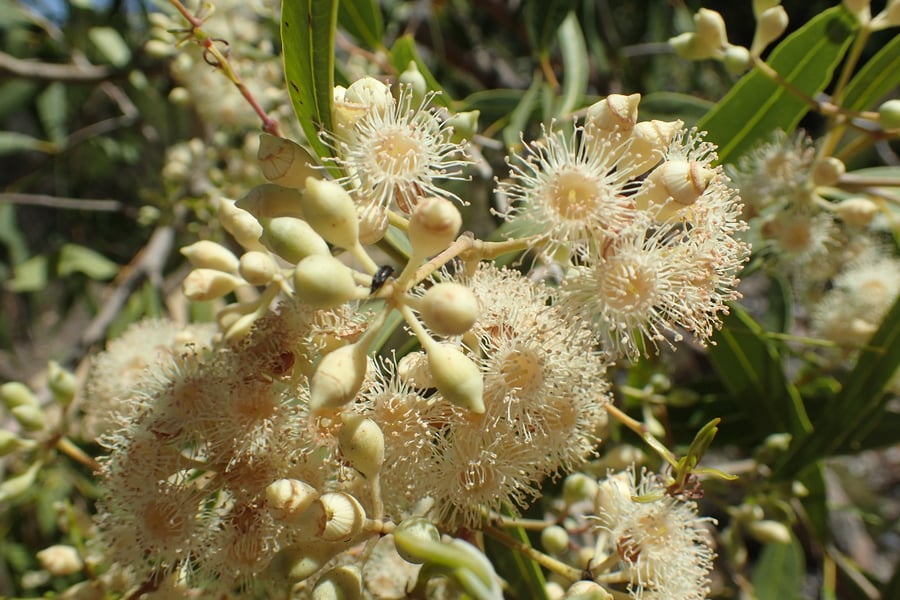
Aboriginal people in Central Australia take three things from the desert bloodwood: water, stored in its roots and dug out when nothing on the surface is flowing; medicine, the red sap that is pressed onto wounds, burns and sores and gave the tree its name; and food, the bush coconut, an apple-sized gall that holds an edible grub inside a white lining that tastes of coconut. Honey is the fourth harvest, and the newest. Since 2015, hives around Alice Springs have worked the tree’s white autumn and winter flowers, and the jars that come out of those hives hold a dark amber honey with a strength to match the country it comes from. It is the only one of the four harvests that is sold; the other three are still taken from the tree itself, on Country. The desert bloodwoods stand along the dry watercourses of the Red Centre, where their roots reach groundwater – the trees flower through the cool months, and the hives sit where the trees are.
Characteristics
Desert bloodwood honey is dark amber in the jar and strong on the spoon. It is sold raw and unfiltered, straight from the hive, and like most raw eucalypt honeys it crystallises in time; the producer states this plainly and treats it as normal, with a warm-water bath as the only correction. The strength is the point of the honey: producer and buyer accounts consistently describe flavour that holds through hot oats, yoghurt and toast rather than disappearing into them. No laboratory sensory analysis has been published; the description here is the market’s, from producer and buyer accounts.
Click to Display — The Details: botanical origin, sensory profile, and its regional identity
Botanical Name: Desert bloodwood (Corymbia opaca)
Botanical Family: Myrtaceae
Bee Species:
The European honey bee (Apis mellifera), in managed hives around Alice Springs. The Northern Territory’s bees are free of the varroa mite, and the whole Territory is a declared protected area for honey bees under its Livestock Act. The producing apiary breeds its own queens locally, sold as desert-adapted stock.
Color:
dark amber
Flavor Profile:
strong, dark and lasting; intense for a eucalypt honey
Tasting Notes:
The recorded descriptions are the producer’s and its buyers’, and they agree: this is a honey that stays present in whatever it is added to. Buyers report tasting it through hot porridge with cinnamon, through Greek yoghurt, and on toast, and describe it as darker and stronger than supermarket honey; one reviewer notes it is thick enough to sit on yoghurt rather than sink into it. The producer contrasts it with its own river red gum honey, which it calls the smoother and lighter of the two desert varietals.
Forage Origin:
The nectar comes from the desert bloodwood, Corymbia opaca, a tree of 3 to 15 metres with brown, flaky, tessellated bark, growing on sandplains, stony plains and drainage lines across the southern Northern Territory, inland Western Australia and the far north-west of South Australia. Around Alice Springs it lines the dry watercourses. Its white flowers open in clusters of seven at the ends of the branches from April to August, the cool months of Central Australia, and the hives that produce this honey are placed along the dry riverbeds where the trees concentrate. The tree reaches water the desert surface does not show: researchers in the Ti-Tree basin north of Alice Springs group Corymbia opaca with the river red gum among the region’s groundwater-using trees.
A buyer should know that bloodwood honey on an Australian shelf usually comes from a different tree. Most bloodwood honey in trade is from the red bloodwood, Corymbia gummifera, an east-coast forest tree that flowers in cycles of two to four years, and the Kimberley coast sells a third bloodwood honey from tropical species. The desert bloodwood is the inland member of the family, and its honey is jarred as a named varietal only around Alice Springs. The tree’s own name is contested in the herbarium record: some botanical authorities place Corymbia opaca inside a broader Corymbia terminalis, and the two names refer to the same central Australian trees in different institutions' records.
The varietal name is the producer’s claim, made from knowing which trees the bees work and jarring each flow separately – desert bloodwood and river red gum as distinct harvests. Laboratory pollen verification has not been applied to central Australian honey; the first systematic pollen study of Australian honeys, published in 2018, sampled southern Australia only.
Pairings:
It is used where a lighter honey vanishes: stirred into tea, over hot porridge, through yoghurt, on toast. Buyers treat it as a breakfast honey with the strength to carry through other flavours rather than a finishing honey for delicate dishes.
Origin Story
The jarred honey is recent, and its documented story is short and local. A network of backyard hives grew across Alice Springs through the 2010s, tended in ones and twos in private yards and harvested for the town’s markets. In 2015 a commercial apiary, Kekwick, began jarring the desert bloodwood as a named varietal alongside the river red gum. In 2016 the region’s beekeepers dealt with an outbreak of chalkbrood, a fungal brood disease that cut the yield of the town’s most experienced keeper, Russell Wilson, by four-fifths before a first-year apprentice’s hive-management fix spread through the community. The honey has been produced against that scale ever since: a few hundred registered beekeepers across the whole Territory, about ten of them commercial, in the one part of Australia the varroa mite has not reached.
Cultural Context
The desert bloodwood’s place in Central Australian life is documented use, layer on layer. The roots store water, and were dug and drained into a container when surface water failed. The tree bleeds red sap where the bark breaks – the reason for the English name – and Aboriginal people used the sap as medicine for sore eyes, wounds, burns and sores, and as a tanning agent for kangaroo-skin waterbags; oval sections of bark were cut from the trunk and worked into wooden bowls, and the urn-shaped gumnuts were used as decoration. The branches host the bush coconut, an apple-sized gall raised by a scale insect, split open for the edible insect inside and a white lining that tastes of coconut; the Arrernte name for this food is Merne arrkirlpangkwerle, and it holds a listing on Slow Food’s Ark of Taste. In the northern parts of the tree’s range its hollows are also recorded holding nests of native stingless bees – sugarbag, the older honey of inland Australia. The jarred honey on this page stands apart from that record: it is a beekeeper’s product of the last decade, made by an introduced bee, and it is bought rather than gathered.
Harvest & Forage
The flow is a cool-season flow. The desert bloodwood flowers from April to August, so the honey comes from autumn and winter – the reverse of the spring-and-summer pattern of Australia’s southern honey regions. The producer jars the desert bloodwood and river red gum flows separately. Scale is the binding constraint: the whole Northern Territory holds about ten commercial beekeepers, and one disease event – the chalkbrood outbreak of 2016 – was enough to cut the town’s most experienced keeper’s yield by four-fifths for a season. Supply is a single town’s, and batches sell through.
Beekeeping Context
Alice Springs beekeeping is a small community with one commercial anchor. Backyard keepers run one or two hives each under Territory registration rules, meet through the Alice Springs Beekeepers Association, and harvest for local markets. Kekwick, founded in 2015, runs its own hives on the desert bloodwood and river red gum country around the town, breeds its own queens, and sells from Alice Springs stockists and by shipping Australia-wide. The Territory’s protected- area status for honey bees, and its freedom from the varroa mite, are the regulatory background to all of it.
Named Producers
KEKWICK HONEY – Alice Springs. Jars Desert Bloodwood and River Red Gum as separate raw varietals from its own hives around the town; also raw honeycomb, seasonal bee pollen, and locally bred queens. Founded 2015; pickup in Alice Springs, local stockists, ships Australia-wide. kekwick.com.au
RED CENTRE HONEY – Alice Springs. A local apiary running its own hives around the town since 2010, sold through the IGA supermarkets of Alice Springs, Tennant Creek and Yulara.