
Northern Territory Honey
The Northern Territory is a sixth of Australia with a quarter of a million people in it, and it is really two countries. In the north, the Top End, the year splits into a wet and a dry, and the land floods and dries around wetlands, waterfalls and a long sandstone escarpment. In the centre, the Red Centre, it almost never rains, and the desert holds monoliths, gorges and some of the oldest rivers on earth. Aboriginal people have lived across both for tens of thousands of years and still hold about half the Territory. Nowhere else in the country is their presence so much the whole story.
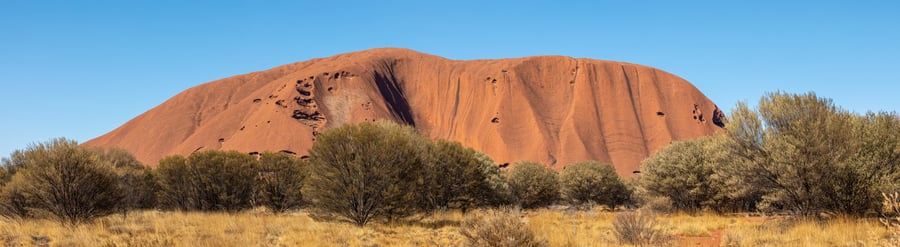
At the centre stands Uluṟu, a single block of sandstone rising three hundred and forty-eight metres from a flat plain, the exposed tip of a slab that runs kilometres underground. It belongs to the Aṉangu, who ask that you not climb it, and since 2019 no one does. You walk around its base instead, past waterholes and rock art, and nearby the thirty-six domes of Kata Tjuṯa rise higher still. Both are World Heritage listed twice over, once for the land and once for the culture, which is rare.
Fifteen hundred kilometres north, the country turns to water. Kakadu, the largest national park in the country and also World Heritage for both its land and its people, floods across a third of itself each wet season and dries back each winter, and its wetlands hold a third of Australia’s birds and more than ten thousand crocodiles. The saltwater crocodile here is not confined to the sea, so you swim only where the signs allow. On the escarpment walls people have painted for twenty thousand years, and the Bininj who own that country read six seasons in the year where the calendar shows two.
And honey runs through all of it, though not in jars. In the Top End, sugarbag – the honey of the native stingless bee – is tracked through the bush and cut from hollow trees, and the Yolŋu have sung and painted it for thousands of years. In the desert, honey ants store nectar in their own bodies underground, and women dig for them at the roots of the mulga. When senior men at Papunya painted a Honey Ant Dreaming on the school wall in 1971, it became the spark of the whole Western Desert painting movement. There is honey in jars too, from the Territory’s beekeepers – some of them Aboriginal-owned – working tropical and desert blossom with bees that have never met the varroa mite. But the honey that runs deepest here is the older kind.
Food
On a dry-season evening you carry a laksa down onto the sand at Mindil Beach, where the crowd goes quiet and then breaks into applause as the sun drops into the Timor Sea. Darwin is closer to Jakarta than to Canberra and eats like Southeast Asia; the market lays out Thai, Malay, Filipino and Timorese food along the shore, and the city’s cult dish is the laksa, hunted down at the Saturday Parap market as keenly as here. The iconic fish is the barramundi, a food of northern Aboriginal peoples for thousands of years and still best cooked the old way, wrapped in paperbark that steams the flesh moist and leaves a light campfire smoke. A thousand kilometres south the table changes with the country: in Alice Springs the Arrernte cook Rayleen Brown walks visitors through the desert bush foods and lays out quandong, saltbush and pepperberry – the Centre’s own flavours beside the Top End’s.
Darwin's table, and the bush behind it
Darwin is the most Asian of Australian cities, and its food shows it, built up by generations of Southeast Asian, Chinese, Greek and Timorese families. The Mindil Beach market is the clearest window on it, though it runs only through the dry season, roughly late April to October, on Thursday and Sunday evenings. Out of the bush come the native foods that Aboriginal people have gathered for millennia. The Kakadu plum, a small green fruit of the Top End, holds one of the highest concentrations of vitamin C of any fruit known, many times that of an orange. Crocodile and buffalo, both farmed or culled in the Territory, appear on menus as steaks, sausages and bao. The magpie goose, a bird of the wetlands and a traditional food, is protected wildlife, so it stays a cultural food rather than a menu item. And in the build-up to the wet, around September to November, the Top End goes through what locals call mango madness, when the fruit floods the markets and the heat frays the temper.
Culture
Each August in Darwin you can buy a painting from the hand that made it, yarning across the stall at the Darwin Aboriginal Art Fair, every dollar going back to the artist’s community. This is the heartland of Aboriginal Australia – three in ten Territorians are Aboriginal, more than a hundred languages are still spoken, and about half the land is Aboriginal freehold – and out of it came one of the twentieth century’s great art movements, the Western Desert dot painting that began on a school wall at Papunya in 1971. The same country carries a music to match: the Yolŋu band Yothu Yindi turned a broken treaty promise into “Treaty”, the first song in an Aboriginal language to chart, and each August the National Indigenous Music Awards fill the Darwin amphitheatre in the same week as the fair. And laid over all of it is a harder recent history that the Territory does not hide.
The desert that painted itself, and the harder history
In 1971, at the settlement of Papunya northwest of Alice Springs, senior men painted a Honey Ant Dreaming on the wall of the school, and the interest it stirred grew within a year into the Aboriginal-owned company Papunya Tula Artists. That mural is now regarded as the beginning of the Western Desert painting movement, the tradition of dot painting that carried Aboriginal art into the great galleries of the world. There are now dozens of Aboriginal art centres across the Territory, and each August the Darwin Aboriginal Art Fair brings work from more than seventy-five of them together, with all of the sale price going back to the artists and their communities. The harder history is close behind. Under Territory law, Aboriginal children were taken from their families through much of the twentieth century, the Stolen Generations whose testimony filled the 1997 Bringing Them Home report and led to the national apology of 2008. On the pastoral frontier, at Coniston in 1928, a police-led party killed Warlpiri, Anmatyerre and Kaytetye people in what is often called the last of the officially sanctioned massacres; the death toll has never been agreed, and Aboriginal accounts put it far higher than the official record. These are not stories the Territory keeps out of sight, and they belong beside the art.
Natural History
Climb the rim of Kings Canyon at first light – five hundred steps up the pinch they call Heart Attack Hill – and the top opens onto a lost city of weathered sandstone domes above hundred-metre walls, a green waterhole hidden in its heart. This is the Red Centre, arid and ancient, a worn desert of monoliths and gorges where the heat sets the rules and there is no water to fear. Fifteen hundred kilometres north the country turns to water: at Nitmiluk the Katherine River has cut thirteen gorges you paddle one into the next, waterfalls run and dry with the season, and the saltwater crocodile means you swim only where a sign says you can. Almost all of both is walked and cruised from marked places, and almost all of it is owned or jointly managed by the Aboriginal people whose country it is.
The Red Centre
Uluṟu is a single block of sandstone, three hundred and forty-eight metres high and nine kilometres around, and only the tip of a formation that runs kilometres down. The base walk loops the whole rock past waterholes and painted shelters, and the climb, which crossed a sacred Aṉangu route, closed for good in 2019. Nearby, Kata Tjuṯa is a cluster of thirty-six domes of a different rock, a cemented conglomerate, its tallest dome higher than Uluṟu; the Valley of the Winds walk threads between them. To the north, Kings Canyon drops a hundred metres in sheer walls and is walked on a rim loop, and west of Alice Springs the gorges of the West MacDonnell Ranges, strung along the two-hundred-kilometre Larapinta Trail, hold waterholes cold enough to take your breath. Further out stand the balanced granite boulders of Karlu Karlu and the eroded ring of Tnorala, a crater a comet punched into the desert about a hundred and forty million years ago. Through it runs the Finke, reckoned one of the oldest rivers on earth. In the heat of summer the desert walks close from late morning, so the Centre is best in the cooler months.
The Top End
Kakadu is the largest national park in the country, nearly twenty thousand square kilometres, and it floods and dries with the seasons; at the height of the wet, water covers a third of it, and its wetlands carry a third of all the bird species in Australia. You see it best from the water, on the Aboriginal-run Yellow Water cruise among the crocodiles and the waterbirds, and from the escarpment at Ubirr and Nourlangie, where the rock has been painted for twenty thousand years. Its tallest waterfall, Jim Jim, plunges two hundred metres, reached only by four-wheel drive in the dry. South of it, Nitmiluk is a run of thirteen gorges cut by the Katherine River and owned by the Jawoyn, cruised or paddled by canoe. Closer to Darwin, Litchfield is the easy one, its spring-fed pools at Florence and Wangi Falls flowing year round, and its black plains studded with the thin, tomb-like mounds of the magnetic termites, which build them aligned north to south to dodge the midday heat. Everywhere in the Top End the same rule holds, from the same animal: the saltwater crocodile lives in fresh water as well as salt, so you swim only where a sign allows it.
Built Heritage
Long before the telegraph, this coast was already tied to the world: for two centuries, until 1907, Makassan fishermen rode the monsoon down from Sulawesi to the Arnhem Land shore to harvest trepang, trading with the Yolŋu and leaving words, tamarind trees, and paintings of their praus on the rock. The European line came later. In 1872 the Overland Telegraph was strung the length of the continent from Adelaide to Darwin, and through a cable from there it joined Australia to the world for the first time, cutting the time for a message to London from months to hours; its repeater stations founded the inland towns, Alice Springs among them. And Darwin, at the top of the line, grew a Chinatown that in the early days outnumbered the European town – its Chung Wah temple still stands off the Mall – before it was destroyed twice, once by war and once by weather.
Darwin, twice destroyed
On 19 February 1942 Japanese aircraft bombed Darwin in the first and largest enemy attack ever made on Australia, with more bombs dropped than on Pearl Harbor a few weeks before, and the first of some sixty raids on the north. Around two hundred and fifty people died, though the toll was hidden at the time and the true figure is still argued over. Then on Christmas Eve 1974, Cyclone Tracy came ashore and flattened the town, killing sixty-six people and destroying most of its buildings, after which almost the whole population was flown out in the largest airlift the country had seen. Darwin was rebuilt to withstand the next cyclone, and the story of both disasters is told at the Museum and Art Gallery of the Northern Territory, along with Sweetheart, a five-metre saltwater crocodile caught in 1979 and kept on display. Away from the coast, the same era survives more gently: the telegraph line that made the Territory is traced through its old stone repeater stations, and the Ghan railway still runs the length of it, named for the Afghan cameleers who once carried freight where the train now goes.
I want to dig deeper
Four experiences reward the traveller who wants to feel the Territory rather than drive through it. At Uluṟu, walk the base at first light with an Aṉangu guide, when the rock is cool and the story of each hollow and cave is told by the people whose law it is; and stay after dark for Bruce Munro’s Field of Light, where fifty thousand solar-lit stems bloom across the desert floor to the horizon, a one-of-a-kind artwork kept running now for more than a decade. In Kakadu, take the Yellow Water cruise in the early morning, when the mist is on the wetland and the crocodiles and the magpie geese are close, then climb to Ubirr for the escarpment paintings and the sunset over the floodplain. And in the Red Centre, a bush-tucker walk with a desert family, tasting the seeds and the honey ants that have fed people here for tens of thousands of years, does more than any museum to explain the country you are standing in.
The Honey of the Northern Territory
In the Territory the honey is old, and mostly it is not made by the honeybee at all. In the Top End, the honey is sugarbag, the small store of the native stingless bee, tracked through the bush and cut from a hollow tree with the wax and the brood together; the Yolŋu of Arnhem Land call it guku and have carried the Sugarbag Dreaming in their songs, dances and bark paintings for thousands of years. Sugarbag has even reached the shelf in a new form: the Larrakia-owned label Seven Seasons wild-harvests Top End bush honey and turns it into a liqueur and a whisky. In the desert, the honey is the honey ant, a worker gorged with nectar until its body swells to a bead of sweetness, dug by women from the roots of the mulga and pressed onto the tongue. The Honey Ant Dreaming runs through Central Australia, and the painting of it at Papunya in 1971 began the Western Desert art movement. And the sweetness is in the plants as well: the honey grevillea, kaliny-kalinypa to Aṉangu, holds nectar taken straight from its golden flower spikes or steeped in water for a sweet drink, in the Centre and again in the Top End. Alongside all this there is a small but real industry of bee honey – about two hundred and seventy registered beekeepers working some three thousand hives, only ten or so of them commercial, on an island of bees the varroa mite has never reached – and it is more varied than its size suggests. The Top End yields a dark, almost-caramel bush honey off the tropical eucalypts and paperbark, and its seasons, the wet, the dry and the build-up, each carry a different flavour; the Red Centre yields pale desert honeys from the bloodwood and the river red gum. Two of the producers are Aboriginal-owned. The sugarbag and the honey ants remain the older and deeper story, met on Country rather than bought – but the jarred honey is real, distinct, and for sale.
The Honey Road
The Territory’s honey road is not a row of shops but the two ends of the land, and mostly you meet the honey rather than buy it. In the Red Centre, a bush-tucker tour is the way in: at Wanmarra, near Kings Creek, the Luritja and Pertame guides of Karrke explain the honey ant among the desert foods, and in season you taste it. In the galleries of Alice Springs and Arnhem Land the two honeys turn up again as art, the honey ant in the Western Desert paintings that began at Papunya, the sugarbag in the bark and the ḻarrakitj poles of the Yolŋu. The traditional honeys themselves, sugarbag and honey ants, are cultural-harvest foods and are rarely sold; take them as they are offered, on Country, and leave the colony to recover as the harvesters always have. The commercial honey is easier to take home. In Darwin, Beescreek’s raw bush honey is on the shelves of grocers and delis across town, and you can carry a jar to its Winnellie shed to be filled; the Aboriginal-owned Uniquely Territory Honey bottles a separate honey for each Top End season – the wet, the dry and the build-up – sold at Aboriginal Bush Traders and Greenies in Darwin and across Katherine. Katherine’s Aboriginal-owned Nambula works the Big Rivers blossom, and its honey reaches Darwin and Alice through stockists. In the Red Centre, Kekwick jars its desert bloodwood and river red gum separately, and Red Centre Honey, run from its own hives around Alice since 2010, is sold through the town’s IGAs. The whole Territory is a declared protected area for honey bees under the Livestock Act, part of how its bees have stayed free of the varroa mite – still the case in mid-2026, with the mite now established across the eastern states but not here.
Getting Here
The Territory has two front doors, Darwin in the north and Alice Springs in the centre, both with airports, and between them lies a great deal of nothing. The Stuart Highway, the Track, runs sealed the whole way from Darwin through Alice to Adelaide, and the Ghan railway makes the same crossing in three days as a journey in its own right. The distances are the thing to plan for: this is a sixth of the country, and the marquee sights are hundreds of kilometres apart. Season matters as much as distance. The Top End is best in the dry, roughly May to October, when the roads are open and the crocodiles concentrate; in the wet, floods close many park tracks, and much of Kakadu’s back country needs a four-wheel drive. The Red Centre, ruled by heat rather than water, is most comfortable in the cooler months, when the desert walks are not shut by the late-morning sun.
Seasonal Events Not to Miss
The Territory’s calendar bends around the dry season, when the weather lets people gather. In autumn, the Alice Springs desert lights up for Parrtjima, a free festival that throws Aboriginal art in light across the MacDonnell Ranges. In August the north fills up: the Darwin Festival and the Darwin Aboriginal Art Fair run together, and out on Yolŋu Country in Arnhem Land the Garma Festival gathers the largest Aboriginal cultural meeting in the country. The same month, on the dry bed of the Todd River, Alice Springs runs the Henley-on-Todd Regatta, a boat race with no water, along with the Camel Cup. Dates shift year to year, so confirm each with the organiser before you plan around it.
Where to Buy Honey
The Territory’s oldest honeys – sugarbag and honey ants – are gathered on Country and rarely reach a shelf, so the way to taste them is on a bush-tucker tour such as Karrke’s in the Red Centre, or to see them held as art in the galleries of Alice Springs and Arnhem Land. The honey in jars, though, is real, for sale, and more varied than the Territory’s size suggests. The easiest counter to walk into is Aboriginal Bush Traders, an Indigenous-owned store in central Darwin (Shops 4-5, Smith Street Mall) that stocks Territory honey beside its art and bush foods. Darwin’s own Beescreek Honey, a dark raw bush honey, is carried by grocers and delis across the city and can be bought by the refill at its Winnellie shed. The Aboriginal-owned Uniquely Territory Honey, out of Katherine, bottles a separate honey for each Top End season and is widely stocked across Darwin and Katherine. A second Aboriginal-owned Katherine apiary, Nambula, works the Big Rivers blossom and reaches Darwin and Alice Springs through stockists. In the Red Centre the honey turns to the desert: Kekwick jars its desert bloodwood and river red gum separately in Alice Springs, and Red Centre Honey, run from its own hives around town since 2010, is stocked in the IGAs of Alice Springs, Tennant Creek and Yulara.