Kangaroo Island Honey
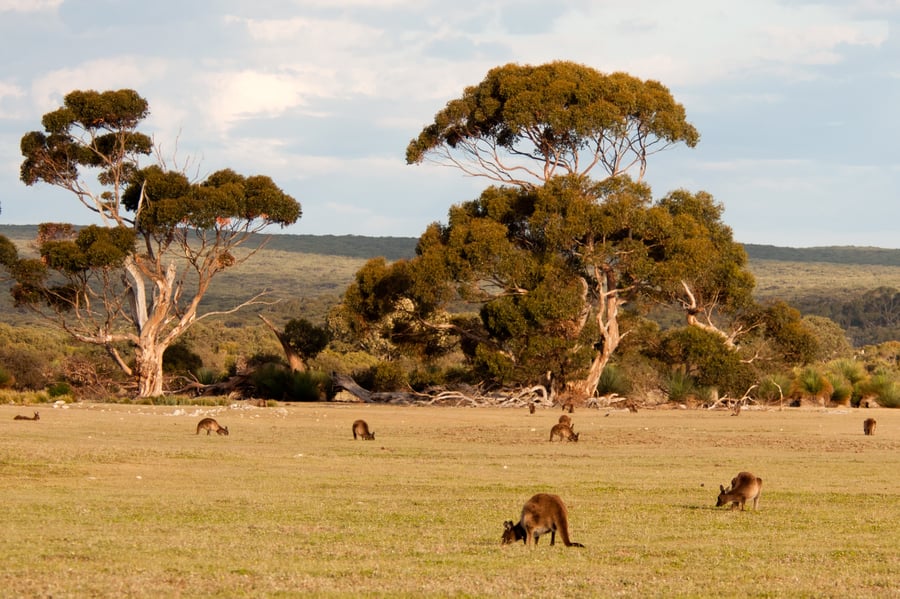
Kangaroo Island lies about sixteen kilometres off the coast of South Australia, across a strait called Backstairs Passage, and it has been an island for roughly ten thousand years. People walked here in the deep past, before the rising sea closed the gap; when they stopped is not settled, and no one was living here when Europeans arrived in 1802. To the Ngarrindjeri and Kaurna peoples of the facing coast it is Karta, the Island of the Dead, the place the spirits of the dead set out for – a connection their descendants hold to this day.
That long isolation is much of why people come. Cut off from the mainland, the island’s animals went their own way, and some now live nowhere else – a darker, stockier kangaroo, an endangered echidna, the glossy black-cockatoo that has gone from the South Australian mainland. Foxes and rabbits never reached the island, so a good deal of what disappeared elsewhere survived here. On the south coast at Seal Bay you can walk the sand with a guide among a wild colony of Australian sea lions, one of the rarest seals in the world.
The island a visitor crosses is really two. The east is settled and green, and it holds most of the island’s life – the farmland, the towns, the wineries and distillers, the studios of a place where an unusual share of people make things by hand. The west is wilder and emptier: the granite of the Remarkable Rocks on a bare dome above the sea, the fur-seal cove under Admirals Arch, surf coasts and beaches reached through gaps in the headlands. That western country is still coming back from the fire of the 2019 and 2020 summer, and the regrowth – green breaking straight from black trunks, the boardwalks and the park’s visitor centre rebuilt – is now part of what you go to watch.
And the island holds one thing found nowhere else. In 1885 it was made a sanctuary for the Ligurian honey bee, a gentle golden strain from northern Italy, and no other bee has legally set foot on it since; the checks at the ferry and the ban on carrying so much as a jar of honey across still hold. It leaves Kangaroo Island with one of the most isolated populations of the bee left anywhere, and the honey those bees work off the island’s sugar gums and mallee is something you can carry home from nowhere else.
Food
Kangaroo Island eats and drinks well out of all proportion to its size, and its Farm Gate and Cellar Door Trail runs the length of the island – three loops of about a day each, the Dudley Peninsula by the ferry, the centre around Kingscote, and the south coast – taking you to the growers and makers at the source. The island delicacy is marron, a freshwater crayfish raised only here and in Western Australia, sweet and nutty and rated by chefs among the finest of any crustacean, eaten fresh from the farm where it is grown.
The place to eat the island’s seafood in one sitting is the Oyster Farm Shop at American River, where an aquaplatter comes loaded with marron or King George whiting, oysters, abalone and smoked mullet, and a fish dip to smear on island-baked ciabatta; it is the only place on the island that shucks the native Angasi oyster. Marron is freshwater and comes through the year, but the marine catch is not the sure thing it was – a coastal algal bloom has disrupted the island’s oysters and abalone since 2025, and the long-running abalone farm is closing – so ask what is local before you order. For something plainer, Kangaroo Island Fresh Seafoods at Kingscote turns out fish and chips that locals rate among the best in the state.
The drinks keep pace. At Cygnet River, Kangaroo Island Spirits flavours its gins with coastal daisy and boobialla and has taken awards in New York and London; its whisky, aged in ex-bourbon, apera and tawny casks, is made from island-grown barley. The Emu Ridge distillery at MacGillivray runs a cafe beside its eucalyptus still and pours a gin distilled from mallee blossom that is made nowhere else, and the wineries and cellar doors gather on the Dudley Peninsula by the ferry. A brewery at Kingscote and another at Parndana, and a scatter of wine and whisky bars, have thickened the scene since 2024, and the island’s bread comes from a single sourdough bakery, D’Estrees, which keeps no shopfront but supplies the cafes and both markets.
Near Kingscote you queue at Clifford’s Honey Farm for Jenny’s honey ice cream – the drunken honeycomb and nut is the one people come back for. The markets that gather the growers at Penneshaw and Kingscote run through the warmer months, roughly October to April; in winter a food festival spreads producer dinners and tastings across June to August instead.
Culture
For an island of five thousand people, a startling number of them make things. Above Hog Bay at Penneshaw a free sculpture trail winds a kilometre and a half through coastal scrub, over wooden walkways and a suspension bridge, past nearly twenty works with the sea behind them. In Kingscote you can watch a silversmith at his bench and buy the piece he has just finished, in a gallery that also hangs painters whose work is in the National Gallery; smaller studios open across the farmland, some by appointment, some just when the flags are out at Baudin Beach. Around one islander in ten works in the arts. And the island’s oldest story belongs to people who no longer live here but have never let it go.
Karta, the Island of the Dead
Aboriginal people lived on Kangaroo Island in the deep past. Stone tools from the Seton rock shelter date human presence to at least sixteen thousand years ago, before the rising sea cut the island off from the mainland around ten thousand years ago. When, and why, people stopped living on the island is genuinely debated among archaeologists – estimates range across several thousand years, and the old colonial idea of a simply empty island is disputed – so it is best not stated as a settled fact. What is clear is that no one was living there when Europeans arrived in 1802. To the Ngarrindjeri and Kaurna peoples of the facing coast the island is Karta, the Island of the Dead. In the Ngarrindjeri tradition of Ngurunderi, an ancestral creator, the dead travel west along his path to the end of the island, where he dived into the sea and rose to become a star. This is a living belief, not a story of a vanished people, and the connection to the island is held by their descendants today. On-island interpretation of this history is still thin. A Ngarrindjeri-led walk at Penneshaw has run in recent years, but it is arranged privately through a mainland operator rather than offered on a schedule, so hearing this story told by its own people takes planning ahead.
Natural History
This is the reason most people come. At Seal Bay a ranger walks you down onto the beach to within twenty metres of a wild colony of Australian sea lions – pups nursing in the dunes, young ones sliding down the sand and scrapping at the water’s edge, big males hauling in from the surf – the only beach in the world where you can walk among them like this. The sea lion is found nowhere but Australia, and the island is thick with other creatures that live nowhere else. At the western tip the granite of the Remarkable Rocks stands hollowed and streaked with orange lichen on a bare dome above the sea, best in the low light of morning or evening, and a short boardwalk drops down the cliff at Admirals Arch to fur seals sprawled on the rocks below. The coast runs from the sheltered rock pool at Stokes Bay, reached through a passage in the headland, to surf beaches where the rips make swimming a bad idea, and kangaroos come out to graze the paddocks at dusk.
The ark: what the isolation kept
The Kangaroo Island kangaroo is its own subspecies of the western grey, darker and stockier than its mainland cousins. The short-beaked echidna here is an endangered island form, and the glossy black-cockatoo is the whole point of a long recovery effort: the island holds the only surviving population of the South Australian subspecies, and a program begun in the 1990s has lifted it from about a hundred and fifty birds to more than four hundred and fifty, feeding it back up on the drooping sheoak whose seeds are almost its only food. The island is also the last home of the Kangaroo Island dunnart, a tiny marsupial found on no other land; its habitat mostly burned in 2020, and it now holds on inside a predator-free refuge built for it, doing better than anyone expected. At Seal Bay a guided walk takes you onto the beach among Australian sea lions, the country’s only endemic seal and one of its rarest; a boardwalk gives a self-guided view for those who do not join the walk. The refuge is real, but it is isolation and strict biosecurity that keep certain pests off the island, not any magic health.
The western wonders
At the island’s southwest tip, in Flinders Chase National Park, the Remarkable Rocks are a cluster of granite boulders weathered into hollows and curves on a bare dome above the sea; the granite is early Palaeozoic, hundreds of millions of years old, the shapes the slow work of wind, rain and salt. A short drive away a boardwalk drops down the cliff to Admirals Arch, a limestone arch with a breeding colony of long-nosed fur seals on the rocks below, and the Cape du Couedic lighthouse stands above it. Inland, the Kelly Hill Caves are a dry limestone system seen on a guided tour, reopened in 2023, and at Little Sahara a field of white dunes rises from the scrub, where you can hire a board and toboggan down. The fire of 2020 came through this western country and burned most of Flinders Chase; the recovery is the thing you now watch as you walk, fresh growth breaking from blackened trunks and a new park visitor centre, opened in 2024, built to stand up to the next one.
Built Heritage
The island’s built history is short and easy to walk into. At American River a community has spent more than a decade rebuilding the schooner Independence, the first vessel ever built in South Australia, by hand in an open boatshed you can walk into and talk to the builders; the hull was finished in early 2026. On the eastern point, Cape Willoughby lit South Australia’s first lighthouse in 1852 and is still climbed on a daily tour. And at Reeves Point near Kingscote the South Australian Company made the colony’s first official settlement in 1836, five months before Adelaide was founded – the mulberry tree the first settlers planted still stands and fruits.
The sealers, and the women they held
Before any official settlement, sealers and escaped convicts worked the island’s coast from about 1802, and the hardest chapter of its past belongs to them. From the early 1800s they abducted Aboriginal women from Tasmania and the South Australian mainland and held them on the island in servitude, forcing them to hunt and skin seals, trap wallabies and prepare the catch. The women were highly skilled at the sealing, swimming out to the rookeries, but they were held against their will, and accounts record women trying to escape back across the water. A number stayed on the island for decades, and Aboriginal families today trace their descent to them; it is a history older on the island than the first farm. The community project rebuilding the Independence at American River sits beside a small museum, and the interpretive work there and at the Penneshaw visitor centre is beginning to tell these harder parts of the story alongside the ships and the lighthouses.
I want to dig deeper
The island rewards slowing down, and a few experiences repay it best – a wild colony met at close range, a burnt wilderness walked as it comes back, and a coast of old light stations.
A few days, well spent
Seal Bay, at close range. The guided beach walk takes you in among a wild colony of Australian sea lions, one of the rarest seals on earth; a ranger holds the distance and the animals carry on around you. A boardwalk gives a self-guided view for those who would rather not join the walk.
Flinders Chase, the ark and its recovery. At the western end, rebuilt boardwalks carry you out to the Remarkable Rocks on their bare granite dome and down the cliff to the fur-seal colony under Admirals Arch. All of it burned in 2020, and the regrowth is the thing you watch as you go. The new visitor centre, built in 2024 to stand up to the next fire, is the place to start, and the sixty-one-kilometre Wilderness Trail runs from here for those with days to give it.
A lighthouse at each corner. Three light stations hold the island’s edges: Cape Willoughby in the east, South Australia’s first, lit in 1852 and still climbed on a daily guided tour; square-set Cape Borda on the northwest cliffs, now seen self-guided; and Cape du Couedic above Admirals Arch, with the ruins of the cliff-top winch station that once hauled its supplies up from the sea. Staying the night under one is harder than it once was – Cape Willoughby’s cottages are closed while the station is rebuilt through 2026, Cape Borda’s have not reopened since the fires – so check what is open before you plan around it.
The Honey of Kangaroo Island
Kangaroo Island is the only place in the world that is, by law, home to one kind of bee and no other. The act that made it a sanctuary for the Ligurian bee in 1885 has been carried in law ever since, and it is still illegal to bring another bee, or even a jar of ordinary honey, across the water. What that leaves is a honey made by one of the most isolated bee populations on earth, worked off the island’s own flora – sugar gum and cup gum and mallee, and a rare honey from a mallee-ash that grows nowhere else. You buy it at the farm gates around Kingscote, and carry off the island a thing you cannot bring onto it.
The sanctuary, the fire, and the mite
The Ligurian is a strain of the Italian honey bee, valued by beekeepers for its gentleness and its yield, and it reached Kangaroo Island in the 1880s across a handful of separate introductions. Cut off by the sea, the island’s bees never mixed with the bees that later spread across the rest of Australia. Geneticists have shown they are not perfectly pure – black bees were on the island before the Italians arrived, and traces of them remain – so the popular line about the last pure Ligurians on earth overstates it. But as one of the most intact surviving populations, the island’s bees are a source of queen stock for breeders elsewhere, a living genetic bank, sent as far as Japan.
What protects them began as one of the oldest bee-protection laws anywhere. The 1885 act made the whole island a sanctuary; it was repealed and rewritten in 1931, and rewritten again in 1997, but the protection has never lapsed. It is illegal to bring any live bee onto Kangaroo Island, or any used beekeeping gear, or even ordinary processed honey that could carry disease, and bringing banned bees carries a fine of up to ten thousand dollars. The wall is not perfect – the small hive beetle reached the island in 2021 – but it has held out the worst of what troubles beekeepers elsewhere.
That same wall exacts a price in a bad year. When the fires of 2020 swept the western half of the island, they killed roughly a quarter of its hives and burned the sugar-gum country the beekeepers work. Anywhere else a beekeeper who lost that many hives would buy in new bees; on Kangaroo Island that is forbidden, because bought-in bees would break the thing the island exists to keep. So the surviving bees were hand-fed through the bare season, and the industry rebuilt from its own stock, slowly, as the burnt country flowered again.
And the old law now does a job no one designed it for. The varroa mite has worked its way through almost every beekeeping country on earth and reached the South Australian mainland in 2025; Kangaroo Island, watched by sentinel hives at its ports, has so far kept it out, guarded by the same ban that has protected the Ligurian bee for a hundred and forty years.
The Honey Road
Kangaroo Island’s honey road is a short one, gathered around Kingscote and the island’s centre, so you can taste most of it in a day. The friendliest stop is Clifford’s Honey Farm at Haines, with a farm-gate shop, a glass hive you can watch, and the honey ice cream the island is known for. On the edge of Kingscote, Island Beehive – now also trading as the Kangaroo Island Ligurian Bee Co – is the big certified-organic producer, with a shop, tastings and paid factory and bee tours. Also near Haines, Kangaroo Island Living Honey runs beekeeping experiences and sells raw organic honey from its gate on Fridays and Saturdays, and by appointment; it is a small family operation, so call ahead. And at MacGillivray, the Emu Ridge eucalyptus distillery keeps a few hives of its own and sells its honey beside its oil, with a cafe on site. Between them and a few smaller keepers, the island runs only about four thousand hives, so the honey is made in small amounts and sold close to where it is worked. Most of these keep a farm gate, but hours move with the season, so check before a long drive across the island.
Getting Here
The ferry is the usual way over. The SeaLink vehicle ferry crosses from Cape Jervis, about two hours’ drive south of Adelaide, to Penneshaw on the island’s eastern end in around forty-five minutes, and it carries cars – which you will want, because there is little public transport and the island is large. You can also fly from Adelaide to Kingscote in about half an hour. The key thing to know is that Kangaroo Island is bigger than it looks: the drive from Penneshaw across to Flinders Chase in the west is a solid two hours and more, so plan on at least two or three nights rather than a day trip. The main roads are sealed, but many minor ones are unsealed gravel, and it is best not to drive at dusk or after dark, when the wildlife is on the move.
Seasonal Events Not to Miss
The island’s calendar runs on its wildlife and its produce. Over the winter months southern right whales pass the southern coast and can be watched from the cliffs and southern beaches; the tourism board keeps a seasonal guide to where they are being seen. In February the Kangaroo Island Cup racing carnival brings the island together at the Cygnet River track, the biggest gathering of its year. At Penneshaw, guided night tours run to a little-penguin colony that has climbed back over the last few years, even as others around the island have thinned. And through the colder months a winter food festival spreads producer dinners and tastings across June to August, while the produce markets at Penneshaw and Kingscote run through the warmer half of the year. Dates shift year to year, so confirm each with the organiser before you plan around it.
Where to Buy Honey
Because no honey can be brought onto the island, everything sold on Kangaroo Island is made there, which makes it hard to buy badly. The most welcoming stop is Clifford’s Honey Farm at Haines, with a daily farm-gate shop, a glass hive and the honey ice cream the island is known for. On the edge of Kingscote, Island Beehive – also trading as the Kangaroo Island Ligurian Bee Co – runs a shop with tastings and factory tours, and nearby Kangaroo Island Living Honey sells raw organic honey from its gate on Fridays and Saturdays and by appointment, so call ahead as it is family-run. The Emu Ridge distillery at MacGillivray sells its own small-batch honey beside its eucalyptus oil. Most keep a farm gate open through the main season, but hours change with the time of year, so check before driving across the island, and remember you cannot legally carry any other honey back the other way.