South Australia Honey
The oldest known animal life on Earth is preserved in the hills of South Australia. In 1946 a young geologist, Reg Sprigg, found the fossilised impressions of soft-bodied creatures in the Flinders Ranges – the earliest complex animals science has ever identified – and the chapter of the planet’s timescale that begins with them was named after the range where he found them: the Ediacaran, the first new period added to the geological record in more than a century. The marker that fixes its base for the whole planet, geology’s “golden spike,” is set into a creek bed in the Flinders.
South Australia is the one Australian colony that never took a convict. It was planned that way in 1836: Edward Gibbon Wakefield’s scheme priced the land dear enough that newcomers worked for wages first, and spent the land money bringing out free settlers – among them German Lutherans promised religious freedom, who went to the Barossa. The plan brought the people but not the money: within five years the colony was insolvent, rescued by a British advance of 155,000 pounds later written off as a gift, and run from London as a Crown colony from 1842. Four years after the bankruptcy came the copper – first at Kapunda, Australia’s first major copper discovery, then the Burra strike that paid the colony’s way and brought the Cornish. The state still holds two-thirds of the nation’s copper resources, the world’s largest known uranium deposit, and most of the world’s gem opal. And the colony that began without convicts kept legislating first – the secret ballot in 1856, and in 1894 the first parliament in the world that women could both vote for and stand in.
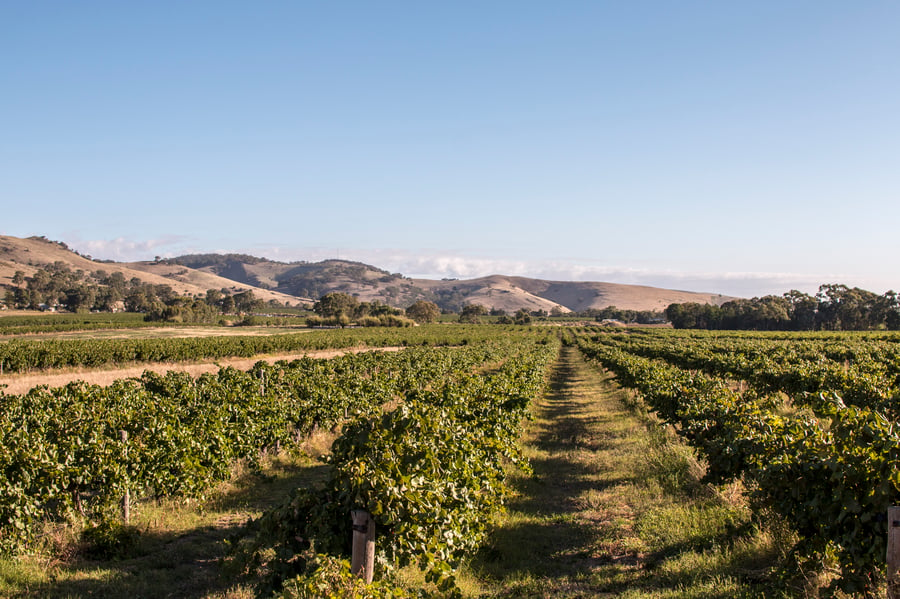
Farming in South Australia still stops at a line a surveyor drew in 1865. George Goyder mapped the edge of reliable rainfall across a state where only about a fifth of the land gets more than 250 millimetres of rain a year; the wheat farms that pushed past his line failed in the droughts that followed, and their abandoned stone farmhouses still stand in the scrub. Everything intensive settled south of the line, and that corner now makes half of Australia’s bottled wine and about eighty per cent of its premium wine. Adelaide has been a Great Wine Capital of the world since 2016 – alongside Bordeaux and Napa – with two hundred cellar doors within an hour of the city, and in the Barossa, vines a Prussian refugee planted in 1843 still produce. The food and the honey sell the way they always have here: Saturday markets, farm shops, honesty stands.
No major electricity grid in the world now takes a larger share of its power from wind and sun – one per cent of South Australia’s supply in 2007, eighty-four per cent by late 2025, with one hundred per cent net legislated for 2027. All of it sits on Kaurna country: Adelaide still carries a Kaurna name, Tarntanya, and the language – written down by German missionaries in 1840 – is taught again today, while in the far north-west about a tenth of the state is Aboriginal freehold. The settled south is only one corner. Beyond Goyder’s line is dry country the size of France and Germany together, where the salt lakes fill from rain that fell in Queensland and the largest desert park closes every summer because a breakdown out there can kill you.
Food
On a Saturday morning the way to eat South Australia is to graze the Adelaide Central Market – trading since 1869 and rated the third-best food market in the world in 2026, behind only London’s Borough Market and Philadelphia’s Reading Terminal – stall to stall with a flat white: Barossa mettwurst, Adelaide Hills cheese, a laksa locals argue is the best in the state, oysters shucked to order. The market gathers what the settlers grew. The German Lutherans who came for religious freedom brought a preserving culture – smallgoods, dill cucumbers, wood-oven bread – still on Barossa tables; the Cornish left the pasty on Yorke Peninsula; and on the Coorong, Ngarrindjeri families still harvest kuti – pipis – as they have for around nineteen thousand years, and sell the catch through their own company. In the Barossa the same history is in the wine: the vines a Prussian planted in 1843, seeking religious freedom, are the world’s oldest surviving Shiraz.
An 1869 market hall, a wood oven fired daily since 1924, a nineteen-thousand-year-old shellfish harvest, and the pie South Australia eats after midnight
Adelaide Central Market, Gouger Street. Traders have sold here since 1869, busiest Friday evening and Saturday morning, closed Sunday and Monday. Lucia Rosella opened Adelaide's first pizza bar here in 1957 with seven stools -- food historians now credit it as Australia's first -- and her daughters still run it. The market is doubling in size through 2026, so check the layout when you go.
The Barossa, Saturday morning. At Angaston the Barossa Farmers Market runs 7:30 to 11:30 in a working wine shed, breakfast cooked by whichever community group is raising money that week; at Tanunda the Apex Bakery has fired its wood oven every working day since 1924. This is also the heart of Australian wine: the Barossa holds some of the oldest vines on earth, saved by the quarantine that kept phylloxera out. At Langmeil in Tanunda you can taste a Shiraz off the Freedom vineyard -- planted in 1843 by Christian Auricht, a Prussian who had come to the valley seeking religious freedom, and named for his family's history, "From Persecution to Freedom" -- now the world's oldest surviving Shiraz. The cellar doors string north and south along the Epicurean Way, through the Barossa, Adelaide Hills, McLaren Vale and Clare.
Kuti Shack, Goolwa Beach. The restaurant of Kuti Co, a fishing company wholly owned by Ngarrindjeri families who have harvested kuti -- pipis -- from these beaches for around nineteen thousand years; the middens are in the sandhills behind the deck. Pipi dishes with native ingredients, local catch, and a Cedric Varcoe mural across the building. Open Thursday to Sunday; ring ahead midweek in winter.
The late-night plate. The pie floater -- a meat pie upended in pea soup -- was served from Adelaide pie carts from 1871, and the National Trust listed it as a South Australian Heritage Icon in 2003. Cafe de Vili's serves it around the clock at Mile End. The AB -- charcoal yiros meat over chips under garlic and chilli sauce -- is claimed by two shops fifty metres apart on O'Connell Street, and neither has backed down.
Culture
At Arkaroo Rock in the Flinders Ranges, an Adnyamathanha guide from Wadna walks you along an ancient riverbed to a rock shelter painted in ochre and charcoal, then tells the creation story of Ikara – Wilpena Pound – that the paintings carry. Travellers rate those two and a half hours among the best things they did in the outback, and they are the pattern for culture here: the people it belongs to show it themselves. The Barossa’s German institutions have run since the 1850s, the Cornish towns hold the largest Cornish festival outside Cornwall, and Adelaide gives its late summer to the world’s second-largest annual arts festival.
Adnyamathanha guides, the Southern Hemisphere's oldest brass band, the world's largest Cornish festival outside Cornwall, an 1851 Jesuit winery still making altar wine, and a city that schedules its year by festivals
On country, with the owners of the story. In the Flinders, Adnyamathanha guides at Wadna in Blinman take small groups to Arkaroo Rock and Sacred Canyon and sell hand-carved boomerangs from the shop. At Warriparinga in Adelaide's south, the Kaurna-owned Living Kaurna Cultural Centre runs wetland tours and weaving workshops. On the Coorong, a Ngarrindjeri elder co-hosts the Spirit of the Coorong cruise -- pipi harvest and smoke ceremony included -- Wednesdays and Sundays, October to May. In town, Bookabee's Aboriginal guides walk you through the SA Museum's Aboriginal Cultures Gallery, the largest collection of its kind in the world.
The valley that kept its voice. The Tanunda Town Band, founded in 1857, is the oldest continuous brass band in the Southern Hemisphere -- and it kept playing through the First World War, when anti-German feeling ran high enough that a 1916 Act erased the state's German place names: the village of Langmeil became Bilyara, then disappeared into Tanunda altogether. The band's Melodienacht -- two nights, up to two thousand people, mulled wine in hand -- fills the Tanunda Show Hall on the last Friday and Saturday of May. The Liedertafel, a German male-voice choir going since 1850, still rehearses on Tuesdays, and the language association's children's club means the valley's German is still being handed down.
Little Cornwall. The copper towns of the Yorke Peninsula hold the Kernewek Lowender, the world's largest Cornish festival outside Cornwall, every second May since 1973 -- pasty bake-offs, maypole dancing, and the Dressing of the Graves; the next runs 10 to 16 May 2027. Between festivals, Moonta's National Heritage mine precinct and its pasty shops carry the tradition day to day -- note the heritage sites are on reduced hours while the National Trust reorganises.
A working Jesuit winery, 1851. Sevenhill was the Clare Valley's first winery, planted by Austrian Jesuits in 1851 to make altar wine -- and they still do: sacramental wine is about a quarter of the winery's output, shipped to churches Australia-wide and across Asia and the Pacific. You taste in the rock cellars the brothers cut in the 1850s, walk up to St Aloysius' Church and down into its crypt, and the vines outside are among the oldest in the valley.
A city that schedules its year by festivals. Adelaide runs the Fringe -- the world's second-largest annual arts festival -- and WOMADelaide back to back in late summer, and gives all of August to SALA, open artists' studios across the state. And its own festival, Tarnanthi, has made the city the national platform for contemporary Aboriginal and Torres Strait Islander art -- born at the Art Gallery in 2015, now touring the country, with an art fair where sales go straight to the artists.
Natural History
A few times in a lifetime, enough monsoon rain falls in Queensland to travel a thousand kilometres down the channel country and flood Kati Thanda-Lake Eyre – and the dead salt heart of the continent becomes Australia’s largest lake. Its shallows turn rose-pink with salt-loving algae, tens of thousands of pelicans arrive to breed on islands that exist only while the water lasts, and from a light plane at dawn the whole lake is a mirror. This is the driest state on the driest inhabited continent, and its natural history runs on water that arrives from somewhere else: southern right whales calve below the Bunda Cliffs each winter, and half a million years of ice-age giants lie trapped under the Limestone Coast.
The oldest animal fossils on Earth, a salt lake that fills from another state's rain, ice-age giants under the Limestone Coast, and whales below the Bunda Cliffs
The dawn of animal life, up close. Nilpena Ediacara National Park opened the original fossil beds -- the ones Reg Sprigg found in 1946 -- to guided tours in 2023, and the Brachina Gorge Geological Trail is a 20-kilometre self-drive that climbs through about 130 million years of rock. The Flinders' Ediacaran country is on Australia's tentative list for World Heritage, with a decision possible from 2027. The golden spike that fixes the base of the Ediacaran for the whole planet -- ratified in 2004 -- sits nearby in Enorama Creek.
Kati Thanda-Lake Eyre. Australia's largest lake when it floods, and at about 15 metres below sea level the lowest point on the continent. The floodwater takes weeks to arrive down the channel country, and a complete fill is rare -- only three times in the twentieth century, the last in 1984. Scenic flights run from William Creek and Marree while the water lasts; most years it is a blinding salt pan you can walk out onto.
The Limestone Coast underworld. Naracoorte Caves is South Australia's only World Heritage site: half a million years of ice-age megafauna -- marsupial lions among them -- trapped and preserved under the plain, with guided cave tours year-round and summer viewing of the bat colony. An hour on, Mount Gambier sits inside Australia's youngest mainland volcano, about five thousand years old; its Blue Lake turns cobalt every November, and Boandik stories appear to record the eruption itself.
Whales under the Bunda Cliffs. At the Head of Bight, where the Nullarbor -- the world's largest single slab of limestone -- breaks off into the Southern Ocean from cliffs over 120 metres high, southern right whales gather to calve from June to October. The viewing platform is on Yalata Aboriginal land; August is the peak.
Built Heritage
At the Burra visitor centre they hand you an actual key. Leave a deposit, and it unlocks eleven National Heritage sites at your own pace – a miners’ dugout cut into the creek bank, a gaol, a brewery cellar – in the town whose 1845 copper strike dug the colony out of its bankruptcy. South Australia’s history is unusually easy to stand in front of like this. Adelaide’s park-land grid – the only city in the world completely surrounded by park lands – is on the National Heritage List; the Parliament’s 1894 Act made this the first place on earth where women could both vote and stand for election; and the towns the migrations built are still working towns, Hahndorf on its Prussian village plan, Moonta on its mine.
A world-first vote, a key that unlocks eleven heritage sites, a Prussian village plan, and the mainland's first railway still running
Parliament House, North Terrace. The National Heritage listing is for the democracy: full male suffrage including Aboriginal men in 1856, the secret ballot the same year, and in 1894 the Act that made South Australia the first place in the world where women could both vote and stand for parliament -- a right-to-stand clause opponents added hoping to sink the bill, which passed anyway. The listed attributes include the 1894 suffrage petition itself.
Burra, the town that paid for the colony. The 1845 copper strike arrived four years after the bankruptcy and paid the colony's way; by 1851 Burra was the largest inland town in Australia, with hundreds of miners' families living in dugouts cut into the creek banks. Behind the key's doors: those dugouts, Morphett's Enginehouse on the mine, the Redruth Gaol and the Unicorn Brewery cellars -- the passport scheme has run from the Market Square visitor centre since 1979.
Hahndorf's Prussian plan. Australia's oldest surviving German settlement (1839) keeps more than bratwurst: the town's layout is a Prussian village form found nowhere else in Australia, and St Michael's, whose congregation dates to 1839, is the oldest Lutheran church in the country still worshipping on its original site. It is a State Heritage Area, and the walking is free.
The first railway on the mainland. In 1854 a horse-drawn iron tramway opened from Goolwa to Port Elliot so river trade could dodge the treacherous Murray Mouth -- the first public railway on the Australian mainland. The line still runs as the volunteer-crewed Cockle Train along the dunes to Victor Harbor; in winter you can watch for whales from the carriage windows.
I want to dig deeper
The four themes above can be reached from a city bed. These three cannot: they are the South Australia that asks for days, a full tank, and a season chosen on purpose. The Flinders run on deep time and Adnyamathanha guiding; the Eyre Peninsula is the seafood coast, eaten at the source; and the outback tracks north of Goyder’s line cross telegraph ruins, an underground opal town, and a desert park that shuts all summer. Pick one and give it days, not hours.
Three commitments: the Flinders deep-time circuit, the Eyre seafood coast, and the outback tracks north of Goyder's line
The Flinders deep-time circuit -- April to October. Base at Wilpena or Blinman and work the ranges: the Brachina Gorge trail through 130 million years of rock, a booked fossil tour at Nilpena, and Arkaroo Rock or Sacred Canyon with an Adnyamathanha guide from Wadna. The Prairie Hotel at Parachilna does feral-grill dinners beside the fossil fields but closes entirely from mid-December to the end of February. Three days covers the core; a week adds the Gammon Ranges and Arkaroola's geological tours in the north.
The Eyre Peninsula seafood coast -- year-round. Fly or drive to Port Lincoln, home of the southern bluefin tuna fleet, and eat from the factory-door marketplace an ex-fisherman runs on Proper Bay Road. At Coffin Bay, pull on waders and eat oysters standing in the water they grew in -- one operator runs year-round, others pause in mid-winter. The west coast road to Streaky Bay and Ceduna adds sea cliffs, an Aboriginal-led art centre selling for more than a hundred Far West artists, and, on the October long weekend, one of the country's biggest oyster festivals.
The outback tracks -- May to September. North of Goyder's line the state runs on 4WD tracks: the Oodnadatta past the stone ruins of Overland Telegraph repeater stations, Marree with its replica cameleer mosque and June Camel Cup, and Coober Pedy, where opal miners live underground against the heat. Lake Eyre scenic flights run when floodwater arrives; Witjira's warm artesian springs are swimmable at the desert's edge; and the Simpson Desert park -- Australia's largest -- closes 1 December to 15 March and demands a Desert Parks Pass and real preparation the rest of the year. A ghost-town bakery at Farina fires its 1880s underground oven for about eight winter weeks.
The Honey of South Australia
The honey follows the same map as everything else here. Bees work the blue gums of the Adelaide Hills, the mallee scrubs along the coasts, and the flowering that moves across the farm country with the seasons, and the honey is sold the way this state sells its food: off Saturday market stalls, from a farm shop in a German town, from honesty stalls where you serve yourself and leave the money. There are no honey tours in South Australia – we looked – and no tasting rooms. What there is instead is a second-generation beekeeper selling raw honey and honeycomb at the Barossa market, a family stall that has weighed out bulk varietals in the Central Market for about thirty years, and a roadside stall near the Southern Ocean that never closes. The Honey Road below strings them into one unhurried drive south.
The Honey Road
One itinerary. The honey is the reason to go; everything else happens along the way.
Adelaide Central Market -- year-round (city gateway)
Start where the state shops. The Honey Shoppe, a Gilbert's family outlet in the market precinct, sells South Australian varietals in bulk -- taste the blue gum and the mallee before you buy, refill a jar by weight. The market is mid-rebuild and the stall moves into the new hall in late 2026, so check the floor plan; while you are there, the Friday-night trade and Lucia's pizza bar are the market at its best.
Mount Barker and the Hills -- Saturday morning
Half an hour up the freeway, the Adelaide Hills Farmers Market runs 8:30 to 12:30 under the elms at Mount Barker, where Kathryn at As Sweet As Honey sells raw, unfiltered Hills honey straight off the stall. The road back through Hahndorf passes Beerenberg's farm shop, which bottles a local blue gum, and Otto's Bakery for the pretzels.
Angaston, Barossa -- Saturday, 7:30 to 11:30
At the Barossa Farmers Market in the Vintners Shed, Kirsty and her daughter run Kapunda Honey Co -- second-generation beekeepers with three hundred hives, raw honey always and honeycomb when there is some. The Waechter family's produce stall sells honey too, with a discount if you bring the tub back. Have breakfast off the community grill, then Tanunda for the wood-oven bakery.
The Fleurieu -- year-round
Do Bee Honey sells raw blue gum and orange blossom from the door of its Aldinga Beach property, at Willunga on Saturdays and the Adelaide Showground on Sundays. Down the coast at Port Elliot, Rose Herbs and Honey keeps a self-serve honesty stall at 32 Waterport Road, open around the clock and lit at night. The road ends at Cape Jervis, where the ferry leaves for Kangaroo Island -- a bee sanctuary by law since 1885, with a honey story of its own -- and where this road stops: no honey may be carried across to the island.
Getting Here
Adelaide is the gateway. Its airport sits about six kilometres from the city – a fifteen-minute run in, unusually close for an Australian capital, though there is no train or tram and you take a taxi or the JetBus. Adelaide is also the crossing point of Australia’s two transcontinental railways: the Ghan runs north to Alice Springs and Darwin (March to November only) and the Indian Pacific east to Sydney and west to Perth, both from the Parklands terminal, while the Overland runs a daylight service to Melbourne twice a week. Distances stretch quickly once you leave the city – the Barossa is an hour north-east, the Flinders Ranges around five hours, Coober Pedy nine. The Stuart Highway is sealed the whole way to the border, so an ordinary car reaches the outback towns; the unsealed tracks off it need four-wheel-drive. Regional flights connect Adelaide with Port Lincoln and Coober Pedy.
Seasonal Events Not to Miss
South Australia crowds its calendar into two seasons. Late summer is festival time: for four weeks from late February, Adelaide runs the Fringe, the Adelaide Festival, WOMADelaide and Writers’ Week at once – the “Mad March” the city plans its year around – with Tasting Australia following in May. Autumn belongs to the wine country: the Barossa Vintage Festival, Australia’s oldest, runs in odd-numbered Aprils (next in 2027), and on the second Saturday of March the Tanunda Show holds a dill-cucumber championship a visitor can enter for a dollar. In late July, when the trees blossom, Willunga holds its Almond Blossom Festival. In odd-numbered Mays the Cornish towns of the Yorke Peninsula hold Kernewek Lowender, billed as the largest Cornish festival outside Cornwall. And the outback keeps its own calendar: Marree runs its Camel Cup in late June, Ceduna its Oysterfest on the October long weekend, and the Farina ghost town fires its 1880s underground bakery for about eight weeks each winter.
Where to Buy Honey
The mainland honey is sold close to where it is made, mostly off market stalls and farm gates. The Honey Shoppe, a Gilbert’s family outlet in the Adelaide Central Market Plaza, carries South Australian varietals in bulk – taste before you buy, refill a jar by weight – though it moves into the rebuilt market hall in late 2026, so check the location first. In the Barossa, Kapunda Honey Co sells raw honey and seasonal honeycomb at the Angaston farmers market on Saturday mornings. In the Adelaide Hills, As Sweet As Honey sells raw honey at the Mount Barker farmers market on Saturday mornings, and Beerenberg’s farm shop at Hahndorf bottles a local blue gum. On the Fleurieu, Do Bee Honey sells raw blue gum and orange blossom from the door at its Aldinga Beach property and at the Willunga (Saturday) and Adelaide Showground (Sunday) markets; a little further down the coast at Port Elliot, Rose Herbs and Honey keeps a self-serve honesty stall at 32 Waterport Road, open around the clock. On the Eyre Peninsula’s west coast at Streaky Bay, Bay Bees sells fresh local honey self-serve from the fridge on the verandah at 3 Linklater Street. Kangaroo Island honey is sold on the mainland too, at a dedicated island stall in the Central Market – but you cannot carry any the other way: no honey may be taken across to the island.