
Pink Gum Honey
The Story
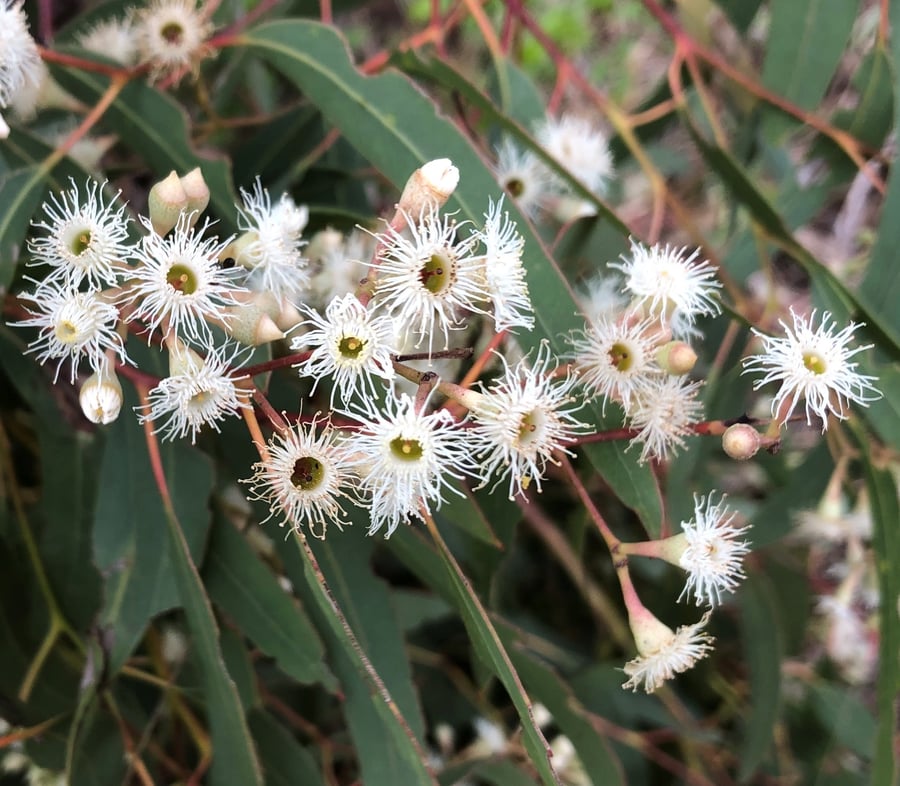
Pink gum honey is not made every year. The tree flowers, and in some seasons the flow is heavy enough to take as a crop of its own; in others it is not, and the gap can run to several years. That one fact governs how South Australians meet this honey. It appears as a single-source jar in the seasons there has been a crop, and in the seasons between, the nectar goes into a mixed honey rather than one carrying its own name.
The tree grows almost nowhere but South Australia, so this is a local honey in the strict sense rather than a style that could be made elsewhere and sold under the same name.
What arrives when there is a crop is pale and delicate, and it keeps its pour long after the gum honeys around it have gone solid, which is part of why the people who sell it put it on a cheese board rather than into baking.
Characteristics
A pale honey, delicate and sweet, with light caramel and a soft floral note behind a mild eucalypt character. A 1977 CSIRO survey of Australian honeys placed pink gum among the eucalypt honeys notable for staying liquid, and put South Australian blue gum in the same table among those notable for setting solid. It granulates eventually – one producer’s label tells the buyer to stand the jar in warm water if crystals form – but it stays pourable longer than most gum honeys.
Click to Display — The Details: botanical origin, sensory profile, and its regional identity
Botanical Name: Pink gum (Eucalyptus fasciculosa)
Botanical Family: Myrtaceae
Bee Species:
Apis mellifera, the western honey bee, as with every commercial South Australian honey.
Color:
pale. A 1977 CSIRO survey of Australian honeys listed pink gum among the lightest of the eucalypt honeys, and the producers who bottle it describe it the same way
Flavor Profile:
delicate and sweet, with light caramel and a soft floral note behind a mild eucalypt character
Tasting Notes:
Producers describe it as sweet and delicate, and one names the mouthfeel velvety.
Aroma:
not documented – no published description of this honey’s aroma was found
Forage Origin:
Nectar from pink gum, Eucalyptus fasciculosa, a small tree in the Myrtaceae family reaching six to twenty metres. It is almost restricted to South Australia, in three areas: the Mount Lofty Ranges south from the Barossa Valley, Kangaroo Island, and the south-east of the state from near Meningie to just over the Victorian border. It grows on well-drained sandy soils of low fertility, in woodland or standing above low shrubland, often alongside river red gum and South Australian blue gum and sometimes as the dominant tree on a site. In Victoria it is confined to a small area near the border and is rated rare there.
The name describes the timber, not the flower. The heartwood is dark pink and very hard, the bark is smooth and light grey to pinkish, and the blossom is white to cream. The tree is also called hill gum, scrub gum and white gum, and it is cut for fuelwood and planted as a street and garden tree.
Two names sit close to this one. A single-varietal Hill Gum honey is sold in Australia from Eucalyptus blakelyi, a red gum of the country east of the Great Dividing Range; hill gum is a genuine South Australian name for E. fasciculosa, but no pink gum honey is sold under it. Separately, the nursery trade sells a red-flowered form of South Australian blue gum, E. leucoxylon ‘Rosea’, as winter-flowering pink gum. A jar of pink gum honey from South Australia holds E. fasciculosa.
The flowers open seven to a cluster, on branched stalks at the ends of the shoots. Their outer stamens carry no anthers, so colonies working this flow take nectar and little pollen with it, and South Australian apiarists name pink gum among the flows they feed pollen supplement on.
Pairings:
Sold as a cheese-board honey. The producer who bottles it single-source pairs it with camembert and brie, and calls it versatile enough for hot and cold drinks. An Adelaide restaurant was serving it through bircher muesli with Fleurieu yoghurt and toasted almonds in 2019.
Origin Story
Ferdinand von Mueller described pink gum in 1855, in the same paper series and the same year he described South Australian blue gum and cup gum, from collecting he did on foot out of Adelaide. The epithet fasciculosa comes from the Latin fascis, a bundle or sheaf, for the way the flower buds gather at the ends of the shoots. The timber has been cut for fuelwood, the heartwood being dark pink and very hard, and the tree is now planted in gardens, parks and streets.
The state herbarium lists pink gum as Rare in South Australia, and its woodlands are much reduced. Little of South Australia’s original temperate woodland survives in the agricultural districts, and the guidance written for landholders in the Coorong and eastern Mount Lofty country records blue gum and pink gum woodlands persisting largely as roadside vegetation and isolated paddock trees.
The trees themselves have been counted. A survey of 2,814 pink gums in the Mount Lofty Ranges and the adjoining plains between 2009 and 2012 found mean canopy intactness of 70 per cent, and no seedlings at all in almost 30 per cent of populations. Aerial photographs of two woodlands compared between 1949 and 2005 place the start of canopy decline in the mid-1970s, alongside falling groundwater, rising mistletoe infection and a decline in autumn rainfall that is still running. Mistletoe load and insect damage account for most of the variation between stands; an outbreak of lerp, the sugary shell secreted by a leaf bug, stripped canopy in one episode and then passed. A pink gum takes eighty to a hundred and twenty years to make a generation.
Cultural Context
A pink gum near Naracoorte carries notches cut up its trunk. The National Trust records it as an authenticated Aboriginal climbing tree, which it notes is rare: trees holding a reliable supply of honey-possums, or birds in their hollows, had step-holds cut into the trunk, and stones were set into the notches. Where the stones were left, the growing tissue closed over them and raised the knobbly, evenly spaced outgrowths that still run up the trunk.
Harvest & Forage
The tree flowers widely; the crop is what is occasional. Flowering has been recorded in most months from March to December, the Botanic Gardens of South Australia describes the blossom as prolific and carried over a long period, and the state herbarium gives the season as autumn to spring. What comes only some years is a nectar flow heavy enough to take as a single-source crop. Producers put that interval at several years. The 2008 flowering ecology study found the same pattern across the region’s eucalypts, with flowering frequency ranging from one to seven years and most species yielding once in two to four.
In the years without a flow worth isolating, the nectar is still worked, but it goes into a mixed honey. A Fleurieu producer names pink gum among the seasonal sources in its multifloral raw honey rather than bottling it alone, an Aldinga bulk seller rotates it through one dispenser with seven other varieties, and an Adelaide Hills apiarist whose recorded apiary flora includes pink gum sells all of it as multiflora by policy.
For a single-source crop the beekeeper works a stand while pink gum alone is out. It shares the Mount Lofty Ranges and the South East with South Australian blue gum and river red gum, and grows alongside both often enough that the vegetation assessments name the association, so either can enter a lot where the flowering overlaps.
Beekeeping Context
Pink gum sits seventh among the eucalypts South Australian beekeepers use, in the list the state association publishes from the 2004 survey of the state’s floral resources – five places below South Australian blue gum, one below big cup mallee. The apiarists surveyed for the 2008 flowering ecology study rated its honey yield 4.5 on a five-point scale. Only two of them rated it, so the number rests on a small sample.
Pink gum yields nectar heavily and very little pollen. Bees gather the two in parallel rather than together, nectar in the crop and pollen packed onto the hind legs, so a flow can run strongly while the colony goes short of the protein it needs for brood. Its flowers carry the same structure as South Australian blue gum’s, the outer stamens bearing no anthers, and the 2008 survey lists pink gum among the species apiarists feed pollen supplement on.
It is worked inside the same migratory system as the rest of the state’s honey. Hives take the Riverland almond bloom in July and August, then early mallee or canola and on to citrus, with the native flows taken as they come. A 2010 note in the national beekeeping press recorded pink gum as having potential to be a good crop in the South East of the state.
Named Producers
Gumeracha Honey and Olive Oil – Gumeracha, Adelaide Hills. A family business of more than twenty-five years, selling through South Australian supermarkets and food outlets rather than online. Its pink gum comes in one size, a one-kilogram jar, and is sourced from the Riverland and the South East.
The Gathered Bowl – South Australia. Bottles a single-source pink gum in 500g in the years there is a crop, and tells buyers it can be several years between flowerings. Also supplies the bulk honey dispensed at the Bulk Cellar in Aldinga, where pink gum is one of eight varieties in rotation.