South Australian Blue Gum Honey
The Story
South Australia’s everyday honey is a cold-season crop. Most eucalypts flower in the warm months. South Australian blue gum flowers through autumn and winter, and begins on less warmth than the trees around it, so it fills the part of the year when the state’s other flows have stopped. That is why it is the honey South Australians buy without thinking much about it.
These flowers yield nectar heavily and almost no pollen, so a colony left on blue gum through a long flowering runs short of the protein it needs to raise brood. The beekeeper supplies what the crop does not, and the difference that makes to a season is large and has been measured.
The honey is light and mild, and it sets to a fine grain – reliably enough that a government apiculturist once used its candying as the standard he compared other honeys against. It is also the honey South Australia names after itself, which is how its tree is kept apart from two unrelated species sold as blue gum honey elsewhere in the country.
Characteristics
A light amber honey with a sweet, fruity eucalypt aroma and a mild to medium eucalypt flavour. The texture is dense and smooth. Colour varies by lot: packers describe batches from white, a formal honey grading term, through to light amber, and some South Australian producers sell a deeper amber. It candies to a fine grain, and did so reliably enough by 1922 that the Victorian Government Apiculturist used it as his benchmark, describing another honey as candying much like Yellow Gum. A CSIRO survey in 1977 likewise placed it among the Australian honeys notable for setting solid. South Australian producers sell it both liquid and naturally set; setting changes texture and colour, not flavour.
Click to Display — The Details: botanical origin, sensory profile, and its regional identity
Botanical Name: South Australian blue gum (Eucalyptus leucoxylon)
Botanical Family: Myrtaceae
Bee Species:
Apis mellifera, the western honey bee. The commercial crop is entirely post-contact: the first surviving introduction of honey bees to Australia was in 1822, and every blue gum harvest since has come from managed hives.
Color:
light amber, the grade the Australian honey industry gives it. Batches run from white, itself a formal grading term, through to light amber, and some South Australian producers describe a deeper amber lot
Flavor Profile:
mild to medium eucalypt with a fruity sweetness; smooth and even, with caramel reported on some lots
Tasting Notes:
South Australian beekeepers grade it on density and colour as much as on flavour. Keith Richter, taught at his father’s kitchen table where merchants dipped a teaspoon into a 60-pound tin to taste before buying, learned that the density of the honey matters and that a light colour and good flavour mark a good one; among blue gums he describes the better lots as carrying an extra finesse.
Aroma:
sweet and fruity eucalypt
Defining Compounds:
The volatile fraction of Australian blue gum honey was characterised by gas chromatography and mass spectrometry and published in 1997, reporting norisoprenoids, monoterpenes and other natural volatiles. The authors concluded that Australian honeys are chemically distinctive against the honeys previously studied by the same method.
Forage Origin:
Nectar from South Australian blue gum, Eucalyptus leucoxylon, a medium-sized tree in the Myrtaceae family. It grows through the medium-rainfall country of South Australia, from the Flinders Ranges south through the Mount Lofty Ranges and adjacent districts, and east into the western half of Victoria and just over the Murray into New South Wales. In South Australia it takes the heavier clay soils and is common in the foothills of the Adelaide Hills. It is also planted widely as a street, shade and windbreak tree.
Three unrelated species are sold in Australia as blue gum honey. E. leucoxylon is the South Australian one. E. globulus, the Tasmanian blue gum, is a much taller tree of Tasmania and southern Victoria, and E. saligna, the Sydney blue gum, is a third. Victoria calls E. leucoxylon yellow gum. The split is old and was recorded at the time: the 1922 Honey Flora of Victoria, written by the Victorian Government Apiculturist, lists the species as “Yellow Gum (White Gum, White Ironbark, Blue Gum in South Australia)”. A survey of the floral resources South Australian beekeepers use found no use of E. globulus in the state, so a South Australian jar labelled blue gum holds E. leucoxylon.
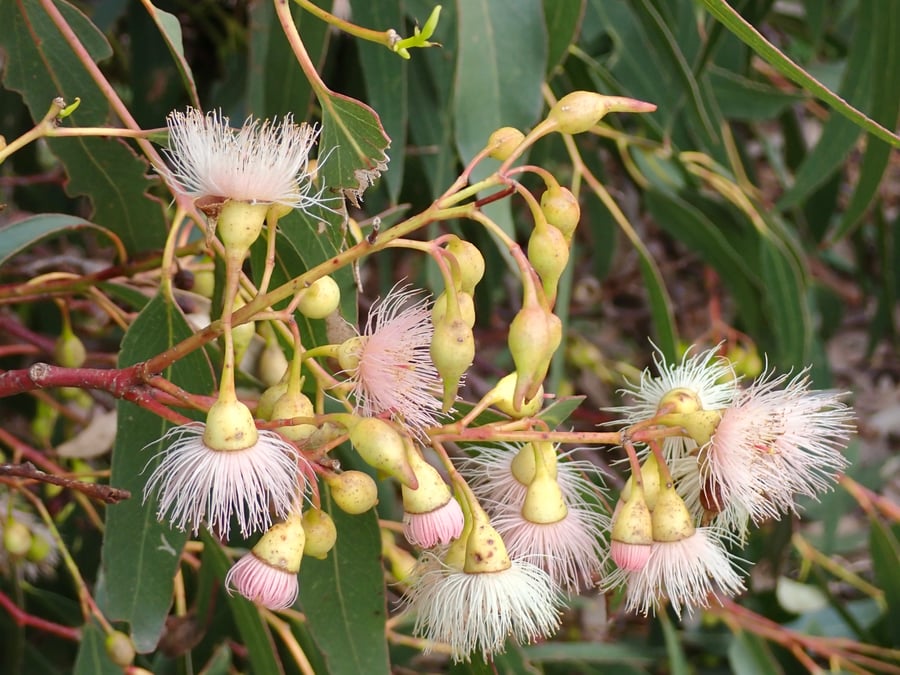
Neither colour word describes the flower. The species name leucoxylon means white wood, and the blue of the common name refers to the bluish cast of the seedling leaves. The blossom is cream, pink or red, and trees standing next to each other in one street can carry different colours.
The flowers open three to a cluster, hanging on stalks where the leaves join the stem. Their outer stamens carry no anthers, so colonies working this flow take nectar in quantity and very little pollen with it.
Pairings:
It is sold as an everyday table honey and used as one: on toast and crumpets, stirred through yoghurt and porridge, in tea, and in baking. Beerenberg, which bottles a Hills blue gum at Hahndorf, suggests it for honey joys and honey-glazed carrots.
Origin Story
The woodland this honey came from was cleared early. South Australian blue gum grew on the fertile flats of the South East and the Mount Lofty foothills, which made it the country settlers wanted and the easiest to break, and the state’s own vegetation guidance records that those woodlands survive now largely as scattered trees in paddocks, as roadside strips, and in remnants around Lake Alexandrina. Few high-quality stands are left. Much of the crop is therefore worked off paddock trees, roadside remnants, revegetation plantings and street trees rather than off woodland, and the trees yield in those settings as well as they do in native vegetation.
The honey was documented as its own type early. Frederick Beuhne, Victoria’s Government Apiculturist, set it down in his Honey Flora of Victoria in 1922 as a fairly regular bloomer and a heavy yielder of nectar, blossoming through the winter months, more or less every year but more heavily every second season.
Beekeepers found the same pattern in the field. Arnold Richter worked hives across an eighty-mile radius of the Mid North and Flinders, wintering them on the Port Pirie side of the ranges where the frosts did not reach; a photograph from the early 1980s shows him at nearly a hundred hives at Stony Creek, north of Wilmington. After one lucerne crop near Mount Bryan he left the hives standing, with only scattered blue gums nearby. He came back to check for ants and water, found them full, took two and a half extracts off that stand, and put Mount Bryan into his run every second year from then on. His son Keith, who now keeps about twenty hives in the Adelaide foothills, told the story to Stock Journal.
Asked what limits their floral resources today, South Australian apiarists named dieback of eucalypts, grazing of the understorey, more frequent drought, and the loss of agricultural weeds as country shifted from grazing to cropping.
Cultural Context
On the Adelaide Plains this tree grew in Kaurna country. Philip Clarke’s survey of Aboriginal plant use in the Adelaide region, published in the Transactions of the Royal Society of South Australia, records the plains carrying forests of river red gum, South Australian blue gum and peppermint gum, and lists nectar and gum among the classes of vegetable food gathered there. The sweet foods of those forests came from the trees and the insects on them: lerp, the sugary shell secreted by leaf bugs on eucalypts, was a highly prized food rich in carbohydrates in the warmer seasons. The timber was worked as well. Museums Victoria records the narrow parrying shields of south-eastern Australia as most often made from ironbark and from this species, and the Botanic Gardens of South Australia records its wood used for fighting sticks and shields.
South Australia singles the honey out by name. The Royal Adelaide Show runs a class for blue gum honey, and it is the only single-varietal class on the honey schedule: every other liquid-honey class is defined by colour band and by native or imported flora. The class is long-standing, appearing in results from 2013 and on the 2026 schedule, and country shows carry it too, with the Mount Pleasant Show calling for a 500g jar of blue gum alongside one of red gum.
The tree is part of Adelaide’s built landscape as well as its honey. It is planted through the city’s parks and streets, and one of the Adelaide Park Lands, Blue Gum Park / Kurangga, is named for it. The honey is also distilled: the Sydney distillery Archie Rose ferments South Australian blue gum honey for seven days and distils it in copper vacuum stills as a honey spirit, sold as Eau de Bee.
Harvest & Forage
The flow runs in the cold months, over a longer season than almost any Australian honey tree. Apiarists surveyed for the 2008 flowering ecology study recorded a flowering period of over ten months, with the bulk of any one event lasting about six. Timing shifts by district: Beuhne recorded it in 1922 as flowering generally through winter, from May and June to December near the Grampians, April to November in the drier inland, and September to November in the Mallee. Flowering has been reported in every month somewhere in its range.
Its flowering is also unusually dependable. That same study found most species flower irregularly, and of the eight rated regular flowerers, blue gum was the only one that does not flower annually. The apiarists put that down to the length of the season: when a flowering event is interrupted early, the later part of the season still runs.
What varies is how much the tree flowers, not how much nectar a flower makes. University of Adelaide measurements in the Mount Lofty Ranges found heavy flowering in 2004 and 2006 and poor flowering in 2005, while nectar held at 7 to 15 mg of sugar per flower per day across all three years, and held whether the trees stood in native vegetation, as paddock trees or in revegetation plantings. The crop is therefore decided at the bud. Blue gum is a long-budder, carrying bud for twelve to twenty-four months before it opens, and long-budders grow over bud and yield less; high temperatures and northerly winds make trees drop bud before flowering, which cuts nectar output for that season.
For a single-source crop the beekeeper works a stand while blue gum alone is out. Pink gum shares its country in the Mount Lofty Ranges and the South East and flowers across the same months, and salvation jane runs through the same districts, so either can enter a lot. The judgement is made from what is in flower around the hive, before the honey is extracted. Keith Richter, who grew up on his father’s commercial hives in the Mid North and Flinders, says the purity of the honey is determined by the beekeeper: if only blue gums are flowering, or only red gums, the take is fairly pure.
Beekeeping Context
Commercial beekeeping in South Australia is migratory. Hives work the Riverland almond bloom in July and August, then move to early mallee or canola, then to citrus, and blue gum is among the flows they return to through the cold months. In the list the South Australian Apiarists’ Association publishes from the 2004 survey of the state’s floral resources, blue gum stands second among the eucalypts South Australian beekeepers use, behind coastal mallee.
The flow is rich in nectar and poor in pollen, and that shapes how it is worked. Beuhne set it down in 1922 as a heavy yielder of nectar from which bees gather no pollen, and it is one of the flows South Australian apiarists feed pollen supplement on. Keith Doull measured what that is worth over a year in South Australia: colonies given a pollen supplement through a blue gum flow produced 63.8 kg of honey each, against 25.5 kg in colonies without it.
Not all of the crop is worked by migratory hives. Blue gum is planted through South Australian streets, parks and windbreaks, cultivated trees flower from about two years old, and Adelaide beekeepers work suburban and peri-urban hives on garden and street gums.
Bees do not always take the nectar. Beuhne noted in 1922 that the tree sometimes secretes nectar the bees will not collect, while honeyeaters feed on it freely. University of Adelaide fieldwork in 2006 found nectar left unexploited and dripping from flowers at most Mount Lofty sites, and put the surplus down to a shortage of birds rather than to any increase in secretion, noting that the inability of commercial loads of bees to crop the nectar fully may come down to inadequate pollen.
Named Producers
Buzz Honey – Adelaide Hills. A family single-varietal producer whose labels name the tree and the district; the blue gum is collected in Adelaide Hills native bushland and sold through stockists rather than a shopfront.
Oh Honey – Fleurieu Peninsula. Raw single-origin South Australian varietals, with hives moved through the flowering season; blue gum is one of three it bottles, alongside cup gum and coastal mallee.
Beerenberg – Hahndorf, Adelaide Hills. A family farm and shop bottling a local blue gum; it is one of only two honeys in the range.
Gumeracha Honey and Olive Oil – Gumeracha, Adelaide Hills. A family business of more than twenty-five years, sold through South Australian supermarkets and food outlets; blue gum in 320g, 700g and one-kilogram jars.
The Gathered Bowl – South Australia. Sells a single-source Adelaide Hills blue gum in 500g.
Source Regions
- Eucalyptus leucoxylon – Australia – Victoria: The same tree, worked and sold as yellow gum. Beuhne’s 1922 Victorian honey flora treats it as a Victorian crop, and Victorian packers sell the honey today.
- Eucalyptus leucoxylon – Australia – New South Wales: The species reaches just over the Murray into the south-west of the state, the eastern edge of the range the Australian industry names for this honey.
Festivals and Fairs
Royal Adelaide Show honey competition – Adelaide Showground, Wayville (annual): The state’s honey competition, and the only one that judges this honey by name. Blue gum has a class of its own, where every other liquid-honey class is set by colour band and by native or imported flora.