Western Australia Honey
Western Australia is the most isolated place of its size on earth: a third of a continent, two thousand kilometres of desert between its one big city and the next, four out of five of its people in a single green corner. Too far from the rest of the country to lean on it, the place has always had to look after itself. The free colony founded on the Swan River in 1829 was so remote it could not find labour for its poor land, and after twenty years of struggle did the unthinkable and asked Britain for convicts, taking the last convict ship sent anywhere in Australia in 1868; when the goldfields later ran short of water, it pumped its own 560 kilometres uphill through a pipe still running today. What you cannot get here, you make, mend, or do without.
What the ground held made it rich. Gold in the 1890s broke sixty years of stagnation and more than trebled the population in a decade; the iron and gas of some of the oldest rock on Earth have since made it the wealthiest state in the country per head, and much of the world’s steel begins as ore from the Pilbara. But mineral money comes and goes on prices set overseas, and West Australians have learned to hold it lightly – whole towns have boomed and emptied within a lifetime, and thousands fly a thousand kilometres to a fortnight’s shift in the desert and home again, taking the fat years and the lean ones as they come.
Distance has made them their own people, too. Governed and out-voted from an east most rarely see – Perth is closer to Jakarta than to Canberra – the state has always half-felt like a country of its own; in 1933 it voted two to one to leave the federation, and though the split never happened, the sense of being a place apart never left. It looks west and north, to the Indian Ocean and to Asia, as readily as back east.
And for all its hardness it is a fine place to live. The same desert that cut the state off fenced its green southwest into a biological island of plants and animals found nowhere else, and gave a life lived outdoors – on white-sand beaches under the afternoon sea breeze they call the Fremantle Doctor, in the vineyards and tall karri forests of the far corner. Its first people have been here longest of all, their unbroken tie to country now guiding the Aboriginal rangers who care for some of the largest managed land in the nation. And in those southwest forests grows jarrah, a tree found nowhere else, and the honey that is the state’s own.
Food
Western Australia’s food was shaped by isolation and by who came to its coast. Sicilian and Molfettese fishing families built Fremantle’s seafood – the fish and chips, the sardines, and the western rock lobster, the first fishery in the world certified sustainable. Two thousand kilometres north, Broome was exempted from the White Australia Policy to keep its pearling luggers crewed, and grew an Asian-Aboriginal food culture decades ahead of the rest of the country. The southwest makes some of Australia’s best wine and the southern hemisphere’s largest truffle harvest. And because the state is so far from everywhere, some of its food – like the continental roll – simply never left.
Fremantle's Sicilian seafood, lobster bought off the boat, Broome's pearling-crew table, and the sandwich that never left the state
Fremantle's fishing harbour. Cicerello's has done fish and chips since 1903 -- Salvatore Cicerello was a Sicilian pioneer of the Abrolhos crayfishing grounds -- and the Kailis family, Greek fishers on the harbour since 1926, still put Fremantle sardines on the menu. Each October the Blessing of the Fleet carries two Madonnas, from the Molfetta and Capo d'Orlando home towns, down to the boats. Fishing Boat Harbour, daily.
Lobster off the stern. Along the Coral Coast, from Kalbarri to Mandurah, you can buy live western rock lobster straight off the boat at "Back of Boat" landings -- the fishers publish their boat names and phone numbers, at roughly half shop price. It began when the 2020 China export ban left the catch at home. December is the peak; or eat it cooked at the Lobster Shack in Cervantes.
The pearling table at Broome. Matso's brews Australia's first mango and ginger beers in Chinatown; the Yawuru-owned Mabu Mayi cafe at Cable Beach cooks the town's Asian-Aboriginal fusion; and two and a half hours north at Cygnet Bay you eat pearl meat off the family's own farm, on a menu built from the lugger crews' Malay, Chinese, Japanese, Filipino and Aboriginal cooking. Dry season for the Peninsula.
The continental roll. A crusty roll packed with deli meats, cheese and pickled vegetables -- a name used nowhere else in Australia. The Re Store in Northbridge has made them since 1936, and the tradition is thriving again across a new wave of delis. Any lunchtime.
Culture
The oldest culture here keeps its own calendar. The Noongar of the southwest divide the year into six seasons, read from flowering and weather rather than dates, and across the state Aboriginal owners now guide the visiting themselves – Whadjuk walks in Perth, Menang walks in Albany, custodian-led rock-art tours on the Burrup, and Kimberley art centres where you buy from the painter. The settler state has its own rituals: the world’s third-largest fringe each summer in Perth, a pearl festival in Broome born of Japanese Obon, and a bush two-up ring outside Kalgoorlie that plays every Sunday, legally, nowhere else. And its art spills into the open air – on grain silos, beaches and laneway walls.
Six seasons, custodian-guided country, Broome's festival of the pearl, and the goldfields' Sunday religion
Six seasons, and a sweetness that was not honey. The Noongar year turns on the weather and the flowering, from Birak, the hot dry season of December, around to Makuru, the cold wet heart of winter. The southwest had its own sweetness long before the honey bee, but it was not honey: Noongar people soaked the nectar-heavy flower spikes of the banksia in water to make a sweet drink called mangite, and the same nectar feeds the honey possum, a tiny marsupial that lives on flowers and nothing else. Australia's honey-storing native bees never reached the southwest; the European honey bee arrived with the settlers.
On country, with the custodians. In Perth, Walter McGuire's Go Cultural walks begin at Elizabeth Quay with a welcome in Noongar language. In Albany, Kurrah Mia's Menang guides walk you to fish traps and stone arrangements. On the Burrup, Murujuga's own rangers show the World Heritage rock art on Tuesdays and Thursdays. And at Ngilgi Cave near Yallingup, Koomal Dreaming plays didgeridoo underground and cooks a bush barbecue -- closed each July, booked ahead the rest of the year.
Broome's festival of the pearl. Shinju Matsuri grew out of the Japanese divers' Obon celebrations and now runs for a fortnight each dry season (21 August to 6 September in 2026), ending with a floating lantern ceremony at Gantheaume Point for the divers who never came up. The rest of the year, Sun Pictures -- the world's oldest operating picture gardens, screening since 1916 -- still shows films nightly under the stars in Chinatown.
The goldfields' Sunday religion. Seven kilometres north of Kalgoorlie, in the original corrugated-iron shed, the state's only legal bush two-up ring plays every Sunday afternoon -- free in, eighteen and over, and locals compare it to church. In town, the Museum of the Goldfields keeps the state's biggest gold display (short hours, ten to three), and each December the mining families hold St Barbara's parade, haul trucks and rescue teams down the main street.
Grain silos painted forty metres high, sculptures on Cottesloe Beach each March, Fremantle's laneway murals, and a free rooftop over the Perth galleries
The painted silos. Across the wheatbelt and the Great Southern, a self-drive trail links giant murals painted onto working grain silos, each telling its own town's story. It began at Northam in 2015 with the first silo mural in Australia and runs through Merredin, Katanning, Newdegate and Pingrup down to Albany, where a ruby seadragon curls across the grain terminal. At Ravensthorpe, on the edge of the wildflower country, the silo shows a banksia coming into flower and the honey possum that feeds on its nectar -- the same tiny marsupial the southwest's forests keep. The murals are free and stand in the open; the drive between them is the wheatbelt itself.
Sculpture on the beach. For three weeks each March, Cottesloe Beach becomes an open-air gallery: dozens of sculptures set along the sand and the sea wall, free to walk through, the Indian Ocean behind them. It has run most years since 2005 and draws crowds in the hundreds of thousands.
Fremantle's art in the open. The port town wears its art on the street. The Fremantle Arts Centre, a convict-built former asylum, is free to enter and plays live music in its garden on Sunday afternoons; the gold-boom streets of the West End hold artists' studios and galleries; and a marked street-art trail threads murals through the lanes, from a giant numbat to the painted Dingo Flour sign that has watched the harbour since 1940.
The Perth galleries. In the Cultural Centre at Northbridge, the Art Gallery of Western Australia is free to enter and opens its rooftop as a sculpture walk with the city spread below; next door, the Perth Institute of Contemporary Arts shows free exhibitions, among them Hatched, the country's national graduate show. The precinct is being rebuilt around them.
Natural History
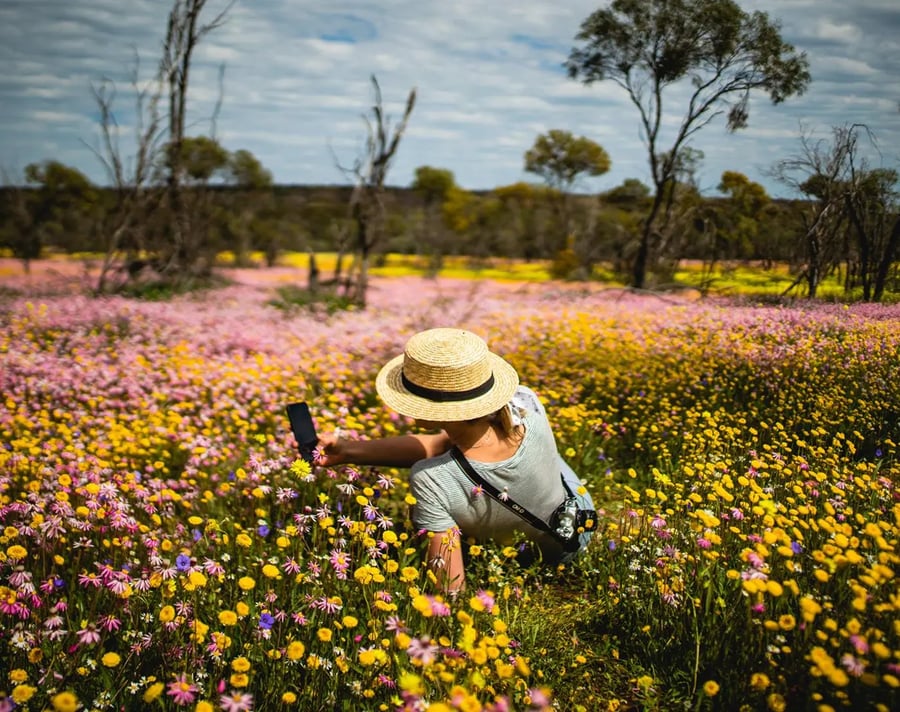
Western Australia holds the oldest known pieces of the planet and the oldest clear traces of life on it. The crystals are from the Jack Hills, far from any road; the fossil evidence is in the Pilbara. But the same story is still alive where you can reach it: at Shark Bay, and at Lake Clifton an hour south of Perth, living reefs of microbes are laying down stone today as their kind have for billions of years. On top of the old rock sit the young spectacles – a fringing reef you wade onto at Ningaloo, whale sharks in autumn, and a wildflower season of thousands of species that rolls south from June to November.
The Coral Coast: living rock, a reef at the beach, a desert of spires
The middle of the west coast is a run of singular places. At Hamelin Pool in Shark Bay, water twice as salty as the sea keeps the grazing snails out and lets low stony domes called stromatolites grow, built by microbes of the same kind that first put oxygen into the air; the domes themselves are only a few thousand years old, but they are living copies of the oldest life on earth. The boardwalk that ran out over them was wrecked by a cyclone and is being rebuilt, so for now they are seen from the shore. An hour south of Perth, Lake Clifton in Yalgorup National Park keeps the freshwater version – thrombolites, on their own boardwalk. Nearby, Shell Beach is not sand but shells, billions of them from a single small cockle, piled metres deep. North of there the Ningaloo reef runs about two hundred and sixty kilometres right along the shore, so close that at Turquoise Bay you can wade off the beach and let a gentle current drift you over the coral; from March to August the whale sharks, the largest fish in the sea, gather to feed, and humpbacks pass later in the year. Behind the beach the land rises into Cape Range, the reef’s dry twin, its limestone hollowed by caves and underground streams where blind, colourless fish – the world’s longest cave fish among them – live in an aquifer that never sees the light. That water is the visible edge of something vast: beneath much of this dry state lie huge reserves of groundwater, and it is this hidden water, more than its few rivers, that Western Australia lives on – close to half of Perth’s drinking water is drawn from the aquifers under the city, and the mines and stations of the interior run on bores. Further south, near Cervantes, thousands of limestone spires up to about three and a half metres tall stand out of yellow sand at the Pinnacles, weathered out of the lime of old shells by a process geologists still argue over. And at Kalbarri the Murchison River has cut an eighty-kilometre gorge through banded red and white rock, spanned now by a skywalk that juts out a hundred metres above the water.
Old rock, young shapes: the Bungles, the iron gorges, Wave Rock and the wildflowers
The oldest country holds some of the strangest shapes. In the far northeast, the Bungle Bungle Range rises in a maze of orange and grey banded domes of sandstone laid down more than three hundred million years ago; the dark bands are a living skin of cyanobacteria on the damp layers, the orange bands iron on the layers that dry too fast for it. The range sits in Purnululu, reached by a rough four-wheel-drive track or a light plane, with walks into the amphitheatre of Cathedral Gorge and the deep slot of Echidna Chasm. In the Pilbara, the gorges of Karijini are cut through banded iron laid down some two and a half billion years ago, when the first oxygen was rusting the early oceans. In the wheatbelt, Wave Rock curls up like a breaking wave fifteen metres high; the granite is about two and three-quarter billion years old, but the wave shape is much younger, worn under the ground by water while the rock was still buried and only later uncovered. And across the whole southwest lies one of only two global biodiversity hotspots in Australia – some twelve thousand kinds of wildflower, most of them found nowhere else, blooming north to south from June to November, while the tall forests of karri, one of the world’s tallest hardwoods, and the buttressed old red tingle around Walpole can be walked through on a canopy bridge forty metres up.
Built Heritage
Western Australia’s founding argument is still standing. The Round House on Arthur Head, the free colony’s first public building, is a gaol finished in 1831; the Old Court House in Perth’s Stirling Gardens is the room where, in 1849, the settlers met and asked Britain for convicts; and Fremantle Prison, which the convicts then built to hold themselves, kept working as a prison until 1991 and is the state’s only World Heritage building. What came after was built in rushes – a gold city raised in the desert and kept alive by water pumped uphill for a century, and a pearling port with the largest Japanese cemetery in Australia.
The founding in two buildings, a president's house in a ghost town, water pumped uphill for a century, and the pearling port's Japanese cemetery
The founding, in two buildings. The Round House (1831) is a twelve-sided gaol -- the free colony built a prison first -- open daily half past ten to half past three, by donation, with a cannon fired at one o'clock and a whalers' tunnel underneath. The Old Court House, Perth's oldest surviving building (1836), is now a free law museum, Tuesday to Sunday; it was here that around two hundred settlers voted in February 1849 to petition for convicts. Fremantle Prison runs tours daily, torchlight on Wednesdays and Fridays.
The gold layer. At Kalgoorlie the Super Pit lookout hangs over one of the largest open-cut gold mines on earth, free, seven to seven -- it closes for blasting, and the entry point has moved recently, so check in town. Hannan Street keeps its 1900 boom streetscape. Two hours north, Gwalia emptied within weeks when its mine closed in 1963 and stands as a ghost town with its museum open nine to four -- and you can sleep in Hoover House, the mine manager's residence commissioned by Herbert Hoover before he was president.
Water pumped uphill for a century. The gold city survives on C. Y. O'Connor's scheme: a steel pipeline from Mundaring Weir near Perth, 560 kilometres east and uphill to Kalgoorlie, finished in 1903. Much of the original pipe is still in service, still supplying the city. O'Connor, hounded by critics, took his own life a year before the water arrived. The scheme is on the National Heritage List and ranks as an international engineering landmark.
The pearling port. In Broome, two of the last pearling luggers sit on Dampier Terrace with the hard-hat diving gear, toured daily; the Japanese cemetery on Port Drive holds 919 people, most of them divers, under an obelisk for the forty lost in the 1908 cyclone. And at Cossack, in the Pilbara, the industry's first port stands as a ghost town of restored bluestone buildings, in the care of its Ngarluma and Yindjibarndi owners.
A place of mourning: Wadjemup
Off Fremantle lies a low limestone island the Whadjuk Noongar call Wadjemup and settlers called Rottnest, known now as a car-free holiday island of bicycles, white bays and the small, tame quokka. For most of a century, though, from 1838 to 1931, it was an Aboriginal prison, and men from all over the state were sent there and many never came home. The island holds the largest known burial ground of Aboriginal people who died in custody in Australia, in unmarked graves, and it is being remembered now for what it is – a place of mourning rather than a sight to tick off. The prison building itself was let as holiday accommodation until 2018; an Aboriginal-led project is now returning the island’s story to the centre. A traveller can reach the island in under half an hour by ferry from Fremantle and can learn this history on a Whadjuk-led walk, which is the way to hold the two sides of the place together.
I want to dig deeper
Western Australia rewards commitment on a scale of its own: the state is a third of the continent, and its great journeys are measured in days and thousands of kilometres. The road north runs from the Pinnacles to Broome past reef, gorge and rock art; the Kimberley is a dry-season world of its own; the southwest packs tall forests, sea capes and wine country into the one green corner; and the goldfields loop turns mining history into a long weekend. Pick by season – north in winter, southwest any time. Two more experiences stand on their own, singular enough to plan a trip around by themselves.
Four commitments: the road north, the Kimberley dry season, the southwest corner, and the goldfields loop
The road north -- May to October. Perth to Broome is 2,400 kilometres with the state's icons strung along it: the Pinnacles, Kalbarri's river gorge, the stromatolites and dugongs of Shark Bay, and Ningaloo, where the whale sharks feed from March to August. Swing inland for a few days in Karijini's banded-iron gorges, and near Karratha walk Murujuga's World Heritage rock art with its ranger custodians on a Tuesday or Thursday. Two weeks does it honestly; one week means flying legs.
The Kimberley -- dry season. Broome is the gateway: Sun Pictures at night, the markets on Saturday, and in late August the Shinju Matsuri. North up the Dampier Peninsula, Cygnet Bay pairs a working pearl farm with Bardi-guided tide walks. Inland, Purnululu's banded domes open with the dry roads around May, the Mowanjum Festival near Derby dances one Saturday in late August, and Waringarri's artists sell from their own centre in Kununurra. The wet season closes most of it; plan for May to September.
The southwest corner -- year-round. Margaret River packs surf capes, show caves and a Saturday farmers market into wine country three hours from Perth; Koomal Dreaming adds a Wadandi voice underground at Ngilgi Cave. South again, the karri forests carry the Tree Top Walk near Walpole, and Albany holds the Menang walks, a true farmers market, and the southern whale season. The wildflowers roll through from June in the north to November in the south.
The goldfields loop -- any season. Six hours east of Perth, or an hour's flight: the Super Pit, the 1900 streetscape, the Sunday two-up ring, and the museum's gold vault. Two hours further north, Gwalia's ghost town and a night in Hoover House. Come back the long way along the pipeline that has watered the city since 1903, with Wave Rock a detour on the southern route.
Two things you can do almost nowhere else: ride the tide through the Horizontal Falls, and swim with humpback whales and their calves
The Horizontal Falls, the Kimberley -- dry season, by air and sea. In Talbot Bay, two narrow gorges in the McLarty Range turn the tide into a waterfall that runs sideways: some of the biggest tides on earth bank up against the rock and pour through the gaps, up to four metres higher on one side, then reverse when the tide turns. There is no road -- you come by seaplane and boat from Broome, Derby or Cygnet Bay. David Attenborough called it one of the greatest natural wonders he had seen. The falls are on Dambeemangarddee country, and their future is being handed back to the custodians: licensed boats still run the wide gap through the 2028 season, the narrow gap is now closed for good, and what comes after is theirs to decide.
Swimming with humpback whales, Ningaloo -- July to October. Ningaloo is the only place in Western Australia where you can get into the water with a humpback whale, and one of only a handful anywhere on earth. Through the second half of the year some forty thousand humpbacks travel the coast on their way south from the tropics, and mothers rest with their new calves in the calm water off Coral Bay and Exmouth, close enough to swim alongside on a licensed tour. The same operators run the whale-shark season earlier in the year, so the one reef offers two of the largest animals in the sea, six months apart.
The Honey of Western Australia
The honey is the southwest’s own product. Jarrah, from a tree that grows nowhere else on earth, flowers heavily only every other year; its honey is low in glucose, so it stays liquid, and it is one of the most strongly antibacterial honeys ever measured – an activity that comes from hydrogen peroxide, not the compound that powers New Zealand’s manuka. After jarrah come marri – which Western Australians call red gum, though it is not the eastern red gum – then karri, blackbutt and wandoo, and beyond the forests a wheatbelt york gum and a coastal banksia. Close to two-thirds of the state’s honey is gathered from native flora on Crown land, by hives still free of the varroa mite – the plain fact behind the “clean” labels the honey wears. The Honey Road below follows the forest south.
The Honey Road
One road, south from Perth, following the forest.
Swan Valley -- year-round (city gateway)
Half an hour from the city, the House of Honey keeps a cellar door and meadery, pouring jarrah, marri and the forest honeys beside its own meads -- the easiest first taste of the state's range. From here the road climbs the Darling Scarp into the jarrah and marri belt around Dwellingup, the country that gives the state its flagship honey.
Anniebrook, Margaret River -- daily
On the caves-and-surf coast between Busselton and Dunsborough, Icon Honey pours free daily tastings across a wide range of Western Australian varietals, a live hive behind glass -- an easy near-source stop between cellar doors.
Pemberton -- daily, self-serve
In the tall karri country, Pemberton Honey Co keeps a self-serve farm stall open every day at Channybearup, with shed tours and tastings by appointment -- the place to buy the forest honeys near the trees they come from. Many smaller southern apiaries sell only online or at weekend markets, so check before turning off the highway.
Getting Here
Perth is the gateway, and the scale of the state decides everything after that. Western Australia is a third of the continent, so nothing is close. Margaret River and the southern forests are three to four hours south by car. The Coral Coast and Ningaloo are about a twelve-hour drive up the coast, or a two-hour flight to Exmouth. Broome and the Kimberley are two days on the road or a flight of under three hours, and the Kimberley is dry-season country, its unsealed roads open roughly May to November. Kalgoorlie and the goldfields are about six hours east, or an hour in the air. For the crossing itself, the Indian Pacific train runs from Perth to Sydney across the Nullarbor, taking in the longest dead-straight stretch of railway in the world, four hundred and seventy-eight kilometres without a bend.
Seasonal Events Not to Miss
Western Australia carries around twelve thousand kinds of wildflower, most of them found nowhere else, and the bloom rolls south with the warming year, from the Midwest in June to the far south by November. Off the Coral Coast the whale sharks gather at Ningaloo from about March to August, and humpbacks pass the whole coast between June and November. At Broome, on a few nights around each full moon from March to October, the tide falls back over the mudflats and the rising moon throws a ladder of light across them that the town calls the Staircase to the Moon. Inland at Manjimup, the black-truffle harvest brings the Truffle Kerfuffle in late June. Dates shift year to year, so confirm each with the organiser before you plan around it.
Where to Buy Honey
The easiest first taste is in the Swan Valley, half an hour from Perth, where the House of Honey keeps a cellar door and meadery and pours its own and other Western Australian honeys. In the city, the Honey Boutique in West Perth runs a tasting counter across Western Australian and other Australian varietals, a good place to compare jarrah, marri and the forest honeys before heading south. But the honeys are grown in the southern forests, and to buy them near the trees they come from you head down there: Pemberton Honey Co., at Channybearup outside Pemberton, keeps a self-serve farm stall open every day, with shed tours and tastings by appointment, and on the Margaret River coast the Icon Honey gallery at Anniebrook, on Caves Road between Busselton and Dunsborough, pours daily tastings across its Western Australian varietals. Many of the smaller apiaries sell only online or at weekend markets rather than from a shopfront, so check before making the drive.