Marri Honey
The Story
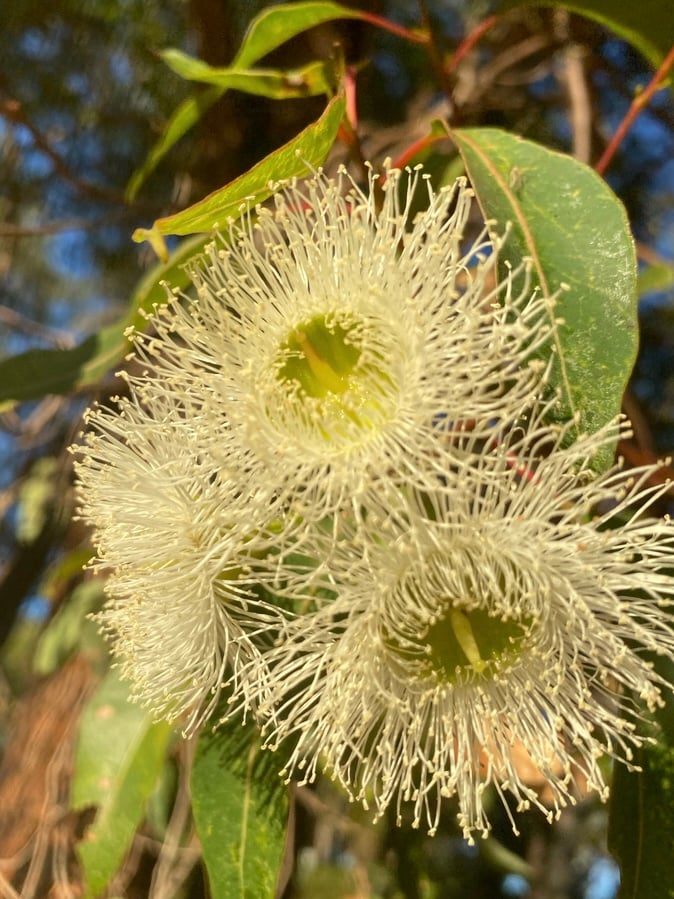
Marri is the Noongar word for blood. The tree it names – Corymbia calophylla, a bloodwood – oozes dark red gum, called kino, from wounds in its rough bark, and Noongar people used that kino as medicine, and soaked the tree’s white blossoms, ngumbit, in water for a sweet drink – a use of this tree’s flowers older than any beehive in the country. The Bureau of Meteorology’s published Nyoongar calendar marks Bunuru, the second summer, as the time of white flowers, when jarrah, marri and ghost gums bloom together across the southwest. Beekeepers work to the same flowering, and marri is the one they count on: it flowers nearly every year, from December into May, and colonies draw both nectar and pollen from it, so beekeepers count on marri to build their hives as much as for the honey itself. In Western Australia the jar often says Red Gum, the local name for marri – an unrelated tree to the eastern river red gum, and a different product: marri is measured and sold for its antibacterial activity, like jarrah from the same forests, and it is one of only three honeys with its own written industry standard.
Characteristics
Marri honey is amber – golden to dark by batch – thick-bodied, and sweet with caramel through it. It is one of the two Western Australian honeys, with jarrah, that laboratory surveys single out for consistently high antibacterial strength, and jars in trade carry Total Activity ratings from TA20+ to TA30+. What sets it apart from jarrah on the shelf is availability and price: the marri harvest comes in nearly every year, and its jars generally cost less. This is the Western Australian activity-rated honey a buyer can expect to actually find.
Click to Display — The Details: botanical origin, sensory profile, and its regional identity
Botanical Name: Marri (Corymbia calophylla)
Botanical Family: Myrtaceae
Bee Species:
European honey bees (Apis mellifera) in migratory box hives produce the commercial honey, in a state still free of the varroa mite. Far more than the box hives depend on the tree: Curtin University research published in 2024 identified marri as a critical food source for more than eighty species of native bee in the southwest biodiversity hotspot.
The honey bee is an introduced species, and its feral population has a documented cost here. Feral colonies have bred wild in the bush for well over a century – a naturalised population now, not recent escapes – and they occupy tree hollows in competition with indigenous hollow-nesters, including the black cockatoos that nest in mature marri; a 2024 Perth study found feral bees occupying about twelve per cent of monitored black cockatoo nests. Today’s beekeepers did not create that population and cannot remove it, but their practice codes oblige them not to add to it: swarm prevention is a standing duty – regular re-queening, relieving spring crowding – the Western Australian Apiarists’ Society collects reported swarms before they establish, and the state recovery plan for forest black cockatoos includes removing bees from occupied hollows.
Color:
amber, from golden to dark
Flavor Profile:
sweet and full-bodied, with caramel notes
Tasting Notes:
Producers describe this honey from two directions, and the spread is worth knowing before buying. At one end, a southern producer sells marri as a traditionally popular honey with a delicate sweet flavour; at the other, a batch-testing bottler describes it as bold and robustly sweet, with deeper caramel notes and a full body that the bottler contrasts against jarrah’s more delicate profile. Between them sit descriptions of caramel sweetness with subtle woody undertones. The honey is thick in the jar, and batches run darker and stronger in some seasons and sites than others.
Defining Compounds:
Marri honey’s antibacterial activity comes from the peroxide pathway: diluted honey generates hydrogen peroxide through the glucose oxidase enzyme, which is a different mechanism from the methylglyoxal that powers manuka honey’s rating. The state survey of Western Australian honeys measured marri at an average of 31.1 per cent on the phenol scale laboratories use to grade antibacterial strength – the highest average of the survey, and with jarrah about 90 per cent above the average it measured for New Zealand manuka – and jars in current trade carry Total Activity ratings from TA20+ to TA30+. Peroxide activity declines with heat, light and storage time, and it is the reason marri is generally bottled raw.
Forage Origin:
The honey is made from the nectar of the marri, Corymbia calophylla, a bloodwood endemic to the southwest of Western Australia – the same genus as the Central Australian tree behind desert bloodwood honey. Marri grows to sixty metres, with rough grey-brown bark that often shows the dark red kino the tree is named for. It grows nearly everywhere the southwest forests do: co-dominant with jarrah through the jarrah forest, present through the karri country, across the coastal plain, and in pockets north toward Eneabba – the 1960 state honey flora survey gives its beekeeping range as Eneabba south and east to Albany.
The flowers are white to pink, in branched clusters of three or seven buds, and open from December into May. The fruit is the largest gumnut in the southwest forests – the honky nut of Western Australian vernacular. Unlike jarrah, marri is resistant to Phytophthora dieback.
Origin Story
The tree’s human record starts long before its honey. To Noongar people marri is the medicine tree: the kino that beads from its bark was powdered onto wounds to stop bleeding, mixed with water as a mouthwash and disinfectant, taken in small doses for an upset stomach, and used in quantity to tan kangaroo skins. The blossoms, ngumbit, were soaked in water for a sweet drink. The wood was made into spears and digging sticks. When beekeepers brought hives into the southwest forests, they worked the same flowering, and the 1960 state honey flora survey records marri plainly: a major honey plant, very sensitive to climate.
The laboratory record came in stages. A state survey of 342 Western Australian honey samples found that the two endemic honeys, marri and jarrah, showed the most consistently high antibacterial activity of every honey tested, and its report set the pair about 90 per cent above the average activity of New Zealand manuka honey. Between 2016 and 2021 the state’s bee industry council and its chemistry centre sampled marri honey across seasons and districts and wrote the result into an industry quality standard – a formal chemical definition of what a jar labelled marri must be, a standing that only jarrah and powderbark honey share.
Cultural Context
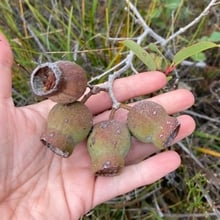
Marri is part of Western Australian childhoods as well as Noongar medicine. Its big urn-shaped gumnuts are honky nuts in the local vernacular – gathered, thrown, and turned into craft in generations of backyards. In the Nyoongar calendar, the white-gum flowering that includes marri marks Bunuru, the second summer – the season traditionally spent living and fishing on the coast. The federal conservation advice for Baudin’s cockatoo, one of the southwest’s threatened black cockatoos, records the bird nesting in the hollows of mature marri and extracting marri seeds with its long upper beak – the chewed honky nuts under a marri are often the sign the birds have been through.
Harvest & Forage
Marri is the dependable flow of the southwest: it flowers nearly every year between December and May, and it yields nectar and pollen together, so beekeepers use it to build colonies ahead of pollination contracts and jarrah seasons, as well as to take a honey surplus. Dependable is not unconditional: the 1960 state survey’s verdict – a major honey plant, very sensitive to climate – still holds, and yields swing with the season.
The tree itself is under documented pressure. Marri canker, caused by the native fungus Quambalaria coyrecup, kills stems and whole trees, and infected trees flood kino in response; state research links the disease’s severity to drought and land disturbance. A second, introduced fungus causes marri shoot blight, which deforms and kills flowers – the state conservation department notes the damage to flowering costs foraging resources for native animals and honeybees alike. A meaningful share of the state’s honey production now depends on a tree assessed as near threatened in 2019.
Beekeeping Context
Marri honey comes off the same public-land apiary permit system as the rest of the southwest forest honeys, administered by the Department of Biodiversity, Conservation and Attractions across conservation and state land. Its role in the beekeeping year is structural: colonies are built on the marri flow, and marri makes up the volume where jarrah makes the rare years.
Producers add their own assurance layers over the industry standard – organic certification at a Toodyay apiary working marri country since 1958, and batch-level ChemCentre activity certificates from smaller bottlers.
Named Producers
Pemberton Honey Company – Whispering Woods farm, Pemberton. Family producer whose marri line sits beside its karri and jarrah; hives worked across the South West. https://www.pembertonhoney.com
The House of Honey – Swan Valley. Sells its marri under the western trade name Redgum, TA-rated. https://thehouseofhoney.com.au
Bee Happy Apiaries – Toodyay. Certified organic marri honey from an apiary in production since 1958. https://beehappy.com.au
Certifications
BICWA Industry Quality Standard – the Bee Industry Council of Western Australia’s standard, developed with ChemCentre from a 2016-2021 sampling program, chemically defines uni-floral (single-source) marri honey; certified honeys may carry the council’s registered quality trademark.