Karri Honey
The Story
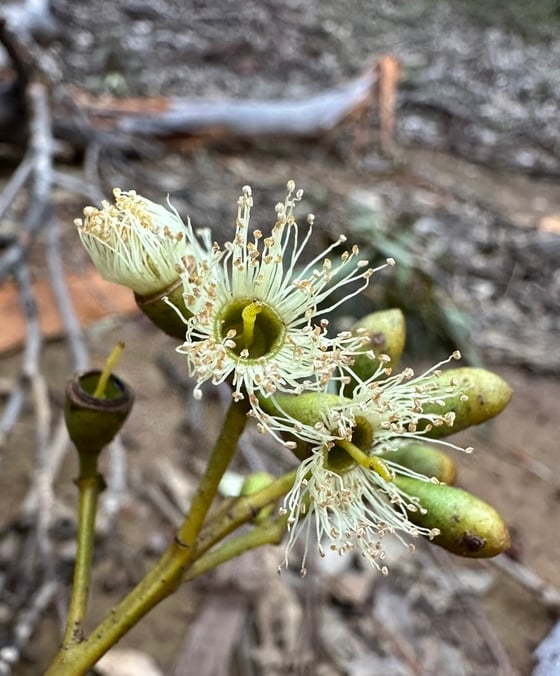
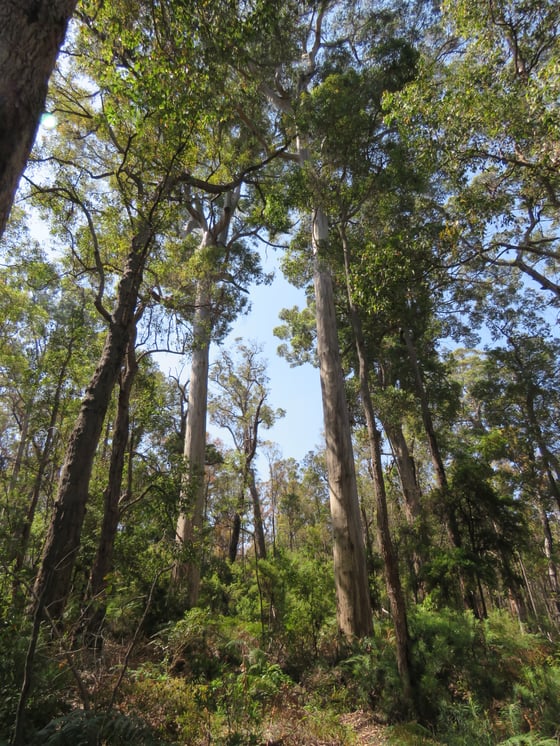
In the far southwest corner of Western Australia grows a eucalypt that grows nowhere else: karri, Eucalyptus diversicolor, the state’s tallest tree and, with Victoria’s mountain ash, one of the two tallest flowering trees on earth. Its white flowers open at the top of a trunk that can pass sixty metres. In 1947 foresters drove climbing pegs up a karri outside Pemberton and built a fire lookout cabin in its crown; foresters later replaced the tree lookouts with spotter planes, and today the Gloucester Tree is open for anyone to climb. The karri country below it is a named food region – the Southern Forests, where growers around Manjimup produce the Southern Hemisphere’s largest black truffle harvest and Pemberton farmers raise marron, avocados and cool-climate wine. Honey belongs on that list. A family producer outside Pemberton bottles twenty-five tonnes of raw honey a year from hives worked through the South West, and its karri line is the one its beekeepers call the rarest: the karri flowers heavily only every few years, and beekeepers move their hives in when it does. The honey they bring back is pale and mild for a eucalypt – producers describe butterscotch and vanilla – and it is measured and sold for its antibacterial activity, like jarrah from the drier forests to its north.
Characteristics
Karri honey is pale gold, light-bodied and mild – an unexpected profile from a family of honeys that is mostly dark and strong, and the reason buyers who find eucalypt honey overpowering keep returning to this one. The sweetness is gentle and the finish clean, with the butterscotch and vanilla notes its producers describe sitting low rather than loud. Like jarrah and marri from the same forests, it carries measurable antibacterial activity and is sold with a Total Activity rating on the label, most commonly TA20+ and above in current trade.
Click to Display — The Details: botanical origin, sensory profile, and its regional identity
Botanical Name: Karri (Eucalyptus diversicolor)
Botanical Family: Myrtaceae
Bee Species:
European honey bees (Apis mellifera) in migratory box hives produce all commercial karri honey. Western Australia remains free of the varroa mite, and its beekeepers work without the chemical mite treatments now standard in the eastern states.
Color:
pale gold to light amber
Flavor Profile:
mild, smooth and gently sweet; delicate for a eucalypt honey
Tasting Notes:
The producers who bottle it agree on how mild it is. Pemberton Honey Company describes its karri as a light coloured honey with a smooth butterscotch flavour; The House of Honey, which harvests its karri at Pemberton, describes undertones of vanilla and a honey very smooth on the palate. Set beside jarrah, the region’s dark and malty benchmark, karri reads as the light half of the pair.
Defining Compounds:
Karri is one of four Western Australian eucalypt honeys recognised for antibacterial activity that comes from the peroxide pathway rather than the methylglyoxal that drives manuka. Industry testing places karri at a Total Activity of roughly 15 to 30, and jars in current trade carry ratings from TA20+ to TA30+, with one Swan Valley bottler publishing its current batch reading of TA32. State agriculture research measured karri honey’s antibacterial strength at 32.2 per cent on the phenol scale laboratories use to grade it, and a 2024 laboratory study of Western Australian honeys found karri among the strongest against clinically important yeasts. Peroxide activity declines with heat, light and time, which is one reason producers bottle it raw.
Forage Origin:
The honey is made from the nectar of the karri, Eucalyptus diversicolor, a smooth-barked eucalypt endemic to the high-rainfall southwest corner of Western Australia. Its belt runs from the Boranup forest near Margaret River through the Warren country around Pemberton, Manjimup and Northcliffe to Walpole, Denmark and the hills behind Albany. It is Western Australia’s tallest tree – commonly past sixty metres – and one of the six forest giants named in the state’s south-west forests.
The flowers are white and open in clusters of seven, high in the canopy. Within the karri belt some trees are in flower through much of the year, but the honey crop comes when whole stands blossom together, and that happens years apart.
Karri regenerates from seed alone. Unlike most eucalypts it does not resprout from a rootstock or from beneath its bark after a severe fire, so the forest grows in stands of trees all the same age – including forest that grew back over settler farms abandoned early last century, now mature. The tree has been planted in South Africa, where it is naturalised, listed as invasive and worked by beekeepers as gum forage; the tallest reliably measured tree in Europe is a planted karri in Coimbra, Portugal. No varietal karri honey is bottled outside Australia.
Pairings:
A Southern Forests lunch documented by the Los Angeles Times in 2009 finished with buckwheat cake and persimmons poached in karri blossom honey under double cream. A Pemberton distillery roasts macadamias in karri honey to infuse a vodka. Producers recommend it over soft-rind cheeses – camembert or brie with fresh fig – where a stronger eucalypt honey would take over the plate. Its mildness makes it the WA honey to reach for wherever the honey is meant to sweeten rather than dominate: tea, yoghurt, fruit.
Origin Story
The karri forest’s first European industry was timber. Pemberton was settled from the 1860s, and karri blocks were shipped to pave streets in early Sydney and London – a 1905 timber trade volume shows Regent Street surfaced with them. Between 1937 and 1952 foresters built a different kind of structure: fire lookout cabins pegged into the crowns of eight giant karris, because the karri country had no hills high enough to watch it from. The Gloucester Tree, selected in 1947 and named for the Duke of Gloucester who watched its construction, was test-climbed by forester Jack Watson in a six-hour ascent. Foresters replaced the tree lookouts with spotter planes, and the pegs stayed; visitors climb them today.
Beekeepers entered the forest in 1936. In 1954 the biggest honey crop on record came out of it: Bob Smith’s 460 hives at Manjimup averaged 346 kilograms of karri honey each – a world record that still stands. By the early 1950s an estimated quarter of Western Australia’s honey came out of the karri forests.
The timber era closed in stages. Old-growth logging ended in 2001, and on 1 January 2024 Western Australia ended commercial logging in native forests altogether, protecting nearly two million hectares of karri, jarrah and wandoo under the Forest Management Plan 2024-2033. The karri forest’s working economy today is tourism, the Southern Forests food industry, and honey – taken from hives placed under licence in forests that are no longer logged.
Cultural Context
Karri is a Noongar word, and the tree is in the name of the country’s own representative body: the Karri Karrak Aboriginal Corporation, the Traditional Owner corporation for the southwest forest region under the South West Native Title Settlement, takes its name from the tree and karak, the forest red-tailed black cockatoo. The state’s Forest Management Plan for the karri country calls the forests djarilmari, carries a commissioned Noongar seasons artwork, and names joint management with Noongar Traditional Owners as a strategic goal. The Bibulmun/Pibelmun people are acknowledged as the Traditional Owners of the Gloucester karri forest at Pemberton.
At Northcliffe, the community arts group Southern Forest Arts opened the Understory Art and Nature Trail in 2006: more than seventy site-specific sculptures and twelve commissioned songs along a 1.2 kilometre walk beneath the karri canopy.
Harvest & Forage
Karri honey is an event crop. Individual trees flower in most years, but the heavy stand-wide flowerings that produce a commercial flow come at intervals of several years – producers’ own statements range from every four years to once a decade or longer – and a major flowering, once underway, can run for as long as nine months. The 1960 state honey flora survey places the major flow between mid-December and the end of April, and one Swan Valley bottler working Pemberton sites harvests karri from March to July. The same survey traces the cycle to the tree itself: buds take three years from new tip growth to flower, and it links the rhythm to fruit load on the trees and the timing of winter rains.
When a flowering comes, beekeepers truck hives into the Warren forests to meet it; apiary sites in the region are valued specifically for the chance of a karri event. Jarrah and marri flower in the same country, so a clean karri crop depends on timing the supers to the karri flow. One bottler that publishes batch pollen analysis reported its karri at sixty per cent karri pollen, with jarrah and pasture clover behind it.
Beekeeping Context
Karri honey is produced by migratory beekeepers who work the public forests of the southwest under apiary permits issued by the Department of Biodiversity, Conservation and Attractions – the permit system under which most of Western Australia’s honey is produced on conservation and state land. Since commercial native logging ended in January 2024, the karri forests these permits reach are managed for conservation, recreation and forest health rather than timber.
The working shape of the industry is small and family-scale. Pemberton Honey Company, based at a farm outside Pemberton with eight hectares of its own karri forest, runs hives from Pemberton to Esperance and the Goldfields across up to nine varietal lines; karri is its most popular. Its owner serves as vice chair of the state’s bee industry council, where forest flowering resources are the industry’s standing concern.
Named Producers
Pemberton Honey Company – Whispering Woods farm, Pemberton. Family producer bottling about twenty-five tonnes of raw honey a year across up to nine varietal lines; karri is its most popular honey. https://www.pembertonhoney.com
WA Bush Honey – Albany. Raw southern-forests varietals including karri from the region’s rare flowerings. https://wabushhoney.com.au
The House of Honey – Swan Valley, with karri harvested at Pemberton and sold TA-rated. https://thehouseofhoney.com.au