Coastal Mallee Honey
The Story
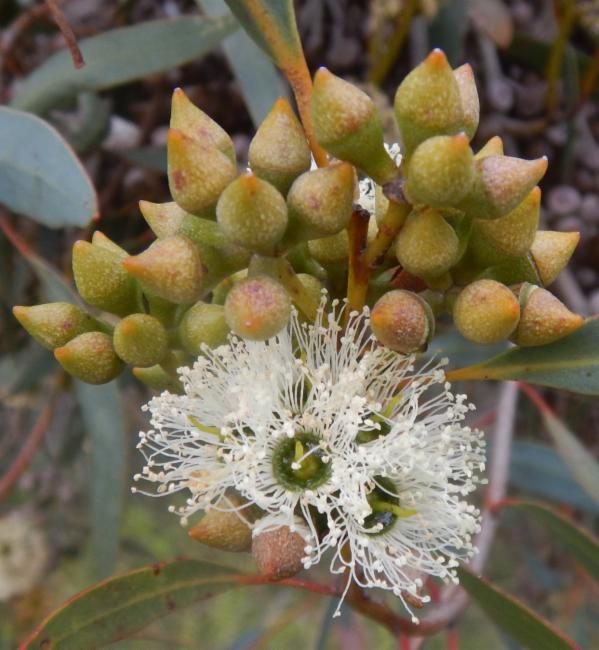
Coastal mallee is the eucalypt South Australian beekeepers use more than any other. A 2004 survey of the state’s floral resources, built from the returns of a hundred and three commercial beekeepers, found it in use at more sites than any other native plant, ahead of South Australian blue gum and river red gum.
It is a mallee, and it grows on well-drained sand over limestone within reach of the coast, through much of Eyre Peninsula, the southern end of Yorke Peninsula and the South East. On exposed cliff tops it flowers at half a metre; in sheltered country it reaches ten.
Beekeepers call it stoney mallee. That is the name it carries in the crop reports the industry publishes each month, and it is not the name on the jar: the honey is sold as coastal mallee. The crop behind that jar is not the same size every year. In one season the reports record colonies breeding well and surplus honey coming off the West Coast; in another, the same tree gives a little honey and no flow worth the name.
Characteristics
Every description of this honey comes from the people who sell it. The producer who bottles it single-source describes it as rich and full-bodied, with malty, toffee and earthy notes, an earthy complexity behind a darker and more layered finish than its other eucalypt honeys, and a savoury character it recommends alongside charcuterie and aged cheese. No laboratory measurement of the honey has been published: it was not among the eucalypt honeys in the 1977 CSIRO survey of Australian honeys, and it does not appear in the national composition and antimicrobial surveys since. How quickly it granulates is not recorded.
Click to Display — The Details: botanical origin, sensory profile, and its regional identity
Botanical Name: Coastal mallee (Eucalyptus diversifolia)
Botanical Family: Myrtaceae
Bee Species:
Apis mellifera, the western honey bee, as with every commercial South Australian honey.
Color:
not independently documented. The producer who bottles it describes a darker, more layered honey than the other eucalypt varietals it sells
Flavor Profile:
described by the producer as rich and full-bodied, with malty, toffee and earthy notes
Tasting Notes:
The producer who bottles it single-source calls it bold in character, with a lingering sweetness and a savoury bush note, and puts it with aged cheeses and charcuterie rather than in baking.
Aroma:
not documented – no published description of this honey’s aroma was found
Forage Origin:
Nectar from coastal mallee, Eucalyptus diversifolia, in the Myrtaceae family. It grows on several stems from a rootstock at ground level, anywhere from half a metre on exposed cliff tops to ten metres in sheltered country, with smooth bark in cream and grey over pink, yellow or brown, and cream-white flowers carried seven, nine or eleven to a cluster.
The species name records a change in the leaves rather than a difference between plants. Young growth carries broad leaves in opposite pairs, clasping the stem; mature growth carries narrow leaves, singly and on stalks. Ferdinand von Mueller gave it a second name, Eucalyptus santalifolia, for a resemblance he saw between those leaves and sandalwood, and it is from that name that the Victorian government apiculturist was calling the tree sandal gum in 1922.
It is restricted to well-drained sandy soils, usually over limestone, in coastal country: much of Eyre Peninsula, the southern end of Yorke Peninsula, Kangaroo Island and the South East, with smaller separated stands in the Mount Lofty Ranges at Newland Head and Carrickalinga. It stands in the second line back from the water rather than on the front, and it does not tolerate waterlogged or salty ground. Yorrell, red mallee, dryland tea-tree and drooping sheoak share the same country.
The names are the difficulty. The jar says coastal mallee. Beekeepers say stoney mallee, and that is the name in the monthly crop reports. The state herbarium gives coastal mallee and coastal white mallee; the national eucalypt reference gives soap mallee; the standard beekeeping flora indexes it as stony mallee. Three of those names are also worn by other trees. White mallee is used for two other species in the same top-ten list a South Australian beekeeper would read, and blue mallee usually means a Victorian oil mallee. In Western Australia, honey sold as coastal mallee comes from a different tree again, Eucalyptus incrassata, and is described as light-coloured where this one is described as dark.
Few of these honeys name a species at all. South Australian mallee is usually sold by district – Murray Mallee, Coorong Mallee, South East Mallee – or as mallee and nothing further, and one seller states plainly that its flavour depends on which mallee species the bees worked. Where the Latin name is printed on the label, it settles the question; where it is not, the district is all the buyer has.
The same blurring happens well before the jar is filled. Of all the honey South Australian beekeepers delivered to one national packer between 1991 and 2002, the largest single share arrived described only as mallee, while red, white, black and yellow mallee were each recorded separately. Whatever coastal mallee contributed sits inside that undivided line.
Pairings:
The producer who bottles it puts it with aged cheese and charcuterie, over roasted vegetables, and into marinades, glazes and slow cooking, as well as on toast and through porridge. It is sold as a honey for savoury use rather than for baking.
Origin Story
The tree reached botanical science by an unusual route. In January 1803 the French expedition under Nicolas Baudin collected seed on Kangaroo Island. That seed was grown in France, at Malmaison and at the botanic garden in Toulon, and it was from those cultivated plants that Aime Bonpland described the species in 1814 – a South Australian coastal mallee named from a garden outside Paris.
Its standing as a honey plant took longer to settle. The Victorian government apiculturist, F. R. Beuhne, gave it a page in his 1922 handbook of the state’s honey flora under the name sandal gum, and recorded a verdict that was honest about how little was then known: a good oil yielder, and as a source of nectar it promised well, but had only been watched for a short time. Beuhne was writing about the small stand at the Victorian end of the range, near Portland, not the South Australian country where the honey is now taken.
The reason there is still mallee to work is the ground it stands on. The sand over limestone that suits this tree does not suit crops, so the scrub through the south-west of Yorke Peninsula was never extensively cleared, and that corner of the peninsula still carries about half its native vegetation where the rest of it carries less than a fifth. The species is listed as vulnerable internationally, but on a measure of how much has been lost to past clearing rather than of how scarce it is now. It remains a common tree in the country that was left.
Harvest & Forage
The flowering runs long and peaks late. The state herbarium gives winter to spring; the 2004 survey of South Australian beekeepers describes a generally broad flowering season with a late winter to spring peak, and records the tree in use at ten or more sites in every month from April through November. In August and September it heads the state’s list of plants being worked.
The size of the crop is not steady, and the unsteadiness has a shape. The same survey puts honey yield at average to good in alternate years, with a moderate yield of pollen every year, and names 1984, 1995, 1996, 1998, 1999 and 2000 among the seasons the tree flowered extensively. The monthly crop reports show the swing from the other side: in one season the West Coast stand doing very well, with colonies breeding and surplus honey coming off; in another, this tree among several that yielded a little honey and no flow worth taking as a crop of its own.
Keeping the crop to one tree is the standing difficulty. Coastal mallee grows interleaved with yorrell and other mallees, and the monthly reports name yorrell and coastal mallee yielding in the same weeks. The producer who bottles it single-source describes the honey as coming from native mallee species, in the plural, and says no two harvests are the same because rainfall, the weight of flowering and the surrounding scrub all bear on it. No pollen analysis of this honey has been published, so how close a given jar sits to a single monofloral source is not something the record can answer.
Beekeeping Context
Hives reach this flow inside a year built around other work. Colonies are wintered in remnant scrub, moved to the Riverland almond orchards for the July and August flowering, and then put onto early mallee, canola and citrus as those come on. The 2004 survey traces the coastal leg of that year: through autumn, hives move away from the South East and the ranges towards the coast, work coastal mallee there through winter and into spring, and from October begin returning inland. Coastal mallee is worked in two districts: the West Coast of Eyre Peninsula, and the South East. The Riverland and the Murray Mallee, where most South Australian mallee honey is sold from, are different country and a different tree.
What beekeepers report of it is that it does two jobs at once. In May 2013 the state report recorded colonies on the West Coast stand breeding well and taking surplus honey, at a time when the Mid-North, Riverland and South East were going backwards. In the autumn and winter of that year, beekeepers from Tintinara and Keith in the South East moved their hives about nine hundred kilometres to Streaky Bay, on the West Coast, to get them fed before the almonds. The 2004 survey measures what the crop reports describe: across thirty-seven beekeepers and a hundred and thirty-four sites, the tree is recorded at sixty-six per cent nectar and thirty-four per cent pollen. South Australian blue gum, worked by more beekeepers than this tree, is recorded as providing negligible pollen. This one carries ordinary anthers on all its stamens.
Most of it is taken off private land. South Australia has roughly four hundred licensed hive sites on public land, against eight and a half thousand in New South Wales, and between two hundred and fifty and three hundred of the South Australian sites are in a single inland park that grows no coastal mallee. In the coastal parks the pattern runs the other way: Lincoln National Park and the reserves of lower eastern Eyre Peninsula permit no beekeeping licences at all, and the sites in the Coffin Bay parks have stood empty since 1992, the department noting when it declined to reopen them that beekeepers can reach the same flowering scrub from private land along the boundary. Venus Bay Conservation Park, on the west coast, is the exception, with five registered sites of which four are in use.
Named Producers
Oh Honey – Fleurieu Peninsula, South Australia, trading from Tailem Bend. Registered in May 2018 and running more than a thousand hives, moved with the state’s flowering seasons, alongside a pollination service for almonds, canola and cherries. Bottles coastal mallee as a single-origin 500 g jar and as a three-jar tasting pack, cold extracted and minimally filtered, with Eucalyptus diversifolia named on the label. Ships within Australia except to Western Australia.
Regional Variants
- Eucalyptus diversifolia – Coastal Mallee Honey – Australia – Kangaroo Island: The same tree grows on Kangaroo Island, where it is worked by the island’s isolated Ligurian bees and sold under the same name from a farm gate at Haines. The island producer describes its honey as mild, with a subtle honeycomb taste, where the mainland honey is described as rich and full-bodied. The island label names no species, and Kangaroo Island carries several other mallees.