Australian Manuka Honey
The Story
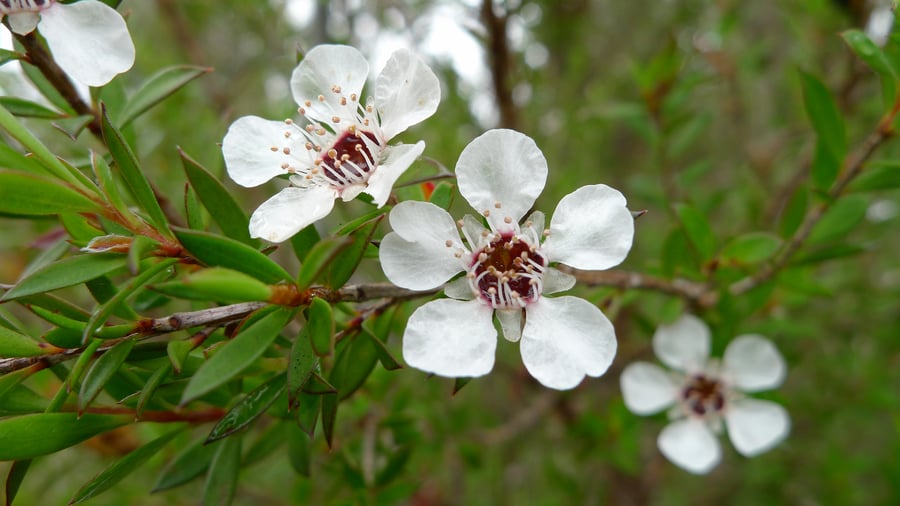
Manuka is usually thought of as a New Zealand honey, but the plant behind it is at least as much Australian. “Manuka” honey is made from the nectar of Leptospermum, a genus of some eighty species – and all but a handful grow in Australia, not New Zealand. New Zealand has just one, Leptospermum scoparium, which Australian botanists argue originated in Australia and crossed the Tasman before the last ice age.
Australian producers mostly do not use that species. Their workhorse is jellybush, Leptospermum polygalifolium, and honey from it – from the Northern Rivers of New South Wales and south-east Queensland – has measured among the most antibacterially active in the world, matching or beating New Zealand manuka in the laboratory. The catch is that the activity follows the species, not the name: of Australia’s many Leptospermum, only some make active honey, so Australian manuka is a matter of finding the right plant.
For years the word “manuka” was contested across the Tasman, and Australian producers are now free to use it: New Zealand’s own courts, along with the UK and the EU, all refused to reserve the name. Australia grades its manuka by MGO rather than New Zealand’s UMF, and its industry body runs its own Mark of Authenticity.
Characteristics
Australian manuka is a dark honey, amber to brown, with a bold, earthy flavour that carries a medicinal, tea-tree edge and a run of sweet caramel underneath – fuller and rounder than a light table honey. Its signature is texture: it is thixotropic, setting to a jelly at rest and turning fluid when stirred, and jellybush, the main Australian source, is named for exactly this. It is thick and smooth, slow to granulate, and usually sold that way. In character it sits close to its New Zealand cousin, with the caramel note more its own.
Click to Display — The Details: botanical origin, sensory profile, pairings, health and what gives it its character
Botanical Name: Jellybush (Leptospermum polygalifolium)
Botanical Family: Myrtaceae
Bee Species:
Australian manuka is the work of the European honey bee, Apis mellifera, foraging on flowering Leptospermum – the same bee used for manuka everywhere. Australia’s native bees, including the social stingless bees of the warmer north, make their own distinct honeys but are not the source of this one.
Color:
Dark amber to brown.
Flavor Profile:
Rich and earthy, with a medicinal, tea-tree edge and sweet caramel undertones; bold rather than delicate.
Tasting Notes:
Full-bodied and robust, with a faint bitterness and a caramel warmth. Thick and smooth, and often thixotropic – jellybush takes its name from the way the honey sets to a jelly and loosens when stirred.
Aroma:
Earthy and herbal, with a woody, tea-tree note.
Defining Compounds:
Australian manuka is active for the same reason New Zealand’s is: its punch comes from methylglyoxal (MGO), which forms in the honey from dihydroxyacetone (DHA) in the nectar and survives after ordinary honey’s hydrogen peroxide breaks down. That chemistry, and the grading science behind it, is set out in full on the New Zealand Manuka Honey page. What is particular to Australia is how the honey is graded and labelled.
Buying Guide -- how Australian manuka is labelled
Australia grades by MGO, the milligrams of methylglyoxal per kilogram, rather than New Zealand's UMF. "MGO 250+" means at least that much of the active compound; the higher the number, the more potent and more expensive the honey.
The Australian Manuka Honey Association runs a Mark of Authenticity in two tiers, each tested by an approved laboratory for MGO, the potency, and DHA, which shows that potency formed naturally in the nectar:
| Tier | MGO (min) | DHA (min) |
|---|---|---|
| Authorised | 30 mg/kg | 60 mg/kg |
| Authentic | 85 mg/kg | 170 mg/kg |
Authenticated honey is labelled "Sourced from Australian Leptospermum honey" with its MGO figure. As with any manuka, the grade measures antibacterial strength, not flavour: a high MGO is more active and dearer, not tastier, so a low grade suits eating and the high grades earn their price mainly for skin or wound use. Look for the MGO number and the Mark of Authenticity, and treat a bare "active" with caution: it can mean ordinary peroxide activity, which is not unique to manuka.
Forage Origin:
Australian manuka is not one honey but a family of them, because it comes from a genus, not a single plant. Leptospermum runs to some eighty species, almost all of them Australian, and only some make antibacterially active honey – the activity follows the species, so where the honey comes from largely decides what it is. A few regions carry the real production, each with its own plant.
Australia's manuka regions at a glance
Three regions carry the story, with the rest still emerging:
| Region | Leptospermum species | What stands out |
|---|---|---|
| Northern Rivers, NSW | L. polygalifolium (jellybush) | The heartland; Australia's most active manuka (MGO to ~1,100) |
| South-east Queensland | L. polygalifolium | Equally strong; a Byfield sample held the country's top reading |
| Tasmania | L. scoparium | The same species as New Zealand; wild-harvested, with medical-grade plantation trials |
| Victoria, SA, WA | various Leptospermum | Minor or plantation-future (WA's bioactive fame is jarrah, a different honey) |
That regional split is why Australian manuka has been as much a research project as an industry: with more than eighty Leptospermum to choose from, most making ordinary honey, the work has been to find – and increasingly to plant – the few that carry the activity.
Pairings:
Australian manuka’s bold, caramel-edged flavour suits strong company: aged cheese, dark toast, strong tea, or a spoonful on its own. As with any manuka, the high grades are bought for their activity, not for cooking – and heat degrades the very compound that makes them worth the price, so keep the strong grades off the stove and use a plainer honey for baking.
Health Uses:
Australian manuka’s interest beyond flavour is its measured antibacterial activity, the same non-peroxide kind found in New Zealand manuka. It has been demonstrated in the laboratory, and medical-grade Australian Leptospermum honey is used in some wound-care products; the evidence is strongest for that topical use. Eaten, it is a honey – enjoyed for its flavour, not for treating illness.
Origin Story
Australians made honey from Leptospermum long before anyone thought it valuable – early colonists called the plant tea tree, and honey from it is recorded back to the 1820s. For most of that history it was just bush honey. What changed was the science. Between about 2016 and 2019 a national research effort led by Liz Harry at the University of Technology Sydney, with the Universities of Sydney and the Sunshine Coast and funding from AgriFutures Australia, tested more than five thousand honeys across some fifty Leptospermum species. It found that at least seven Australian species make honey with exceptionally high antibacterial activity, and that the strength is set by the plant, not the country. That finding turned a scattered bush-honey trade into a medical-grade industry – and it armed Australia for the fight over the name that followed.
The fight over the name, and why Australia can use "manuka"
New Zealand's Manuka Honey Appellation Society tried to trademark "manuka honey" and reserve it to New Zealand. It was refused everywhere it was tested -- by New Zealand's own IPONZ in 2023, the UK in 2021, and the EU -- each finding the term descriptive of a type of honey, so Australian producers may lawfully use it. The full rulings are set out on the New Zealand Manuka Honey page.
Australia's case, stated flat: the Australian Manuka Honey Association argued that "manuka" is a descriptive term Australians have used since the 1800s, that Leptospermum honey here is recorded from 1822, and that L. scoparium is native to both countries. The New Zealand side held that "manuka" is a Maori word and a taonga and sought to protect it, met the losses with dismay, and dropped its appeals.
Cultural Context
Australia’s cultural claim on manuka is newer and more contested than New Zealand’s. Where “manuka” is a Maori word carrying deep cultural weight across the Tasman, in Australia the honey was for a long time an overlooked bush product; the recent fight to keep using the name has become a point of national pride, framed as reclaiming something Australian rather than borrowing it. The colonists’ old name for the plant, tea tree, still lingers – and still gets confused with the unrelated Melaleuca that yields tea tree oil.
Harvest & Forage
Jellybush flowers on the east-coast bush from about September to November, and honey from it is notoriously awkward to harvest – the same thixotropic set that gives the plant its name means the honey grips the comb like jelly and will not spin out cleanly, so beekeepers press or scrape it and warm it gently to move it. Activity is unpredictable: because it depends on the plant, two hives in the same district can yield honey of very different strength, so every batch is lab-tested to grade it. Australia’s newer answer is to plant bred, high-activity Leptospermum, with some varieties now selected to flower for months rather than the wild few weeks.
Beekeeping Context
Australia’s manuka is a young, largely direct-to-consumer industry. Most of it sells online – Gather By and Biosota from the Northern Rivers and Queensland jellybush country, Nature’s Gold, Australia’s Manuka, Bee2, and Tasmanian brands working L. scoparium – while Capilano, the country’s largest honey company, and Berringa carry it into supermarkets and pharmacies. Because wild activity is so variable, the growth story is as much horticulture as beekeeping: bred, high-MGO Leptospermum planted in orchards to make medical-grade honey to order. One shadow over all Australian beekeeping now is varroa, the mite that reached New South Wales in 2022 after Australia had long been the last major producer without it; the industry has shifted from trying to eradicate it to living with it.
Regional Variants
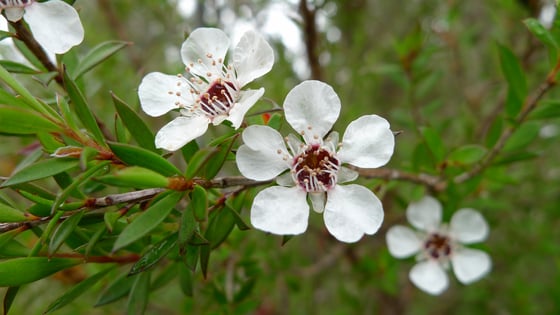
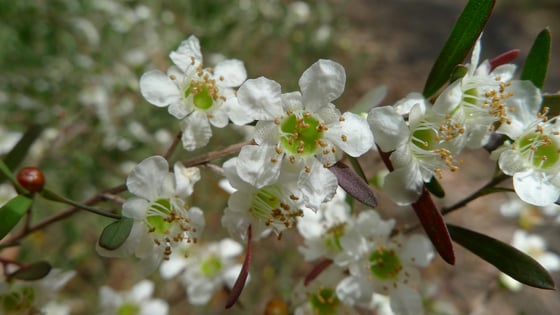
- Leptospermum polygalifolium – jellybush honey, Australia, Northern Rivers NSW and south-east Queensland – the commercial heartland and the most active Australian manuka; the honey sets to a jelly, which is where the plant’s name comes from.
- Leptospermum scoparium – Tasmanian manuka, Australia, Tasmania and King Island – the same species New Zealand uses, wild-harvested and the focus of the ‘manuka is Australian too’ argument, with early plantation trials aimed at medical grade.
Certifications
- Australian Manuka Honey Association Mark of Authenticity – a two-tier certification (Authorised and Authentic) requiring set minimum MGO and DHA, produced entirely in Australia and independently lab-tested, for honey labelled ‘Sourced from Australian Leptospermum honey’.