Sugarbag Honey
The Story
The honey almost everyone knows is made by a single insect, the European honey bee. Sugarbag is not. It is the honey of Australia’s native stingless bees – black, about four millimetres long, and without a sting – and it is a different substance from what sits in an ordinary jar. The difference begins with where the bees keep it. In place of the wax hexagons of a honeycomb, stingless bees store their honey in small round pots built from cerumen, a worked mixture of wax and plant resin. That resin does more than hold the honey: it loads it with the acids and aromatic compounds that give sugarbag much of its flavour and its keeping power. The honey stays thin and pours freely; it runs sharp and sour before it turns sweet; it contains trehalulose, a sugar the European honey bee does not make; and because it is sealed damp in its pots it slowly ferments, so it is kept in the refrigerator rather than the cupboard. It is scarce, too – a whole hive produces about a jar in a year. And it is old: Aboriginal Australians gathered it for tens of thousands of years before the first European hive arrived, which makes sugarbag the oldest honey on the continent.
Characteristics
Sugarbag is an amber to dark reddish-amber honey, thin enough to pour like a syrup. Its water content runs to roughly 25 to 31 per cent, close to twice that of a typical comb honey, and two things follow from it: the honey does not crystallise, and it does not keep at room temperature. Sealed damp in its resin pots it carries wild yeasts and slowly ferments, so it is bottled and sold cold and belongs in the refrigerator. The flavour tracks the acidity – at a pH near 3.5 to 4 it runs sharp and sour first, sweet second, and finishes resinous.
Click to Display — The Details: the bees, sensory profile, and regional identity
Bee Species:
Sugarbag is made by Meliponini, the stingless bees – a separate branch of the same family as the European honey bee, and one that was here long before it. Three species carry almost all of the honey. Tetragonula carbonaria, the bee most people mean by “sugarbag bee,” is kept from south-east Queensland down the New South Wales coast to about Bega. Tetragonula hockingsi covers similar ground further north through Queensland, and Austroplebeia australis is the smaller bee of the tropical far north and the Top End.
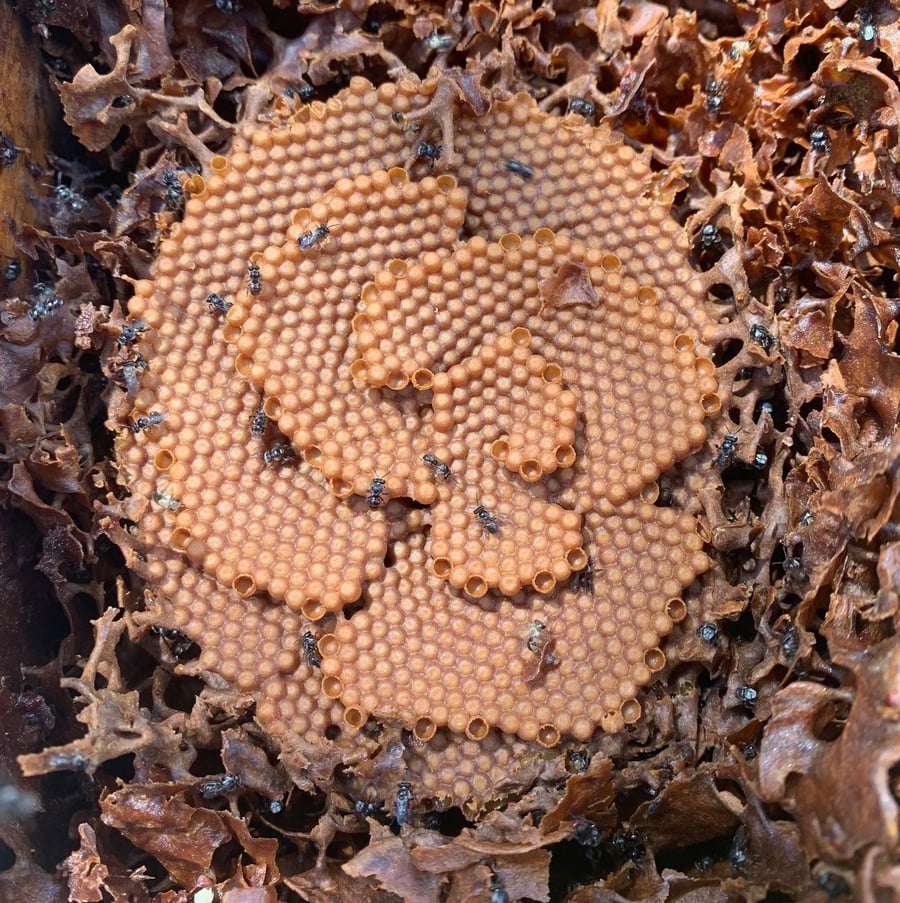
They are tiny – around four millimetres, black, and easy to take for a small fly at the hive entrance. Stingless is not defenceless: they bite, they swarm an intruder, and T. carbonaria will wrap a hive beetle too large to drag out in resin and wax and hold it there until it suffocates. What matters for the honey is where they put it. In place of the wax hexagons of a honeycomb, stingless bees build cerumen pots – soft rounded cells of resin and wax, clustered like a bunch of small grapes – and it is the resin, as much as the nectar, that gives the honey its acidity and its keeping power.
One name, two bees: how a sugarbag colony is told apart
Tetragonula carbonaria and Tetragonula hockingsi are so alike as individual bees that a worker of one cannot reliably be told from the other by eye; their sizes overlap, and colour is no guide. What separates them is architecture. Open a carbonaria nest and the brood is a single advancing spiral, a flat coil of cells winding outward like a staircase seen from above. A hockingsi nest is a loose lattice instead -- clusters of cells on short pillars, with no spiral. Keepers and researchers read the comb, or run a DNA test, rather than trust the bee.
The difference has begun to matter. As the climate warms and boxed colonies are traded and carried between regions, hockingsi has spread south into carbonaria country, and where the two meet they compete for nest sites -- sometimes in battles that run for weeks and end with one colony taking over the other's hive and installing its own queen.
Color:
amber to dark reddish-amber, sometimes near-black; stays liquid rather than setting
Flavor Profile:
acid-sweet – tangy and sour before it turns sweet, with citrus and a resinous, faintly fermented finish
Tasting Notes:
Thin on the spoon, and thinner still on the tongue – closer to a cordial than to the slow drip of a comb honey. The first note is sourness, not sweetness: a clean citrus-and-lime sharpness that arrives before the sugar does, then gives way to a light floral sweetness and a resinous, almost savoury finish that recalls the pots the honey was kept in. The tang is a live edge, faintly fermented, and it lingers. It is met a teaspoon at a time rather than a tablespoon.
Aroma:
resinous and propolis-forward, faintly tropical and fruity
Defining Compounds:
Three things set sugarbag apart chemically, and all three come from the bee or its pots rather than from any flower.
The first is trehalulose, a rare sugar the bee builds rather than gathers. Fed plain sucrose, T. carbonaria turns it into a honey that is mostly trehalulose; fed the same sugar already split into glucose and fructose, it makes almost none – the change is worked in the glands of the bee’s own head, not taken from the flower. The European honey bee does not make it at all. Trehalulose is slow to raise blood sugar and, unlike ordinary sugars, does not feed the bacteria behind tooth decay, and it is now the honey’s legal signature: Australia’s 2024 standard requires native bee honey to contain at least two per cent of it.
The second is the phenolic and flavonoid load the bees carry in from plant resin, which gives the honey an antibacterial activity that works by a different route from either manuka or the eucalypt honeys – and one that survives heating and holds up in a sealed jar for years. The third is the slow fermentation of the pot itself, the source of the sour, faintly winey edge. None of these is a trace: together they are most of what makes sugarbag taste, keep, and behave as it does.
Forage & Resin:
Sugarbag has no single flower behind it. Australia’s stingless bees forage close to the nest – rarely more than a few hundred metres – across whatever is in bloom, so the honey is a shifting blend rather than a varietal. In the warm-east production country that means eucalypts and their kin (bloodwoods, brush box, paperbarks), the macadamia and other crops the bees also pollinate, and, around the suburban edges of Brisbane and the Northern Rivers where many hives now sit, the flowers of gardens and street trees. What is in the jar depends on the season and the place: a wet-season honey from the tropical north and a spring honey from a Sydney-basin backyard start from the same bee but not the same forage.
There is a second forage that a comb honey does not have. Stingless bees also gather plant resins, and they build the honey pots from them. The resin is not incidental to the flavour: it loads the honey with the phenolic and flavonoid compounds behind its acidity, its resinous finish, and its antibacterial activity. Because the resin is gathered from the trees at hand, it varies as the flora does, which is one reason a northern sugarbag and a southern one taste and test differently even from the same kind of bee.
The resin map: why a northern jar and a southern jar differ
The compounds a stingless bee works into its pots are a record of the trees around the nest. Surveys of Australian stingless-bee propolis find the total phenolic content falls as you move south, so honey and cerumen from tropical Queensland tend to carry more of these compounds than the same species' work in New South Wales; the two Tetragonula species differ too, with hockingsi propolis running richer in phenolics than carbonaria. This is terroir written partly in resin rather than only in nectar: the bee sets the type, and the local trees -- their flowers and their gums together -- fill in the rest.
Pairings:
Because it is thin and sharp, sugarbag is used the way a squeeze of lime is – as a finishing note rather than a bulk sweetener. It is wasted in baking, where its acidity and aromatics cook off. Drizzled cold over vanilla ice cream, fresh curd or a soft cheese, or stirred through yoghurt, it does what lemon does, lifting and cutting rather than only sweetening. Its sour, citrus edge has also made it a bar ingredient: at least one Australian distiller uses sugarbag as a botanical in a gin. It is added at the end and in small amounts, and kept in the refrigerator between uses.
Health Uses:
Sugarbag has a long life as a bush medicine as well as a food. Aboriginal use recorded across northern Australia includes the honey taken for coughs and colds and put on sores and wounds, and that sits within a much older and wider tradition: stingless bee honey has been used medicinally by peoples across the tropics, from the Maya to communities in Indonesia and India, where the resin the bees carry into the honey was prized as much as the sweetness. These are traditional and folk uses, described here as practice, not as clinical fact. What laboratory work has since measured in the honey – its antibacterial activity, its slow-releasing sugar – is set out separately under its compounds, and is a different matter from the traditions.
Origin Story
Sugarbag is the oldest honey on the Australian continent, and there is a way to date it. Across the Arnhem Land plateau and the Kimberley, Aboriginal artists used the bees’ own beeswax to make figures on rock, pressed and modelled onto the stone; because wax can be radiocarbon dated, some of these images can be placed in time, and one in western Arnhem Land has been dated to roughly four thousand years ago. The honey behind that wax was gathered far longer – tens of thousands of years – as one of the most valued foods across northern and eastern Australia, found by watching a bee load up at a flower and following it home to its hollow.
European settlement did not so much replace that tradition as fail to notice it. The colonists brought their own bee in 1822 and their own idea of honey, and the small native bee and its sharp honey did not register as the same thing; sugarbag was neither banned nor absorbed, and it continued. What changed was the packaging and the law. Over the last few decades the bees moved into boxes and their honey into bottles, and in 2024 the food standard finally made room for it. The continent’s first honey has, only now, become something a shop can legally sell. Its deeper cultural life – the Sugarbag Dreaming, and the bee understood as kin – belongs to the wider Australian story and is told there with the country’s honey as a whole.
Cultural Context
To the Aboriginal peoples who gathered it, sugarbag was not a sweetener but a whole food. The nest was taken entire – honey, pollen, the soft brood, and the waxy pot walls together – and eaten as one thing: sugar from the honey, protein and fat from the larvae, more from the pollen. In a number of languages a single word covers all of it at once, the bees and the honey and the wax and the nest, understood as one and not as an animal and the thing it makes. The English word “sugarbag” came to stand in for those many words.
That older sense sits a little apart from the jar on sale today. The bottled honey is the sweet fraction alone, drained from the pots; it is the same bees and the same chemistry, but not the whole-nest meal the word first named. Sugarbag is still a food gathered as much as farmed, and in northern Australia it is more often met on Country than bought. Its place in ceremony and law, the Sugarbag Dreaming that crosses much of the north, is carried in the wider account of Australian honey rather than repeated here.
Harvest & Extraction
Sugarbag is a once-a-year harvest, and a small one. A strong Tetragonula carbonaria hive yields around half a kilogram to a kilogram of honey in a year; the smaller tropical species give less, sometimes only a couple of hundred grams. The honey is taken in the warm months, when the colony is strongest and has stored more than it needs to carry itself. In a modern hive box the honey sits apart from the brood, so it can be drained from the resin pots without opening the nest; the older way was to lift the whole nest out at once. Through the cooler months the bees live on their stores, and south of about Wollongong they use all of it, leaving nothing to take. This is the hard limit on sugarbag: a European hive can be asked for twenty kilograms or more, a stingless hive for little more than a jar, and no change of method lifts that ceiling. It is why sugarbag is sold in small bottles, mostly straight from the producer, and never travels far.
Beekeeping Context
Keeping stingless bees is its own craft, closer to gardening than to commercial beekeeping. The bees come in a wooden box about the size of a large book, most often a design called an OATH box, and once settled the keeper’s main job is to give them a dry, shaded spot and otherwise leave them alone; they are gentle and stingless, which is part of why they suit a suburban yard. Most colonies begin not as a bought package of bees but as a split – an established box divided in two – or as a wild nest moved from a felled tree, because these bees cannot be raised from a mail-order queen the way European bees are, and a colony multiplies only slowly. Across subtropical Queensland and northern New South Wales they are kept in back gardens for pollination and for the interest of the hive as much as for honey, which for most keepers is an occasional bonus of a few small jars. The commercial honey side is young and small, built on a handful of specialist producers – among them Tim Heard, who wrote the standard book on these bees – and it is that scale, as much as the biology, that the 2024 standard has only begun to change.
Source Regions
- Tetragonula carbonaria – Australia – South-East Queensland: the commercial heart of sugarbag production, around Brisbane, the Sunshine Coast and the Glass House Mountains; warm-climate hives that make a harvestable surplus.
- Tetragonula hockingsi and Tetragonula spp. – Australia – Far North Queensland (Wet Tropics): the northern edge of commercial production, around Cairns and the tropical coast.
- Tetragonula carbonaria – Australia – Northern Rivers, New South Wales: the southern commercial range, from the Tweed and Byron hinterland down the warm coastal band; production thins and then stops south of about Wollongong.