Jarrah Honey
The Story
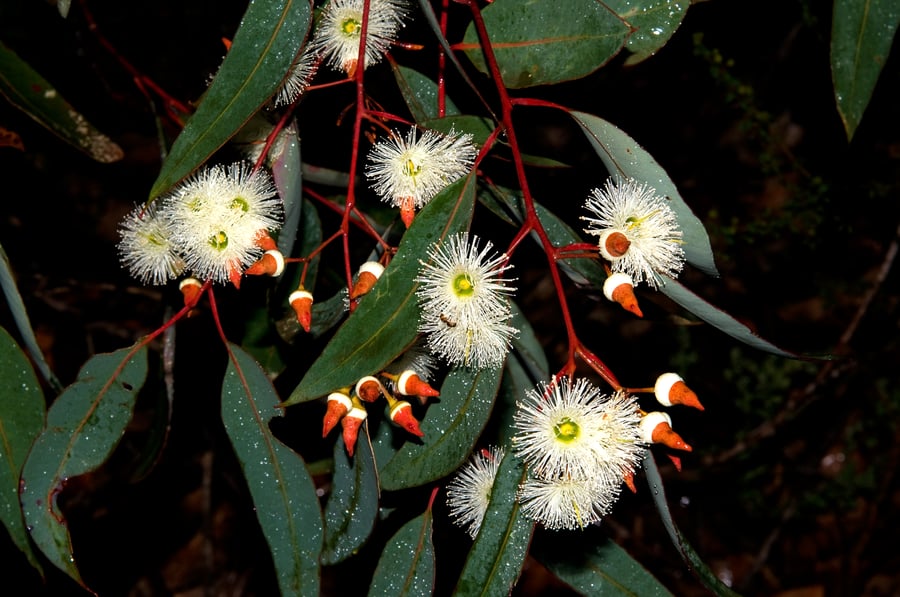
Jarrah takes the hilltops. In the south-west corner of Western Australia, where the laterite caps still sit on the ridges, Eucalyptus marginata is the tree on the high ground – fifty to a hundred and thirty-five feet of it, straight-stemmed, its bark fissured in long lines that often spiral up the trunk. It grows nowhere else on earth. Below it, on the deeper sands and in the hollows, stands marri; along the stream banks, blackbutt. Three trees, three honeys, sorted by soil and water down one slope. The honey off the top of that slope is pale to medium amber, will not granulate, and tastes – in the words of the state’s own honey flora – of “a delightful nutty flavour.” It is the most valuable honey Australia produces, and the most famous, and the tree gives it up about once every four to six years.
Characteristics
Jarrah is a medium amber honey that will not granulate. Two things hold it liquid. The first is sugar: it runs about 42.5 per cent fructose against 20.8 per cent glucose, a ratio above two to one, and glucose is the sugar that comes out of solution first. The second is pollen, or the lack of it – jarrah honey carries little, and pollen grains are the nucleation sites that crystals form around. Smith’s flora put the practical result in three words in 1969: “very slow to granulate.” It is also the honey of an erratic tree. Smith again, in the same entry: “Honey flows erratic.” A jarrah year is not most years.
Click to Display — The Details: botanical origin, sensory profile, pairings, health and what gives it its character
Botanical Name: Jarrah (Eucalyptus marginata)
Botanical Family: Myrtaceae
Bee Species:
Apis mellifera, the introduced European honey bee, which carries all commercial jarrah production. The tree was providing for others long before it arrived: the WA Parks Foundation records jarrah as habitat for animal life “especially birds and bees” both standing and in the hollows that open as its heartwood decays.
Color:
medium amber; pale gold to amber, clear. Smith’s 1969 flora rates it medium amber, and the only study to measure jarrah’s colour against manuka found manuka the darker of the two
Flavor Profile:
mild to full, clean, with a delightful nutty flavour in the state’s own honey flora; the modern trade describes it as caramel, butterscotch or malty
Tasting Notes:
The anchor is Smith’s 1969 honey flora, written for Western Australian beekeepers by the state’s own apiarist, and it gives jarrah four words: medium amber, and “a delightful nutty flavour.” Nutty is not a word the modern trade uses. Producers reach instead for caramel, butterscotch and malt – “smooth with caramel-like taste,” “smooth malty caramel flavour profile,” “rich and dark with caramel notes” – and those are not wrong so much as later. Both can be true of one honey, and the range is recorded here as a range. What everyone agrees on is that jarrah is fuller than the pale eastern table honeys without turning resinous or medicinal, and that it stays liquid long enough to be sold, shipped and eaten as a liquid honey.
Aroma:
soft, warm, faintly resinous; the eucalypt cleanness rather than the medicinal bite of the darker gums
Defining Compounds:
Jarrah has a marker of its own, which is rare among eucalypt honeys. Analysis of the honey’s volatiles identified isophorone as the dominant compound at about 40 per cent, and as a chemical marker found only in jarrah honey – a signature carried over from the tree. Nonanoic acid, the next most abundant, is not exclusive: it turns up in jelly bush and tea tree honeys too, which makes it a marker of a floral neighbourhood rather than of this honey.
Beyond the volatiles, thin-layer chromatography of Western Australian honeys has identified jarrah’s phenolic constituents by name – hesperitin, o-anisic acid, taxifolin, kojic acid, m-coumaric acid, lumichrome, epigallocatechin gallate and 2,3,4-trihydroxybenzoic acid – and measured its total phenolic content at 50.58 milligrams gallic acid equivalent per 100 grams. That is second of the four honeys in that study, behind red bell at 59.4 and ahead of coastal peppermint and marri.
One caution travels with all of it. The antioxidant activity in those studies is read using DPPH, and the 2026 review points out what that means: the DPPH radical “does not exist naturally in biological or food systems,” so the assay identifies antioxidant constituents without telling you what they do in a person. The authors ask for more biologically relevant models. It is the same shape of caveat as the activity number, and it applies to the antioxidant figures the market quotes.
Forage Origin:
Jarrah honey comes from the nectar of Eucalyptus marginata, and the tree is particular about where it stands. Smith’s flora places it “on the tops of hills where the hard laterite caps still exist, and on the slopes of laterite gravel,” common through the higher-rainfall south-west and limited inland and northward by a minimum of thirty inches of winter rain. It is, in the same entry, the “principal timber tree.” Its epithet is Latin marginatus, furnished with a border, for the thickened and often paler margin of its leaves; the Noongar name for the tree is Djara.
Djara: the name is a mishearing, and the colonial record contains eighteen attempts at it
The Department of Conservation and Land Management's own jarrah monograph opens its chapter on nomenclature without ceremony: "The Aboriginals of south-western Australia used the name Djara, subsequently anglicized and mispronounced as jarrah."
It then lists fifteen variants recorded in their original spellings -- Cherring, Chiaragl, Djarrail, Djarryl, Djerral, Dyerral, Jarrah, Jarral, Jarril, Jarraly, Jeril, Jerral, Jerrail, Jerril and Jerryl -- and adds three more: Jerrile, from Ferdinand von Mueller quoting the explorer A.C. Gregory, and tjirrala and tjiarral from the western and southern coasts. Eighteen ways of writing down one Noongar word, and the version that reached the jar is the one the ear got wrong.
The word is still in the country. Pinjarra, the town on the Murray River south of Perth, carries it: the name means to dig in the swamps amongst the djarraly trees.
The jarrah forest runs from a little north of the Swan and Avon Rivers to the south coast, and east to just beyond Albany. Most of it, Smith notes, is in forest reserves. Within it the trees sort themselves by ground: jarrah on the laterite tops, marri on the deeper sandy soils and in the hollows and dry river beds where the moisture is better, and forest blackbutt on the banks of the streams. The understorey is bull banksia, blackboy, zamia palm and bulloak, and it gives the bees nothing – Smith records that the jarrah forest understorey “provides no appreciable” flow.
The jarrah forest's honey is marri
Smith's 1969 flora is unsentimental about which tree in the jarrah forest actually fills the drums: "In the jarrah forest the most important honey flow comes from the marri in February and March. Marri yields in most years, with particularly good honey flows every three to seven years. The jarrah is less productive, and flowers according to district between September and January."
The tree the forest is named after is not the forest's honey tree. And that turns out to be a pattern rather than an irony. Marri also carries the higher antibacterial activity of the two -- 31.1 against jarrah's 30.2 per cent phenol equivalence, in the Department of Agriculture's own survey. Red bell, a Calothamnus honey almost nobody sells, carries more phenolics and more antioxidant activity than jarrah does. The paving blocks that took Western Australian timber to the streets of England were mostly karri. Jarrah is the name the south-west's reputation collects around; it is rarely the tree at the top of the column.
One measure it does take is phenolic content, where it runs second of four Western Australian honeys tested and well ahead of marri. Which is its own small puzzle, since marri is the more active of the two.
Pairings:
Jarrah is a liquid honey that behaves, which is most of what a table honey is asked to do. It will not granulate in the jar, it is fuller than the pale eastern honeys without being resinous, and Smith’s nutty note sits well with anything that likes nuts: yoghurt, porridge, a hard cheese, brown butter, a cheeseboard where the caramel end of the flavour meets an aged cheddar.
It is also expensive and slow to make, which argues for the spoon and the cheeseboard over the baking tray. And there is a practical reason to keep it off the heat beyond the price: jarrah’s activity is measurably reduced by warmth. If the number on the jar is why you bought it, do not cook with it.
Health Uses:
Jarrah is sold as an activity-rated honey. It is graded on a Total Activity number, commonly TA 20+ through TA 35+ and sometimes higher, and that number is the reason for its price.
The activity is real and it is well measured. In the largest survey of Australian honey ever run – 477 samples across 142 floral sources – jarrah is the best-represented honey in the results table: nineteen samples, eighteen of them with detectable activity, a median of 25.1 per cent phenol equivalence. The paper’s own summary is that “jarrah and marri honeys have exceptional levels of hydrogen peroxide-dependent activity.” The Department of Agriculture’s separate survey put jarrah at 30.2 per cent across sixty-two samples.
Three things about that number are worth a buyer’s attention, and none of them are on the label.
What the number measures, and what it misses
It measures one mechanism. Jarrah's activity is hydrogen peroxide, made when the enzyme glucose oxidase meets glucose and water -- so it forms on dilution rather than sitting in the jar. But peroxide is not the whole honey. The 2026 review of Oceania's medicinal honeys notes the measured peroxide is "too low to solely justify" what jarrah does, and points to a second, non-enzymatic source: the honey's own polyphenols oxidising, with the phenolic constituents "acting as synergizing agents." When researchers at Sydney and UTS tested jarrah against skin fungi, the effects "persisted when H2O2 was eliminated and could not be replicated using synthetic honey spiked with H2O2." You cannot fake jarrah with sugar syrup and peroxide. The review's own conclusion is the plainest statement anyone has made about this honey: consider "the integrated chemical matrix of honey, rather than attributing bioactivity to a single compound or mechanism."
It comes from a scale with a ceiling. The assay is agar diffusion against Staphylococcus aureus, read against a curve of phenol standards, and it was published in 1991 as a survey method for New Zealand honeys. Its own developers have written on its limits. The curve stops being linear at a phenol equivalence of 35 -- not because of anything in honey, but because phenol will only dissolve in water to about 8.3 grams per 100 millilitres. Some laboratories report anything above that as ">35"; others extrapolate past it, which is where TA 40+, 50+ and 70+ come from. A validated replacement, developed at the University of Western Australia and measuring activity by optical density in liquid rather than diffusion through agar, came into commercial use in March 2025.
It is a property of the season, not of the species. The Department of Agriculture compared jarrah's activity across the years 1999 to 2004 and found a statistically significant difference between all of them. And it does not keep forever: honey held sixteen weeks at 45 degrees loses most of its activity, while honey at room temperature or below changes only slightly over the same period, and even over sixteen to thirty-two months. After five years at ambient temperature the peroxide is essentially gone -- though the antibacterial activity, in that same study, changed in varied ways. Keep it out of the heat. A cupboard is not the enemy.
The best-documented thing jarrah does is topical and antifungal. Against the dermatophytes that cause tinea – Trichophyton rubrum, T. mentagrophytes, Microsporum canis – jarrah inhibited growth at 1.5 to 3.5 per cent, several times lower than the concentrations it needs against bacteria, and electron microscopy showed it working on the surface of the fungal filaments rather than inside them. Note that a second study, testing at much higher concentrations, found no jarrah activity against the same organisms; the two results have not been reconciled.
Its glycaemic index has been measured once, properly: 52, by the University of Sydney’s glycemic index service, on a single Western Australian jarrah, in ten fasted people. That is a low-GI food, and its glycemic load at an average serve is 9, which is low. Four different GI figures circulate in the jarrah market. Only one of them was measured.
Origin Story
The jarrah forest’s first industry was not honey; it was wood, and the wood mostly left. From the mid-1890s Western Australian paving blocks went to the streets of England’s major cities, and at the turn of the century half the state’s timber exports were going to Great Britain as pavers. Karri and jarrah went to South Africa for the mines, and out as railway sleepers, jetties and bridges. By the early twentieth century, the State Library of Western Australia records, ninety-five per cent of local timber was sold to England, eastern Australia, India, South Africa and New Zealand. Jarrah paved Regent Street in London’s west end, creosote-soaked, one example among many.
That is the trade Smith was still writing inside in 1969, when he called jarrah the principal timber tree in a book about honey. And it is why the definitive ecological study of the species – a hundred and fifty-six pages from the Department of Conservation and Land Management in 1986 – contains no beekeeping at all. Not a mention of nectar, not a mention of hives. Its single use of the word honey is a line in the reference list, citing Smith. The tree that makes Australia’s most valuable honey was studied, for a century, as timber.
The honey’s own turn came by accident. Western Australia’s active honey was found, Manning records, when a routine screen for antibiotic residue in honey from a Perth packer came back positive – and proved false when the samples were run again on a better test. What had tripped the screen was the honey.
Cultural Context
The jarrah forest is Noongar boodja, and it is kept by a calendar that reads the year off the trees rather than off a page. The Bureau of Meteorology carries the Nyoongar seasonal calendar – six seasons, Birak, Bunuru, Djeran, Makuru, Djilba and Kambarang – and describes how they work: they “can be long or short and are indicated by what is happening and changing around us rather than by dates on a calendar.” Among the indicators the Bureau names first is the flowering of plants.
It is a way of keeping time that a jarrah beekeeper would recognise. Jarrah flowers according to district, in a good year, when the tree has held its buds – which is not most years and not to a schedule.
The honey has no ceremony and no festival of its own, and its own state does not judge it. The Royal Agricultural Society of Western Australia runs eight competitions in its 2026 Perth Royal Food Awards – beer, dairy, chocolate, bread and pastry, distilled spirits, wine, branded meats and smallgoods – and honey is not among them, though it was there in 2019, when a Western Australian jarrah took a bronze. Australia’s honey show is in Sydney, and it sorts honey by colour rather than by flower, so jarrah is entered there as a shade.
To be judged as jarrah, the honey leaves the country. The London International Honey Awards sort entries by variety and keep a category called Jarrah – Eucalyptus Marginata, which no Australian competition does. What jarrah has at home instead is a name older than the industry that sells it.
Harvest & Forage
Jarrah makes flower buds every year and throws nearly all of them away. The mechanism is in the 1986 monograph and it is worth reading slowly: the flower bud primordia appear in the axils of the new leaves after the leaves mature, about January. “Most of these buds are cast off while immature between the annual growth flushes. Annual replacement takes place. Every four to six years conditions favour the retention and development of the primordia. In such cases, flowering occurs in spring or early summer some ten months after formation of the buds.”
So a jarrah crop is ten months old before it opens, and it exists only because one year in four to six let the buds stay. When it comes, it comes everywhere at once – most trees in a region flower together. Harvest runs September to January.
How often is genuinely unsettled. The 1986 ecology gives four to six years for significant flowering; the 2026 review of Oceania’s medicinal honeys says three to four; Manning, for the Department of Agriculture, says the flowering is biennial. All three are on the record, and they are describing the same tree.
Beekeeping Context
Jarrah is worked in a forest that is mostly reserve, on ground the industry does not own, for a crop that arrives when the tree allows. Smith’s 1969 assessment of the working reality has not been improved on: honey flows erratic, and the jarrah is less productive than the marri standing below it.
There is a soil rule that almost nobody quotes. Smith, in the same paragraph that ranks marri first: “Better honey is obtained on sandy soil than on laterite soil.” Jarrah’s best honey does not come from jarrah’s signature ground.
What the tree does give the hive is pollen. Smith rates it “apparently highly nutritious” – his hedge, kept here – which sets jarrah apart from the trees at the top of the eastern honey list, where yellow box and grey ironbark yield nectar in quantity and no useful pollen at all.
Source Regions
- Eucalyptus marginata – Australia – the jarrah forest of south-west Western Australia, from a little north of the Swan and Avon Rivers to the south coast and east to beyond Albany: the tree grows wild nowhere else on earth, and most of the forest is reserve.
- Eucalyptus marginata – Australia – the Darling Range and Darling Plateau: the laterite country east of Perth, where jarrah takes the hilltops and the hard laterite caps.
- Eucalyptus marginata – Australia – the southern forests, Pemberton to Albany: jarrah is also dominant on the low-lying sandy plains within the karri forest country, and Smith records that the better honey comes off sand rather than laterite.
Regional Variants
- Jarrah proper – Eucalyptus marginata subsp. marginata – Australia (the main range of the south-west forests): The subspecies behind the honey, a small to medium tree to about forty metres, running from the northern outlier near Mount Lesueur – where it grows as a mallee – south through the forests, with outliers inland at Jilakin Rock and Tutanning. Its honey is the benchmark: medium amber, nutty, very slow to granulate.
- Blue-leaved jarrah – Eucalyptus marginata subsp. thalassica – Australia (the northern Darling Range, north to New Norcia): The commonest form of jarrah in the northern Darling Range, distinguished by bluish to greyish adult leaves and often drooping branchlets, and a tumble-down habit in the east of its range. No separate honey is sold from it and no sensory description was found; whether the trade distinguishes the subspecies at all is unknown. A third subspecies, spurgeana, is accepted by the Australian Plant Census, and the state’s own silviculture reference notes that recent genetic analysis does not support the subspecific split.
- Marri – Corymbia calophylla – Australia (the same forest, on the deeper sands and in the hollows): Not jarrah, and included because the two are inseparable in the forest and in the market. Marri is the jarrah forest’s most important honey flow, in February and March, and it yields in most years where jarrah does not. It carries the higher antibacterial activity of the two and the lower phenolic content. It is sold in its own right, and in Western Australia it is also sold as Red Gum – which is a third tree again, and not the river red gum of the eastern states.
Festivals and Fairs
- London International Honey Awards – London (annual, ceremony in June): The competition that judges jarrah as jarrah. LIHA sorts entries by variety and carries a category called Jarrah – Eucalyptus Marginata, which no Australian competition does. Western Australian jarrahs have taken Gold in the 2021 Quality Awards (Forest Fresh TA40+ and Honey for Life Super Jarrah TA50+) and Platinum in 2025 (Fewster’s Farm TA55). The 2025 jarrah category shows a single result: one jar entered, and it won.
- Sydney Royal National Honey Show – Sydney Royal Easter Show, Sydney (annual, entries close late January): Australia’s honey competition, around sixty classes covering liquid honey, natural granulation and creamed, comb, beeswax, candles and mead. Exhibitors pick their class off a Pfund colour guide, not by floral source, so a jarrah is shown against honeys of its own shade rather than its own species – there is no jarrah class, and no varietal class of any kind. Western Australian honey travels to it: the Perth packer Wescobee has taken Champion Commercial Honey Exhibit.