River Red Gum Honey
The Story
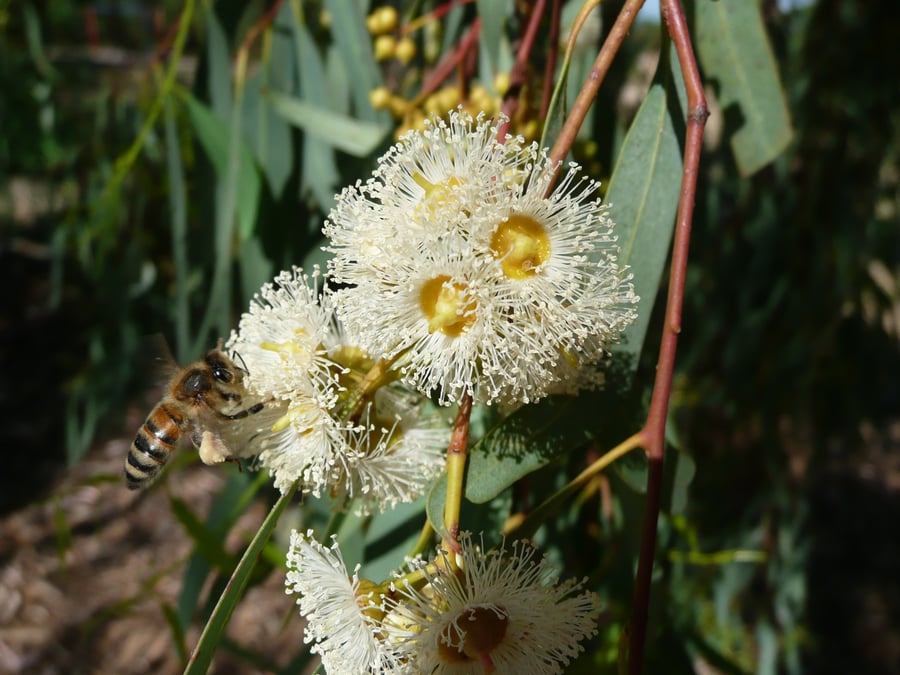
River red gum is the tree most Australians can picture without being asked: the heavy, pale-limbed thing standing in the bend of an inland river, holding the bank up. It is the most widely distributed tree in inland Australia and one of the most widely planted trees on earth, and the honey it makes is a mild, pale table honey that behaves in exactly one memorable way. It sets. It sets fast, and Queensland’s own honey flora says the trade has to heat it carefully to get it back out of the drum. That single habit is what separates river red gum from the honey it is otherwise most like. Yellow box and river red gum share their districts, share their summer, and sit beside each other on the shelf as the two great pale table honeys of the south-east. One stays liquid for years. The other goes solid in the jar.
"Red" is the timber and the river. It was never the honey.
The Montreal Process, the intergovernmental forest assessment that treats river red gum as one of Australia's indicator trees, states what the common name means without any room to move: "The common name refers to the distribution of the species in riverine ecosystems and the colour of the heartwood." The red is the wood inside the trunk. Trees of Stanford puts the same fact the other way round -- the ruddy heartwood, highly resistant to termites, "gives the 'red' in its common name."
Neither half of the name is about the honey, and the honey is not red. Blake and Roff, cataloguing it for the Queensland Department of Primary Industries, rate it white to light amber. It is one of the palest eucalypt honeys Australia sells.
This is the second time the trick has been played on this shelf. Ironbark is named for a hard black bark and the honey is pale. Red gum is named for a red heartwood and the honey is pale. Both trees are sold beside their own timber, and in both cases the buyer reaching past the pale jar for something darker and stronger is reading the tree, not the honey.
Characteristics
River red gum is a pale, mild, heavy-bodied table honey whose defining behaviour is crystallisation. It sets readily and it sets fast, and the Queensland flora’s note is a working instruction rather than a tasting note: the honey candies readily, and needs to be carefully heated to render it. The chemistry sits underneath that. Of the eight Australian honeys in the only published analysis, river red gum carries the highest glucose of the set at 32.9 grams per 100, against a fructose of 34.6 – a ratio of about 1.05, near enough to even. Yellow box, the honey it is otherwise most like, runs 26.8 against 45.5, a ratio of 1.70, and stays liquid. Glucose is the sugar that comes out of solution first, and it is where beekeepers point when asked why this honey behaves as it does – though the study that measured those sugars is careful to say that no formula built on them reliably predicts how a honey will set. How hard it then sets is genuinely contested, and the variants below carry both sides.
Click to Display — The Details: botanical origin, sensory profile, pairings, health and what gives it its character
Botanical Name: River red gum (Eucalyptus camaldulensis)
Botanical Family: Myrtaceae
Bee Species:
Apis mellifera, the introduced European honey bee, which carries all commercial river red gum production. The tree is of major importance to the honey bee industry in the Montreal Process assessment’s plain words, and unlike most of the trees at the top of Australia’s honey list it feeds the bee as well as the jar.
Color:
white to light amber; clear pale gold, occasionally deeper. Blake and Roff rate it white to light amber and rate it dark nowhere
Flavor Profile:
mild, clean and sweet, of heavy density; producers reach variously for toffee, caramel, butter and a fruity eucalyptus note
Tasting Notes:
Mild and dense are the two words the Queensland flora gives it, and they are the two that survive contact with the jars. The sweetness is clean and the body behind it is thick, without the resinous medicinal bite of the darker eucalypt honeys. Past that the accounts scatter, and they scatter more than they do for any other honey on this list: medium toffee, fruity eucalyptus at medium sweetness, bold and full-bodied with a rich caramel undertone, soft and delicate with hints of butter and almonds, smooth and mild. One Victorian producer runs two of those descriptions on its own website for the same honey. No published sensory panel exists for river red gum, so the anchor here is Blake and Roff – mild, white to light amber, heavy – and the rest is recorded as a range rather than resolved into a consensus that nobody has actually established.
Aroma:
soft eucalyptus, faintly fruity; one Murray producer calls it the smell of breaking rain
Defining Compounds:
No compound has been proposed as a marker for river red gum honey, and the only published chemistry is the 2005 RIRDC analysis of eight Australian honeys. What that analysis shows is that river red gum is the odd one out of the set on almost everything it measured.
It carries the highest glucose of the eight, at 32.9 grams per 100 – the report says so directly, that the range ran from 20.3 to 32.9 “with the commercial blend (1) (NSW) having the least and Red gum having the highest.” It also carries the highest sucrose, at 2.5 against 0.9 to 1.1 for everything else, and the highest maltose, at 3.7 against a field of 0.9 to 1.6. Three sugars, three times the outlier.
The acids do the same thing and more sharply. Every other honey in that study is malic-dominant, running 1.33 to 1.41 milligrams per 100. River red gum runs malic at 0.02 and succinic at 1.1 – the usual ratio turned over. The report tabulates this and does not remark on it, and no other source has picked it up. It is one sample, unexplained, and it is offered here as a measurement rather than as a marker.
One caution belongs with all of it. The same report warns that several formulae have been proposed to predict crystallisation from glucose, water and fructose, and that “none of these formulae are reliable indicators of crystallisation.” That river red gum has the most glucose is measured. That it sets fastest is observed. The line between the two is drawn by every beekeeper who has handled it, and not by a published mechanism.
Forage Origin:
River red gum honey comes from the nectar of Eucalyptus camaldulensis, and on that point it is simpler than most of the honeys around it. Ironbark is a bark type covering thirteen commercial trees. Red gum, as the eastern trade sells it, is one species. Every eastern producer who names a species names this one.
The tree follows water. It runs along watercourses and the margins of freshwater lakes right across mainland Australia, and the subspecies behind the eastern honey dominates the Murray-Darling river system. NSW Agriculture rates it High for honey, High for pollen, places it in the tablelands and western slopes rather than the coast, gives it a summer flow and notes it is salt tolerant. Producers name the water rather than the region: the shaded banks of the Murray and Darling, the banks of the Yanko Creek in the southern Riverina, the river red gums along the Murray at Echuca, the riverland of north-eastern Victoria and southern New South Wales. The river carries the flow on into South Australia, where hives work the Riverland, the Murraylands and the red gum forests of the lower Murray floodplain, and South Australian producers sell red gum among the state’s named varietals.
The name, though, does not stay on the tree.
"Red Gum" names five trees, and in Western Australia it means a different honey entirely
Five trees are sold or recorded as some kind of red gum. River red gum is E. camaldulensis. Forest red gum is E. tereticornis. Blakely's red gum is E. blakelyi -- one Victorian producer sells it as Hill Gum and explains that it is "a type of Red Gum." Sydney red gum is Angophora costata, which is not a Eucalyptus at all. And marri, in Western Australia, is Corymbia calophylla.
The split is clean and it is geographic. Eastern producers who name a species name camaldulensis. Western sellers use "Red Gum" to mean marri, and say so: one describes Red Gum honey as "also called Marri honey"; another calls the Red Gum tree "native only to Western Australia," which camaldulensis emphatically is not.
This matters more than a naming quibble, because the two honeys are not in the same business. Marri is one of Western Australia's genuinely activity-graded honeys, sitting alongside jarrah, with a measured antibacterial strength that people buy it for. River red gum has no such rating. A jar marked Red Gum in Perth and a jar marked Red Gum in Echuca are different trees, different states, and different products, and only one of them is what this page is about.
Pairings:
This is a breakfast honey and it is sold as one. Mild, clean and heavy-bodied, it goes on toast and into tea without arguing with either, and it is the pale honey to reach for when a recipe wants sweetness and body rather than eucalypt character.
The set is the thing to plan around rather than the thing to avoid. A honey that candies readily is a honey you buy expecting to find it solid, and in the Riverina account at least it sets to a small-crystalled, spreadable solid that is arguably better on bread than the liquid was. Where it has set hard, warm the jar gently in water; the same care Blake and Roff ask of the trade applies at the kitchen bench.
Health Uses:
River red gum honey is a table honey, and the most important thing to say about its health claims is that the best-known one belongs to a different tree.
It carries no non-peroxide activity rating and no TA grade. In the largest survey of Australian honey ever run – 477 samples across 142 floral sources, tested by Irish, Blair and Carter for the University of Sydney – exactly one river red gum sample appears. Its antibacterial activity was undetectable. Zero. With a single sample it fell below the paper’s own threshold for inclusion, and river red gum does not appear in the published results table at all.
The eight samples in that study labelled “redgum” that did show strong activity are annotated by the authors themselves: redgum (marri), Eucalyptus calophylla, all eight from Western Australia. The TA figures of 10 to 20 and above that circulate attached to red gum are marri’s figures. They are real, they are just not this honey’s.
A low glycaemic index is on firmer ground. The 2005 RIRDC study measured river red gum at 46, which is a low-GI food, third-lowest of the six floral honeys it tested and behind yellow box at 35. That is one small study – ten fasted volunteers – and it is the only one there is.
Origin Story
Australia’s most widespread inland tree was named from a garden in Italy. In 1832 Friedrich Dehnhardt, chief gardener of L’Hortus Camaldulensis near Naples – a private estate garden established in 1816 for Francesco Ricciardi, Count of Camaldoli – described a eucalypt growing in his employer’s grounds and called it Eucalyptus camaldulensis, after the garden. The seed had come from Australia; EUCLID, the national eucalypt reference, says only that it “could only have come from south-eastern Australia, though the exact collection location is unknown.” So the tree that lines the Murray carries the name of an Italian nobleman’s garden, and the botanical type of the species was a specimen that had never seen a river red gum’s river. The Naples trees were cut down in the 1920s.
What the tree meant here was older and more practical. Its bark, the Montreal Process records, “was historically used by Indigenous Australians to make canoes and shields,” and the scarred trees left by that work still stand along the inland rivers. Its timber built the inland river economy that came after: the wharf at the Port of Echuca, on the National Heritage List, is three storeys and 332 metres of river red gum, milled between 1864 and 1884 in eight local sawmills out of the forest standing behind it. The honey has no comparable history. It is the newest thing this tree is used for, and the only one that leaves the tree standing.
Cultural Context
River red gum’s standing in Australia is environmental and it is enormous, and almost none of it is about honey. This is the tree of the inland rivers – the one in the paintings, the one holding the bank, the one whose falling limbs make camping under it a documented hazard. The Barmah-Millewa forest on the Murray is the largest river red gum forest on earth, Ramsar-listed since 1982, and returned to Yorta Yorta co-management in 2004.
The honey sits quietly inside that. It has no protected name, no festival and no competition class of its own, and unlike ironbark it has never even been the anonymous base under something else. It is sold under its own name, in its own jar, by producers who name the creek. What the tree carries publicly is the river; what it carries at the shelf is a pale honey that sets.
Harvest & Forage
The flow is a summer one in New South Wales, and it does not arrive to a schedule. The Australian National Botanic Gardens puts the working reality in one line: “Flowering intensity is variable and unpredictable from year to year.” What the same source adds is that the tree produces heavy yields of nectar in good seasons – which is the shape of most Australian eucalypt beekeeping, a heavy crop in the years it runs and nothing much in the years it does not.
The harvest problem is at the other end, in the drum rather than the tree. Because the honey candies readily, it does not wait. Blake and Roff’s instruction – carefully heated to render it – is the whole handling story: get it out, or get it warm. Careful is doing real work in that sentence, because heat is also how honey is damaged.
Beekeeping Context
River red gum does something the other two national honeys on this list do not: it feeds the bees.
NSW Agriculture rates it High for honey and High for pollen. That combination is rarer at the top of the Australian honey list than it sounds, and the tree’s pollen standing is the single best-sourced fact on this page – four independent authorities say it. The Australian National Botanic Gardens: it “provides bees with an important source of good quality pollen.” Blake and Roff rate it major for honey and major for pollen. The United States Department of Agriculture’s germplasm database, citing the Flora of Australia, files it under bee plants as “a good producer of pollen and nectar for honey.” And the Montreal Process calls it of major importance to the honey bee industry outright.
Two trees in the whole New South Wales flora table score Nil for pollen, and they are the other two national honeys
NSW Agriculture's planting guide rates every species it lists for honey and for pollen. Exactly two of them score Nil pollen. One is Eucalyptus melliodora -- yellow box. The other is Eucalyptus paniculata -- grey ironbark. They are, in order, the first and second honeys on this country's national list.
The pattern is not confined to those two. Somerville's survey of what New South Wales beekeepers actually delivered found the box and ironbark bark types made up 55 per cent of the eucalypt honey, and recorded both groups as poor pollen providers, which "will negatively impact on the health and productivity of a colony." More than half the eucalypt honey in Australia comes off trees that do not nourish the bees making it, and supplementary protein feeding exists here as a discipline because of it.
River red gum is the exception standing in the same country at the same time of year. Yellow box and river red gum share their districts in that table -- tablelands and western slopes -- and share a summer flow. One is High honey and Nil pollen. The other is High honey and High pollen.
The tempting sentence is that beekeepers work red gum to fix what yellow box costs them. No source says so, and it is not written here. What the table establishes is narrower and still worth knowing: the two trees stand in the same country, in the same season, and only one of them feeds the hive.
Source Regions
- Eucalyptus camaldulensis – Australia – the Murray-Darling river system: the heartland of the eastern honey, and the subspecies behind it dominates this system; a summer flow off the tablelands and western slopes rather than the coast.
- Eucalyptus camaldulensis – Australia – southern Riverina, New South Wales: named creek by creek by the producers working it, the Yanko Creek among them.
- Eucalyptus camaldulensis – Australia – northern Victoria, from Barmah and Echuca to Bendigo and Mildura: red gum country in the public imagination, and where much of the named honey is packed.
- Eucalyptus camaldulensis – Australia – the Riverland and Murraylands, South Australia: the Murray’s South Australian reach, where hives work the floodplain red gum forests and producers sell red gum among the state’s named varietals.
- Eucalyptus camaldulensis – Australia – inland Queensland, from the Darling Downs to the Maranoa and the Balonne: the country Blake and Roff catalogued, and the source of the candying note.
- Eucalyptus camaldulensis – Australia – Central Australia, around Alice Springs: the species’ desert reach, where an Alice Springs apiary jars river red gum from its own hives as the lighter and smoother of its two desert varietals.
- Eucalyptus camaldulensis – Mediterranean basin and North Africa: the tree is the most widely planted species in arid and semi-arid regions on earth, and its honey there is sold as eucalyptus honey rather than under this name.
Regional Variants
- Queensland inland – Eucalyptus camaldulensis – Australia (Darling Downs, Maranoa, Balonne): The state’s own honey flora is the sensory anchor for the whole page, and it is terse: white to light amber, flavour mild, density heavy, honey major and pollen major. Its divergence is in the handling rather than the taste – this is the account that says the honey candies readily and needs to be carefully heated to render it, which is the hardest statement of the set on how firmly it goes down.
- Southern Riverina – Eucalyptus camaldulensis – Australia (Yanko Creek and the Murray plains, New South Wales): The direct contradiction on texture, and it is worth a buyer’s attention because it is the opposite claim from the same behaviour. Its producer agrees the honey crystallises quite readily, then parts company on what happens next: the crystals are typically very small, so the honey remains soft and easy to spread even after it has crystallised. Rapid setting is not in dispute anywhere. Whether the result is a hard block or a soft spread is, and no source reconciles the two.
- The Murray at Echuca – Eucalyptus camaldulensis – Australia (northern Victoria and southern New South Wales): The fruity end of the range, and the source of the best line anyone has written about this honey: its producer names the aroma as the smell of breaking rain. Sold as a mild table honey off the river red gums along the Murray, in the country whose forest is the largest of its kind on earth.
- Central and north-west Victoria – Eucalyptus camaldulensis – Australia (Bendigo and Mildura): The cautionary entry. One producer with hives in both districts describes this honey on its product page as soft and delicate with hints of butter and almonds, and on its best-sellers page as bold and full-bodied with a rich caramel undertone, this dark amber honey. Same producer, same honey, opposite descriptions, and the second is where a dark-amber claim enters the market for a honey that Queensland’s flora rates white to light amber.
- Western Australia – Corymbia calophylla – Australia (south-west): Not this honey at all, and included because the jar says otherwise. Western sellers use Red Gum to mean marri, an unrelated tree, and one of the state’s genuinely activity-graded honeys: the eight redgum samples in the national antibacterial survey are all marri, all Western Australian, and all annotated as such by the researchers. It is a darker, stronger, medicinally-marketed honey with a measured antibacterial rating that river red gum has never had. Two words, two trees, two products.