Photo: Christina Nguyen, iNaturalist, cropped | CC BY 4.0
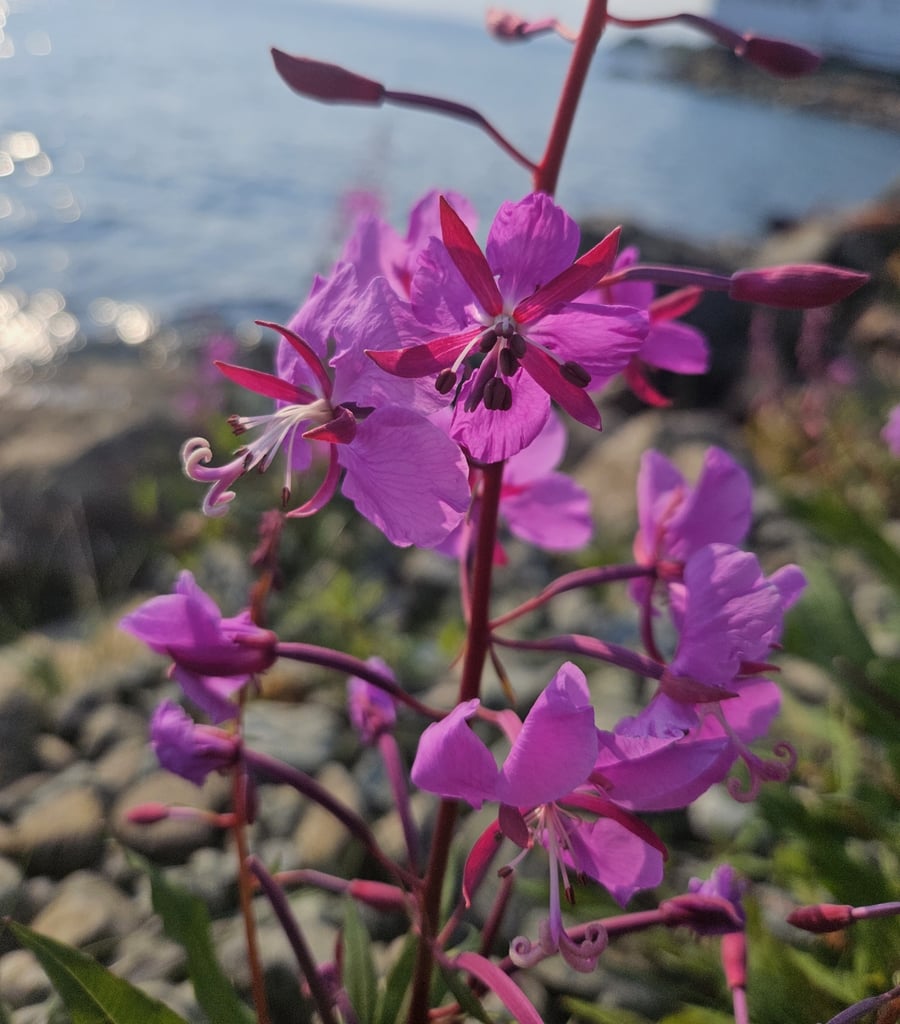
Fireweed on the shore at Atlin
A spike in full flower on the stony shore of Atlin Lake, 6 August 2024. Buds sit at the top of the spike and open flowers below them, and on the lower flowers the anthers have shed and the white four-lobed stigma has unfurled.
Fireweed grows where a forest has been opened. A fire, a logging
cutblock,
a slope scoured by avalanche, the gravel of a river bar: it needs
bare mineral soil and full light, and it holds that ground for a few
years until the trees close over it again. For a few weeks in
midsummer the flower runs, and the bees that reach it make a honey
named after it.
Hives have to be brought to that ground, and in British Columbia
they arrive two ways.
The first is to follow the disturbance. The province’s own
apiculture bulletin gives the reason: in the southern interior the
summer heat shuts the valley forage down, and colonies must be moved
into the mountains for the rest of the season. Hives go up logging
roads into burn and cutblock country and come down when the flow
ends, in the years there is one. Ground taken this way is on a
clock. A cutblock is replanted about two years after it is cut, and
British Columbia counts that stand a success once the young trees
are no longer held back by the plants growing around them. Fireweed
is one of those plants.
The second way is to stand still, beside ground that never closes
over: a riverbank, a road cut, the corridors kept clear beneath
transmission lines. Fireweed returns there every summer without a
hive being moved, and it arrives mixed with whatever else is
flowering nearby.
What stands behind the name on either jar is a place rather than a
test. Canada regulates what honey is, and only pure honey may be
sold as honey, with the food inspection agency testing for added
sugars, residues and contaminants. It sets no rule about which
flower a honey is named for, and the standard pollen test reads this
one as something else. The instrument that could settle it is in the
Fraser Valley, where a beekeeper with a doctorate in molecular
biology built a laboratory around a machine that reads a honey’s
whole chemical spectrum, and set about assembling a reference
library of British Columbian honeys on a public grant. Fireweed is
among the honeys it cannot yet certify: he has not been able to
gather enough samples anyone can vouch for. What a beekeeper offers
instead is the ground the hives stood on.
Characteristics
Water-clear when it comes off a mountain yard early in the flow, and
amber when it is taken late or from high ground; the Terrace
producer who works the Skeena valleys puts the range as far as a
dark purple and says the colour does not change the flavour, which
stays mild and smooth. The taste is light and clean with a little
fruit behind it. What sets it apart in the jar is that it stays
liquid: producers describe it setting slowly if at all, and a
visiting account of Island honey in the 1960s reported it not
granulating, so that it could be sold liquid without pressing.
Click to Display — The Details: botanical origin, sensory profile, and its regional identity
Nectar Contributors:
Primary: Fireweed (Chamaenerion angustifolium)
Secondary: Clovers (Trifolium spp.)
Background: Mixed summer forage, varying by site (Multiple species, undocumented)
Bee Species:
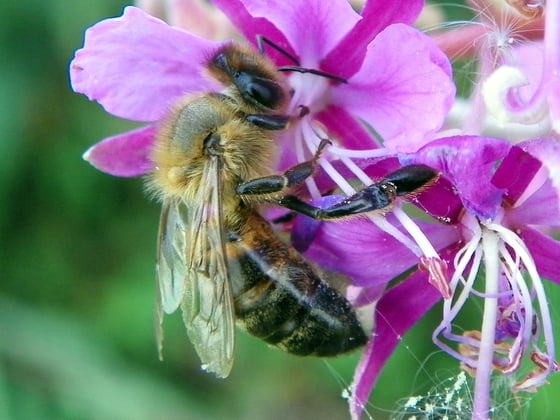
Photo: AnemoneProjectors, Wikimedia Commons | CC BY-SA 2.0A honey bee on fireweedApis mellifera working a fireweed flower, Hertfordshire, 26 July 2014. The anthers and the long four-lobed style stand clear of the bee's body, which is why a nectar forager picks up so little of this plant's pollen.
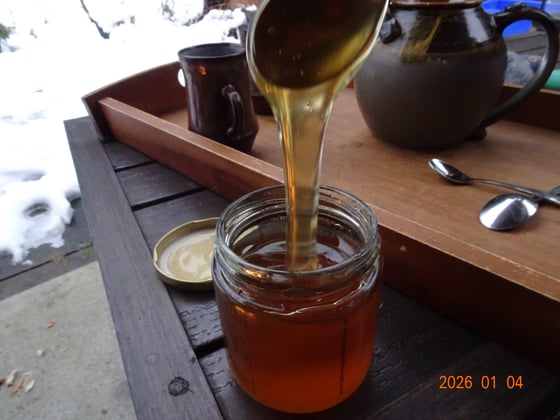
Honey off the spoon at SquamishOne of AnnaMarie Rutishauser's honeys at Bee Wild Paradise Valley, Squamish, poured in the open air on 4 January 2026.
Western honey bee (Apis mellifera). British Columbia has no native
honey-producing bee, so every fireweed crop is made by imported or
provincially raised European stock.
Color:
Water-clear to dark amber, varying with elevation and how late in the season it was taken
Flavor Profile:
Mild, clean and lightly fruity
Tasting Notes:
Producers reach for the same two words. A Creston operation calls
its fireweed “an unique, very light, mild, buttery honey”, and a
Terrace apiary gives “subtle fruity notes and a smooth, buttery
finish”. Buttery, and the champagne of honeys, are trade language
used by nearly everyone selling the honey, and are worth reading as
such.
Buyers say something sellers do not. The note that recurs across
shop reviews and forums is that this is the honey that converts
people who dislike honey.
A peppery or spicy finish is reported often enough to be worth
naming, and it does not belong to this province: every instance
found traces to Oregon or Alaska.
The nearest thing to a structured sensory record is Finnish, from a
panel working to the International Honey Commission’s method: dry
hay, pale malt, apple, brown sugar, grapefruit and almond paste,
with a weak odour and a short to medium finish. Its authors record
that North American fireweed honey carries a different phenolic profile from theirs, so it is a
comparison and not a description of a British Columbian jar.
Aroma:
Light and delicate, with faint fruit
Defining Compounds:
What is measurable about fireweed honey has been measured in Finland
rather than in British Columbia, and the numbers explain the one
thing everyone notices. Across thirty-two Finnish samples the honey
ran about 41 per cent fructose against 30 per cent glucose, with a
glucose-to-water ratio of 1.87. That ratio is the index the
crystallisation literature finds predictive; the more familiar
fructose-to-glucose ratio predicts poorly, at about one case in
seven. Low glucose against the water present is why the jar stays
clear. The same series records fireweed as the most acid of the
Finnish varietal honeys, at pH 3.8.
An older international dataset reaches nearly identical figures from
different samples in a different decade, which is the reason to
trust them. Neither describes a British Columbian jar: the Finnish
authors record that North American fireweed honey carries a
different phenolic profile from theirs.
Forage Origin:
Photo: Alison Northup, iNaturalist | CC BY 4.0
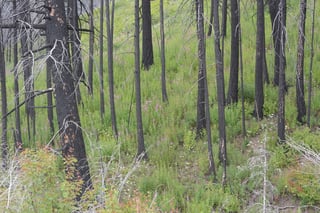
Fireweed in a burn, Okanagan-Similkameen
Fireweed under standing burnt trunks in the Okanagan-Similkameen, 4 July 2019. This is the ground the plant takes first after a fire, and holds until the canopy closes over it again.
Primary: fireweed (Chamaenerion angustifolium, Onagraceae). What the
bees take is nectar from its flowers. The trade and most older
writing call the plant Epilobium angustifolium; Canada’s national
plant register and British Columbia’s own botanical atlas both now
use Chamaenerion. The English name is not exclusive: several
unrelated plants are called fireweed, ragworts in the daisy family
among them, so the binomial and not the common name identifies it.
Away from bees the plant has its own uses, the young stalks eaten,
the stem fibre twisted into twine, the seed floss worked into
bedding. It spreads by
rhizome
and by a plumed seed light enough to stay airborne for hours, and it
germinates only on bare mineral soil in full light, which is why it
arrives after fire and logging rather than under standing forest. On
a burn its cover peaks two to three years on. On a cutblock north of
Prince George it was absent in the first year after logging,
noticeable in the third and in great numbers in the fourth. Then the
canopy closes over it and it thins away; it is gone from stands
three centuries old. Ground that has burned or been cut is therefore
on a clock. Ground that people keep permanently open is not:
British Columbia holds about 77,700 hectares of transmission
corridor clear of trees on a cycle of four to twelve years, and
cutting does not remove fireweed, because cut stems send up more
shoots. The flower spike opens from the bottom upward over several
weeks, so a plant carries ripe seed at its base while it is still
flowering at the tip, and bees taking nectar work the lowest flowers
first. The pollen is unusually large, between 51 and 100 microns,
and bound together by
viscin threads
that make it cling in ropes rather than travel loose. A bee working
the spike for nectar starts at the bottom, where the oldest flowers
have already shed, and carries what pollen it does pick up on the
outside of itself, which is why so little fireweed pollen ends up in
fireweed honey.
Secondary: clovers (Trifolium spp., Fabaceae). Which clovers, and
how much of them, depends on the ground the hives stand on. Where
colonies are trucked into the mountains their keepers report almost
nothing else in flower. Where hives stay on the valley floor clover
is the steady companion: a Squamish beekeeper says she had her
fireweed honey pollen-tested and that it came back mainly fireweed
and clover, and yellow clover comes directly after the flower on the
jar she sells.
British Columbia’s nectar-plant bulletin marks alsike, sweet, red
and white Dutch clover as major nectar producers, several of them
flowering through the same July and August weeks.
Background: mixed summer forage, varying by site (multiple species,
undocumented). What else reaches the comb is the open question of
this honey. Wild raspberry takes the same cleared ground, and
Finland’s beekeepers name it the main obstacle to a clean fireweed
crop; British Columbia’s bulletin marks raspberry a major producer
on the coast and in the south interior a month ahead of fireweed, so
the two meet at the join of the season. Peter Awram, who is building
a chemical reference library of Canadian honeys, suspects mountain
lots also carry pearly everlasting, other mountain flowers and
honeydew.
Pearly everlasting does grow on the same logged ground across almost
all of British Columbia, though the provincial bulletin does not
mark it a major nectar producer and puts its bloom later in the
year. And the aphids that feed on fireweed itself peak with the
flow, so part of what comes in from a fireweed patch can come off
the plant rather than out of its flowers.
Pairings:
British Columbian kitchens use it sparingly and mostly without
saying whose it is. A Duncan brewery brews with a named Vancouver
Island fireweed honey; Bar Oso in Whistler serves fireweed honey
with sobrasada,
and names no producer.
The honey is mild, which is the quality producers and buyers name
most often, and it pours straight from the jar months after harvest
without being warmed. Both of those decide more about how it is used
than any flavour note does.
Origin Story
In 1920 fireweed was the main honey plant of Greater Vancouver. The
district’s apiary inspector, Alex Keir, called it “our principal
honey-flow” in that year’s provincial report, and the department
divided the Lower Mainland into two kinds of beekeeping country: the
open clover districts, and the fireweed locations and burned-over
bush lands. A century on, the province’s own 2016 count put half of
British Columbia’s colonies in the Fraser Valley, and by 2024 three
quarters of the province’s colonies were out on pollination
contract, while its fireweed honey came off mountains several
hundred kilometres north. Fireweed holds ground
only until the trees come back to it.
The north was being tested in the same years and did not hold
either. Frederick Dundas Todd, then assistant inspector of apiaries
for Vancouver Island and the Gulf Islands, spent a fortnight of 1920
along the line of the Grand Trunk Pacific Railway. The next year’s
report records what a cold wet summer did there: “the crop is a
failure and winter stores have been fed to the bees.”
The fullest account of the whole cycle belongs to two sisters. Fire
burned through the Clearwater Valley in 1926 and fireweed came up
across it; a bee inspector told Jessie and Frances Emery about the
fields at Hemp Creek, and in 1930 they founded an apiary on them.
Twelve hives gave up to 250 pounds each and earned them about 540
dollars a year. It ran until about 1940 and the hives came out about
1945, and the guidebook account gives two reasons in that order: the
sisters had young children and homesteads in the lower valley, and
the forest was growing back over the fireweed. They had split the
cabin from cedar the 1926 fire killed. BC Parks and the Friends of
Wells Gray Park restored it in 2001.
In June 1965 Eva Crane of the Bee Research Association visited
Vancouver Island and wrote up her impressions. Much of the Island’s
honey, she reported, held only 15 to 16 per cent water and came
mostly from fireweed growing in recently felled areas; it was
“almost white and does not granulate”, so it could be sold liquid
without pressing. She put the working life of a felled site at two
to ten years. At one farm near Victoria she recorded the chief
difficulties as access to the fireweed sites and damage by bears.
Cultural Context
The long relationship here is with the plant rather than with the
honey: British Columbia has no native honey-producing bee, and no
Indigenous honey tradition is claimed on this page.
Fireweed was food. Peer-reviewed work published in 2025 records that
First Nations across the interior, among them the Nlaka’pamux,
Stl’atl’imx, Secwepemc, Carrier, Wet’suwet’en, Sekani and Nisg̱a’a,
collected and ate the raw pith of young stalks before the plant
flowered, and that coastal nations including the Sechelt, Squamish,
Nuxalk, Haida and Tsimshian did the same. The Saanich steeped the
young leaves for tea. The same paper records that fireweed patches
close to Haida villages were often owned by particular high-ranking
people, and that others had to ask permission to harvest from them.
In Sm’algyax, the language of the Tsimshian, the plant is haas. The
Sm’algyax dictionary records it eaten by splitting the stem, and the
split remains used as a whisk for
soapberries.
That use has lapsed:
a Ts’msyen account of making soapberries today names an electric
beater.
The plant is also a crest. Among the Gitxsan, Gisgaast is the
Fireweed clan; among the Nisg̱a’a the same name belongs to the
Killerwhale, so the nation is named before the crest. When a
Tsimshian-owned apiary at Terrace put a
formline
honey bee and
fireweed on its label, the artist was Frances Campbell, Gitxsan,
born at Gitanmaax, living at Kitsumkalum, and herself Gisgaast, of
the Fireweed clan.
Harvest & Forage
British Columbia’s nectar-plant bulletin marks fireweed a major
nectar producer in all three of the province’s climatic regions
through July and August. It gives no separate timing for elevation,
and nothing finer is published anywhere. Beekeepers work a shorter
window inside that one: a Creston operation trucks hives up in
mid-July and puts the collection period at a month or six weeks; a
Terrace apiary keeps bees in the mountains for most of July and
August; a Squamish beekeeper calls the fireweed itself a couple of
weeks. In the years it comes at all.
Whether those weeks yield anything is weather. Working at coastal
sites in the province, J. P. Michaud found sunshine and mean
temperature each accounted for about the same share of the variation
in daily sugar yield, 62 and 63 per cent, with yield rising to a
peak at 24 C and falling above it; the temperature at which the
flower secretes at all moved with the light, from under 12 C in
bright sun to about 19 C under cloud. Heat also shortens a flower’s
life from five or six days to two or three. Finnish producers add
that the nights have to stay above 12 C. And because the
nectary
sits open on the flower rather than down a tube, sun and wind
concentrate the nectar where rain thins it. Rudi Peters at Terrace
puts his ceiling at 24 C for that reason: above it the nectar dries
out at midday. A good week for him is an eighty-pound gain on a
hive; the same week with a heat wave gives five pounds. His record
is a hundred and sixty.
What can dilute the crop is everything else in flower at the same
time, which is set out under forage origin. On the valley floor that
is chiefly clover; on the mountain, whatever the beekeeper has not
managed to place away from.
The strategy for keeping a crop clean is isolation rather than
analysis. Hives are placed where little else is flowering, which is
what a mountain yard is for. There is no way to read a patch in
advance, as Liz Huxter at Grand Forks put it: “We cannot find any
indicators that [the fireweed] will yield nectar other than putting
hives there.” Some beekeepers answer that by setting sentinel hives
high early and moving the rest up only if those gain weight; the
Huxters chase the fireweed only when the opportunity cost of doing
so is low.
Extraction follows the hives down. At the small end of the trade it
is deliberately cool: a Squamish apiary warms the extractor itself
with a hair dryer before the frames go in, on the reasoning that the
machine should be warmed and the honey should not.
Beekeeping Context
Two systems make this honey and they barely resemble each other.
The first moves. Colonies are trucked out of the valleys in mid-July
and up logging roads into burn and cutblock country, fenced against
grizzly and black bear, and brought down again when the flow ends.
The ground itself costs nothing: since June 2019 British Columbia
has allowed a beekeeper to place a temporary apiary on Crown land
with no tenure, no application and no fee. The conditions are a
footprint of thirty square metres, a hundred and twenty days a year,
ten yards to an operator, a hundred metres between one beekeeper’s
yard and the next, everything removed within a day of the end, and
the policy carried and produced to a conservation officer on
request. Moving colonies across one of the province’s bee district
boundaries needs a permit, and that is free too, though it expires
in thirty days. The ministry’s own moving conditions set out what a
mite check involves, an alcohol wash of three hundred bees with the
varroa count at or below one per cent; the regulation itself leaves
the inspection for the chief veterinarian to request.
The same arrangement decides what happens when a bear gets in. Hives
are not a listed commodity under British Columbia’s wildlife
compensation programme, and the programme asks for a lease over the
land, which the Crown-land permission, being a permission and not a
tenure, does not create. Alberta, under a three-year pilot running
in 2023, paid eighty per cent of losses at two hundred and seventy
five dollars a colony.
Certification runs into the same movement. The Canadian organic
standard asks for colonies under continuous organic management for at
least twelve months, and it contemplates hives being moved, allowing
a reduced buffer around temporary and wintering yards. Where it bites
is elsewhere: a foraging buffer that widens where contamination or
genetically engineered crops are present, and
comb foundation
and replacement colonies that must themselves be organic, with no
exemption granted for what cannot be bought. In a province that
bought about ten imported queens for every one raised at home in
2024, that last condition is the hard one.
The second system does not move. AnnaMarie Rutishauser keeps eleven
hives beside her house in Paradise Valley, north of Squamish, and
when she was asked whether she trucks them uphill for the fireweed
the way other British Columbian beekeepers advertise, she said no:
“We don’t transport our bees. So I want to take care of the bees.”
She does not have to. Her fireweed grows along the Cheakamus River
and under the transmission line, and the meadow it stands in was
made, over a hundred dump-truck loads of fill excavated when the
shopping centre at Garibaldi Estates was built, spread on ground
that had almost no soil to begin with. She takes only the top tier
of each hive, the surplus, and leaves the sixty to eighty pounds a
colony needs to winter.
Named Producers
Wildfire Honey – Venables Valley, between Ashcroft and Spences Bridge. Mark Greenberg’s second season, and an operation whose fireweed came to the bees rather than the other way about: the Shetland Creek fire went through the valley in July 2024 and the flowers followed, so these hives never leave. The three jars are called Spark, Blaze and Phoenix. One valley’s crop in a second season, so what is jarred depends on the year; ask before making the drive.
Honey Bee Zen Apiaries – 220 Placsko Road, Wynndel, in the Creston Valley. Registered in 2012, about 500 colonies. Trucks hives into the Purcells and the Selkirks in mid-July, onto ground disturbed by fire or logging, behind electrified yards against grizzly and black bear; its fireweed is described on its own page as virtually a monofloral, and that page still says the crop does not come every year. It also reaches Vancouver through the Gourmet Warehouse; check with either before travelling for it.
Rushing River Apiaries – Terrace, in the Skeena country. Registered in 2017. Moves bees into the mountains around Terrace for most of July and August and calls the result a specialty honey unique to the Northwest; the fireweed comes off one short mountain season, so the shop can be between crops when you look; check before travelling.
Bulkley Valley Hive and Honey – 6266 Boundary Road, Telkwa. Breeann and Trevor Doerksen, since 2018, taking fireweed from cutblocks and higher ground around the Bulkley Valley in what they call a short window of opportunity. They jarred the first of the 2026 crop on 21 August and carried it to the Bulkley Valley Farmers’ Market the next morning. A short window means what is on the table varies week to week.
AnnaMarie Rutishauser at Bee Wild Paradise Valley
The apiary at 4311 Paradise Valley Road, Squamish, 4 January 2026: eleven hives that do not move, and the beekeeper who guides visitors through them herself.
Bee Wild Paradise Valley – 4311 Paradise Valley Road, Squamish. Eleven hives that do not move, beside ground held open by the Cheakamus River and the transmission line above it. AnnaMarie Rutishauser guides visitors through the apiary herself, and sells her fireweed honey under a season’s name rather than the flower’s: Summer Siesta. Eleven hives make a crop that does not last the year, so ring ahead before visiting.
Haas Honey – Terrace, in Tsimshian territory, harvesting in the Skeena and Kalum valleys. Registered as Mountain Meadow Honey in 2005 and rebranded in 2022 to Haas, the Sm’algyax word for fireweed; the label carries a formline honey bee and fireweed drawn by the Gitxsan artist Frances Campbell. Its storefront carries four jars, and a northern season means they do not all run the year; check before travelling.
Festivals and Fairs
Bulkley Valley Farmers’ Market – Highway 16 at Main Street, Smithers (Saturdays, 8:30 a.m. to 12:30 p.m.): where the Bulkley Valley fireweed reaches a buyer first. Hive and Honey jarred the opening of the 2026 crop on 21 August and brought it here the next morning. Their farm is at Telkwa, and the market’s own page notes that Smithers Transit runs two Saturday round trips from Woodland Park during market hours.
Squamish Farmers’ Market – downtown Squamish, on Saturdays: Bee Wild Paradise Valley sits in the market’s own vendor directory under Farm, and on its weekly line-ups through the summer of 2026. This is the valley honey rather than the mountain kind, from hives that never move. Check the market’s own pages for the season’s hours before travelling.
Whistler Farmers’ Market – the Upper Village Stroll below Blackcomb, Whistler (Sundays, 11 a.m. to 4 p.m., running to 11 October in 2026): the second Sea to Sky market Bee Wild Paradise Valley works, listed on the vendor directory the market links as its own.

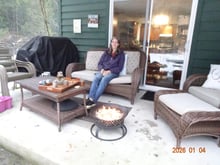 AnnaMarie Rutishauser at Bee Wild Paradise ValleyThe apiary at 4311 Paradise Valley Road, Squamish, 4 January 2026: eleven hives that do not move, and the beekeeper who guides visitors through them herself.