
Goldenrod Honey
The Story
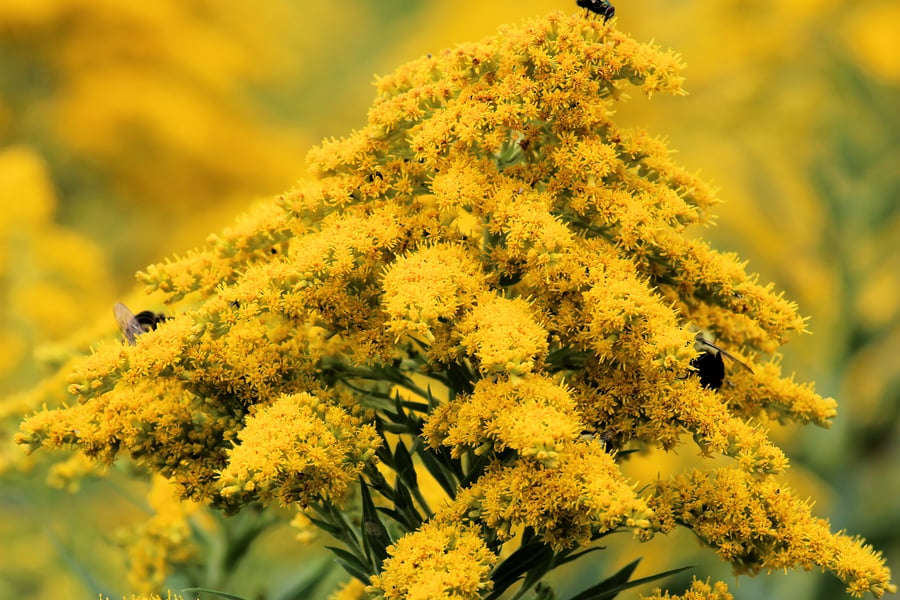
By August the clover is finished and the basswood long over, and the last big bloom of the eastern Canadian year opens on land nobody farms: goldenrod, on old fields, fencerows and road allowances from the Lake Erie shore to the St Lawrence lowlands. The flow runs until freeze-up, and most of it never leaves the hive – beekeepers count it as winter feed, the practice an Alliston beekeeper reported in the Canadian Bee Journal in 1885 and the Ontario Beekeepers’ Association still advises today. What gets bottled is the surplus of a good fall: an amber honey with a bold, spicy taste that producers describe in caramel and licorice terms, sold at Ontario farm gates and fall markets from September, and in Quebec supermarkets as miel de verge d’or. It sets within weeks into a fine, pale, spreadable grain – naturally creamed, with no stirring involved. Much of the goldenrod crop is sold as fall wildflower; a jar that says goldenrod on the label is the beekeeper’s judgment that goldenrod dominated the fall flow, because the asters bloom beside it to the end of the season.
Characteristics
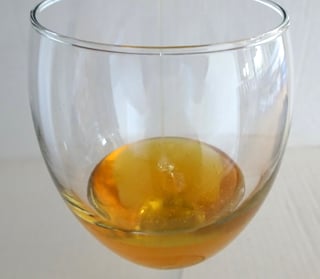
Extracted in September or October, goldenrod honey pours golden amber, thicker in body than the summer crop, with a warm herbal, lightly musky aroma. The flavour is bold and spicy – caramel over a licorice edge – less sweet than clover and longer on the finish, and it strengthens with the share of aster in the fall flow. Within weeks the jar sets into a fine, pale, spreadable grain: the texture other honeys are stirred into as creamed honey; this one sets that way on its own. For most of the year a jar of goldenrod is solid and cream-coloured, and that is its normal state.
Click to Display — The Details: botanical origin, sensory profile, pairings, health and what gives it its character
Nectar Contributors:
- Primary: Canada goldenrod (Solidago canadensis)
- Secondary: Tall goldenrod (Solidago altissima)
- Supporting: Late goldenrod (Solidago gigantea)
- Supporting: New England aster (Symphyotrichum novae-angliae)
Bee Species:
The honey is made by the western honey bee (Apis mellifera). The goldenrod flow serves two purposes for the colony: it is the last nectar of the year, and it comes in while the hive is raising the bees that will live through the winter – around Guelph, those winter bees start emerging in early September, in the middle of the flow. Ontario beekeepers schedule their fall varroa treatments around the goldenrod flow for the same reason: mite controls cannot go on during a honey flow, so treatment happens in August before the bloom or in October after it. The same stands feed more than honey bees – Ontario Parks counts the goldenrods among the province’s most important late-season nectar sources for native pollinators.
Color:
Golden amber, deepening with the aster share of the blend; pale cream once crystallized.
Flavor Profile:
Bold, spicy, caramelized, with a licorice edge and a strong finish.
Tasting Notes:
Thick-bodied from the start – Lovell’s 1926 survey of North American honey plants already called goldenrod honey very thick and heavy. The taste runs stronger than the summer honeys: producers on both sides of the border describe butterscotch and caramel, several note a bite at the end, and one Ontario meadery finds the butterscotch depth grows as the honey ages. It is not uniform year to year – a New York producer records that no two fall harvests are alike, and lighter, milder jars turn up in some seasons and blends. In the creamed state the grain is fine enough that the honey spreads without tearing the bread. A Radio-Canada taster describing a Quebec verge d’or lot found it gentle on the tongue, with a light bitterness, a spiced finish, and an abundance of umami.
Aroma:
Warm herbal, lightly musky, dried grass and beeswax.
Forage Origin:
Primary: Canada goldenrod (Solidago canadensis, Asteraceae). A native perennial that spreads by rhizome into dense clonal stands, Canada goldenrod is the common goldenrod of eastern Canada’s farmland – Ontario’s provincial weed survey finds it in old fields and meadows, forest edges, orchards and fencerows, and along roadsides, streams and shorelines. It is a plant of land going out of farming: the standard Canadian account describes it as characteristic of abandoned farmland and infrequently grazed pasture. Bloom opens in late July or August, and the nectar flow is strongest through August and September. The pollen is heavy and sticky and moves by insect, not wind – the hay fever of the same weeks comes from ragweed, whose green flowers go unnoticed beside it, and Ontario’s own weed guide states that goldenrod must not be blamed for it.
Secondary: tall goldenrod (Solidago altissima, Asteraceae). A near-identical species that peaks later, from September into October, often among the last plants in bloom; it stretches the flow toward freeze-up. Beekeepers do not separate the goldenrods – the species hybridize in the field and arrive in the same combs.
Supporting: late goldenrod (Solidago gigantea, Asteraceae). The smooth-stemmed goldenrod of damper ground, the third of the trio behind the Ontario fall flow.
Supporting: New England aster (Symphyotrichum novae-angliae, Asteraceae). The purple aster blooms beside and past the goldenrods until frost. Its nectar joins the same harvest and deepens the honey’s colour and strength; no Ontario producer bottles an aster honey alone, so the goldenrod name carries the blend.
Southern Ontario holds more goldenrod variety than any other part of Canada – about 32 species grow in the country, and the province’s south is the richest ground for them. Geography decides which provinces can make this honey: on the prairies, where most Canadian honey is produced, the flow from canola and clover ends by mid-August and the season closes; in Ontario the goldenrod flow is only beginning then, and runs to freeze-up. A fall goldenrod honey is an eastern jar almost by definition.
Pairings:
The producers’ own advice is plain: spread it. The fast, fine set makes goldenrod honey a toast and bread honey above all, and an Ottawa producer recommends exactly that. Its strength also survives heat better than the delicate summer honeys, which is why fast-crystallizing honeys of this type have long gone to the baking trade; use it where a recipe needs the honey to still be tasted. Clovermead’s own serving advice for its Golden Rod jar runs the same direction: stirred into hot drinks, drizzled over roasted vegetables, or set beside cheese.
Origin Story
Goldenrod is in the Ontario beekeeping record from the beginning. The Canadian Bee Journal – the country’s first bee paper, published at Beeton from 1885 – discussed it from its first season, and the way it was discussed has not changed in 140 years: a beekeeper at Alliston, a few kilometres from Beeton, reported his colonies going into winter on “Goldenrod for winter stores,” and letters through the 1880s tally goldenrod and aster against the pounds a hive needed to survive until spring. The fall flow was the colony’s provision first and a crop second.
By 1923 the federal Department of Agriculture ranked golden rod among the pictured honey plants in its national manual, Bees and How to Keep Them, and recorded two details at odds with today’s jar: goldenrod honey gathered in the Gatineau Valley in September was white, and two of the small eastern goldenrods had yielded about forty pounds of light-coloured honey per colony on a sandy plain north of Ottawa. Today’s jars run amber; the colour depends on which of the thirty-odd Canadian species the bees worked, and on how much aster came in beside them.
The plant has a place in Canadian letters. Archibald Lampman, born at Morpeth in southwestern Ontario, put it in “In November” – “Over the sand heaps and brown sod, / The mulleins and dead goldenrod” – and Bliss Carman gave it a poem of its own, “The Ghost-Yard of the Goldenrod.” The autumn flower of the Confederation poets is the same plant behind the beekeeper’s last flow.
The plant has a second history abroad. Canada goldenrod was planted in England as a garden flower as early as 1645, escaped in the nineteenth century, and is now listed as invasive across much of Europe and in China. In Hungary and Poland beekeepers harvest a unifloral goldenrod honey from the invader, and it sells at a premium on health claims – kidney and immune benefits that no study supports. A 2021 study in Ecology Letters traced the connection: demand for the honey, driven by those claims, is helping spread the plant, and goldenrod honey is now sold in 37 countries where goldenrod is not native. The plant carries a false reputation on each side of the Atlantic – blamed at home for the hay fever that ragweed causes, credited abroad with cures it has not been shown to deliver.
Cultural Context
The plant has a long record in the Indigenous cultures of the Great Lakes, and it is a record about medicine, not honey. Published ethnobotany documents goldenrod among the Ojibwe as a fever medicine made from the dried leaves and, among the Flambeau Ojibwe, a hunting medicine – the flowers smoked to carry the odour of a deer’s hoof – under the name wasa’waskwune’k, yellow light; Haudenosaunee and Algonquin medicinal uses are documented as well, and the flowers give a yellow dye. Honey bees reached this region with European settlement, so there is no Indigenous goldenrod-honey tradition to report, and none should be read into the plant’s older record.
For a century the plant carried the blame for fall hay fever – the old name for the season’s allergy was goldenrod fever – because it blooms in plain sight while ragweed sheds its wind-borne pollen unnoticed. The conviction was wrong, and it followed the plant for generations.
At the show bench the honey competes without its name. Ontario law classes honey by colour – White, Golden, Amber, Dark – and the Royal Agricultural Winter Fair judges liquid honey in those classes, so a goldenrod entry stands as Amber or Dark: an eastern Ontario producer’s awards record lists goldenrod taking second in the Royal’s Dark class in 2020 and 2022, entered by colour, not flower. The Ontario Beekeepers’ Association’s own competition adds a Black Bottle class, judged from an opaque jar on taste and aroma alone – the one format judged purely on how the honey tastes.
In Quebec the same honey is miel de verge d’or, an ordinary grocery varietal, and fall honey is a named season – miel d’automne – in its own right; a 1979 pollen survey found goldenrod pollen in 83 per cent of Quebec honeys. At Val-Alain in Lotbiniere, the producer Floramiel keeps hives on what its owner calls the beach of the Champlain Sea; one year’s fall honey came back from pollen analysis at 88 per cent goldenrod, and the family calls that honey its miel patrimonial – Quebec’s heritage honey. In Ontario the Polish community buys it under the name it carries in Poland, miod z nawloci.
Harvest & Forage
The flow opens in early-to-mid August in southern Ontario and southern Quebec, peaks through August and September, and runs with the asters until freeze-up; everything shifts earlier moving north. It is the last flow of the year, and the beekeeper’s first decision is whether to take it at all: most of the crop stays in the hive as winter feed, and the Ontario Beekeepers’ Association advises weighing the value of a fall harvest against the spring cost of colonies that went into winter light. A jar of goldenrod honey is the surplus of a strong fall.
The flow is unmistakable in the beeyard. While the bees dry the fresh nectar, the apiary carries a strong smell – sour and cheesy is the common description, gym socks the trade’s shorthand – strong enough that Lovell’s 1926 survey said it could be noticed at a distance on a calm evening, and strong enough that new beekeepers mistake it for brood disease. The smell belongs to the curing nectar, not the honey: once capped and ripened, the extracted honey carries little or none of it.
Timing after the harvest is driven by crystallization: goldenrod honey granulates within weeks – fast enough to set in the comb if extraction waits – so beekeepers pull and extract promptly and bottle liquid only briefly. Most of the crop is sold, or simply left to set, in its fine natural grain. The late date works against ripening: nights are cold, the drying season is short, and a beekeeper pushing for surplus risks taking honey before the bees have finished it.
Monofloral purity is a judgment, not a measurement. The asters flow beside the goldenrods to the end of the season and arrive in the same combs; no accepted pollen threshold exists for goldenrod honey anywhere, and no Canadian pollen survey of the varietal has been published. A jar labelled goldenrod is the beekeeper’s statement that goldenrod dominated the fall flow that year – most of the same crop, from other yards, is bottled as fall wildflower.
Beekeeping Context
Goldenrod honey is fixed-yard production. The plant is nobody’s crop – it stands on old fields, road allowances and farm edges – so there is no migratory chase the way prairie hives follow canola: the bloom surrounds the yards where they already sit, across the mixed farmland of southern and eastern Ontario and north into the near-Shield country. The producers are family-scale: a third-generation outfit near Millbrook runs about two hundred colonies and bottles goldenrod by name, a Kawartha Lakes producer runs about a thousand, and at a nonprofit farm near Hillsburgh the fall jar is harvested with volunteers. The honey sells where the producers are – farm gates, fall farmers’ markets, a bulk refillery tank at Clovermead in Aylmer – with occasional runs into Toronto specialty shelves and grocery delivery. In Quebec the same fixed-yard pattern runs from the Monteregie to the Gaspesie, and verge d’or is also a packer’s varietal: Naturoney and Intermiel jars sit in IGA, Metro and Provigo as everyday grocery honey. In Ontario it is priced with the house varietals, at or just above the same producer’s wildflower: a fall specialty by season and quantity, not by price.
Named Producers
- Clovermead Apiaries – Aylmer, Elgin County. Golden Rod Honey from a 45 g jar up to bulk pails, plus a fill-your-own goldenrod tank in the farm store’s Honey Refillery at $6.50 a pound; the family adventure-farm destination already on the Ontario hub’s Honey Road.
- Hunnabees Honey and Co. – Millbrook, Peterborough County. Third-generation beekeepers Dave and Keri Nicolaou run about 200 colonies on 100 acres; their GOLDENROD jars state the predicted floral source on the label: goldenrod, aster.
- Bela’s Bees (Shoresh) – Bela Farm, Hillsburgh. Volunteer-harvested goldenrod honey in 270 g jars, graded Ontario No. 1 Golden and kosher-certified; a nonprofit farm project.
- Kawartha Lakes Honey – Bobcaygeon. Jerry Jerrard, about 1,000 colonies over more than 30 years; goldenrod in a varietal range sold at the farm gate by appointment, at the Bobcaygeon Farmers’ Market and in local retail. Directory entry at Kawartha Choice FarmFresh.
- Gees Bees Honey Company – Ottawa. Sells the crop as Fall Wildflower Honey with goldenrod named as the lead source; their guide to Ottawa’s honey flavours separates the apiary smell from the finished flavour.
- Miel de la Garde – Prevost, in the lower Laurentians. Certified organic by Quebec Vrai; organic verge d’or from $6.15, each jar identified to the apiary that produced it, with the harvest date under the pot – the house describes the taste as warm and fruity, fruits confits.
- Rucher des Framboisiers – Maria, on the Baie-des-Chaleurs, Gaspesie. Certified organic and hand-extracted; miel de verge d’or biologique the house describes as golden, orange-tinged and silky, finishing warm and spiced; the farm boutique is open late June to mid-September.
Source Regions
- Canada, Ontario - Solidago spp.: Goldenrod honey: a fall farm-gate and market varietal, priced with the house wildflower; much of the crop is bottled as fall wildflower, and the goldenrod name is the beekeeper’s judgment of the dominant flow.
- Canada, Quebec - Solidago spp.: Goldenrod honey (Miel de verge d’or): an everyday grocery varietal with organic bottlings that name the apiary and harvest date; fall honey is its own named category, miel d’automne.
- United States, Northeast - Solidago spp.: Goldenrod honey: a fall varietal from New York, Pennsylvania and Ohio farm producers, sold liquid or naturally crystallized, often marketed to fall allergy sufferers.
- Poland, nationwide - Solidago canadensis: Goldenrod honey (Miod z nawloci): harvested from the invasive Canadian plant and sold on health claims.
- Hungary, western and southern Transdanubia - Solidago canadensis: Goldenrod honey: a recognized unifloral honey, and the reference honey of the goldenrod chemistry literature.
Regional Variants
- Solidago canadensis – European goldenrod honey – Hungary, Poland, Slovakia: lab-verified unifloral honey from dense invasive stands, paler than the Ontario norm – water white to light amber in a three-country study – and sold as a health honey at premium prices.
Translations
- Miel de verge d’or – French: the standard Quebec label for the same honey
- Miod z nawloci – Polish: the name in Poland’s goldenrod honey trade, and on jars in Ontario’s Polish delis
Festivals and Fairs
- The Royal’s honey, beeswax and mead competition – Toronto (November): Canada’s national honey judging, where goldenrod entries compete in the Amber and Dark colour classes.