Linden - Lime - Basswood Honey
The Story
Across Europe and northern Asia the linden was the tree a community
organised itself around. Not farmed for honey. German has a separate word for each of its jobs –
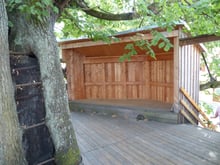
Dorflinde, the village linden; Gerichtslinde, the court linden, under which
judgements were handed down; Tanzlinde, the dance linden, trained so that a
floor could be built into its branches and the musicians could play up in
the tree.
It is the national tree of Czechia, Slovakia and Slovenia, the sacred tree of the Baltic goddess Laima, and holy in Slavic folklore from the Proto-Slavic root lipa. The honey is what fell out of that relationship. Nobody planted a linden for its nectar, and to this day almost nobody grows it as a honey crop: the world’s linden honey comes off village trees, street trees, woodlots and wild forest.
It is known by three names in English and they are not marketing variants. In North America the tree is basswood, in Europe and increasingly on Canadian labels it is linden, and in Britain it is lime – which has nothing whatever to do with the citrus fruit.
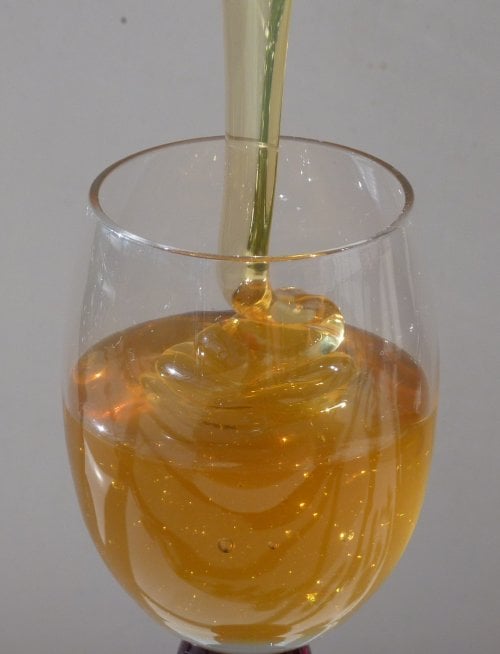
What is in the jar is consistent enough to be recognisable anywhere. It is pale, often water-white, with a greenish cast when very fresh, and it does not behave the way a pale honey should. Colour predicts strength in honey and linden is the documented exception: the aroma is loud, cool and medicinal, and the words tasters reach for – menthol, mint, camphor, balsamic, pharmacy – recur across every producing country and every language in which the honey is sold.
The bloom lasts two to three weeks and cannot be extended. Half a continent named a month after it.
Characteristics
Water-white to pale amber, faintly green when very fresh and settling to a clear yellow-amber, with an aroma out of all proportion to that colour: cool, green and medicinal, menthol and camphor over hay. On the palate it is medium-sweet rather than cloying, low in acidity, faintly bitter, slightly astringent, and long, with a cooling note that arrives late and holds.
Crystallization is medium to fast, into a fine to medium grain. In northeast China, where the honey sets below about 14 degrees C into a smooth white mass with the look of soft lard, the crystallized form is not a defect to be managed but the product itself: it is sold as snow honey and as white honey, and a Heilongjiang producer is credited with turning the market around in 1991 by naming and standardising it rather than fighting it.
The character holds across the genus more than it varies within it, which is why this honey travels under one identity from France to Hokkaido. The exception worth knowing is silver lime, Tilia tomentosa, which Romanian sources single out as giving the most perfumed linden honey of all.
Click to Display — The Details: botanical origin, sensory profile, pairings, health and what gives it its character
Nectar Contributors:
- Primary: Small-leaved lime, winter linden (Tilia cordata)
- Primary: Large-leaved lime, summer linden (Tilia platyphyllos)
- Primary: American basswood (Tilia americana)
- Primary: Amur linden, purple linden (ziduan) (Tilia amurensis)
- Secondary: Manchurian linden (kangduan) (Tilia mandshurica)
- Secondary: Japanese linden (shinanoki) (Tilia japonica)
- Secondary: Silver lime (Tilia tomentosa)
- Secondary: Caucasian lime (ıhlamur, tsatskhvi) (Tilia begoniifolia, syn. Tilia rubra subsp. caucasica)
- Supporting: Common lime (Tilia x europaea)
Bee Species:
Apis mellifera carries the commercial crop everywhere the honey is made. What is unusual about linden is that two dark-bee populations are protected in part because of it.
In Bashkortostan the Burzyan bee, a population of the dark forest bee Apis mellifera mellifera, is described by Russian sources as evolutionarily set to work the linden flow, and it is the object of the only state reserve in the world created to protect a wild bee population together with the craft of keeping it. In northeast China the black bee of Raohe holds its own reserve, established in 1980 and raised in part to national status in 1997; Chinese accounts credit it with working at temperatures around 8 degrees C and crossing ridges to reach the linden stands.
Both are forest bees on a forest tree, and both are protected where that forest and its flow survive.
Color:
Water-white to pale amber, with a green cast when very fresh, deepening to a clear yellow-amber with time
Flavor Profile:
Cool and medicinal over a medium sweetness – menthol, mint and camphor, with low acidity, a light bitterness and a long astringent finish
Tasting Notes:
The intensity of both aroma and taste is stronger than the colour would indicate, and this is the honey’s signature: the usual rule that darker means stronger is broken here.
The vocabulary converges to a remarkable degree across languages. European tasting sheets give woody, pharmacy, fresh, mint, balsamic, menthol and camphor. Canadian and Quebec producers reach for menthol and mint in French and English alike. Chinese sellers describe a mint-like coolness over a dense floral scent; Japanese producers describe a herbal cool that runs up the nose, and one of them reaches instead for cinnamon. Romanian buyers call it simply the fullest and most aromatic honey their country makes.
Under the top notes it is only medium-sweet, with low acidity and often a light bitterness. It is slightly astringent and the aftertaste is persistent. Beyond the menthol there are hay, spice-thyme, geranium and phenolic notes, each of which has been traced to a specific compound.
Aroma:
Loud, green and pharmaceutical – menthol and balsam over hay, with a geranium note and a fresh mint lift
Defining Compounds:
Linden is one of the few honeys whose aroma has been resolved into named compounds, which is a large part of why its description is so consistent from one country to the next. Three studies established it.
Tsuneya and colleagues, working in 1974 from an ether extract of 116 kilograms of lime tree honey, identified 8-p-menthene-1,2-diol as its major volatile compound. Blank and colleagues in 1989 proposed two further indicators of the type: linden ether, 3,9-epoxy-1,4(8)-p-menthadiene, and cis-rose oxide.
The fullest account is Guyot, Bouseta, Scheirman and Collin, published in the Journal of Agricultural and Food Chemistry in 1998. Separating about four hundred volatile compounds by gas chromatography across 110 honeys, they found lime tree honey marked by two groups. The first is shikimate-pathway derivatives: an ethylmethylphenol isomer above 31 parts per billion, 4-tert-butylphenol, estragole above 51, and p-methylacetophenone. The second is high concentrations of monoterpene-derived compounds – menthol, thymol, 8-p-menthene-1,2-diol and carvacrol above 76 parts per billion – together with methyl(1-methylethenyl)benzene.
The sniffing results connect the chemistry to what is tasted. The phenol derivatives were detected with a phenolic note, p-methylacetophenone came through as hay, menthol as mentholated, and estragole – the allyl isomer of anethole, isolated in lime honey by Tsuneya – as anise and fennel. Menthol was evidenced in lime tree honey for the first time in this work, and the authors suspect it of contributing the characteristic mentholated aroma, while noting that it can also turn up in honeys from mint plants.
This is also why the colour misleads. The aromatic load sits in volatile compounds rather than in the pigments that make a honey dark, so a water-white linden carries more flavour than a darker honey beside it.
Forage Origin: 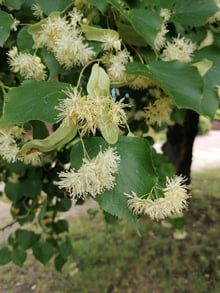
Linden honey is made from the nectar of trees in the genus Tilia, family Malvaceae, formerly placed in a family of its own, the Tiliaceae. The genus runs to roughly thirty species right around the northern temperate zone, and a large number of them are worked for honey. This is why the honey is produced on three continents and why it is the same honey in each.
In Europe the honey trees are the small-leaved lime, Tilia cordata, and the large-leaved lime, Tilia platyphyllos – the German winter and summer linden – together with their hybrid the common lime, Tilia x europaea, and in the Balkans the silver lime, Tilia tomentosa. North America has a single native, Tilia americana, the northernmost species of the genus, the tree that the Forest Service itself calls the bee-tree. East Asia supplies the rest: in northeast China the purple linden Tilia amurensis and the Manchurian linden Tilia mandshurica, and in northern Japan the endemic Tilia japonica.
The bloom order is a commercial fact rather than a botanical footnote. In Germany the summer linden flowers from mid-to-late June and the winter linden from early July; in northeast China the purple linden opens in early July and the Manchurian linden about ten days later, and the two together give an overlapping window of roughly twenty days that is the whole Chinese season.
THE TREE NAMED FOR ITS ROPE. Four peoples on three continents named this tree for the same thing, and none of them named it for honey. English basswood is a worn-down form of bastwood, from the tough fibrous inner bark. German Linde is traced to a north-Germanic root meaning to bind, after the same bark used for binding work. Japanese shinanoki takes its shina from the Ainu word for tying; the Ainu name for the tree, ni-pes-ni, means the tree that rope material comes from. Latvian liepa descends from a root meaning to stick or adhere. The honey came second everywhere. Before it was a honey tree this was the tree you made cord, netting, matting and shoes from, and the wood – soft, pale and even-grained – is still the carver’s standard timber, the material of Riemenschneider’s limewood altars and of the panels that Russian icons are painted on.
One naming trap is worth carrying. In Japan the honey is sold as bodaiju, Bodhi-tree honey, but the true Bodhi tree is Ficus religiosa, a fig and no relation; Japanese sellers routinely flag the confusion themselves. And in Britain the tree is the lime, which is not the citrus.
Pairings:
The aroma that makes this honey worth buying is volatile, which sets the rule: warm it, do not cook it.
Its natural partner is a herbal or mint tea, where the heat of the cup lifts the cool note rather than driving it off – and in the linden-tea countries, a cup of linden-flower tea sweetened with linden honey is the same flower twice. The legacy note on this honey pairs it with lemon sherbet, and the logic holds: cold, sharp and citrus flatters the menthol. It stands up to soft-rinded and nutty cheeses, and it is assertive enough to be worth eating from the spoon.
Keep it out of long baking, where the volatiles that carry its identity are simply lost.
Health Uses:
Linden honey carries an unusually consistent body of folk use, and it is folk use rather than clinical fact.
It has long been taken for colds and fevers as a diaphoretic – a drink to encourage sweating – and as a general fortifying agent. Across Eastern Europe and Russia it is the household honey for sore throat, rhinitis and laryngitis, usually stirred into tea, and it is combined with lemon against a cold that is coming on. It has also been applied externally to sores, eczema and burns. In Romania and Turkey the tradition attaches to the flower first: linden-flower tea is the evening calming drink, and the honey is understood to carry the same quality.
These are traditional and household uses, recorded as such. None of them is a therapeutic claim.
Origin Story
The linden’s place in European life is older than any record of its honey, and it explains why the honey exists in the pattern it does.
In Germanic religion the tree was sacred to Freya and Frigg. Courts were held beneath it: the Teutons heard cases unter den Linden in the belief that the truth would come out there, and the practice ran on through the Holy Roman Empire in the Gerichtslinde, the court linden, with its harder relatives the Prangerlinde, the pillory linden, and the Streitlinde. The Bavarian state forestry institute records the reasoning in a phrase worth keeping: about the linden everything is soft and mild, like its wood and its honey. The last execution at the Gottingen court linden took place in 1859. Something over ten centuries-old court lindens still stand.
The dance lindens are the strangest survival. These are trees trained over generations so that a floor could be built into the lower branches on stone columns, with the village dancing on the platform and the musicians playing from a house set among the boughs. Five three-tier examples remain – at Limmersdorf, Peesten and Langenstadt in Franconia, and Sachsendorf and Effelder in southern Thuringia – and Limmersdorf has held its Lindenkirchweih without interruption since at least 1729. Around fifty church lindens and sixty dance lindens survive in Germany, all several centuries old. Goethe put the scene in Faust; Schubert set Der Lindenbaum.
In the Slavic and Baltic world the tree is holy rather than judicial. Lipa is the national symbol of Slovenia, the national tree of Czechia and Slovakia, and the emblem of the Sorbs of Lusatia. Leipzig takes its name from the Sorbian lipsk, the linden place, and over 850 German towns are named for the tree. In Baltic mythology the lime is the tree of Laima, goddess of fate, who made her decisions from it in the form of a cuckoo, and Lithuanian women prayed and left offerings beneath lime trees and spoke to them as to people.
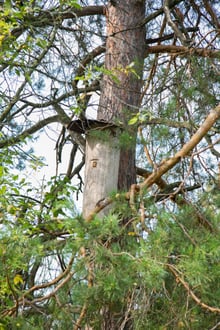
The oldest surviving forms of European beekeeping are both linden practices, at opposite ends of the continent. Medieval Germany had Zeidlerei, forest beekeeping in hollowed living trees. Bashkortostan still has bortnichestvo, which Slow Food calls the only such practice surviving in Europe: bees kept in hollows cut high in living pines and worked on the linden flow, the hive trees inherited down families and each marked with a tamga, the family sign. The count of these hives is a history in itself – 908 in 1927, about 180 by the 1990s, about 400 by 2004, held now inside the Shulgan-Tash reserve.
The classical world knew the tree too. Ovid gave it the ending of Baucis and Philemon, the poor Phrygian couple who fed two gods unknowingly and asked, as their reward, never to be parted – and were granted eternity together as a linden and an oak.
Cultural Context
Half of Europe named a month after this tree’s flowering. Polish lipiec and Ukrainian lypen are July; Croatian lipanj and Slovak lipen are June; Lithuanian liepa is July and is simply the word for the tree; Belarusian lipien and the archaic Russian lipets are the same naming.
It reaches the coinage as well as the calendar. The lipa was the subunit of the Croatian kuna until the country adopted the euro, and lipa was proposed as the name of Slovenia’s currency in 1990 before tolar was chosen instead.
Where the flower is drunk, the honey is eaten with it. Linden-flower tea is a household staple across Romania, France, Turkey and much of central Europe – ceai de tei, tilleul, ıhlamur – taken in the evening as a calming drink, and in those countries the honey of the same flower is its natural partner. This is the practical reason linden honey outsells acacia in Romanian homes, and it is why Romanian and Turkish buyers meet the honey already knowing what the flower tastes like.
The pilgrimage church of Święta Lipka in Poland is named Holy Linden. Rublev’s Trinity, and his Saviour, are painted on linden panels.
Harvest & Forage
Everything about producing this honey follows from the length of the bloom. A linden flowers for two to three weeks and no management extends it. In a cool year it can fail outright, and beekeepers who work linden do not get a crop every season.
Within the window the flow is famously heavy and famously conditional. Warm, humid weather draws the strongest secretion; the legacy record of this honey describes nectar standing on the flowers like morning dew during a strong flow. The Chinese measurements are the most precise available anywhere: in Changbai mixed forest a single Tilia amurensis flower opens for six to eight days and secretes for five, yielding 8.58 milligrams; the nectar averages 37.7 percent sugar and peaks at midday; a tree of 40 centimetres diameter carries some 180,000 flowers and about 1.56 kilograms of nectar; and a hectare of linden yields between 79 and 147 kilograms.
Because the tree is not a crop, hives must be brought to it. Romanian beekeepers move their apiaries to the linden massifs of Tulcea, Vaslui and Moldova for the three weeks of June bloom; Chinese and Russian beekeepers work the forest ranges; North American producers place a yard within flight of a stand and take the crop off the moment the trees finish, before the summer flow blends into it.
Purity is a matter of timing rather than of testing, because the testing does not settle it. Whether a honey counts as unifloral is decided by a pollen count, and the figure that count must beat is set per plant rather than once for all honey: bees do not carry pollen home in proportion to the nectar they take, so chestnut must exceed 86 percent chestnut pollen and eucalyptus 83, while the under-represented types clear at far less. Linden sits at that lower end. The International Honey Commission lists Tilia among the pollen types that can be under-represented: honeys accepted as unifloral linden have been found carrying anywhere from 1 to 56 percent linden pollen, so a low count does not disqualify the honey, and the Commission directs that sensory and physical measurements be read alongside the count rather than the count alone. Bulgaria, the only country found to legislate a figure for linden, sets thirty percent – and a 2025 study of the Bulgarian market found 39 percent of samples sold as monofloral linden did not meet it.
Beekeeping Context
There is no linden honey industry in the sense that there is a canola or a clover industry, because there are no linden plantations. The world’s supply comes off three kinds of stand: wild forest, principally in the Russian Urals, the Chinese northeast and the Carpathians; village and street trees planted for shade, ceremony or civic ornament across Europe and North America; and farm woodlots.
This shapes who produces it. Linden honey is overwhelmingly the work of small and medium beekeepers moving hives short distances to a known stand for a known fortnight, and it is priced accordingly: scarce, seasonal, and usually sold direct or through specialist retail rather than through supermarkets. The two exceptions are at the extremes – China, where the northeastern crop is organised at industrial scale around a geographical indication and a standardised crystallized product, and Romania, where linden is a substantial share of a national industry holding some two million hives.
The oldest method is still practised. In Bashkortostan the bortnik cuts a cavity high in a living pine, and the honey comes out in irregular frameless comb which cannot be cleanly separated from the rest of the hive’s contents – so it is sold as comb and honey together, cloudy and full of wax rather than clear amber.
Source Regions
See all 22 countries
- Russia, Bashkortostan and the Urals – Tilia spp.: linden honey (lipovyi med), taken on the flow Russian names with a word of its own, lipets.
- China, Heilongjiang and Jilin – Tilia amurensis and Tilia mandshurica: linden honey (duanshu mi), sold set white as snow honey; Hulin holds a geographical indication.
- Romania, Tulcea, Vaslui and the Moldavian hills – Tilia spp.: linden honey (miere de tei), about 15 percent of the crop (Radio Europa Liberă, 2022).
- Moldova, the Codri forests – Tilia spp.: linden honey (miere de tei), a permitted type of the Miere din Codrii Moldovei geographical indication since 2020.
- Poland, nationwide – Tilia spp.: linden honey (miód lipowy), which Polish buyers rate above acacia; lipiec, July, is named for the bloom.
- Ukraine and Belarus, the forest-steppe and Polesia – Tilia spp.: linden honey (lypovyi med), from the bloom that names July, lypen and lipien.
- Germany, Austria and Switzerland, village, church and woodland stands – Tilia spp.: linden honey (Lindenhonig), off trees planted for every purpose except honey.
- Bulgaria, the North Central region – Tilia spp.: linden honey (lipov med), legally 30 percent linden pollen; the region’s reached 75 to 78 (2025).
- Slovenia, nationwide – Tilia spp.: linden honey (lipov med), from the national symbol; its Rut linden is said to be 850 years old.
- Croatia, Serbia and the western Balkans, the Sava and Danube basins – Tilia tomentosa: linden honey (lipov med), mostly from the silver lime.
- Turkey, Yenice in Karabük and the Black Sea forests – Tilia spp.: linden honey (ıhlamur balı), protected as Yenice Ihlamur Balı PDO since November 2025.
- Georgia, Adjara, Imereti and Samegrelo – Tilia begoniifolia: linden honey, one of five honeys Georgia names, darker in the west where the bloom meets chestnut.
- Czechia and Slovakia, Bohemia, Moravia and the Slovak uplands – Tilia spp.: linden honey (lipový med), from the national tree of both countries.
- Hungary, the Zselic, the Mecsek and southern Transdanubia – Tilia cordata: linden honey (hársméz), a moved crop taken between the acacia and sunflower flows.
- Lithuania and Latvia, nationwide – Tilia spp.: linden honey (liepų medus, liepu medus), from the tree whose name is July in Lithuanian.
- France, Picardy and the Hauts-de-France – Tilia cordata: linden honey (miel de tilleul), protected as Miel de tilleul de Picardie PGI since November 2025.
- United Kingdom, London and the English lowlands – Tilia spp.: lime honey, largely an urban crop off street and park limes.
- South Korea, Gangwon and the central mountains – Tilia spp.: linden honey (pinamu kkul), from a tree the state now plants to widen bee forage.
- Japan, Hokkaido and northern Tohoku – Tilia japonica: linden honey (bodaiju), Hokkaido’s largest honey crop by volume, flowering about ten days from late July.
- United States, the upper Midwest, Great Lakes, Northeast and Appalachians – Tilia americana: basswood honey, from the northernmost species of the genus.
- Canada, southern Ontario and southern Quebec – Tilia americana: basswood honey (miel de tilleul), documented in full on its own page.
- Italy, Spain, the Netherlands, Belgium, Estonia and Kazakhstan – Tilia spp.: linden honey (miele di tiglio, miel de tilo, lindehoning, pärnamesi), sold under local names.
Translations
- Lipovyi med (Russian) – and lipets, a separate Russian word for the linden flow itself, still used by the Bashkir reserve to announce the season
- Duanshu mi (Chinese) – also xuemi, snow honey, and baimi, white honey, both trade names for the crystallized state
- Bodaiju or shina hachimitsu (Japanese) – sold as Bodhi-tree honey, though the true Bodhi tree is unrelated
- Lindenhonig (German)
- Miód lipowy (Polish)
- Miere de tei (Romanian)
- Lypovyi med (Ukrainian)
- Lipov med (Slovenian, Croatian, Serbian and Bulgarian); lipový med (Czech)
- Liepų medus (Lithuanian) and liepu medus (Latvian)
- Miel de tilleul (French), miele di tiglio (Italian), miel de tilo (Spanish)
- Hársméz (Hungarian), ıhlamur balı (Turkish), pinamu kkul (Korean)
Festivals and Fairs
Lindenkirchweih – Limmersdorf, Upper Franconia, Germany (late August): The village dances on a wooden floor built into the branches of its dance linden, with the band playing from a house set among the boughs. Recorded without interruption since at least 1729, and the best-known survival of a tradition that once ran across Franconia and Thuringia.
Certifications
 Yenice Ihlamur Balı PDO – Registered by the European Union in November 2025 for the Yenice district of Karabük, Turkey, and the only protected designation this site has found for a linden honey. It protects the name, the two linden species and the district, and it defines the honey by its whole pollen spectrum rather than by a linden percentage.
 Yenice Linden Honey, Ark of Taste – Listed in Slow Food’s catalogue of foods at risk of disappearing. The entry records beekeeping in the district back to the 18th century and names the threat: whole branches cut from the trees to harvest the linden flower itself.