
Ontario Honey
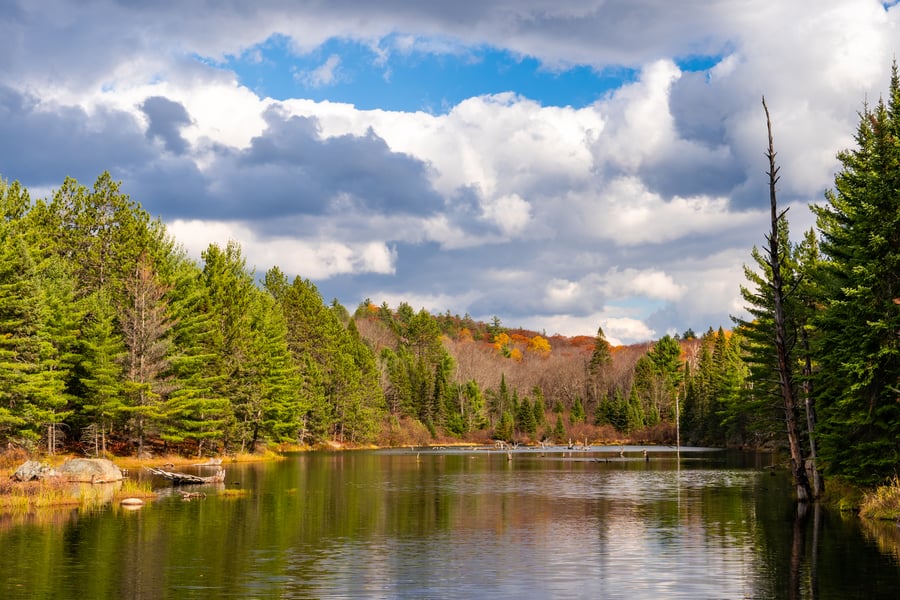
On an Algonquin lake at first light, mist is still moving on the water, a loon calls somewhere ahead, and a moose stands chest-deep in the shallows, feeding, thirty metres off the bow. On these canoe routes the sight is ordinary. The park that holds them is Canada’s first – set aside in 1893, 7,630 square kilometres of lake and forest with 2,000 kilometres of routes and portages – and it lies three hours’ drive from downtown Toronto, where more than half the city was born outside Canada.
The scale is how both can be true. Ontario is larger than France and Spain combined. Most of it is Canadian Shield – a quarter-million lakes set in rock and forest, crossed for thousands of years by water rather than road – while the south is farmland, vineyards and Great Lakes cities. One limestone wall, the Niagara Escarpment, runs 725 kilometres through that south, with the oldest forest in eastern North America growing from its cliffs and vineyards along its sheltered base.
Here the seasons are the itinerary. In May, songbirds that crossed Lake Erie in the dark drop into the forest at Point Pelee at dawn. Summer is lived on the water: cottage lakes, powwow weekends on Manitoulin, locks that carry boats over a height of land. In late September the colour comes – earliest on Algonquin’s high ground – and a tour train runs into Agawa Canyon, where the country’s most famous painters worked. By January the water freezes: a skateway runs through the middle of Ottawa, the nation’s capital, and villages of fishing huts stand on the frozen lakes. Markets follow the same calendar – maple in March, peaches in August, and at the fall fairs, honey jars labelled by the season the bees worked.
Food
Toronto chose its signature dish by public vote, and it costs less than ten dollars at a market stall: the peameal bacon sandwich – cornmeal-crusted cured pork loin, sliced and griddled, stacked on a soft bun – at Carousel Bakery in St. Lawrence Market. Eat it standing up in the morning crowd, then follow the province’s food the way it actually runs: to a Mennonite farmers’ market in horse-and-buggy country, to butter-tart bakeries strung across the Kawarthas, and to Niagara, where the grapes for the country’s most famous sweet wine are left on the vine for the first deep freeze of winter.
Toronto's official sandwich, the butter tart trail, Canada's largest farmers' market, and icewine
The peameal bacon sandwich -- St. Lawrence Market, Toronto
Toronto packed so much pork in the nineteenth century that the British Empire's largest pork-packing firm ran here and the city was nicknamed Hogtown. Peameal -- wet-cured loin rolled in cornmeal -- survived from that trade, and the sandwich was born at the market in the 1960s when a butcher's family began slicing and frying the unsold ends of the loins onto buns. In 2016 the city declared it Toronto's signature dish by public vote. Carousel Bakery dresses it with honey mustard; go in the morning, and leave with a jar of the market's Kozlik's mustard for home.
Butter tart country -- Kawarthas Northumberland
The butter tart is one of the few pastries with a genuinely Canadian origin, first published in a 1900 hospital-auxiliary cookbook, and Ontario is its heartland. The Butter Tart Tour threads more than fifty bakeries through the Kawarthas and Northumberland year-round, self-guided; order one runny and one firm-set and take a side in the raisin debate. Bakeries sell out by afternoon -- go before lunch.
Market Saturday in Mennonite country -- St. Jacobs and Elmira
Canada's largest year-round farmers' market trades Thursdays and Saturdays (plus summer Tuesdays) at St. Jacobs, in the countryside that holds the country's largest Old Order Mennonite community: summer sausage, quilts, produce sold by families who arrived by buggy. A seventy-five-minute farm tour visits an Old Order farm from mid-April to October. On the first Saturday of April, nearby Elmira holds the world's largest single-day maple syrup festival, Guinness-recognized, with attendance above sixty thousand.
Icewine -- Niagara
Canada's first winery licence since Prohibition went to Inniskillin at Niagara-on-the-Lake in 1975; starlings ate the first icewine crop in 1983, netting saved the next, and the 1989 Vidal took the Grand Prix d'Honneur at Bordeaux's Vinexpo in 1991 -- the award that brought Canadian wine international attention. The grapes are picked frozen, at night, in a January deep freeze the region can count on: Niagara has not missed a vintage. Tasting rooms on the Beamsville Bench and around Niagara-on-the-Lake pour it year-round.
Culture
On the August long weekend, the Grand Entry at Wiikwemkoong brings hundreds of dancers in regalia into the arbour to the big drums – the largest and longest-running powwow in northeastern North America, held on Canada’s only officially recognized unceded territory. Visitors are welcome: buy a ticket, follow the etiquette the hosts publish, and the Cultural Pavilion will teach you what you are watching. Much of the province’s living culture is equally open to visitors: the Group of Seven’s canvases in Toronto, two festival theatre towns, and the country’s last corn-broom maker at work.
The Wiikwemkoong powwow, the Group of Seven at the AGO, Stratford and Shaw, and Canada's last corn-broom maker
Powwow summer -- Wiikwemkoong, Manitoulin Island
The Wiikwemkoong Annual Cultural Festival has run since 1961, when Rosemary Odjig set out to revive the powwow: three days of champion Anishinaabe dance, drum, food and craft on the August civic long weekend, with the Cultural Pavilion's regalia and drum teachings included in admission. Manitoulin's six First Nations host about eight powwows between June and September, and Wikwemikong Tourism guides visitors the rest of the season -- the Unceded Journey tour of the 1836 and 1862 treaty history, and a hiking trail along the island's escarpment edge.
The painters -- AGO, Toronto, then the landscapes themselves
The Group of Seven and Tom Thomson painted Algonquin, Georgian Bay and the Lake Superior shore into Canada's national identity, and the Art Gallery of Ontario holds their canvases -- Lawren Harris's Lake Superior paintings among them. Every one of those landscapes is still intact and reachable, from Algonquin's lakes to the Agawa Canyon train that follows the same rail line the painters rode north in 1918.
Two theatre towns -- Stratford and Niagara-on-the-Lake
Ontario runs two of North America's great repertory theatre seasons in two small towns. The Stratford Festival plays April to October in the town it remade from a railway junction; the Shaw Festival at Niagara-on-the-Lake -- founded in 1962 to revive the town, which it did -- is the only theatre in the world specializing in Bernard Shaw and his contemporaries, playing April to December across three stages. Book a matinee and spend the rest of the day in the town.
Watch the makers -- the village of St. Jacobs
In the village's former blacksmith shop, John Davenport makes corn brooms most days in full view -- Canada's last corn-broom manufacturer, founded 1908, still sewing on a vice from 1878 -- and you leave with a broom that sweeps for years. The old flour-mill silos next door hold working artists' studios, and The Mennonite Story visitor centre explains the horse-and-buggy country around it. Most of the village closes on Sundays.
Natural History
For two weeks each May the trees at Point Pelee fill overnight. Songbirds cross Lake Erie in the dark, make landfall at the southernmost tip of mainland Canada, and drop into the first forest they find – warblers at eye level at dawn, with birders from around the world waiting under them; get there before seven, because the parking lots fill. The rest of the year has fixed dates of its own: a turquoise grotto on the Bruce, thousand-year-old cedars on the escarpment cliffs, painted rock on Superior’s shore, and wolves that answer in August.
Point Pelee's May migration, the Grotto and the ancient cedars, the Agawa Rock pictographs, and Algonquin's wolf howls
The spring fallout -- Point Pelee, May
The Festival of Birds runs the first half of May: more than 370 species have been recorded in this small park, 41 of them warblers, and a free shuttle runs to the Tip, where the sand narrows to the very end of mainland Canada. Come back in September for the other migration -- monarch butterflies clustering at the Tip by the thousand before crossing the lake for Mexico -- and stay late around a new moon: the park is a dark-sky preserve and keeps the gates open to midnight on stargazing nights. Twenty-four oTentik tent-cabins stand in the Carolinian forest for overnight stays.
The Grotto and the ancient cedars -- Bruce Peninsula
Where the escarpment finally meets Georgian Bay at Tobermory, a wave-carved chamber holds clear turquoise water -- the Grotto, popular enough that parking must be reserved from late April to the end of October. The cliffs above it carry the oldest forest ecosystem in eastern North America: eastern white cedars three hundred to more than a thousand years old, growing from the rock face, unnoticed until a University of Guelph ecologist identified them in the 1980s. Offshore, Fathom Five National Marine Park holds the Flowerpot Island sea stacks and about two dozen shipwrecks in water clear enough to see them from a glass-bottom boat.
Superior's painted shore -- north of Sault Ste. Marie
Highway 17 runs the Lake Superior shoreline through Lake Superior Provincial Park -- Old Woman Bay's cliff and sand coves, beside the largest freshwater lake on earth by surface area. At Agawa Rock, a granite ledge leads to more than a hundred red-ochre pictographs painted centuries ago by Ojibwe artists, Mishipeshu the great underwater lynx among them; the ledge is walked only when the lake is calm, and the site remains a sacred place. Visit it the way the trail signs ask.
Wolf nights -- Algonquin, August
Algonquin holds the eastern wolf, and on the park's August wolf-howl nights a naturalist howls into the dark from the roadside and wild packs answer across the lakes, with hundreds of visitors listening from the highway shoulder -- check the park's events schedule, because the nights run only when a pack is nearby. Any month, the surer sighting is the moose, chest-deep in the beaver ponds at dawn along Highway 60.
Built Heritage
You can paddle a canoe into the Peterborough Lift Lock, wait while a single extra foot of water tips the balance, and ride the pan sixty-five feet down in about two minutes – no pumps, no engines, gravity alone, since 1904, still the highest hydraulic lift lock in the world. That is the character of Ontario’s built heritage: the canals still carry boats, the 1832 locks on the Rideau are still cranked by hand, and the first capital of Upper Canada is still the best-preserved nineteenth-century townscape in the country.
The world's highest lift lock, the hand-cranked Rideau Canal, Upper Canada's first capital, and Kingston's fortifications
Ride the lift lock -- Peterborough and the Trent-Severn Waterway
The Trent-Severn runs 386 kilometres from Lake Ontario to Georgian Bay, mid-May to mid-October, and its engineering is the attraction: the Peterborough Lift Lock, reputedly the largest unreinforced concrete structure on earth when it opened in 1904, with a visitor centre and working model; and at the Georgian Bay end, the Big Chute marine railway, the only one of its kind in North America, which hoists boats onto an open rail carriage and drives them over a ridge. In the same town, the Canadian Canoe Museum -- the world's largest collection of canoes and kayaks, in a lakeside building opened in 2024 -- lets you tour the collection, then paddle a voyageur canoe out its back door.
The hand-worked canal -- the Rideau, Ottawa to Kingston
Ontario's only UNESCO World Heritage Site still operates: 202 kilometres and 47 locks built by 1832 as a military route after the War of 1812, the oldest continuously operated canal system in North America, and the lock staff still open the gates with the original hand cranks while boaters and picnickers watch. In winter the Ottawa stretch becomes the Rideau Canal Skateway, 7.8 kilometres of naturally frozen ice through the middle of the national capital -- the world's largest rink when the cold cooperates, which some winters now it does only briefly. Check ice conditions in January and February; the locks run mid-May to mid-October.
The first capital -- Niagara-on-the-Lake
Upper Canada's first parliament met here in 1792, and in 1793 it passed the Act Against Slavery, the first legislation restricting slavery in the British Empire. American forces burned the town in 1813; what its citizens rebuilt is now, by Parks Canada's designation, the best collection of 1815-to-1859 buildings in Canada -- twenty-five blocks of it, walkable in an afternoon between Fort George's costumed garrison and a Shaw Festival curtain.
The canal's other door -- Kingston
Where the Rideau meets Lake Ontario, Kingston's limestone downtown and the fortifications above it -- Fort Henry chief among them -- are inscribed on the World Heritage list together with the canal. The city had its own turn as a capital, of the united Province of Canada in 1841, and the harbour it was built to guard is now where the canal's boaters finish their trip.
I want to dig deeper
Four experiences reward more time than a day trip allows. Portage into Algonquin’s interior beyond the road system, drive the Superior shore for three days, spend a week on Manitoulin among six Anishinaabe First Nations, or rent a boat and lock through a nineteenth-century canal system. Each can be done in a day or stretched to weeks.
Algonquin canoe trips, the Superior shore drive, a week on Manitoulin, and boat rental on the canals
Algonquin by canoe -- ice-out to freeze-up; September rewards most
Two thousand kilometres of mapped canoe routes leave from access points all around the park, and the outfitters at Canoe Lake and Lake Opeongo rent everything from the boat to the barrel. Trips run from an afternoon on Canoe Lake to a week beyond the road system, with backcountry campsites reserved by lake. Experienced trippers go in September -- the routes empty out, the colour arrives on the high ground, and the wildlife moves all day. Book interior sites ahead in any season.
The Superior shore -- Sault Ste. Marie to Thunder Bay, June to October
Some seven hundred kilometres of Highway 17 hold the coast the Group of Seven painted: Agawa Rock and Old Woman Bay in Lake Superior Provincial Park, Pic Island off Neys -- Lawren Harris's island -- and, near Thunder Bay, the flat-topped mesa of the Sleeping Giant, with a trail to the top of the cliffs. Superior makes its own weather and its towns are far apart; give the drive three days or more. If you would rather not drive at all, the Agawa Canyon train out of Sault Ste. Marie does a day of the same country by rail, August to mid-October.
A week on Manitoulin -- ferry season May to October
The Chi-Cheemaun ferry sails from Tobermory to the world's largest freshwater island, home to six Anishinaabe First Nations and a summer of about eight powwows. Walk the Cup and Saucer trail along the escarpment's edge, swim below Bridal Veil Falls, and book Wikwemikong Tourism's guided experiences -- the Unceded Journey treaty-history tour, the escarpment-edge hiking trail, and an evening star-teachings tour. A week is a reasonable stay.
Rent a boat on the canals -- Trent-Severn and Rideau, mid-May to mid-October
Rental houseboats and cruisers on both waterways come with instruction and no licence requirement, and the locks structure the trip: you throw lines to staff working nineteenth-century machinery, moor overnight at lock stations, and buy butter tarts in the towns between. The New York Times put the Trent-Severn on its places-to-go list for 2025. Reserve boats months ahead for July and August.
The Honey of Ontario
All of it ends up in jars. Ontario’s beekeepers work the same calendar the traveller does: dandelion honey off the May fields, a pale run in early summer when the basswood trees flow so hard that hives fill in days, darker goldenrod and aster honey as the colour arrives, and jars at the fall fairs labelled spring, summer and fall. It has been this way longer than anywhere else in the country – commercial beekeeping in Canada began an hour north of Toronto, in a village that renamed itself for the bees. The Honey Road below connects them: a market sandwich dressed with honey mustard, the town called Beeton, a university bee yard that teaches the world, a Mennonite market, a family honey farm near London, and a meadery in wine country.
Two boxcars of honey: how commercial beekeeping in Canada began at Beeton
In 1870 David Allanson Jones, a storekeeper in the Simcoe County village of Clarksville, took two colonies of bees in the new movable-frame hives. Ten years later he brought two boxcars of honey -- 70,000 pounds from 400 hives -- to Toronto's first Industrial Exhibition, at a time when other beekeepers brought a dozen jars, and Europe and North America were calling him the Bee King of the nineteenth century. The village had already renamed itself for his bees.
Jones imported breeding stock from Cyprus, Palestine and Borneo -- then isolated the imported queens on islands in Georgian Bay off Parry Sound, running bee quarantine stations in the world's largest freshwater archipelago. He founded and first led what became the Ontario Beekeepers' Association, and in 1885 started the Canadian Bee Journal, which anyone can now read online in full.
After fire took his factory in 1893, Jones planted Beeton's streets with soft maple, elm and basswood -- trees the bees would work. He died in 1910, still the village postmaster. The basswood he favoured remains the province's most prized varietal honey.
The story is marked in Beeton within walking distance: a provincial plaque in the park at Prospect and Second streets, the Honeycomb Heritage Trail past the surviving Jones buildings, and the Honey and Garden Festival, which fills Main Street on the last Saturday of May.
The Honey Road
Three days, south-central Ontario, the honey as the reason to go. Everything else is on the way.
Toronto -- year-round (city gateway)
Start at St. Lawrence Market for the peameal sandwich and the honey stalls, then a St. Clair West storefront that gathers jars from beekeepers across the province, Tuesday to Saturday. (Ontario Honey House, Toronto.) In November, the Royal Agricultural Winter Fair judges the country's honey classes downtown, and the champions' jars are for sale on the spot.
Beeton -- last Saturday of May for the festival; the trail any season
An hour north, on the way to cottage country, the town where it began: walk the Honeycomb Heritage Trail past D.A. Jones's buildings to his plaque in the park, and on festival day Main Street closes for the Honey and Garden Festival -- 190 vendor booths, a firemen's pancake breakfast, and local honey producers down the Victorian main street. (Beeton Honey and Garden Festival.)
Guelph -- tours May to October; shop year-round
The university bee yard that teaches the world: the Honey Bee Research Centre has kept hives since 1894 and its beekeeping videos have been watched thirty million times in fourteen languages. Book the Discover Honey Bees tour at the new centre on Stone Road -- an hour and a quarter from presentation to open hive to the honey shop, stocked from its own 326 colonies. (Honey Bee Research Centre, University of Guelph.)
St. Jacobs -- Thursdays and Saturdays
Forty minutes west, Canada's largest year-round farmers' market puts honey producers among the Mennonite bakers and sausage-makers; the village up the road holds the broom maker and the silo studios. Time lunch for the market.
Aylmer -- honey shop year-round Monday to Saturday; farm May to October
Twenty minutes past London, Clovermead is a family farm attraction built around a working apiary: sixty-odd farm attractions, Ontario's largest glass display hive, the Wonderful World of Bees show daily in July and August, a bookable bee-beard experience, and six honeys on tap -- bring a container, or taste through the summer blossom and fall jars at the honey bar. (Clovermead Adventure Farm, Aylmer.) Port Stanley's beach on Lake Erie is twenty minutes on.
Beamsville Bench, Niagara -- bee experience May to September; wine shop daily
Finish in wine country at Niagara's original meadery, where the family kept bees for seven decades before planting vines: suit up with a Rosewood beekeeper and open a working hive, then taste the result as a mead flight -- the honey comes off the escarpment wildflower above the vineyards. (Rosewood Winery and Meadery, Lincoln.) Niagara-on-the-Lake and the icewine cellar doors are fifteen minutes east.
Ottawa -- an eastern spur, year-round
If Ottawa is your trip instead, the honey stops continue there: Gees Bees keeps a farm shop on River Road and a store on Sussex Drive steps from the ByWard Market -- founded after the Gees found a wild colony living in the wall of their house -- with summer hive visits at the farm. (Gees Bees Honey Company, Ottawa.) The Sussex Drive shop stays open through skateway season.
Getting Here
Toronto Pearson is Canada’s largest airport and the practical gateway; Ottawa has its own international airport for the national capital and the Rideau corridor. Beyond the cities a car is the working tool. Driving times from Toronto: Niagara-on-the-Lake about 1.5 hours; St. Jacobs, Peterborough and the Kawarthas about 1.5 hours; Algonquin’s Highway 60 corridor about 3; Tobermory 4; Ottawa 4.5; Manitoulin about 5.5 by road, or 4 to Tobermory plus the two-hour Chi-Cheemaun ferry (May to October); Sault Ste. Marie 8; Thunder Bay 15 – for the far Northwest, fly. VIA Rail runs the Toronto-Kingston-Ottawa corridor, and GO trains reach Niagara in summer. Winter driving is a real factor from December to March; the far south stays milder than the Shield.
Seasonal Events Not to Miss
Festival of Birds – Point Pelee National Park, first half of May (May 1-18 in 2026). Guided dawn hikes and the continent’s most concentrated songbird migration; dates and registration at Parks Canada. (Parks Canada.)
Beeton Honey and Garden Festival – Beeton, last Saturday of May. The street festival of Canadian beekeeping’s founding town: 190 vendors, honey producers, a pancake breakfast; details from the festival organizers. (Beeton Honey and Garden Festival.)
Wiikwemkoong Annual Cultural Festival – Wiikwemkoong Unceded Territory, Manitoulin Island, August civic long weekend (August 1-3 in 2026). The largest and longest-running powwow in northeastern North America, open to visitors, Cultural Pavilion included with admission; program and admission from Wikwemikong Tourism. (Wikwemikong Tourism.)
Royal Agricultural Winter Fair – Exhibition Place, Toronto, every November. The world’s largest combined indoor agricultural fair and international equestrian competition, by its own designation – with the national honey competition classes and the champion jars on sale; dates and tickets at the Royal. (Royal Agricultural Winter Fair.)
Elmira Maple Syrup Festival – Elmira, first Saturday of April (April 3, 2027 next). The Guinness-recognized largest single-day maple syrup festival, run by volunteers since 1965, with sugar-bush tours from the neighbouring farms; festival guide from the organizers. (Elmira Maple Syrup Festival.)
Where to Buy Honey
In Toronto, a storefront at 1265 St. Clair Avenue West sells jars from beekeepers across the province, Tuesday to Saturday (Ontario Honey House); St. Lawrence Market’s food halls carry Ontario honey among the produce stalls, Tuesday to Saturday. In Guelph, the Honey Bee Research Centre’s shop sells honey from its own 326 research colonies (University of Guelph, Stone Road East). At the St. Jacobs Farmers’ Market, honey producers sell on Thursdays and Saturdays year-round (St. Jacobs Market District, Waterloo Region). Near London, Clovermead’s honey shop fills your own container from six taps, Monday to Saturday year-round (Clovermead, Aylmer). In Niagara, Rosewood’s bottle shop carries the estate’s escarpment-wildflower honeys and meads daily (Rosewood Winery and Meadery, Lincoln). In Ottawa, Gees Bees sells at the River Road farm daily and on Sussex Drive Tuesday to Saturday (Gees Bees Honey Company). Farm-gate stands run across the province from July to fall-fair season; the Ontario Beekeepers’ Association’s honey guide points to its member directory for the beekeeper nearest wherever you are.