Blackberry Honey
The Story
Blackberry takes ground that has been disturbed and then left alone: a fence line, a railway cutting, the strip behind a car park. Its first-year canes root where their tips meet soil, each making a new plant off the old one. One plant becomes a thicket.
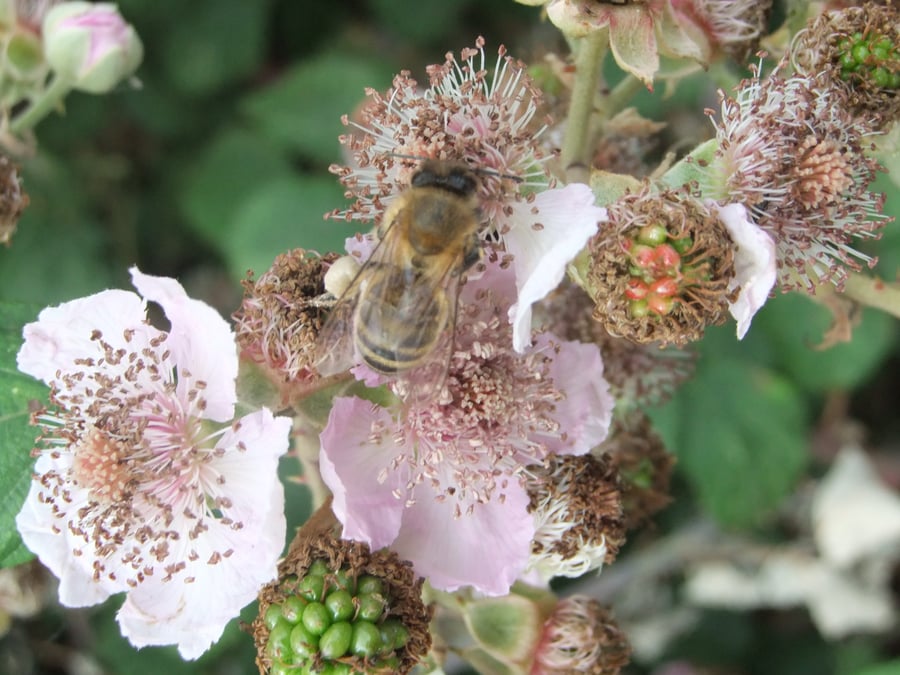
The blossom is white to pink, its five petals ten to fifteen millimetres long and its centre carrying a hundred stamens or more. Bumblebees and honey bees are its primary pollinators. Himalayan blackberry, the naturalised species behind most of the world’s crop, sets seed by pseudogamous apomixis: pollination is required for the embryo and the endosperm to form at all, the embryo is then never fertilised, and the seed is solely maternal in origin. A thicket in fruit is one the bees have worked, and when fifty plants were sampled across twenty-nine Australian locations no genetic variation was found among them.
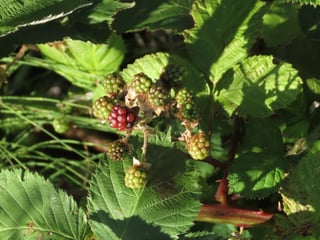
What people pick is an aggregate of fifteen to forty drupelets, and it ripens weeks after the flow – so a blackberry honey and a blackberry pie come off the same canes in the same year and never in the same month.
The honey is made wherever the genus holds ground: across Europe, in North America on the Pacific coast, in Tasmania and New Zealand. In Europe it is sold as miele di rovo, miel de ronce, mel de silva and Brombeerhonig.
Characteristics
Descriptions run from light and delicate to dark and jammy, agreeing on sweet and fruity. It is sold on its texture: the Cowichan Honey Store, on Vancouver Island, describes it crystallising quite quickly but into a smooth, yellow texture, and Campania’s register of traditional products gives rapid crystallisation as a characteristic of miele di rovo.
The one measured series that includes bramble is European. A study of 136 honeys from Galicia and Romania placed Rubus away from the sugar ratios that mark fast crystallisation, beside chestnut and eucalyptus – but that is a position in an analysis, not a rate for any jar, and the paper never states one. No Pacific Northwest or Canadian blackberry honey has been analysed at all, and the study’s bramble is not the same species as the Pacific coast crop.
Click to Display — The Details: botanical origin, sensory profile, pairings, health and what gives it its character
Nectar Contributors:
- Primary: Blackberry (Rubus spp.)
- Background: Mixed summer forage, varying by region (Multiple species, undocumented)
Bee Species:
Western honey bee (Apis mellifera), working the blossom alongside bumblebees and, in North America, ground-nesting native bees.
Color:
Amber to dark amber where it has been measured, in Galicia; sellers and analysts elsewhere describe it anywhere from light to medium amber
Flavor Profile:
Sweet and fruity, reported anywhere from delicate to jammy
Tasting Notes:
Two European specifications describe this honey in law, and the Galician one is the fuller. The Miel de Galicia specification requires at least 45 per cent Rubus pollen and describes what results as aromatic, with a persistent floral aroma, a very fruity flavour and a marked sweetness of medium to high intensity and persistence. A descriptive analysis of Galician samples reports the same honey a shade quieter: floral and vegetal perceptions of medium to low intensity, a medium floral aftertaste, a fruity aroma.
Sellers describe the jar in front of them, and the descriptions do not settle. In Tasmania, Blue Hills at Mawbanna calls genuine blackberry honey light and very delicate; Frogmouth Ponds, on the same island, sells its wild blackberry harvest as light and delicate in one place on its site and as dark, fruity and gently jammy in another. A Eugene newspaper describes the Willamette Valley crop as jammy and fruity; GloryBee, in Eugene, sold its Pacific Northwest blackberry honey on a rich, warm, confectionary sweetness and a tiny hint of spice before it closed its retail line.
Lucia Piana, who wrote Italy’s characterisation sheets, published a reason for the spread. Her 2000 sheet called blackberry honey amber to dark amber, ripe fruit and jam, and rested on a handful of samples. Reviewing a database of more than 4,500 Italian honeys, she found blackberry pollen in nearly all of them and almost always as a minor component, and found that producers regularly sell a whole mixed crop as blackberry – once mixed with honeydew, now with ailanthus. The dark jammy honey was the honeydew. On the purer samples she has seen since, she would now write light or medium-light, with floral and vegetal notes that recall the smell of a rose-family flower. New Zealand’s agricultural advisory tables, describing the same plant on the other side of the world, call it a white honey of excellent flavour. The older reading has not gone away, though: Campania’s register still describes miele di rovo as more or less dark amber, with the flavour of ripe fruit or jam.
Light, on this honey, means one thing in a laboratory and another on a jar. Thirty-three Galician samples averaged 94 mm on the Pfund scale and ran from 39 to 150. The laboratory that measured them files blackberry among Galicia’s light honeys – light against chestnut at 128 mm and honeydew at 142. Under Canadian consumer colour grades the same 94 mm honey would be labelled Dark.
Aroma:
Floral and fruity, of medium intensity where it has been described
Defining Compounds:
The chemistry of this honey sits at the mild end of its group. In a Galician series of 362 honeys, blackberry carried a significantly lower flavonoid content than the honeys measured beside it, 6.1 mg per 100 g, and a total phenolic content below chestnut, heather and honeydew. Those compounds track with colour: the same laboratory modelled the colour of a Rubus honey from its flavonoid content, its electrical conductivity and its Rubus pollen, and found phenol and flavonoid levels tied to the mineral content and the colour. Blackberry groups with eucalyptus rather than with chestnut.
PH is the other separator the study names. At 4.3 blackberry runs a little above the 4.24 mean of the 362 honeys measured, and pH and flavonoid content are the two characteristics it found significantly distinguishing blackberry from the rest. Its electrical conductivity – a measure that rises with the minerals a honey carries, and with them its colour – was 0.69 mS/cm, above eucalyptus at 0.51 and well below the chestnut and honeydew honeys, which ran over 1.0.
Forage Origin: 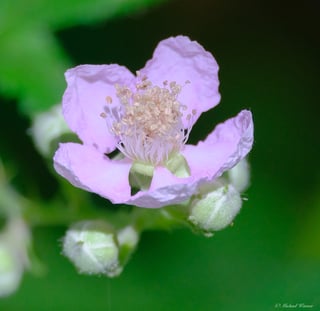
Primary: Blackberry (bramble, Rubus spp., Rosaceae). Bees collect nectar and pollen from the blossom. Rubus is a large genus, and the honey comes from whichever species holds the ground: the European bramble Rubus fruticosus across Europe and in New Zealand, Rubus armeniacus on the Pacific coast of North America, the native Rubus ursinus beside it. It roots from a cane tip wherever one meets soil, so a single plant occupies ground it did not start on. Flowering is staggered rather than concentrated: blossom opens intermittently from spring into late summer, so the plant is in flower somewhere for four or five months, while the surplus a beekeeper can take sits in a narrower June to July peak. The flowers can self-pollinate, but cross pollination increases fruit set. In a seasonal wetland in Oregon, about 70 per cent of the plant’s pollinating visitors were honey bees and about 20 per cent bumblebees and ground-nesting bees.
Background: Mixed summer forage, varying by region (multiple species, undocumented). Blackberry blooms alongside whatever else is in flower in midsummer, and that changes with the region and the year. The Miel de Galicia designation requires at least 45 per cent Rubus pollen in honey sold under it; outside a designation, what else is in the jar follows from where the hives stood.
Origin Story
Rubus armeniacus, the species behind the Pacific Northwest crop, is native to the Caucasus. It was introduced to Germany about 1835, and because its fruit was large and sweet it became the most widely cultivated blackberry in Europe.
In 1885 it reached North America. Every account names the same year and the same man, and they disagree about the place. It is attributed to Luther Burbank, the Californian plant breeder, who is said to have received it in the mail, assumed from the return address that it had come from India, and sold it as the Himalaya Giant. The name held: the plant is still called Himalayan blackberry. Where he first put it in the ground is not settled – Santa Rosa, Oregon, the Pacific Northwest and the east coast are all in print – and almost every later source traces back to one German botanist’s letter from 1998. What is documented is the selling. A Burbank flyer went out to Pacific Northwest customers in 1894.
It worked as a crop. By 1890 it was grown commercially in the Pacific Northwest, by 1915 across the United States, and by 1945 it had naturalised along the west coast. New Zealand had it before 1885. It was planted for its fruit and sold by catalogue; the honey came from where it went next.
Cultural Context
Two European designations name this honey, and both name it inside a place rather than on its own. The Miel des Cévennes PGI, registered in 2015, covers a polyfloral honey and several miels de cru (honeys from a single named plant within the area), and miel de ronce is one of the named summer crus: a light honey, smelling of ripe fruit, with fairly intense aromas. Bramble is also named among the plants that characterise the area, with chestnut, the heaths and raspberry.
In Galicia, mel de silva is one of the botanical types the Miel de Galicia designation recognises, and the Asociación Galega de Apicultura runs a Mel de Silva class in its Concurso de Mel 5 Estrelas under the same 45 per cent pollen minimum the designation uses – a threshold its beekeepers wrote into a competition rulebook of their own. Its monofloral bramble class is one of the hardest it has to fill. Sixty-one honeys reached the final of the first competition in 2019, thirty-six of them monofloral and spread across chestnut, eucalyptus, heather and oak honeydew; the bramble category was left uncovered for want of samples. At the seventh, in 2025, two finalists were silva, against thirty-six multifloral and twelve chestnut.
Italy ties it to two small territories and writes down how it is to be made. Miele di rovo is on the national register of traditional agri-food products for the communes of the Valle di Suessola and the western Partenio, in the provinces of Caserta and Avellino, and the register sets the practice as well as the place: harvested in June, supers taken above 70 per cent capping, three to four weeks of maturation, sold in glass and no later than the autumn of the year after the harvest, with the production environment free of plant-protection residues within two kilometres of the apiary. The traditionality note places monofloral honeys in both the peasant and the monastic pharmacopoeia, the monastic one belonging in particular to the monastery of Montevergine on the Partenio. In Sicily, Petralia Sottana in the Madonie has given miele di rovo a municipal De.C.O., which the comune describes as the identity card of a product rather than a quality mark. In 2014 a Campanian rovo from Lapio, made by the beekeeper Cristian Mattei, was named both Miele del Sindaco and Italian honey of the year at Montalcino.
In Britain the honey has no name on a jar and the plant is among the three the bees work most. The National Botanic Garden of Wales compared honey pollen across sixty-five years: in 1952 Rubus appeared in 58 per cent of British samples and was a major source in 5 per cent of them; by 2017 it appeared in 73 per cent and was a major source in 36, putting it among the top three plants for honeybees with white clover and Brassica. The cause the garden gives is agricultural. White clover collapsed as grass leys were reseeded without it and cut more often for silage, and the bees moved onto bramble, which flowers at the same time. The older beekeeping writers said why the name never came: Manley, in 1936, called bramble honey a thing never seen pure in this country.
In the American Northwest the claim is commercial and local. The Queen’s Bounty, a Willamette Valley apiary of more than 600 hives, told a Eugene newspaper in 2018 that in the Willamette Valley blackberry is the signature honey; a fourth-generation apiary at Mulino, Oregon, sells Oregon Blackberry Honey as what Oregon tastes like; and Washington State University’s magazine calls the plant synonymous with summer in Washington state.
Harvest & Forage
In the northern hemisphere the blossom opens from May and the flow that fills a super sits in June and July. South of the equator the same plant runs on the opposite calendar: New Zealand’s agriculture ministry records Rubus fruticosus flowering November to January and yielding a surplus.
Purity is the working problem, and it is a problem of proof rather than of quantity. Italy’s analyst found blackberry pollen in almost every Italian honey she examined, and almost always as a minor component, so its presence in a jar settles nothing on its own. What has to be established is share. Thirty-three Galician samples ran from 46 to 91 per cent Rubus pollen; honey sold under the Miel de Galicia designation has to clear 45 per cent, which means a laboratory count before the label goes on.
The pollen test works here, which is not true of every monofloral. A Galician study of 362 honeys classified all 56 of its blackberry samples correctly. What defeats the name is not the test but what goes into the tank alongside the blackberry, and that differs by country. In Italy the crop folded in has changed with the countryside: honeydew once, ailanthus now.
Beekeeping Context
Blackberry forage is standing ground rather than a crop a beekeeper buys into: it is already there, and the beekeeping decisions are where to put the hives and when to put the supers on.
The flow is short. The Puget Sound Beekeepers Association’s hive calendar gives blackberry as the major lowland nectar flow of that region, starting in June and lasting two to four weeks depending on altitude, weather and location. What that adds up to has been put in print once: a monograph on Canadian weeds records Washington State producing 3.25 million pounds of honey in 2003 and judges that a major proportion of it can likely be attributed to wild Himalayan blackberry flowers. The hedge is the monograph’s own. Where the plant is thinner on the ground, the crop depends on the season going right.
The plant is a listed weed in places that sell the honey. It is Class C noxious in Washington, where the state university’s own magazine calls it the state weed and, in the same article, quotes a forager from Northwest Wild Foods saying the blackberries make a wonderful honey. In Tasmania a producer states the supply effect directly: Blue Hills, at Mawbanna, sells a wild blackberry honey and says large stands are now hard to find and that it is one of a few beekeeping families still making it.
Source Regions
- Spain, Galicia – Rubus spp.: blackberry honey (mel de silva), one of the botanical types recognised under the Miel de Galicia designation, which sets a 45 per cent Rubus pollen minimum.
- Portugal – Rubus spp.: blackberry honey (mel de silva), the same name and the same plant as Galicia, sold across the border with no designation of its own.
- France, Cévennes – Rubus spp.: blackberry honey (miel de ronce), a named summer cru within the Miel des Cévennes PGI, whose zone the designation characterises by its chestnut, heaths and bramble.
- Italy, Campania – Rubus spp.: blackberry honey (miele di rovo), on the national register of traditional agri-food products for the Valle di Suessola and the western Partenio, harvested in June under a written protocol.
- Italy, Sicily – Rubus spp.: blackberry honey (miele di rovo), given a municipal certificate of origin by Petralia Sottana in the Madonie.
- United States, Pacific Northwest – Rubus armeniacus: blackberry honey, the major lowland nectar flow of Puget Sound and a honey Willamette Valley producers sell as their regional signature.
- Canada, British Columbia – Rubus armeniacus: blackberry honey, the main summer flow of the south coast, sold by coastal and Vancouver Island producers.
- Australia, Tasmania – Rubus fruticosus: wild blackberry honey, from stands left by early European settlers and described by its producers as shrinking.
- New Zealand – Rubus fruticosus: blackberry honey, flowering November to January and recorded by the agriculture ministry as yielding a surplus of white honey of excellent flavour.
Translations
- miele di rovo – Italian
- miel de ronce – French
- mel de silva – Galician and Portuguese
- miel de zarzamora – Spanish
- Brombeerhonig – German
Certifications
 Miel de Galicia PGI – Registered in 2007. Recognises mel de silva as one of its botanical types and requires at least 45 per cent Rubus pollen in honey sold under the name.
- Miel des Cévennes PGI – Registered in 2015 across 202 communes of the Ardèche, Aveyron, Gard and Lozère. Names miel de ronce as one of its summer crus, and counts bramble among the plants that characterise its zone.
 Prodotti Agroalimentari Tradizionali – Miele di rovo – Italy’s national register of traditional agri-food products, for the Valle di Suessola and the western Partenio. Sets a June harvest, supers taken above 70 per cent capping, three to four weeks of maturation, and sale in glass no later than the autumn of the year after the harvest.
- De.C.O. Petralia Sottana – A municipal certificate of origin issued by the comune in the Madonie, Sicily, which describes it as the identity card of a product rather than a quality mark.