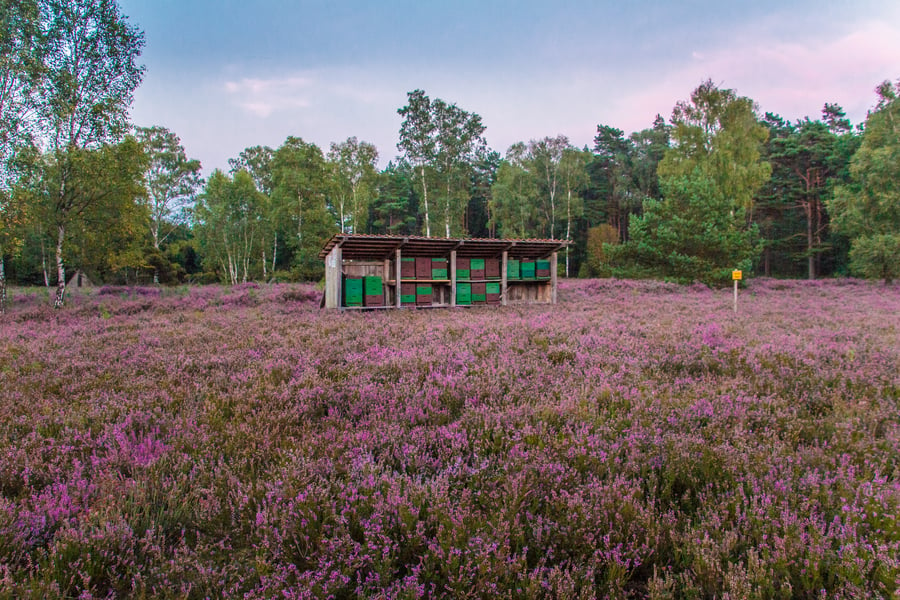
Hives in an open bee shelter on flowering ling at the Wacholderpark, Soltau, on the Lüneburg Heath, in August.
Heather honey is the honey of ling, Calluna vulgaris, and of ground that
people made. Across northern and western Europe they cleared the wood for
grazing and for fuel – in Lower Saxony to fire the Lüneburg salt works –
and on the leached, acid soil that followed, heath spread. Grazing, turf
cutting and burning have kept it open for four thousand years, and where
that work stops the ground goes back to trees.
Ling flowers from July into September, at the end of the European season,
and its nectar carries protein as well as sugar. That is why the honey is a
gel: it holds its shape in the jar, and it will not leave a comb by itself.
So the bees are carried onto the heath for a few weeks in late summer and
carried away again, the honey is pricked or pressed out of the comb rather
than spun from it, and it has carried a premium over the honey beside it on
the shelf since at least the eighteenth century.
Characteristics
Photo: HoneyTraveler | CC BY-SA 4.0
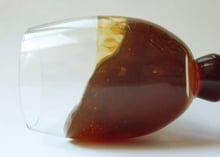
Heather honey in a glass laid on its side
Ling heather honey holding its shape in a glass laid on its side, photographed for HoneyTraveler in 2011.
Dark red-amber and only part transparent, strongly aromatic, weak in
sweetness and tart, with a bitter edge that stays. Colloidal proteins
carried over from the nectar make it
thixotropic: a firm gel until it is worked, and a firm gel again afterwards.
Crystallisation is slow to moderate, and left alone it throws big hailstone
crystals inside the gel; stirred through crystallisation it gives crystals
too small to feel on the tongue. It is also the one honey the world
standard lets carry more water, 23 grams in a hundred against 20 for
everything else, and that water with the honey’s acidity gives it a shorter
life on the shelf.
Click to Display — The Details: botanical origin, sensory profile, pairings, health and what gives it its character
Botanical Name: Ling heather (Calluna vulgaris)
Botanical Family: Ericaceae
Bee Species:
Western honey bee (Apis mellifera). The European honey directive and the
United Kingdom regulations both define honey itself as the product of Apis
mellifera bees, and no producing country inside ling’s range keeps another
managed species.
Ryan Hodnett, via Wikimedia Commons | CC BY-SA 4.0
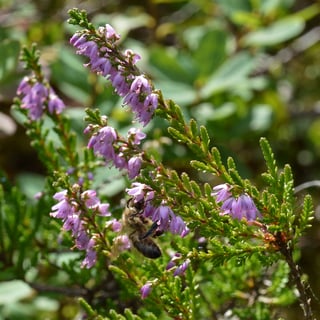
Honey bee on ling
A western honey bee working ling, Calluna vulgaris, at Sandnes, Norway.
Which of the two heathers the bees work has been measured: DNA markers put
on UK heather honeys in 2025 found far more ling in them than Erica.
On the Lüneburg Heath, centuries of multiplying colonies by taking swarms
selected a local dark-bee stock that swarms early and often. German
beekeeping calls it the Heidebiene, the heath bee, and no bee institute,
state body or peer-reviewed paper gives it a Latin subspecies name.
Color:
Dark amber to very dark, with a reddish or orange tone; part transparent rather than clear
Flavor Profile:
Strongly aromatic, tart and medium-bitter, weak in sweetness, with a long finish
Tasting Notes:
A buyer or a judge identifies this honey by texture, and the test takes no
instrument. Lay an open jar on its side and the honey should stay where it
is; draw a spoon across the surface and the groove should stand, because a
groove that floods back means other honey in the jar. Dutch judges run two
heather classes and move an entry between them on that one question,
demoting a heather honey that runs and promoting a blend that holds.
Bubbles are the same sign read another way. A gel holds air in suspension,
so bubbles that sit still are evidence of it and bubbles that rise are
evidence of a honey that is weak or diluted.
In the mouth the sweetness is weak, the bitterness sits in the finish, and
the finish is long, and one European register writes the mouthfeel itself
into law: a gelatinous sensation in the mouth.
Aroma:
Strong, woody and warm, floral with a fresh-fruit note, and recognisably the scent of the heather flower itself
Defining Compounds:
The gel is protein. There is enough of it for a national food code to test
for, at least 1.15 grams in a hundred, and enough to change what happens in
a pan:
heat the honey to 65 degrees and the proteins set into a gelatinous foam
full of air bubbles that will hardly crystallise at all. Two acids carry
the smell, and a German state laboratory names them, phenyllactic and
phenylacetic acid.
The compound named after the plant is
callunene, and it is specific to that nectar: the team that found it in 2019
detected none in the leaves or the flowers. Of 17 monofloral honeys
screened against a gut parasite of bumblebees, only ling heather and
viper’s bugloss stopped it completely, at about half the concentration the
honey carries. The work is about bumblebees, and it makes no claim about
people.
Nobody has found a molecule that proves the flower. Three chemists at
Louvain went looking for volatile markers of Calluna and Erica arborea
honeys in 1999, opening by stating why: pollen analysis and sensory
assessment alone were not enough to authenticate the origin. That is still
the problem, and it is why authentication went to DNA in 2025.
Forage Origin:
The substance is nectar, from the flowers of ling heather, Calluna
vulgaris, of the heath family Ericaceae. The plant is a low evergreen
subshrub, usually under 60 centimetres, that takes nutrient-poor acid
ground and holds almost any moor up to the point where it waterlogs, and
cross-leaved heath grows there instead. Kew gives its native range as
Macaronesia and Europe to central Siberia and northern Morocco, and
wherever heather honey is made outside that range, somebody planted the
heather first.
The nectar is thick before the bees touch it. Alongside the sugars it
carries glycoproteins, proteins with sugar chains attached, and a German
state bee institute describes the test: draw the nectar out of a flower
with a capillary and the drop strings.
janetgraham84new, via Wikimedia Commons | CC BY 2.0
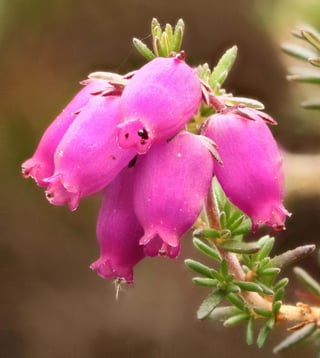
Bell heather, Erica cinerea
Bell heather, Erica cinerea, sold under the same English word as ling but a different plant. North Wales, August.
One English word, two genera. Calluna holds a single species and Erica
holds hundreds. Honey from the Erica side is sold as heather honey too,
and it has its own page here,
Erica heather honeys.
The test between them is the gel: ling honey is thixotropic and Erica honey
is not, and a German state laboratory names thixotropy as the criterion
that tells the two apart.
Which the word means depends on where it is printed. German law writes one
heading for both and two specifications underneath; the United Kingdom
regulations, the Codex standard and the Japanese and Turkish national codes
all name ling and bell heather as separate items. In the shops the word
runs the other way, and the Portuguese, Greek, Croatian and Turkish trade
words for heather honey all name an Erica; Spain’s protected heather honeys
are Erica honeys, except Asturias, which also registers a ling type.
Italian sellers use each word for the other plant: a Piedmontese house sells
its ling honey as miele di erica and a Ligurian one sells tree heath honey as
miele di brugo, so there the flowering month settles it, not the name.
Heather honey is often a blend, and the trade names the blends: the Dutch
judging class heidemelange, which takes in heather honey that does not gel;
the British heather blend, which is ling with oilseed rape rather than with
another heather; and Norway’s kystlynghonning, ling declared with bell and
purple heather.
A pollen count will not settle a ling jar either. Pricking and pressing put
pollen into the honey through the beekeeper’s own handling, so a count
measures the method as much as the flower: against a 45 per cent default
for calling a honey the product of one plant, the world method publishes a
measured Calluna range of 10 to 77. No international minimum exists at all,
the national bars that fill the gap run from 8 per cent to 50, and Latvia
and Asturias set heather below their own general bar because ling pollen is
under-represented in a count. What is left to go on is the gel, and the
water allowance the world standard writes for this honey alone.
The plant’s other use is in its names. Calluna is from the Greek for
sweeping, and the German Besenheide means broom heather: the cut stems were
bound into besoms.
Pairings:
The pairing that recurs across producing countries is strong cheese, and
the reason is the honey’s own weight rather than an affinity: it is strong
enough not to be flattened by a mature or blue cheese, and it will flatten
a mild one. German sellers send it to Roquefort and old Gouda, Dutch
sellers to aged and blue-veined cheese, and Scottish producers to a soft
crowdie rolled in pinhead oatmeal and black pepper.
The second use is baking and dark bread, and a national beekeepers'
association speaks for it: Sweden’s says ljunghonung (heather honey) works
excellently in tea and in baking. German sellers put it on dark rye.
The third is meat, where the bitterness survives heat and fat: game in both
Germany and Sweden, and caramelised roast vegetables in Germany.
It goes into hot drinks in both Germany and Sweden, and the earliest
British notice of Highland honey arrives inside one. Writing in the 1720s,
Edward Burt records that when Highlanders chose to qualify their spirit for
punch they sometimes mixed it with water and honey, or with milk and honey.
Health Uses:
Where heather honey carries a traditional use, it inherits the plant’s own
reputation. Calluna is a urinary-tract herb in central and eastern European
herbal practice, and the honey is recommended for the same complaints: a
Polish pharmacy encyclopaedia describes it as long used in natural
medicine, diuretic, antibacterial and anti-inflammatory like the dried
flowers, and names the bladder and the prostate, digestive complaints,
colds and sore throats. Russian consumer and encyclopaedic sources add
rheumatism and bronchitis, and return repeatedly to insomnia and nervous
complaints. None of it comes from a registered body: the writing is
consumer, pharmacy and producer, and it is reported here as tradition and
as nothing else.
A 2014 veterinary study of eleven honeys against ten equine wound isolates
found a Scottish heather honey the best performing product of that set, and
a German state bee institute has replied in print that the study tested
only the effect on bacteria, verified neither the constituents nor the
botanical origin of the jars, and reached results that contradict many
other investigations.
Origin Story
Heathland is a made landscape, and the making is dated. Calluna is in
European pollen records through the Holocene, but from about 5,000 years
ago its pollen rises alongside human settlement and a general clearance of
woodland, and the extent peaked in the Bronze Age and the early Iron Age.
Then the work changed and the heath went. The decline begins about four
centuries ago and runs hardest from the eighteenth century, driven by
afforestation, reclamation, urban growth and agricultural intensification.
Belgium holds one per cent of the heath it had in 1775, and the Netherlands
lost 95 per cent of its own between 1900 and 1960. Only in the abandoned
uplands of the Mediterranean is heath gaining ground.
Denmark converted its heath on purpose. Jutland held some 8,000 square
kilometres of heath in 1848; a national survey in 2016 found 84,789
hectares, a little over a tenth of it. The instrument was Det danske
Hedeselskab, the Danish Heath Society, founded in 1866 to bring the heath
under plough and plantation, under the phrase of the years after the loss
of the duchies: what was lost without shall be won within.
A 2025 review of the British evidence finds heather dominance and moorland
fire running through the Holocene, so what is recent is the intensity of
the burning, not the fire.
Where heath survives in quantity, something other than farming usually kept
it. The German state bee institute lists its country’s heaths and closes
the list with one sentence: all of them are or were military training
areas. Both Polish protected heather honeys say the same of their own
heaths. On the Lüneburg Heath the rescue was
cultural: writers and painters made the heath a subject in the decades it
was disappearing, and the Prussian government declared the ground around
the Wilseder Berg a reserve in 1921.
Axel Hindemith, via Wikimedia Commons | Public domain
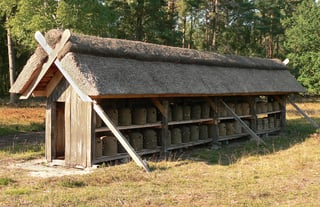
A Bienenzaun on the Wilseder Berg
A Bienenzaun, a thatched bee fence holding straw skeps, on the Wilseder Berg, Lüneburg Heath.
Two beekeeping systems grew on that ground, and they differ in what
happened to the bees afterwards. In Britain and Ireland the colonies were
carried up to the hills about the middle of August and brought home again,
a custom Alexander Wallace already called old in 1903. In Germany and the
Low Countries the economy was inverted: Heideimkerei, heath beekeeping,
gave up the earlier crops and bred for swarming instead, so that one colony
became three or four by August, and the honey was pressed from natural comb
in bottomless straw
skeps standing in a Bienenzaun, a bee fence. The surplus
colonies were killed or sold after the crop.
In the Landes of south-west France the record is older and the trade is
younger. The specification for the Landes designation cites twelfth-century
writings attesting the beekeeping, and callune wax prized for its whiteness
that made the Landais suppliers of candles to French châteaux; and it dates
the modern market to 1947 and the picoteuse, the machine that pricks the
gel so the honey will spin, bought because German buyers were paying enough
to make hauling hives into the Landes worth it. The designation is still
not registered, and the department’s beekeepers’ syndicate called the
scheme a purely commercial project in August 2023.
British Bee Journal (1912), via the Internet Archive | Public domain
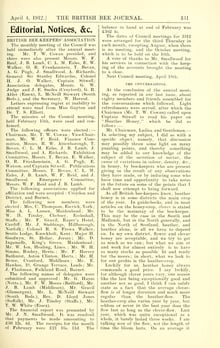
Sitwell, 'Heather Honey', 1912
The opening of Captain F. Sitwell's paper 'Heather Honey', British Bee Journal, 4 April 1912.
What the trade thought it was buying was settled early. Captain F. Sitwell,
reading a paper to the British Beekeepers’ Association in March 1912, gave
the definition this page still uses: by heather honey, in the north
certainly, is understood the honey the bees make from the nectar of common
ling. From six years of his own records at the foot of Cheviot he gave the
flow’s character too: on average, he wrote, it seldom lasts ten days.
The premium and the fraud are the same age. In the same volume a Banffshire
beekeeper recalled an advertisement offering heather honey by the ton at
three and a half pence a pound, on a British market where the genuine
article sold at about eighteen pence. Poland measured the quieter version
in 1958: of 24 samples sent in by beekeepers as heather honey, eight were
heather honey and the rest were mixtures.
Neither the method nor the landscape has been continuous. The German swarm
economy is gone, the British skeps went with it, and most of the ground is
gone too.
Cultural Context
R. L. Stevenson, Ballads (1890), via the Internet Archive and Wikimedia Commons | Public domain
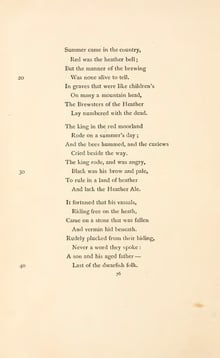
Stevenson, 'Heather Ale', 1890
The page of Stevenson's 'Heather Ale' with the bees in it, from Ballads (New York, 1890).
Robert Louis Stevenson published Heather Ale: A Galloway Legend in Ballads
in 1890, and the bees are in it: “The king in the red moorland / Rode on a
summer’s day; / And the bees hummed, and the curlews / Cried beside the
way.” The drink the poem turns on is a
gruit brewed from heather flowers, not from the honey, and Stevenson filed
the legend himself in his own note: the Picts, he reminds the reader, were
never exterminated. The honey connection is narrower: nineteenth-century
writers collected in 1903 report that the heather drinks then surviving in
the Highlands had honey or sugar added to make them ferment.
One Scottish liqueur does name this honey. Drambuie describes itself as a
blend of aged Scotch whisky, spices, herbs and heather honey. Mead is the
other drink, and a commercial niche rather than a household one: craft
guidance treats heather honey as the feedstock for a sweet, strong mead
matured for years, while a British beekeeping reference records that few
beekeepers in the heather districts make mead at all.
In the kitchen the honey is used where something else has to be stood up
to. Cranachan and Atholl brose, the Scottish oatmeal-and-whisky dishes,
both call for it by name, and the reason food writers give is that it
survives whisky where a mild blossom honey does not. It also reaches the
shop as comb more often than most honeys do, which is the one place the gel
is an advantage: cut a block of heather comb and the cut cells do not run.
Away from the jar, the plant carries a custom of its own. Queen Victoria
recorded it in her journal on 9 September 1872, when her servant John Brown
saw a piece of white heather from the carriage and jumped down to pick it:
“No Highlander would pass by it without picking it, for it is considered to
bring good luck.” White heather is a colour form of Calluna vulgaris.
Where heather honey is judged, it is judged as itself. The National Honey
Show at Sandown Park doubles its schedule into ling and free-from-ling
classes, and the same show prices the premium, its 2026 buy-back list
paying GBP 11 for a 454-gram jar of heather honey against 8 for other
honey. At the Scottish National Honey Show seven of the sixteen honey
classes are heather classes, and the blossom classes are written to exclude
heather. Outside the British Isles the French Concours Général Agricole
judges bruyère and callune as separate sections, and Norway’s national
championship runs stirred ling, liquid bell heather and the coastal blend
as three categories.
Harvest & Forage
The flow is the last big one of the European season and the shortest. Ling
flowers from July to September, with the peak in August, earlier and higher
in the mountains and later on the Atlantic and north German heaths. Inside
a four to six week bloom the nectar comes in bursts of days rather than
weeks.
How big the crop will be is settled before the plant flowers. Two Danish
seasons of measurement traced the number of flowers, and the rate at which
the nectar comes, to the warmth and rainfall of the preceding spring.
Pure
monofloral heather honey is rare, and a registered specification says
so outright: heather nectar comes mixed with the other moorland flowers,
rosebay willowherb, blackberry and gorse. The 2025 DNA survey found 68 per
cent of the jars it tested ling-dominant. A second dilution arrives as
honeydew: aphids on pine and larch are running at heather time, and German
heather honeys carry up to 9 grams of the aphid sugar melezitose in a
hundred.
Two things keep a crop clean. Erica flowers before Calluna, so by the time
the hives arrive the bell heather is spent or worked out. And the combs can
be emptied twice: spin them unpricked and the ordinary honey flies out
while the heather stays in the cells, then prick and spin again for the
heather alone.
British Bee Journal (1912), via the Internet Archive, cropped | Public domain
A heather-honey loosener, 1912
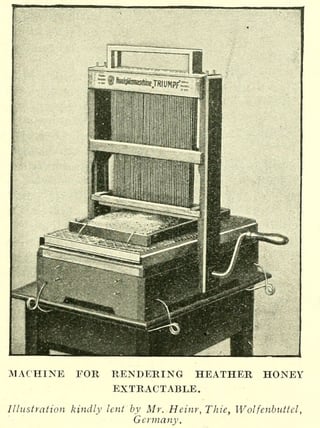
'Machine for rendering heather honey extractable': a German needle loosener, British Bee Journal, 5 September 1912.
Getting it out is the rest of the work. A heather comb put straight in a
centrifuge will break before it empties, so the gel is broken first with a
loosener – a brush, a roller, or a plate of needles pressed briefly into
each cell and drawn out again – and the honey then spins, inside a working
window of minutes. One Polish specification writes the dose down, 400
sticks to the square decimetre in a water bath at 40 to 50 degrees; another
caps the honey at 42 degrees throughout and concedes in the same clause
that this makes it harder to dry. The older method is to press the comb,
which destroys it, and food law lets a pressed jar carry five times the wax
and comb fragments another honey may. Sud Ouest gave the plain cost from
the Landes in 2011: callune honey takes twice as long to extract as any
other.
The flow also falls in weeks the beekeeper needs for other work.
Summer treatment against varroa would leave residues in the honey, so a
colony with too many mites stays at home; feeding is barred before and
during the flow; and the crop is taken off rather than left on, because
heather honey is poor winter food and can make bees void inside the hive
instead of flying.
Recent seasons have been short in England. A Northumberland bee farm told
the BBC in August 2025 that heather beetle had taken the five to ten tonnes
it usually makes at that time of year down to nothing, and a year later its
own stock notice gave the 2026 harvest as limited by dry moors and further
beetle loss.
Beekeeping Context
This is a honey the bees are brought to. Commercial beekeepers across
Europe move hives onto heather moorland for the late-summer flowering: the
Dutch and Belgian onto the Veluwe, the Drenthe and the Limburg heaths, the
German
transhumance to the Lüneburg and Süd heaths, the Scots and northern English to
the moors in the first week of August, and a French circuit that ends on
the heathers. Poland writes the move into law, down to the veterinary
certificate before departure and the night transport.
The apiaries are small. Ten Scottish moorland sites carrying seasonal
commercial apiaries averaged 34 hives each through the 2022 bloom, and
across twenty sites ling supplied 91 per cent of the landscape’s nectar in
the weeks the hives were there, which is why a moor crop comes in as clean
as it does. The same study measured what those hives do to the heath and
found the effect on its plant-pollinator networks modest beside the effect
of how the habitat is managed; its advice, to bring hives in only during
peak flowering, is what the trade already does for its own reasons.
Ian Alexander, via Wikimedia Commons | CC BY-SA 4.0
Muirburn in the Yorkshire Dales
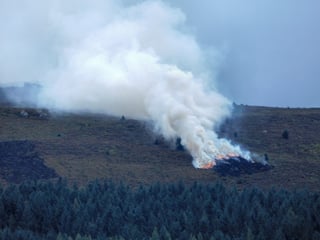
Controlled burning of heather moor at Appletreewick, in the Yorkshire Dales.
Whose ground it is matters. In Britain the heather the bees work grows very
largely on moor burnt on a rotation kept for red grouse, and hives go on by
prior arrangement over permission, rent and siting, so the beekeeper is a
guest on a sporting estate. That rotation matters to the honey as well as
to the birds: a state bee institute states the plant fact plainly, that
young heather plants yield more nectar than the woody old ones, and the
Welsh protected specification carries the causal version, that grazing and
controlled burning encourage young heather and so a greater yield. Nobody
has measured it. The law around it moved this month in Scotland:
muirburn has required a licence since
15 September 2026, and the season now runs from 15 September to 31 March.
Source Regions
See all 21 countries
United Kingdom, Scottish and northern English moors and Welsh uplands – Calluna vulgaris: ling heather honey (Mêl Grug), sold pressed, spun or as cut comb.
Ireland, Comeraghs, Wicklow, Sliabh Aughty, Wexford and Donegal – Calluna vulgaris: heather honey (mil fraoch), named by the national federation among Ireland’s few surplus crops.
France, Landes, Pyrenees, Millevaches, Cévennes and Auvergne – Calluna vulgaris: callune heather honey (miel de bruyère callune), judged as its own competition class.
Netherlands, Veluwe and Drenthe – Calluna vulgaris: heather honey (heidehoning), an August transhumance onto Natura 2000 heaths; the judging rule bands it by the gel.
Belgium, Limburg Kempen – Calluna vulgaris: heather honey (heidehoning, miel de bruyère callune), one current chain: hives to the Houthalen heath each August.
Germany, Lüneburger Heide and Südheide – Calluna vulgaris: heather honey (Heidehonig), the food code’s own type, pricked or pressed from the comb.
Denmark, Jutland heaths – Calluna vulgaris: heather honey (lynghonning), harvested in September and sold from beekeeper’s gate to national brand.
Norway, southern and coastal heaths – Calluna vulgaris: ling heather honey (røsslynghonning), the association’s only traditionally stable varietal on Norwegian shelves.
Sweden, Västsverige, and from Österlen to Lule lappmark – Calluna vulgaris: heather honey (ljunghonung), an August flow under a 50 per cent pollen rule.
Finland, Satakunta heather heaths – Calluna vulgaris: heather honey (kanervahunaja), a September forest crop; the association’s own varietal sheet and price series.
Estonia, fens, raised bogs and forest – Calluna vulgaris: heather honey (kanarbikumesi), first of the six honeys the national union names, pressed rather than spun.
Switzerland, Graubünden (Vals, Splügen) – Calluna vulgaris inferred: heather honey (Heidehonig), an alpine crop at 1,600-2,200 m; no seller prints the plant.
Italy, Val Sangone and the Piedmontese Alps – Calluna vulgaris: heather honey (miele di brughiera, miele di brugo), a rarity the national sensory register gives its own sheet; one Piedmontese house sells it as miele di erica.
Spain, south-west Asturias – Calluna vulgaris: Calluna honey (miel de calluna), sold under the genus name and kept apart from Erica brezo.
Russia, Pskov oblast – Calluna vulgaris: heather honey (Вересковый мёд, vereskovyi myod), pressed in early September and sold from the apiary.
Belarus, Vitebsk, Grodno and Brest – Calluna vulgaris: heather honey (Верасовы мёд, verasovy myod), a scarce monofloral sold on farmer marketplaces.
Poland, Bory Dolnośląskie, Drawsko, Roztocze and Masuria – Calluna vulgaris: heather honey (miód wrzosowy), two protected names and a premium price on every specialty shelf.
Czechia, Brdy heaths – Calluna vulgaris: heather honey (vřesový med), a limited edition from two named apiaries since the military district opened in 2016.
Romania, Apuseni Mountains above 1,200 m – Calluna vulgaris: heather honey (miere de iarbă neagră, negruș), certified as an EU mountain product.
Lithuania, Dzūkija and Zarasai raised bogs and heaths – Calluna vulgaris: heather honey (viržių medus), the season’s closing crop, taken mid-September.
Latvia, Kurzeme – Calluna vulgaris: heather honey (viršu medus), pressed and unfiltered from pine heaths and bogs; priced above honeydew.
Regional Variants
Hector Montero, via Wikimedia Commons | CC BY-SA 2.0
Ling in Snowdonia
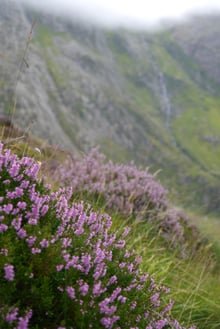
Ling in flower in Snowdonia, Wales.
Welsh heather honey (Mêl Grug Cymru) – Calluna vulgaris – United Kingdom, Wales: Great Taste judges found butter filled toffee and sweet burnt caramel under the bitterness, in words the registered text quotes. The name tells a buyer that every hive is in Wales, that ling pollen predominates – judged by an inspector’s eye and palate rather than by a count – and that the honey is not pasteurised. It does not promise ling alone, because bell heather is named in the same text. Altitude is what sets the Welsh crop apart: ling grows higher here than in Scotland, and colonies do not survive above about 250 metres, so the specification puts the hives below the heather, the bees flying uphill empty and back down loaded. It is sold by Welsh producers, independent stockists and Fortnum & Mason, where a 275-gram jar was GBP 8.95 in January 2026. The 2025 crop was thin: one Denbighshire beekeeper took three kilograms a hive, against thirty in a good year.
Stefan Wolmarans, via iNaturalist | CC BY
Ling at Cangas del Narcea
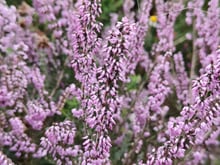
Ling in full flower at Cangas del Narcea, Asturias, September 2025.
Asturian Calluna honey (Miel de Calluna) – Calluna vulgaris – Spain, Asturias: amber with reddish-brown tones and a rippled surface, smelling floral and persistent with earth under it, sweet with clear bitter and salty notes, and gelatinous in the mouth – all of it written into the type’s legal description. Beside it on the same shelf sits miel de brezo, the Erica honey, much darker, running to caramel rather than to salt and bitterness, and not a gel. What the name assures is the plant: Miel de Asturias is the only protected name found that gives ling a type of its own and keeps it apart from its Erica honey by name, and the jars print the Latin genus rather than brezo or heather. The apiaries stay put, the specification arguing that Asturian terrain and the brown bear make hives hard to move, so this is the one ling honey here the bees are not carried to. Locally the plant is brecina, biercol or setembrina.
rem49, via Wikimedia Commons | CC BY 3.0
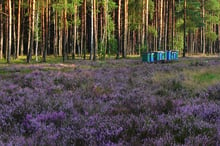
Hives on the Lower Silesian heath
Hives on a flowering heath in the Bory Dolnośląskie, the Lower Silesian forest.
Lower Silesian heather honey (Miód wrzosowy z Borów Dolnośląskich) – Calluna vulgaris – Poland, Bory Dolnośląskie: amber to orange-brown, reddish before it granulates and yellowy-orange to brown after, thick and gelatinous, strongly scented of heather flowers, faintly sweet and then sharp and bitter. That description is the specification’s own, and its Drahim sibling uses the same words. What is particular here is the ground: heather grows almost everywhere in Poland, mostly as shaded forest understorey that yields little, while the dense open heath sits on old military ranges, and the specification’s case is that an open sunlit heath gives a cleaner honey. The name guarantees the foraging ground rather than the packing house – no apiary stands there, and the bees are trucked in for August and September. It travels further than the certificate does: jars carrying the name were on Polish shelves at around 80 zloty a kilogram in September 2026, while the state register of 25 August 2026 showed a single valid certificate holder.
paciana, via Wikimedia Commons | CC BY 3.0
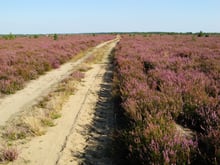
Heath in the Drawsko Lakeland
Open heath in flower in the Drawsko Lakeland, Poland.
Drahim heather honey (Miód drahimski wrzosowy) – Calluna vulgaris – Poland, Drawsko Lakeland: ruby-brown, with an intense scent of heather flowers and a taste the producing family calls bitterish and sharp, which they note is uncommon among honeys; its registered sensory text is the one it shares with its Lower Silesian sibling. The gel is not a constant, and the same family says so on its own shop page: the 2025 crop set less than usual. Of the five European heather designations this is the one that writes Calluna vulgaris into its definition of the honey, so the label means ling rather than heather in general, and it forbids pasteurisation and pollen filtering. It is sold as the honey of the Klomino heaths, about 6,000 hectares of open heath on acid sand that was a Soviet garrison range until 1992, through the family’s own shops and Polish specialty retailers – 105 zloty for 900 grams of the 2025 crop.
Translations
See all 19 Translations
Mêl grug – Welsh; the registered name is Mêl Grug Cymru
Mil fraoch – Irish, as the jar prints it
Mil an fhraoich – Scottish Gaelic
Miel de bruyère callune – French; miel de callune is the producers’ short form, and bruyère alone names either genus
Heidehoning – Dutch
Heidehonig – German; the food code names Heideblütenhonig and Heidehonig together, and no German jar read in 2026 used the longer form
Lynghonning – Danish; hedelynghonning where the seller names the plant
Lynghonning – Norwegian; røsslynghonning where the seller names the plant
Ljunghonung – Swedish
Kanervahunaja – Finnish; the jar itself often reads kanerva
Kanarbikumesi – Estonian; kanarbiku mesi in the open form
Miel de calluna – Spanish; miel de brecina and miel de biercol are the older Cantabrian forms
Miód wrzosowy – Polish
Vřesový med – Czech
Miere de iarbă neagră – Romanian; miere de negruș is the name the producers use
Viržių medus – Lithuanian
Viršu medus – Latvian
Вересковый мёд (vereskovyi myod) – Russian
Верасовы мёд (verasovy myod) – Belarusian
Festivals and Fairs
Conwy Honey Fair – Conwy, north Wales (Saturday 12 September 2026, 09.00 to 16.00, High Street and Lancaster Square): the right to hold it is set out in the town’s Royal Charter and goes back to Edward I, when local beekeepers were first allowed to sell honey inside the walls every 13 September, midnight to midnight, free of charge. The heather link is dated: by 1835 large quantities of very excellent honey were sold annually in Conwy, attributed to heather and wildflowers from the surrounding hills, at about two shillings a quart. Prize competitions were added in 1904, and the organisers’ own stallholder advice says customers ask for heather honey by name.
Honing- en Bijenmarkt Eerbeek – Eerbeek, Gelderland, Netherlands (Saturday 26 September 2026, 10.00 to 16.00, at the Korenmolen): a market held every fourth Saturday in September since 1902, which the provincial heritage platform describes as known for its heather honey. The honey brought in is still judged before it is sold, with the judging open to the public since 2016. The 2026 edition falls in the organising association’s 125th year. (Dutch translated to English )
Dolnośląskie Święto Miodu i Wina – Przemków, Lower Silesia, Poland (26 to 27 September 2026, Park Miejski): the 26th edition of the honey and wine festival, held inside the Lower Silesian heath district that the Miód wrzosowy z Borów Dolnośląskich specification draws its honey from, and the public face of the Wrzosowa Kraina, the Heather Land local action group. A heather-land cycle ride runs inside it on the Saturday. (Polish translated to English )
Certifications
Welsh Heather Honey / Mêl Grug Cymru, United Kingdom – The first honey of any kind on the GB protected food name register. It ties the name to Welsh hives and to heather worked the Welsh way. It protects the place and the plant, but not ling alone: the specification names bell heather too.
Miód wrzosowy z Borów Dolnośląskich, Poland – A European protected geographical indication held by a federation of five beekeepers’ associations over heather honey from the open heaths of the Lower Silesian Forest. It guarantees where the bees foraged rather than where the honey was jarred, and it is claimed on more Polish shelves than it is certified.
Miód drahimski, Poland – A European protected geographical indication covering five honeys of the Drawsko Lakeland, of which heather is one and the only one the scheme defines by species, so the label means ling and not heather in general. It also bars pasteurisation and pollen filtering.
Miel de Asturias, Spain – A European protected geographical indication over Asturian honey, and the only protected name found that gives ling a type of its own, miel de calluna, kept apart by name from the Erica honey miel de brezo. It guarantees the plant, the region and packing inside it.
Veluwse heidehoning, Netherlands – An entry on the Slow Food Ark of Taste, which catalogues foods at risk rather than certifying quality. It records a honey made under permit on the Veluwe heather fields, checked at the yearly autumn inspections, and falling in quantity. It counts both ling and cross-leaved heath as heather.
Produs montan, Romania – The European Union’s optional quality term for mountain products, administered in Romania by the national mountain agency and carried by a Cluj producer’s Miere de iarbă neagră. It tells a buyer the honey came from a mountain zone, and nothing about which heather. (Romanian translated to English )
 Hector Montero, via Wikimedia Commons | CC BY-SA 2.0Ling in SnowdoniaLing in flower in Snowdonia, Wales.
 Stefan Wolmarans, via iNaturalist | CC BYLing at Cangas del NarceaLing in full flower at Cangas del Narcea, Asturias, September 2025.
 rem49, via Wikimedia Commons | CC BY 3.0Hives on the Lower Silesian heathHives on a flowering heath in the Bory Dolnośląskie, the Lower Silesian forest.
 paciana, via Wikimedia Commons | CC BY 3.0Heath in the Drawsko LakelandOpen heath in flower in the Drawsko Lakeland, Poland.
)
 Welsh Heather Honey / Mêl Grug Cymru, United Kingdom – The first honey of any kind on the GB protected food name register. It ties the name to Welsh hives and to heather worked the Welsh way. It protects the place and the plant, but not ling alone: the specification names bell heather too.
 Veluwse heidehoning, Netherlands – An entry on the Slow Food Ark of Taste, which catalogues foods at risk rather than certifying quality. It records a honey made under permit on the Veluwe heather fields, checked at the yearly autumn inspections, and falling in quantity. It counts both ling and cross-leaved heath as heather.