Strawberry Tree Honey
The Story
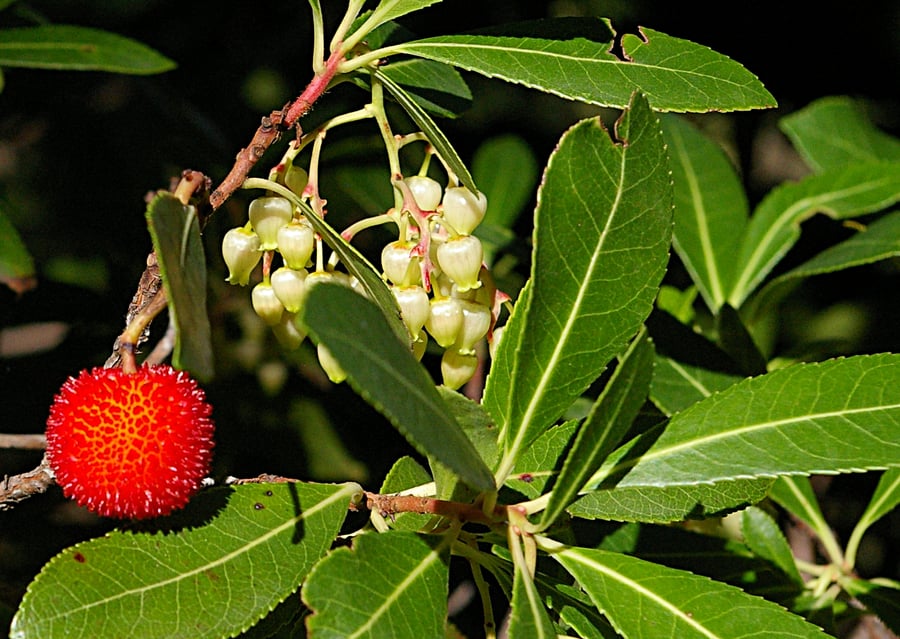
Strawberry tree honey is made from a winter flower. The strawberry tree (Arbutus unedo), an evergreen of the Mediterranean maquis, flowers from October into January beside the red fruit of the year before, and in several places the honey goes by names that call it bitter: Sardinia’s register of traditional products calls it miele amaro, a Portuguese study says it is known as mel amargo, and in north-east Algeria beekeepers know it as lenj, or bitter honey.
It is a small and uncertain crop, made only where bees can still fly in autumn and winter, which in Italy means almost only Sardinia.
Its bitterness divides buyers. Italy’s beekeepers’ union calls it “un miele per amatori”, a honey for enthusiasts.
Characteristics
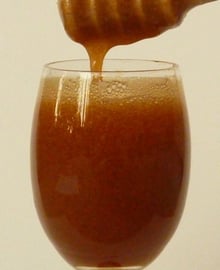
An amber honey when liquid that crystallises quickly and often unevenly, setting hazel to brown with grey-green tones. It smells pungent, of ivy leaves, coffee grounds and burnt leather, and tastes little sweet, acidic, astringent and above all bitter.
Because it is gathered in autumn and winter, its water runs high, above 20 percent in more than a third of Greek samples, and it can ferment. Sardinian beekeepers dry it with dehumidifiers, and Italy’s honey observatory advises drying it or keeping it chilled. It is also naturally low in enzymes: Italy’s sheet records diastase that can fall below 3, and by that reading a genuine jar can fall under even the lower floor EU honey law sets for honeys naturally poor in enzymes.
Click to Display — The Details: botanical origin, sensory profile, pairings, health and what gives it its character
Nectar Contributors:
- Primary: Strawberry tree (Arbutus unedo)
- Secondary: Ivy (Hedera helix)
- Background: Rough bindweed (Smilax aspera)
Bee Species: 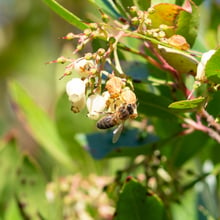
Apis mellifera, the western honey bee, makes the honey everywhere it is produced. Two of its protected designations name the bee: Corsica’s requires the island’s own ecotype, a locally adapted strain, of Apis mellifera mellifera and forbids bringing in other stock, and Morocco’s names two races, Apis mellifera intermissa and one the order calls Apis Mellifera Major.
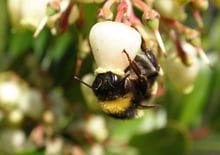
A 2005 study of the tree in the Massif des Maures, citing earlier fieldwork there, reports honey bees collecting the strawberry tree’s nectar and not its pollen, and its flowers as the only source of pollen and nectar for buff-tailed bumblebees in those hills in winter.
Color:
Amber when liquid; hazel to brown with grey-green tones when crystallised
Flavor Profile:
Bitter and little sweet, acidic and astringent
Tasting Notes:
Italy’s descriptive sheet gives the taste as poco dolce (not very sweet), at least decidedly bitter, acidic and astringent, the aroma as recalling gentian liqueur and rhubarb, and the finish as very persistent, above all in its bitterness. Spain’s reference guide describes a dominant bitterness with salty notes and the sweetness secondary, and Morocco’s protected honey is defined as very bitter and piquant, moderately sweet.
The bitterness changes with age. Antonio Gómez Pajuelo’s 2004 book on Spanish and Portuguese honeys found it dominant in a fresh honey, possibly still dominant after a year and no longer so after two, and the honey sensory analyst Lucia Piana describes new honeys as green and vegetal – ivy leaves, bark, sap, bitter herbs – and older ones as toasted, of coffee, burnt leather, tobacco and cocoa bean.
HoneyTraveler’s editor tasted a strawberry tree honey from the Hérault at a Paris honey shop in September 2026 and found the bitterness very light, coming after the sweetness: “that one just excites the taste buds a little and then you really taste the honey.”
Aroma:
Pungent: ivy leaves, coffee grounds, burnt leather and bitter herbs; gentian liqueur and rhubarb in the mouth
Defining Compounds:
Its chemistry marks it out. Homogentisic acid, a compound carried from the nectar, averaged 378 mg/kg in the honey and was proposed in 1999 as its marker because no other monofloral honey then tested contained it; a 2021 review notes that a Turkish thyme honey has since shown similar levels.
The bitterness comes from another compound. Unedone, first described in the honey in 2010, is present at 30 to 50 mg/kg, and a 2021 study found it responsible for the bitter taste: in its tests unedone at 300 mg/L tasted about as bitter as quinine at 10 mg/L. Homogentisic acid is not bitter, and arbutin, the leaf compound once blamed, is variable in the honey and sometimes absent.
Its electrical conductivity, a lab measure of the honey’s minerals, can pass the 0.8 mS/cm line that otherwise marks a honeydew honey, and French honey law names strawberry tree among the blossom honeys excepted from it.
Forage Origin: 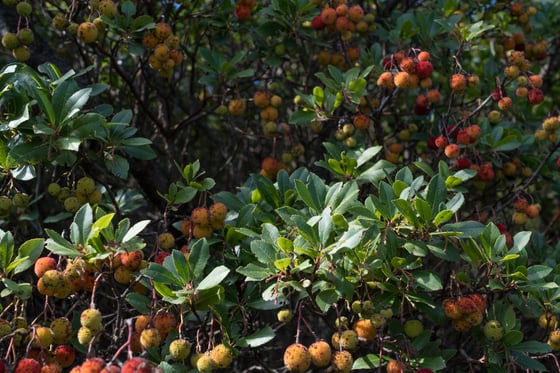
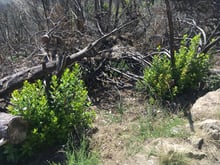
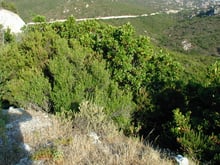
Primary: strawberry tree (corbezzolo, arbousier, madroño, medronheiro, Arbutus unedo, Ericaceae). An evergreen shrub or small tree up to 8 metres, native from Portugal and Morocco to Turkey and Lebanon, that can dominate the Mediterranean scrub and in Sardinia forms whole woods. It favours loose, slightly acid soils below about 500 metres and grows back from its base after fire. It flowers from October to January, at times that follow altitude, and carries its white flowers beside the red fruit of the previous year’s flowering, which takes a year to ripen; Pliny noted it in the first century. Its flowers hold a great deal of nectar, but the honey carries little of its pollen, because of the flower’s form and the grains’ large size: 0.7 to 40 percent in Corsican samples and 4 to 59 percent in Greek ones.
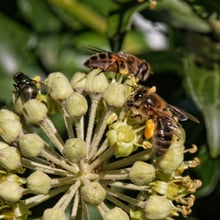
Secondary: ivy (Hedera helix, Araliaceae). Ivy flowers in the same season and its pollen is abundant in the honey: 31 to 84 percent in Greek samples, and the dominant pollen in some Corsican ones.
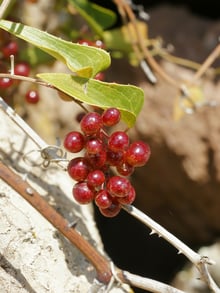
Background: rough bindweed (Smilax aspera, Smilacaceae). An autumn plant of the maquis, found with it in Corsican honeys, and the same genus in Sardinian ones.
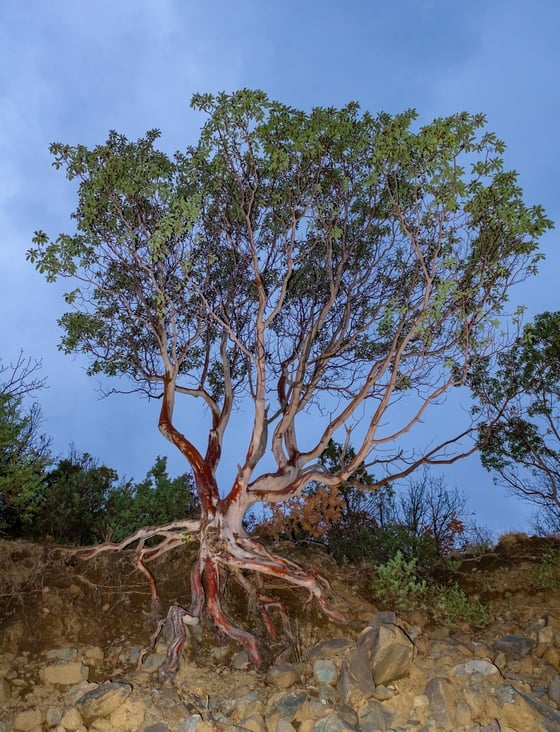
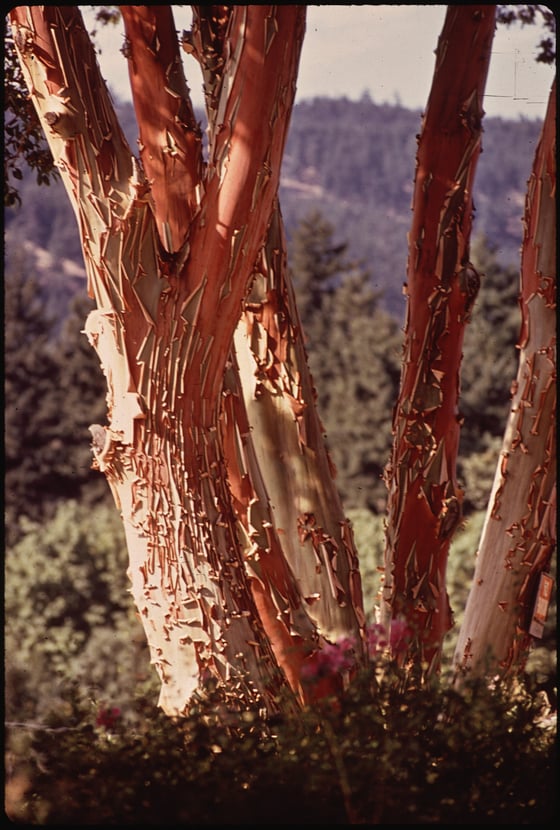
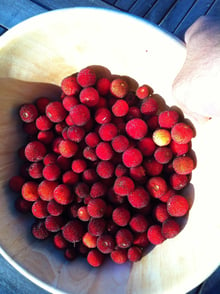
The name covers several trees. The eastern strawberry tree, Arbutus andrachne, native from Albania and Greece to northern Iraq, flowers in spring and has smaller fruit, and the two form a natural hybrid. In Libya’s Jebel Akhdar a separate species, Arbutus pavarii, gives a bitter honey called hanon. The Pacific madrone (Arbutus menziesii) of western North America belongs to the same genus, and no honey is sold from it as a varietal. The garden tree often called Arbutus marina is a hybrid, ‘Marina’, introduced in 1984 by the Saratoga Horticultural Research Foundation in California. The fruit, edible but, in the words of Italy’s honey sheet, not very tasty, goes into jams and liqueurs and, in Portugal, into aguardente de medronho, a fruit spirit.
Pairings: 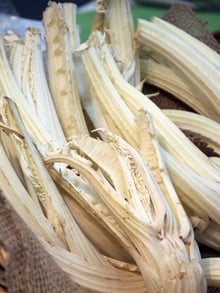
Coffee first. Italy’s beekeepers’ union calls it “il miele perfetto per il caffè”, the perfect honey for coffee, the two bitternesses going well together. The union pairs it with bitter vegetables such as cardoons and artichokes, by likeness, and with sweet, fatty cheeses, by contrast. A cheese specialist’s list gives ricotta, mascarpone, sweet robiola and fresh goat’s cheese, and a Sardinian shepherds' cooperative serves it with semi-aged pecorino and pane guttiau, the island’s crisp flatbread.
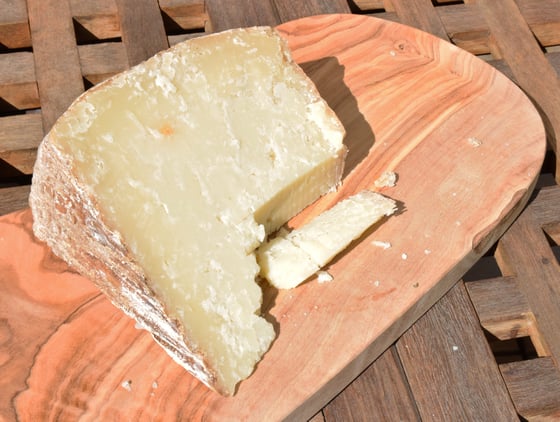
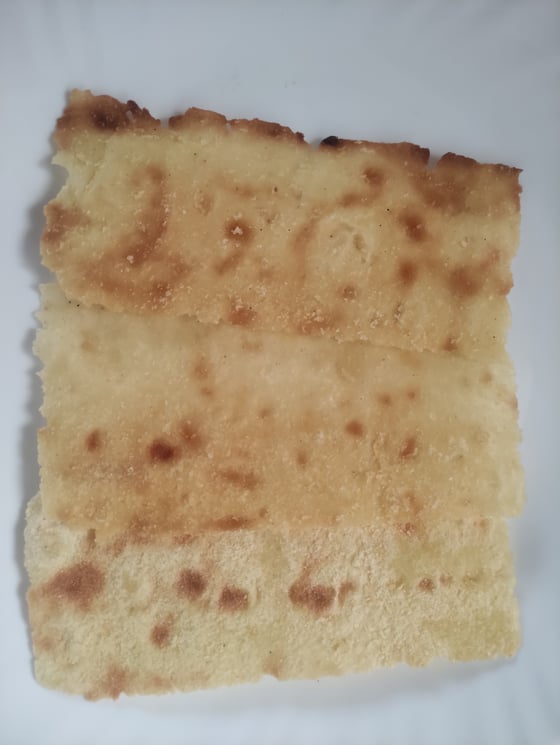
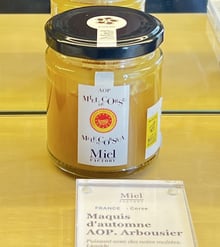
In the kitchen the Corsican autumn maquis honey, mostly strawberry tree, goes into dishes from goat’s-cheese salads and scallops to foie gras, roast kid and cochon nustrale, the island’s own breed of pig. A Paris honey shop suggests the Corsican strawberry tree honey in place of cocoa in a fondant or ganache, and an Italian food magazine suggests it as a glaze for lamb.
Health Uses:
The honey has a long reputation in folk medicine. Sardinia’s forest agency describes it as antiseptic and often used for bronchial ailments, and the island’s register of traditional products records its traditional use against coughs. Kew calls it a popular folk medicine in the Mediterranean.
Laboratory studies have measured a high antioxidant capacity and activity against bacteria in vitro; these are test-tube results, not trials in people.
Origin Story
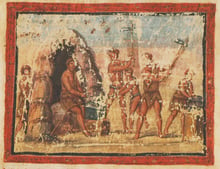
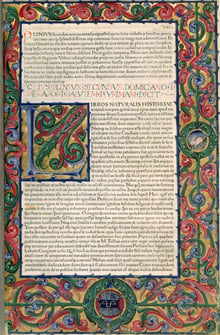
The ancient writers knew the tree and a bitter honey, but did not put the two together. Virgil has bees feeding on arbutus in the fourth Georgic, and Pliny explained the Latin name unedo as the fruit a person eats only one of. Horace put Sardinian honey among the things that spoil a good dinner without naming its plant, and Dioscorides, as a 2021 review quotes him, credited Sardinia’s bitter honey to wormwood.
The plant behind the bitterness was argued over into the twentieth century, as the same review traces it. An Italian scientist suspected tree wormwood in 1889; in 1931 a study in Gallura found arbutin in both the honey and the strawberry tree and, not without reservations, blamed it for the bitterness. Homogentisic acid was proposed as the honey’s marker in 1999. In 2021 a separate study named unedone, a compound first described in the honey in 2010, as the cause of its bitterness.
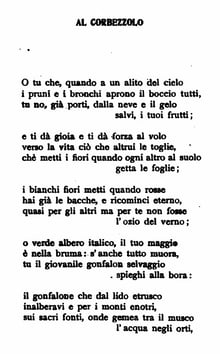
In 1906 Giovanni Pascoli’s ode Al corbezzolo called the tree “o verde albero italico”, green Italian tree, and saw the Italian flag in its green leaves, white flowers and red berries.
The honey’s standing has changed. In Greece it was once rarely harvested pure and usually went into heather honey; by 2015 a Greek beekeeping laboratory reported strong interest from some buyers, and a 2025 study found significant quantities still going unsold, with a project under Greece’s 2014-2022 rural development programme set up to create a value chain for it, from hive to buyer. In Portugal a 2017 study found it little valued at home because it is dark and bitter, which led many beekeepers to leave it in the hive or sell it locally. Morocco protected the strawberry tree honey of the western Rif as a geographical indication, a name reserved by law for honey of that area, in 2013 and widened the area in 2018, and in 2025 the European Union registered the Miel de Asturias with a strawberry tree type.
Cultural Context
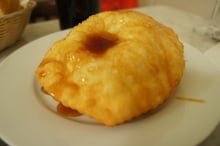
In Sardinia the honey is part of the island’s cooking. Seadas, the cheese pastries served under hot honey, are usually covered with bitter strawberry tree honey, according to the Region’s traditional product sheet, and it is one of the two bitter honeys, with eucalyptus, in traditional Sardinian torrone, a nougat. The Region’s forest agency keeps bees in its public forests and won prizes for two of its strawberry tree honeys in 2025.
In Corsica it is sold within an autumn range. The president of the Corsican honey designation told a trade magazine in 2022 that the island produces no monofloral honeys, and the syndicate’s recipes for Corsican chefs use the island’s protected autumn maquis honey, “miel de Maquis d’automne AOP” (AOP being France’s protected designation of origin).
In Morocco and Algeria it is valued as a remedy. A Chefchaouen beekeeper interviewed in 2026 classed it as a therapeutic honey rather than a table honey, and Algerian researchers report that local buyers seek it for its reputation as a remedy.
In the Algarve hills the same wild stands give fruit for the spirit and nectar for the honey, and studies there link bee pollination to a better fruit crop.
Harvest & Forage
The strawberry tree flowers from October to January, and in Sardinia its nectar flows most strongly from early November to mid-December. A crop depends on the weather at both ends of the year: Italy’s honey observatory ties it to a rainy summer, and Gómez Pajuelo to a mild autumn. Cold ends the flow two ways: honey bees seldom forage below about 16 C, and frost thins the nectar. In southern France in 2004 its sugar fell from 31 to 43 percent in October to 10 percent after the December frosts.
Harvest follows the flowering. In Corsica it runs from November; in Albania the Slow Food entry says it is generally produced from mid-October to late November; in Portugal it is taken in December and January; and in north-east Algeria in January.
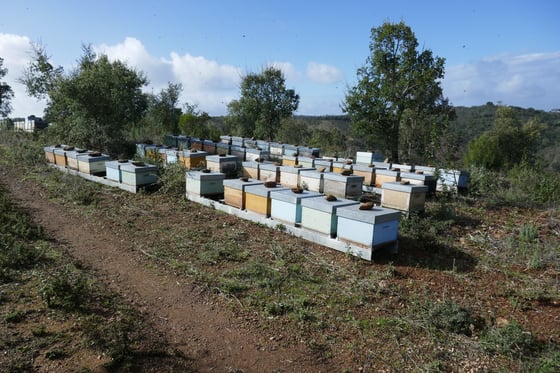
The yield is small, and often left to the bees. A Portuguese study of the 2015-16 winter recorded producers’ yields of under 10 kilograms a colony, against 20 to 30 for the spring and summer honeys, and what is taken there is mostly sold locally. Greek and Portuguese beekeepers often leave the strawberry tree honey in the hive as winter food, and Greek researchers advise removing unsealed strawberry tree combs at the end of autumn so that they do not ferment.
Keeping the crop pure is the other difficulty. Ivy flowers at the same time, and in the Algarve eucalyptus or rosemary can too. The Croatian beekeepers’ journal wrote in 2007 that a wholly pure strawberry tree honey is barely edible. Morocco’s designation, which requires more than 50 percent strawberry tree pollen, sets the hives inside the strawberry tree stands in autumn and takes the honey only from the supers, between late December and early January, extracted cold.
Beekeeping Context
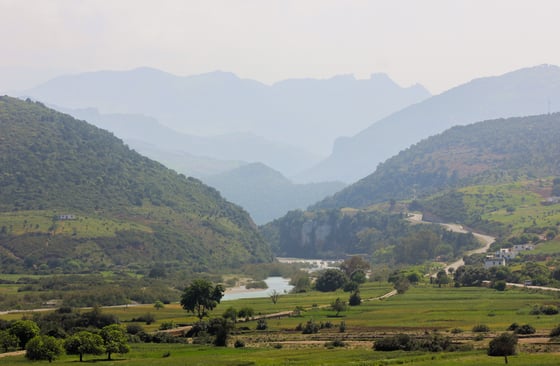
Where the honey is protected, the rules set how it is made. Morocco’s designation has the colonies built up from September on sticky fleabane (Dittrichia viscosa), a pollen plant that yields no honey, then set out in the strawberry tree stands, and lets them move only within the protected area. Corsica’s admits only the island’s own bee.
In Asturias the designation’s text says the brown bear, a predator of hives, forces beekeepers to protect their apiaries and, with the steep terrain, keeps them fixed, with hives rarely moved.
In Sardinia, in a normal year, the autumn honey, marked by strawberry tree, was about 5 percent of the island’s crop, according to a 2018 regional survey.
Source Regions
- France, the Var, the Gard and the Landes coast – Arbutus unedo: strawberry tree honey (miel d’arbousier), sold by producers in the Massif des Maures and the Esterel as read in 2026, awarded in the Gard at a national competition of the 2022 crop, and made on the Landes coast, one of the seven honeys named in the Miel des Landes geographical indication application the European Union published in June 2026; Corsica’s honey is a regional variant below.
- Italy, Sardinia – Arbutus unedo: strawberry tree honey (miele di corbezzolo), which Italy’s beekeepers’ union says is made almost only in Sardinia, a regional variant below, with a rare favourable year in Tuscany.
- Spain, Catalonia – Arbutus unedo: strawberry tree honey (mel d’arboç in Catalan; miel de madroño), made in small quantities in the Girona hills and exported mainly to Italy and Germany, a beekeepers’ association said in 2012; Asturias’s protected honey is a regional variant below.
- Portugal, the Algarve hills – Arbutus unedo: strawberry tree honey (mel de medronheiro), a small winter crop from the Serra de Monchique and the Caldeirão, sold locally, a 2017 study found, and known as mel amargo.
- Greece, Epirus – Arbutus unedo: strawberry tree honey (μέλι κουμαριάς, méli koumariás), 37 Epirus honeys in a 2025 study, which found a small market with significant quantities unsold.
- Croatia, southern Dalmatia – Arbutus unedo: strawberry tree honey (med od planike), from the Dalmatian coast and islands such as Brač, sold under a unifloral name that a 2009 regulation reserves for honey with at least 10 percent strawberry tree pollen.
- Algeria, the north-east coast – Arbutus unedo: strawberry tree honey (lenj), from Cap de Fer near Skikda and the Edough near Annaba, harvested in January and known locally as bitter honey; the Edough’s beekeepers’ association says it has sought an appellation of origin since 2018.
- Morocco, the western Rif – Arbutus unedo: strawberry tree honey (miel d’arbousier, عسل بخنو), made under a protected indication that a union of beekeeping cooperatives requested; the protected honey is a regional variant below.
- Albania, the Përmet district – Arbutus unedo: strawberry tree honey (mjalte mare), made in small quantities and sold locally; a regional variant below.
Regional Variants
- Corsican autumn maquis honey (Maquis d’automne) – Arbutus unedo – France, Corsica: the autumn range of the Miel de Corse protected designation of origin, led by strawberry tree with ivy and sold under the range name, with arbousier added only as a complement; Italy’s descriptive sheet of 2000 ranked Corsica’s production beside Sardinia’s for abundance and purity.
- Sardinian strawberry tree honey (miele di corbezzolo di Sardegna) – Arbutus unedo – Italy, Sardinia: the one significant Italian production in Italy’s descriptive sheet of 2000, on the Region’s register of traditional products, which calls it the bitter honey, miele amaro; 16 of the 18 strawberry tree honeys awarded in Italy’s Tre Gocce d’Oro guide in 2025 were Sardinian.
- Asturian strawberry tree honey (miel de madroño) – Arbutus unedo – Spain, south-western Asturias: a type of the Miel de Asturias protected geographical indication registered in 2025, with at least 8 percent strawberry tree pollen, very bitter with salty notes.
- Moroccan strawberry tree honey (Miel d’Arbousier Jbal My Abdessalam) – Arbutus unedo – Morocco, the western Rif: a geographical indication since 2013, widened in 2018 to 31 communes in six provinces; more than 50 percent strawberry tree pollen, brown, uncrystallised and very bitter, taken from the supers between late December and early January.
- Albanian strawberry tree honey (mjalte mare) – Arbutus unedo – Albania, the Përmet district: on the Slow Food Ark of Taste, made for generations and sold locally in small quantities; the Ark describes a sour taste, a beige colour and production generally from mid-October to late November.
Translations
- miele di corbezzolo – Italian
- miele amaro – Italian, the Sardinian name, bitter honey
- miel d’arbousier – French
- Maquis d’automne – French, the Corsican protected range it is sold under
- miel de madroño – Spanish
- mel d’arboç – Catalan
- mel de medronheiro – Portuguese
- mel amargo – Portuguese, bitter honey, the name a 2017 Portuguese study says it is known by
- μέλι κουμαριάς (méli koumariás) – Greek
- κουμαρόμελο (koumarómelo) – Greek, the one-word form
- med od planike – Croatian
- mjalte mare – Albanian, as the Slow Food Ark of Taste writes it in its entry’s text
- عسل بخنو (‘asal bakhnu) – Arabic, Morocco, as the Arabic title of the protected indication names it
- اللنج (lenj) – Algerian Arabic, the local name for strawberry tree honey
Festivals and Fairs
Sagra del Miele – Montevecchio, Guspini, Sardinia (late August): the island’s honey festival, with the regional competition for Sardinia’s traditional honeys, which in 2025 gave nine of its certificates to strawberry tree honeys. (Italian translated to English
)
Certifications
 Miel de Corse - Mele di Corsica PDO – Protects Corsican honey made by the island’s own bee; its autumn range, Maquis d’automne, is led by strawberry tree with ivy. (French translated to English
  Miel de Asturias PGI – Registered in 2025; its Miel de madroño type requires at least 8 percent strawberry tree pollen. (Spanish translated to English
  Miel d’Arbousier Jbal My Abdessalam – Morocco’s geographical indication for the strawberry tree honey of the western Rif, by an order of 2013 widened in 2018; more than 50 percent strawberry tree pollen. (French translated to English
  Slow Food Ark of Taste, Mjalt Maret – Lists the strawberry tree honey of the Përmet district, Albania.