Javier Martin, via Wikimedia Commons | Public domain
Tree heath in flower, Sierra Madrona
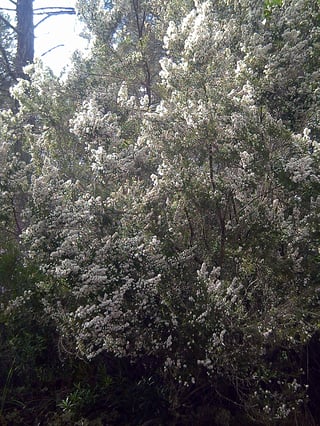
Tree heath, Erica arborea, in flower in the Sierra Madrona, Spain, in March.
The honey the Romans called heath honey came from an Erica, and the word they
used – Greek ἐρείκη (ereike), Latin erice – belonged to the Mediterranean
tree heath. In 1551 an English herbalist, William Turner, wrote the same word
against the low pink shrub of the northern moors, and that shrub is what an
English reader now means by heather. The speakers of the other European
languages kept the older word for their own Erica honeys and never took up
the English one.
Erica is a genus of about 850 species by the 2026 count, more than 600 of
them endemic to the shrublands of the South African Cape. That is why the European honeys of this
genus come off a handful of plants while the South African crop comes off a
whole biome. Between them, the six
monofloral
Erica honeys sold under their own names come off plants that flower in every
month of the year, from the tree heath of late winter to the winter heath of the
Catalan and Tunisian coasts at Christmas. Because the seasons run right round
the calendar, no one profile fits the honeys.
Registered designations in southern Europe, on the Atlantic seaboard and in
Tunisia name an Erica honey in its own language. That native word is what a
buyer looks for, because a jar labelled only heather honey is usually
ling.
Characteristics
Amber to very dark amber, with orange or red lights in the liquid honey and
brown-orange tones once it sets. Caramel or cooked sugar recurs wherever this
honey is described, over a marked acidity and a light bitterness. How it sets
depends on the species
and the place: Italy’s registered description of the tree heath honey has it
crystallising rapidly into a fine, easily soluble grain, while South Africa’s
national bee-plant reference gives low viscosity and slow granulation to the
Cape Ericaceae honeys taken predominantly from single-grain pollen species,
and a light golden colour to one sample from a species that sheds its pollen
in fours. It pours, in every country that describes it.
Click to Display — The Details: botanical origin, sensory profile, pairings, health and what gives it its character
Botanical Name: Heaths (Erica spp.)
Botanical Family: Ericaceae
Bee Species:
Honey is the product of Apis mellifera in European Union law, and no Erica
honey comes from another species. What the
Erica designations add is the subspecies. Corsica requires the island’s own
ecotype
of Apis mellifera mellifera and bars imported stock; two Portuguese designations
admit only the local Iberian bee. No designation for a ling honey found in
this round names a subspecies at all.
Ferran Pestaña, via Wikimedia Commons | CC BY-SA 2.0
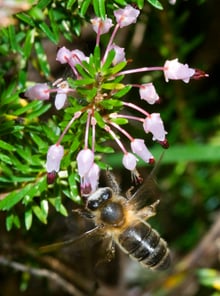
A honey bee at winter heath
A honey bee comes in to the small urn-shaped flowers of winter heath, Erica multiflora, in Catalonia.
Which bees can work an Erica depends on the shape of its flower. Most Erica
flowers are small urns,
narrower at the mouth than at the middle, and those are the ones bees pollinate.
In the Cape, where most of the genus lives, many species have long red tubes and
are pollinated by birds; the working bee there is Apis mellifera capensis, a
fynbos specialist that does poorly when it is taken out of it.
Color:
Amber to very dark amber, with orange or red lights in the liquid honey; brown with orange tones once it has set
Flavor Profile:
Caramel and cooked sugar over a marked acidity and a light bitterness, with the sweetness moderate rather than forward
Tasting Notes:
An Erica honey runs when the jar is turned on its side; a ling honey does not,
and the
British judges’ guide makes that a pass or fail rather than a timed test. The
property behind it,
thixotropy,
belongs among the heathers to ling alone, and the test works only while both
honeys are liquid.
A honey that runs can still be a thick one. The Comunidad de Madrid measured its Erica
arborea honey at 5,807.9 g for viscosity against 814.3 g for its rosemary
honey: six or seven times as resistant as the jars beside it, and still
pourable.
The honey is cloudy even freshly extracted, because it carries crystalline
matter that does not dissolve. And in the Basque Country the custom is to beat
these honeys to a fine cream, which leaves the jar paler than its floral
origin would otherwise warrant.
Aroma:
Caramel and cooked sugar, a damp-woodland note of wet leaves and earth, aromatic wood, and anise or liquorice
Defining Compounds:
The caramel has a chemical basis, and two independent 2021 studies found the
same class of compounds at opposite ends of the range. A study of 33 north-west
Iberian honeys and a study of 25 Greek autumn honeys share a subset of degraded
carotenoids:
safranal, isophorone and 4-oxoisophorone among them. The Greek authors name the
class outright, writing that many of the compounds they found are degraded
carotenoids related to heather honey. That these are what a taster is calling
caramel is this page’s inference from the compound class, and no source states
it.
The same two studies disagree. The Iberian team found
hotrienol
in 82 per cent of its samples, averaging 45.7 per cent of the volatile fraction,
and concluded that hotrienol could be a clear marker for all heather honey; the
Greek team reports that hotrienol was not detected in any of its samples. Both
were peer-reviewed and both were working on Erica: the Atlantic heaths and the
Aegean heath are chemically different honeys sold under one word.
Diastase
behaves unusually here, and it inverts how a laboratory sheet reads. The
International Honey Commission lists Erica among only five European honey types
in its low-enzyme exception, at a measured minimum of 3.7 Schade units, the
scale diastase is reported in, and Italy writes the derogation into its national
sheet at not less than 3 units provided HMF stays under 15 mg/kg. So on an Erica
honey a low diastase figure is the plant and a high HMF figure is the fault,
though the honey is not always low in enzymes.
No mineral analysis of an Erica honey was found; what is supported is the
conductivity, which is a proxy for mineral content, and the European directive
exempts Erica by name from its general 0.8 mS/cm ceiling, so a reading above
that ceiling is no evidence against the jar. The one bioactivity study done on
Erica honey itself, on Portuguese monofloral honeys, found hydrogen peroxide the
most important of four factors tested – the ordinary honey mechanism, made by
an enzyme the bee adds and destroyed by heat and light.
Forage Origin:
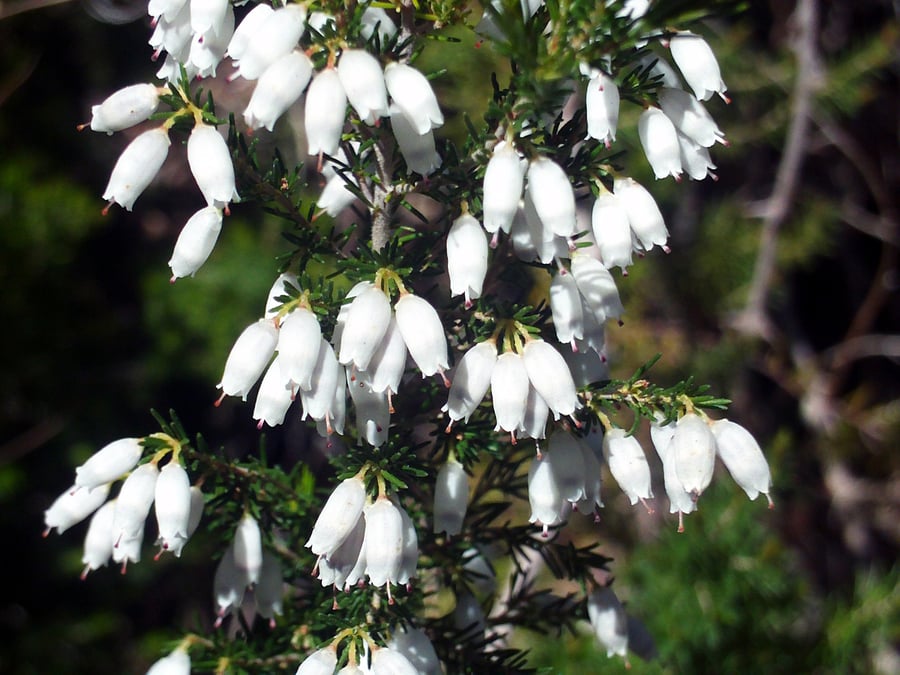
Javier Martin, via Wikimedia Commons | Public domain
Tree heath in full flower
A tree heath in full flower in the Sierra Madrona, Spain.
The bees take nectar from the flowers of shrubs in the genus Erica. It sits in a
ring of tissue inside the base of a small urn-shaped corolla whose mouth is
narrower than its middle, and in most species the pollen is shed in
tetrads;
the few Cape species that shed single grains give the honeys South Africa’s
reference describes as slow to set.
Most of the genus is knee-high scrub; the exception is the tree heath, Erica
arborea, which reaches over five metres. That plant came out of the East African
mountains and colonised the Mediterranean more than once, so the shrub that
gives Corsica its spring honey gives the Ethiopian highlands theirs.
Six species carry a honey sold under its own name – Erica arborea, E. cinerea,
E. tetralix, E. manipuliflora, E. multiflora and E. carnea – and the regional
variants below take them one at a time.
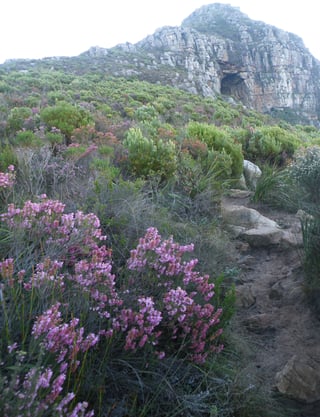
Abu Shawka, via Wikimedia Commons | CC0
Ericas in Cape fynbos
Pink-flowering Ericas in the fynbos below the Constantiaberg, Cape Town.
Four landscapes carry the genus. In the Mediterranean
maquis
the tree heath takes light, deep, acid ground and not limestone. On the
Atlantic seaboard wetness splits two species, bell heather taking the dry
sunny slopes and cross-leaved heath the wettest ground, where ling will not
go. In the Western Cape the genus is a biome: Erica species are the main
source of
fynbos
honeys, in the words of South Africa’s national bee-plant reference, and every
jar there is sold under the biome’s name rather than the plant’s. The owner of
Overberg Honey Co says the main nectar of his dark fynbos honey is Erica.
Heath is a stage between cleared ground and closed forest. In 1927 a botanist writing on Algeria
put tree heath in the hilly parts of cork-oak forest that people, fire or
grazing had opened, and saw in Kabylie that in well-kept forest the oak tends
to eliminate it. An Erica crop is therefore a crop off worked ground: where the
cutting, grazing and burning stop, the forest closes over the flow.
Three plants are confused with this one. Ling, Calluna vulgaris, is a genus of
its own and carries
its own honey and its own page;
in English the unqualified word heather belongs to it, and in Spain its honey
is sold as miel de calluna, miel de brecina or miel de biercol. St Dabeoc’s
heath, Daboecia cantabrica, is a genus of its own in the same family. And on
the Croatian coast vrijesak or vrisak can also mean winter savory, Satureja
montana, a mint-family plant, so a jar printing that word has to be read for
its plant before it is taken for heather. The
strawberry tree, Arbutus unedo, is a fourth case of a different kind: it
shares the maquis, the bee and the same legal exemption, and in Greece the two
are blended and sold as a declared two-plant honey.
Wellcome Collection, via Wikimedia Commons | CC BY 4.0
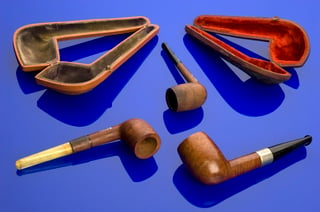
Briar pipes, 1890-1925
Briar tobacco pipes with their cases, Europe, 1890 to 1925. Briar is turned from the root burl of tree heath.
Four uses of the plant are not honey, and three of them kill it. A briar pipe is
turned from the
lignotuber
of Erica arborea, and digging it out takes the shrub with it; the shrublands
were a source of charcoal; Erica scoparia is the broom heath in its own
botanical name and in its French, Italian, Spanish and Portuguese ones, and a
Turkish chemist writing for a Muğla foundation laments that the plant goes
mostly into brush brooms rather than honey. In
the Cape a fourth use spares the plant: the flowers are cut for the flower
trade.
Pairings:
One pairing recurs across the producing countries and each gives the same
reason: matured, piquant cheese, intensity against intensity, with the honey’s
bitterness doing the work. Italy’s national beekeepers’ union writes on its own
Miele di Erica sheet that the honey can be paired with aged and piquant cheeses;
Portuguese sellers put mel de urze against cured goat’s cheese and say the
heather’s intensity cuts the goat’s acidity; the Spanish trade sends brezo to
blue cheeses and intense desserts; Turkish sellers put püren balı on an autumn
cheese board. That is the trade describing its own product.
Two countries independently report the honey reading as less sweet than its
sugar content, which is why they eat it on its own: Italy’s beekeepers’ union
says that tasted neat it does not bring on a quick feeling of fullness. Turkish
sellers put it in tea and hot drinks by preference.
As an ingredient, Italy’s national honey observatory calls the tree heath honey
very easy to use in milk-based sweets and says it suits tarts and biscuits
equally well; a Trentino house suggests its Miele di Erica with chicken curry.
Health Uses:
The tradition that attaches to these plants belongs to the plant and not to the
honey. In France an infusion of the flowering tops of Erica cinerea carries a
recognised traditional use for promoting the elimination of water by the kidneys
and as an adjuvant in benign urinary complaints, alongside the same use for
ling. The pharmacy press that reports it adds that only the flower is used, that
the use rests on traditional practice and practitioners’ observations, and that
arbutin,
the one mechanism named, is present only in small quantity even in the plant.
The wider folk record is the family’s: the Ericaceae appear in folk medicine as
a diuretic and an antiseptic and in the treatment of urinary infections.
The ancient record is short: a Hippocratic preparation for inflammation of the
womb, Galen on the
diaphoretic
action of the flower and leaves, and a belief about snakebite that was claimed
of many plants. Fuchs stated in 1542 that the plant was not used in
apothecaries’ shops, and the story that the genus is named for breaking bladder
stones comes from the Renaissance herbalist Pietro Andrea Mattioli rather than
from the ancient world.
No traditional use of the honey itself, independent of the plant’s, was found at
any tier in English, French, Spanish, Italian, Greek or Turkish.
Origin Story
The oldest notice of heath as a bee plant is a poem. Nicander of Colophon, in
the second century BC, tells his reader to take the thick-growing heath when in
flower, “round which the thronging bees crawl and feed”. The line comes from
the Theriaca, a hexameter poem about venomous animals and their antidotes, so
the heath is there as a drug ingredient; but his translators, Gow and
Scholfield, take his word to mean the Mediterranean tree heath (ἐρείκη,
ereike).
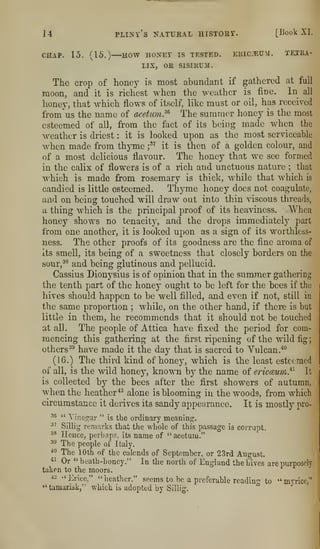
Pliny the Elder, trans. Bostock and Riley (1855), via the U.S. National Library of Medicine and Wikimedia Commons | Public domain
Pliny's heath honey, 1855 translation
Pliny's chapter on testing honey, with ericaeum, the heath honey, in Bostock and Riley's translation of the Natural History (London, 1855).
Two centuries later Dioscorides described the honey, and the oldest surviving
verdict on it is in doubt: in the text as usually printed the bees make honey
“which is not particularly good”, while another manuscript of the same work says
nearly the opposite, that they work it diligently. Pliny, in the same century,
is harsher. He gives the honey a Latin name of its own,
ericaeum, makes it one of only three kinds he recognises, ranks it last, and
dates it: gathered after the first autumn rains, between the end of the vintage
and 13 November, when the heath alone is in flower in the woods. He adds the
oldest surviving instruction about an Erica crop, and it is a restraint. Leave
the bees two-thirds of the crop.
Pliny’s calendar names his plant more nearly than his own text does. Erica
arborea flowers in winter and spring, so the historian of the name reads
Pliny’s heath as likely Erica manipuliflora, the only autumn-flowering heath of
south-eastern Greece and the plant Greek beekeepers still take an autumn crop
from, while recording that most commentators take Pliny to mean Erica arborea.
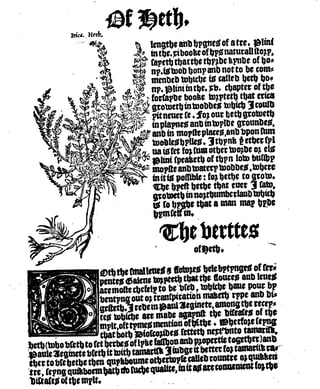
William Turner, A New Herball (1551), via Wikimedia Commons, cropped | Public domain
'Of Heth', William Turner, 1551
'Of Heth' in William Turner's A New Herball (London, 1551), where he writes that Pliny put heath in woods, 'which I could yit neuer se'.
Then William Turner moved the word to another plant. In 1551 he printed the
equivalences
as he found them – Greek erice, English heath, hather and lyng, Dutch heyde,
French bruyer – and went on to say that Pliny put heath in woods, “which I
could neuer se”, because English heath grows on plains and moist wild ground;
the highest he ever saw was in Northumberland, high enough for a man to hide
in. That passage is taken as the first published record of ling from Britain
and Ireland, and it is the moment the classical Erica word settled on a
different plant. Turner was listing translations and not cognates, and the
western heather words – Spanish brezo, Italian brugo, Catalan bruc, French
bruyère – still cover both plants.
A decade later the first portrait of an Alpine Erica was drawn from a garden:
Conrad Gessner painted Erica carnea about 1560 from a specimen in his own,
more than twenty years before Clusius put the plant into print. The snow heath has been a
European garden plant for four and a half centuries.
The pipe trade was built on the part of the shrub that keeps it alive. By the
mid-1920s Algeria alone was producing 30,000 to 60,000
quintals
of rough pipe blanks a year, worked by 1,233 men in 34 workshops. Then pipe
smoking declined, and Sicilian foresters describe what followed: the burls are
no longer dug, the stands have thickened and they burn more often.
Cultural Context
In 1912 a beekeeper put the naming problem in print. Writing in the British Bee
Journal, N. Sitwell reported an experiment at Newcastle: sealed sections of ling
and of bell heather cannot be told apart by eye, but on cutting, “the veriest
novice could tell the difference” – the bell heather ran freely, tasted like a
flower honey, and extracted more easily than clover. His conclusion was a naming
plea. “Call the latter heath honey if you like, Erica honey would sound rather
strange perhaps, but Bell-heather Honey would look fine on a label! But do not
call it heather honey.” The trade did not make the change.
One modern poem took the heath for a word rather than a plant. Apollinaire’s
“L’Adieu” of 1903 opens on one: “J’ai cueilli ce brin de bruyère”, I have
picked this sprig of heather. French bruyère covers every heath, ling included,
so the poem names a season and not a species.
In Greece the autumn honey is sold as a health food, in the words of the
Cretan house Meli Romanakis, and one Greek seller prints Dioscorides'
Greek at the foot of the page that sells it – the half of the manuscript
tradition that says the honey is not good. In Turkey two sellers say that püren
balı is consumed mostly abroad while the plant is used mostly for brooms.
Harvest & Forage
Somewhere in the world this genus is in harvest in every month of the year.
Tree heath is the earliest crop of the European year: the Corsican appellation
treats bruyère blanche as the whole of spring, Italy and Asturias give March to
May, and Tunisia’s appellation fixes its spring honey to May and June. Bell
heather comes off at the end of August in the Landes, cross-leaved heath in July
across Scandinavia, and the autumn heather of Greece from September into
November. Winter heath is harvested at the turn of the year on Menorca and in
Tunisia, and snow heath from February into early April in the Dolomites.
The Ericas therefore bracket the ling, which is a late-summer plant wherever it
is a crop. A spring heather honey is an Erica honey; so is a January, March or
midwinter one; and in the Mediterranean so is an autumn one. The test fails in
one place only, the Atlantic north, where cross-leaved heath and bell heather
flow in July and August just before the ling opens. There the beekeeper has to
spin the Erica crop off immediately before the ling starts flowering, in the
words of the Danish national research report.
The spring crop is the unreliable one, and Spanish and French beekeepers say
so independently:
the bloom is early, the weather is still unstable, and the French national
beekeepers’ union reported failed bruyère blanche flows in both its 2024 and its
2025 bulletins. Italy’s official sheet names the other early-harvest problem:
the honey can come in wetter than keeps well, and it degrades quickly.
That matters at the counter as well as in the honey house. The 23 g/100 g water
allowance the world standard and the European directive grant to heather honey
is written for Calluna, and the Erica honeys take the ordinary ceiling, which is
why the Greek apicultural laboratory points out that on a faithful reading of
the law several Greek heather honeys are irregular. Tunisia’s appellation, in a
different legal order, does set 23 per cent for an Erica arborea honey. Where
a European designation gives an Erica honey room it gives it on
HMF
instead, not on water. A wetter honey ferments sooner, which is what the ceiling
protects. Extraction is ordinary: Mel de Galicia bars pressing outright, a rule
no ling beekeeper could work under.
Keeping the crop to one species is done with the calendar and the map, because
no registered designation in Europe certifies a single Erica: every floor found
counts the genus. A Greek jar from October is Erica manipuliflora and a
Corsican jar from May is Erica arborea. What dilutes a crop is the ling in the
Atlantic north, the strawberry tree in the maquis, and chestnut in Asturias.
The registered pollen floors run from 25 per cent to 65, so the figure behind a
label is the country’s and not the genus’s. France has another on the way: the
Miel des Landes specification, homologated in August 2023 and published as a
European application in June 2026, would keep a bruyère cendrée honey separate
by name from a ling honey.
Beekeeping Context
Much of what this genus produces was never meant for us. Pliny’s advice on the
autumn heath crop was to leave the bees two-thirds of it, because at that season
they have nothing else. Nineteen and a half centuries later the Laboratory of
Apiculture-Sericulture at the Aristotle University of Thessaloniki gives the
same reason from the other end of the year: spring heather honey is rarely
harvested, because the flow coincides with the build-up of the colony and the
bees consume it directly. North of the Alps the snow heath flow does the same
thing in February, going straight into rearing the first brood. A monofloral
Erica jar is therefore scarce because someone chose to take it, not because the
plant is rare.
In Greece the autumn move to the heather is made for pollen. Beekeepers working
the pine honeydew of Marchalina hellenica, a scale insect that feeds on the
sap of Greek pines, run their colonies down, because
honeydew carries none; the heather’s pollen rebuilds the brood, and the honey is
what the beekeeper gets for going. At the other end of the genus the heather
flowers first in the year, not last: in Provence the
transhumance
begins on Erica multiflora before the rosemary and the thyme, and in Corsica,
whose appellation names three dominant flows in the island’s year, bruyère
blanche is the first.
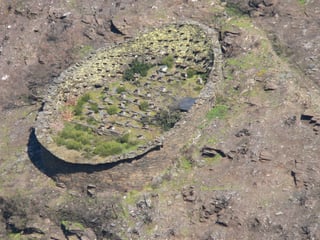
m.dolores paderne sanchez, via Wikimedia Commons | CC BY-SA 3.0
A bear wall around an apiary, Galicia
A dry-stone wall with an overhanging slab coping around traditional hives at Quiroga, Galicia, built against the bears.
In north-west Iberia the hives did not travel, and the buildings say why. The
cortines of Galicia, Asturias and northern Portugal are dry-stone enclosures,
usually round, with high walls, small doors and a projecting overhang, built to
keep the combs out of reach of the Cantabrian brown bear. The registered
Asturian specification says as much in its own words: the difficult terrain and
the bear, which obliges beekeepers to protect their hives, keep the apiaries
stationary, which is what lets Asturias harvest a distinct honey from each
zone.
And in Norway a beekeeper told the Oslo association that his father’s deliveries
used to be sent back because they would not thicken, the bees having brought
klokkelyng into the ling honey.
Source Regions
See all 16 countries
Portugal, northern serras – Erica umbellata and E. arborea: heather honey (mel de urze), dark and astringent, named in five protected designations.
Spain, the Atlantic north, Catalonia and Tenerife – Erica spp.: heather honey (miel de brezo), four protected names and crops from spring to midwinter.
France, Landes, Provence and Corsica – Erica arborea and E. cinerea: white and bell heather honeys (bruyère blanche, bruyère cendrée), spring then summer.
Italy, Liguria to Calabria and the islands – Erica arborea: tree heath honey (miele di erica), a spring crop, and a Lunigiana DOP type.
United Kingdom, northern England and Scotland – Erica cinerea: bell heather honey, port-wine coloured and runny, taken in July before the ling.
Norway, the Rogaland coast and Boknafjorden – Erica tetralix: cross-leaved heath honey (klokkelynghonning), spun in July and staying liquid.
Denmark, Hulsig Hede and north Jutland – Erica tetralix: cross-leaved heath honey (klokkelyng), a July crop taken before the same heath’s ling.
Sweden, Skåne and the western provinces – Erica tetralix: cross-leaved heath honey (klockljung), a small July bog crop that stays liquid longer.
Greece, Evia, Chalkidiki and the islands – Erica manipuliflora: autumn heather honey (ereikomelo), September to November, and the Meli Kissouri PDO.
Turkey, Muğla and the Datça peninsula – Erica manipuliflora: autumn heather honey (püren balı), harvested September to November, sold across the Aegean.
Tunisia, Kroumirie and Mogods – Erica arborea, E. multiflora: heather honey (miel de bruyère), a national appellation covering spring and midwinter crops.
Algeria, the Tell mountains around Sétif – Erica spp.: heather honey (asal al-khalanj), sold as a dark single-plant honey of the cold highlands.
Morocco, Tanger-Tétouan-Al Hoceïma – Erica spp.: heather honey (asal al-khalanj), sold by a Rif cooperative and a Tétouan terroir shop; no species named.
Ethiopia, the ericaceous zone of Wonchi and Borena Sayint – Erica arborea: giant heath honey (ye’asta mar), sold at local markets by name.
Albania, Kashnjet and the northern hills – Erica arborea: heather honey (mjalti i shqopes), a March-to-May crop sold direct by the beekeeper.
Croatia, Korčula, Brač and Hvar – Erica multiflora: heather honey (med od vrijeska), an autumn island crop; the vrisak word means savory.
Regional Variants
John Lyden, via iNaturalist | CC BY 4.0
Tree heath close up, Crete
Tree heath in flower near Chania, Crete, in April.
Tree heath honey (miele di erica, miel de bruyère blanche, miel de brezo blanco, mel de urze branca, mjalti i shqopes) – Erica arborea – Portugal, Spain, France and Corsica, Italy, Tunisia, Albania, Ethiopia: the first heather honey of the year. It reaches the jar dark amber with orange or red lights, cloudy rather than clear because it sets quickly into a fine crystal that dissolves easily. Italy’s registered description gives caramel, creme caramel and aromatic wood, with the bitterness barely there, which is what separates it from the summer and autumn heathers; the Corsican appellation’s own account adds liquorice and coconut, and Tunisia’s appellation calls its spring type wooded, with cocoa and liquorice. Nothing about it gels. Honey sold under the name Erica arborea, as the Lunigiana DOP and the Kroumirie-Mogods AOC sell it, comes from maquis and woodland understorey worked in late winter and spring, not from moorland.
Jean-Paul Boerekamps, via iNaturalist | CC0
Bell heather close up, Dordogne
Bell heather, Erica cinerea, in flower in the Dordogne in July.
Bell heather honey (miel de bruyère cendrée, miel de bruyère Erica) – Erica cinerea – United Kingdom, France (the Landes, Brittany, Charente-Maritime), Spain (Asturias): the summer heather, taken in July and August before the ling comes in. Port-wine coloured with a reddish brightness, and runny: the British beekeeping associations say plainly that it is not gelatinous and that it belongs in a liquid class, which is the whole difference between it and the ling honey beside it on the shelf. The registered French description for the Landes gives light amber to dark brown, dried flowers, leather and liquorice, complex woody flavours and an almond note with a little bitterness at the end, and the registered Cévennes text adds a pronounced fresh floral smell of faded roses, the one rose note found for any Erica honey. Asturian houses sell it as a summer brezo and name the species. Where a label says bruyère cendrée or bell heather, the buyer is promised a honey that pours.
Maria G, via iNaturalist | CC BY 4.0
Autumn heather close up, Attica
Autumn heather, Erica manipuliflora, in flower in Attica in late September.
Autumn heather honey (ereikomelo, meli reiki, püren balı, anama) – Erica manipuliflora – Greece, Turkey, Croatia, Albania: the last crop of the year, from September into November. Dark, with copper-red tones and a slightly bitter taste, setting within two or three months into a fine grain that lightens as it goes. Greek sellers tell it from the spring honey by colour, calling it red reiki against white. This is a hot-country honey off a low whorled shrub on dry limestone scrubland, the phrygana (φρύγανα), rather than off a moor, and the hives are walked down the mountain behind the bloom as it moves to the coast into December. Greece’s Meli Kissouri is the only protected name anywhere whose product is an Erica honey and nothing else; Turkish packers print püren or funda on the jar and usually name no plant at all.
Sigitas Juzėnas, via iNaturalist | CC BY 4.0
Cross-leaved heath close up
Cross-leaved heath, Erica tetralix, in July, its bells in a single cluster at the tip of the stem.
Cross-leaved heath honey (klokkelynghonning, klokkelyng, klockljung) – Erica tetralix – Norway, Denmark, Sweden: the northern Erica, and the one heather honey a Scandinavian buyer can tell from ling by looking at it. It is darker than ling and milder, tasting of caramel where ling is bitter, and it stays liquid – for years, when it is pure – because its fructose share is high, which is why the Danish and Norwegian associations describe it as the northern honey that is naturally runny. Norway judges it in a national class of its own, written klokkelyng flytende, liquid. The crop is July, and it has to come off before the ling starts or the ling’s bitterness and its crystals take the jar over. The plant is a bog and coastal-heath shrub, and the steadiest Norwegian deliveries come off the coastal heath of Rogaland, a habitat now largely gone.
Louis Aureglia, via iNaturalist | CC BY 4.0
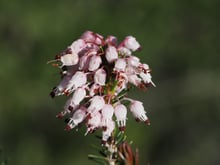
Winter heath in flower, Provence, January
Winter heath, Erica multiflora, in flower at Trets, Provence, on 10 January.
Winter heath honey (mel de bruc, sepell, xipell; primorski vrijes) – Erica multiflora – Spain (Catalonia and the Balearics), Tunisia, Croatia: the only heather harvested in midwinter. Menorca’s own heritage inventory puts the mel de xipell harvest between late December and early January, and Tunisia’s appellation dates its autumn type to December and January. Where that appellation describes it, it is light amber with a wooded aroma and a pronounced bitter aftertaste that stays in the mouth; an Adriatic beekeeping journal calls the island honey bitter and piquant, and notes that the bees often eat it in the hive before anyone can take it. It is a honey of dry coastal scrub – Brač, Hvar and Vis, the Catalan littoral – worked when almost nothing else is flowering. Honey sold in Catalonia as sepell or xipell is this plant’s honey, not the spring bruc blanc.
stanze, via Wikimedia Commons | CC BY-SA 2.0
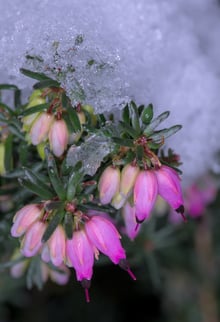
Snow heath under snow
Snow heath, Erica carnea, flowering through snow in a garden.
Snow heath honey (miele di erica carnea, la sloda) – Erica carnea – Italy, Val di Zoldo and the Belluno Dolomites: a late-winter honey taken with snow still on the ground, made in small quantity and mostly sold by the beekeeper. Italy’s national honey observatory has it sweet, without the bitterness the other Ericas carry. The Zoldo beekeeper who sells it says he was the first in Italy to take it pure, at the end of the 1970s, that he works it between February and early April above a thousand metres, and that it tastes of cocoa, toffee, candyfloss and anise; his honey has carried the national competition’s gold drop, and that competition judges the species as a spring honey in a class of its own, apart from tree heath. North of the Alps the flow arrives when there is no other forage and goes straight into raising the first brood, so it yields no honey there.
Translations
Mel de urze, mel de queiro – Portuguese; the Mel de Barroso DOP allows both
Miel de brezo – Spanish
Miel de brezal – Spanish, Canary Islands, the registered type name of the Miel de Tenerife DOP
Mel de bruc, mel de bruc blanc, mel de xipell, mel de sepell – Catalan
Miel de bruyère blanche, miel de bruyère cendrée, miel de bruyère Erica – French, the first two being the registered plant names
Miel de bruyère de Kroumirie-Mogods – French, Tunisia; the appellation’s legal name for both its spring and its autumn honey
Miele di erica – Italian; la sloda in the dialect of the Belluno Dolomites
Μέλι ερείκης, Μέλι ρείκι (meli ereikis, meli reiki) – Greek; ερεικόμελο (ereikomelo) in running copy, and αναματόμελο (anamatomelo) on Ikaria and Fournoi
Püren balı, piren balı, funda balı – Turkish
عسل الخلنج (asal al-khalanj) – Arabic, across Tunisia, Algeria and Morocco, printed beside miel de bruyère on bilingual labels
Klokkelynghonning – Norwegian and Danish; the Danish jar prints klokkelyng
Honung från klockljung – Swedish
Mjalti i shqopes – Albanian
Med od vrijeska, vrijeskov med – Croatian; crnjuša is the genus word
የአስታ ማር (ye’asta mar) – Amharic, the market name in Ethiopia for Erica arborea honey
Festivals and Fairs
Tuttomiele – Bruzolo, Val di Susa, Piedmont, Italy (September; the 2026 edition ran Friday 11 to Sunday 13 September): a three-day street fair run by the comune with the local associations, founded in 2002 and inside the Gusto Valsusa food circuit since 2003. It is the only fair found anywhere that puts a heather honey first among the honeys it sells: the regional tourism board names the excellence of the honey sold as miele d’erica ahead of dandelion, chestnut and the high-mountain honeys, and the honey-towns network’s calendar lists the same order. Which Erica stands behind the word is not stated, and in Piedmont ling is sold under it too. The date has moved in every recent year and should be checked with the comune. (Italian translated to English )
Bancarel’Miele – Mulazzo, Lunigiana, Tuscany, Italy (September; the second edition ran 19-20 September 2026): a market and tasting fair created by the comune with the consortium behind the Miele della Lunigiana DOP, with guided cheese-and-honey tastings, a round table on climate and beekeeping, and a mead tasting. It celebrates the whole designation rather than its heather type, which entered the DOP only in 2025, so the 2026 edition was the first at which the Erica honey was a DOP honey. (Italian translated to English )
Certifications
Meli Kissouri PDO (Greece, 2024) – the only protected name in the world whose product is an Erica honey and nothing else. It guarantees the plant, Erica manipuliflora Salisb.; the place, the Municipality of Karystos in southern Evia; and the autumn crop, taken as the hives come down Mount Ochi to the coast.
Miele della Lunigiana DOP, Miele di Erica type (Italy) – a designation widened by decree in 2025 so that a tree heath honey could carry it. It guarantees the species, Erica arborea, and that every stage including packing happened inside the fourteen comuni of the Lunigiana; the label must name the type beside the designation. (Italian translated to English )
Miel de Corse - Mele di Corsica AOP (France) – an island appellation whose spring maquis honey is the Erica arborea one. It guarantees Corsican origin, the island’s own ecotype of Apis mellifera mellifera (which Corsica protects by barring imported bees), cold centrifugation and no pasteurisation. A plant name may go on the jar only beside the appellation’s seasonal name, and only when the honey comes mainly from that plant. (French translated to English )
Miel des Cévennes IGP (France, 2015) – the only registered text found that names both Erica honeys as separate monoflorals, bruyère blanche and bruyère cendrée, beside a ling honey. It guarantees that the honey came from the Cévennes, with its floral origin checked by pollen analysis. (French translated to English )
Miel de Provence IGP (France) – a regional indication whose specification names Erica arborea and Erica cinerea among the heathers that can mark a Provençal honey, and whose control plan lists tree heath pollen among the most characteristic. It guarantees Provençal origin; a floral name may be added only once the honey’s floral origin has been attested. (French translated to English )
Mel de Galicia / Miel de Galicia PGI (Spain) – a regional name with a heather monofloral among its types. Besides Galician origin it sets a limit no other designation read here does: sunflower, olive and Cistus pollen together may make up no more than 5 per cent of the spectrum.
Miel de Liébana DOP (Spain) – a Cantabrian valley designation whose brezo monofloral is an Erica honey. Ling is a permitted nectar plant there but its pollen does not count towards the heather threshold, and the registered text calls it the false heather.
Miel de Asturias PGI (Spain, 2025) – one designation selling both genera under different names, with miel de brezo and miel de calluna as separate types. It guarantees Asturian origin and packing in Asturias, numbered labels and no bulk sale.
Miel de Tenerife DOP (Spain, Canary Islands), Miel de Brezal type – a heather honey off the laurel-forest heath, a habitat no mainland Erica honey shares. It guarantees Tenerife origin, it is the one designation read here that puts a physical origin check in its text and makes every monofloral pass a sensory typicity gate, and its own technical sheet calls this type scarce and añera – a honey that does not come every year. (Spanish translated to English )
AOC Miel de bruyère de Kroumirie-Mogods (Tunisia, 2020) – the only designation found anywhere that protects two Erica honeys under one name, a spring honey of Erica arborea and an autumn honey of Erica multiflora. It guarantees the two plants, the Kroumirie and Mogods hills, no pasteurisation and no feeding from a fortnight before the flow. (French translated to English )
Mel das Terras Altas do Minho DOP (Portugal) – a place designation that lets a jar be relabelled mel de urze once its heather pollen passes a threshold, so the heather name rides on a place name. Its production rules are strict: no artificial feeding as routine practice, syrup only in abnormal weather, no apiary within 1,000 metres of a eucalyptus plantation, transhumance only inside the demarcated area, and a full year’s wait before hives taken outside may be re-registered. (Portuguese translated to English )
Mel de Barroso DOP (Portugal) – the second Portuguese place designation to carry the heather name, and it allows two words for it, mel de urze and mel de queiro, once the heather pollen passes a threshold. It also admits only the local Iberian bee. (Portuguese translated to English )

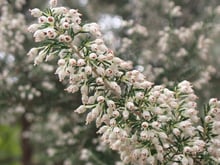 John Lyden, via iNaturalist | CC BY 4.0Tree heath close up, CreteTree heath in flower near Chania, Crete, in April.
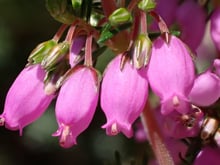 Jean-Paul Boerekamps, via iNaturalist | CC0Bell heather close up, DordogneBell heather, Erica cinerea, in flower in the Dordogne in July.
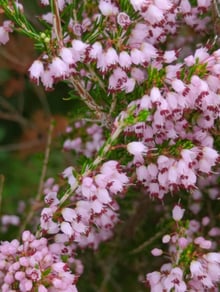 Maria G, via iNaturalist | CC BY 4.0Autumn heather close up, AtticaAutumn heather, Erica manipuliflora, in flower in Attica in late September.
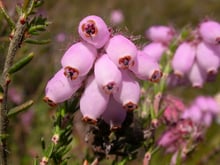 Sigitas Juzėnas, via iNaturalist | CC BY 4.0Cross-leaved heath close upCross-leaved heath, Erica tetralix, in July, its bells in a single cluster at the tip of the stem.
 Louis Aureglia, via iNaturalist | CC BY 4.0Winter heath in flower, Provence, JanuaryWinter heath, Erica multiflora, in flower at Trets, Provence, on 10 January.
 stanze, via Wikimedia Commons | CC BY-SA 2.0Snow heath under snowSnow heath, Erica carnea, flowering through snow in a garden.
)
 Meli Kissouri PDO (Greece, 2024) – the only protected name in the world whose product is an Erica honey and nothing else. It guarantees the plant, Erica manipuliflora Salisb.; the place, the Municipality of Karystos in southern Evia; and the autumn crop, taken as the hives come down Mount Ochi to the coast.
 Miel des Cévennes IGP (France, 2015) – the only registered text found that names both Erica honeys as separate monoflorals, bruyère blanche and bruyère cendrée, beside a ling honey. It guarantees that the honey came from the Cévennes, with its floral origin checked by pollen analysis. (French translated to English
  AOC Miel de bruyère de Kroumirie-Mogods (Tunisia, 2020) – the only designation found anywhere that protects two Erica honeys under one name, a spring honey of Erica arborea and an autumn honey of Erica multiflora. It guarantees the two plants, the Kroumirie and Mogods hills, no pasteurisation and no feeding from a fortnight before the flow. (French translated to English