Banksia Honey
The Story
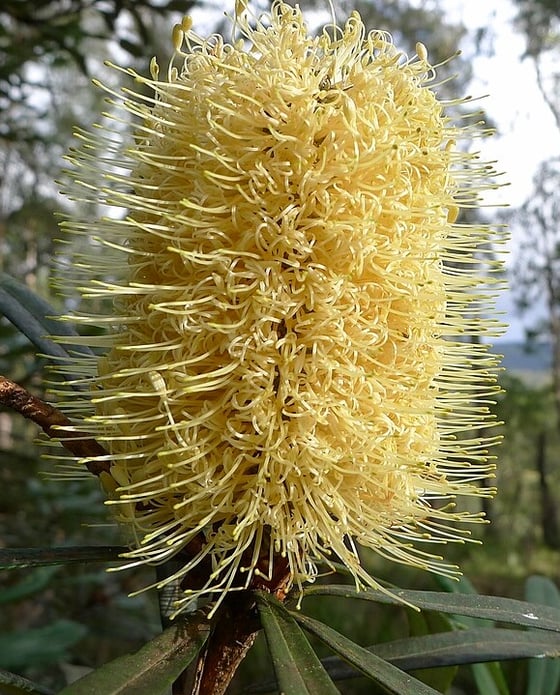
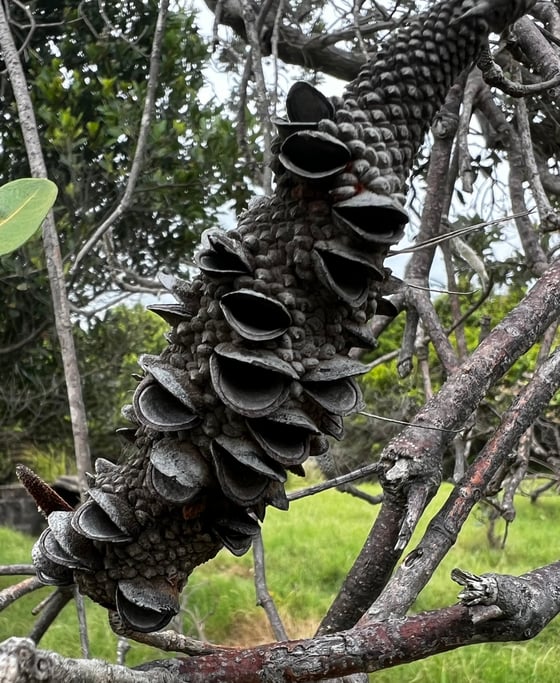
Walk through coastal scrub almost anywhere in Australia and you will find them: grey woody cones, about a hand long and covered in what looks like goofy smiles. There are around 170 banksias, in every state and territory, and most of them leave a cone something like it.
The cone is a spent flower head. A season earlier the same spike carried anywhere from a few hundred to several thousand separate flowers, opening in sequence from the base up. In Western Australia in 1842, George Fletcher Moore wrote that a single banksia flower held more than a tablespoonful of honey at the proper season, and that this was how the tree came to be called honeysuckle. He meant nectar. Honey is what bees make of it.
Bees work those same flowers. What they make from them is bottled in small runs and sells for around five times the price of bulk honey – not because the plant is scarce, but because banksia flowers in autumn and winter, when a colony is living on its reserves. Most of what it produces is eaten by the bees that gather it.
Characteristics
Sweet and full-bodied, with caramel or toffee in nearly every account of it. At the western end it is light amber and can carry a tang; at the eastern end it runs dark gold to near-black, with molasses and burnt caramel. On crystallising the trade is close to unanimous: it sets fast and it sets hard, which is the stated reason the large packers heat it and blend it away rather than bottle it. One Victorian house is the exception and calls its banksia slow to crystallise, while running crystallisation notices on the same product. What varies between jars is which banksia was flowering and what came in alongside it.
Click to Display — The Details: botanical origin, sensory profile, pairings, health and what gives it its character
Botanical Name: Banksia (Banksia spp.)
Botanical Family: Proteaceae
Bee Species:
European honey bee, Apis mellifera. Every jar of banksia honey sold in Australia is made by introduced honey bees; the first of them arrived in 1822, tens of thousands of years after people were already taking sugar from these flowers. On Kangaroo Island the bees are the island’s Ligurian stock.
Color:
light amber to dark amber, and the spread is real rather than a matter of opinion. Western Australian sellers describe a light amber honey and eastern sellers a deep gold or an incredibly dark one, because they are describing different species carrying different companion nectars. No laboratory colour grading has been published for banksia honey
Flavor Profile:
sweet and full, with caramel or toffee running through nearly every description; a slight tang at the light Western Australian end, and molasses and burnt caramel at the dark eastern end
Tasting Notes:
These are the words of the people who bottle it, region by region.
Western Australia: light-coloured, with a distinctive and sometimes slightly tangy flavour. A Perth producer bottling a single species calls its own bold and earthy.
Victoria: caramelised banana on the Mornington Peninsula; incredibly dark with deep caramel and molasses in the north-east; dark amber with a burnt caramel taste and a harsh finish in East Gippsland, where the producer’s own chef adds salty and briny.
New South Wales: a thick, creamy honey with robust sweet toffee and hints of caramel and butter.
Kangaroo Island: malted cookie dough and toasted caramel, over a resinous bush-flower finish.
Aroma:
sweet, with a caramel note; one East Gippsland producer describes the aroma of its own dark banksia as sweet and sour
Defining Compounds:
Sucrose, unusually. Ordinary honey is capped at 5 per cent by the international standard and Menzies banksia is written into it at 10, one of only seven honeys in the world with that allowance. The sucrose is not a plant trait so much as a timing one: nectar arrives in the hive largely as sucrose and the bees cut it into glucose and fructose with an enzyme as they ripen it, and in a heavy flow the nectar comes in faster than they can work through it, so some sucrose is still there when the comb is capped. It does not stay. Smith found that honey held a year in store had about half of it left, and German laboratory measurements fifty years later put the loss at roughly 0.8 per cent a month in a cool store. A banksia honey reading high in sucrose is not evidence that anyone fed the bees.
Hydrogen peroxide, for the antibacterial activity. In a 2011 Australian study, 22 of 25 banksia samples showed activity at a median of 15 per cent phenol equivalent – the strength of the disinfectant solution that kills bacteria as well as the honey does, which is how honeys are ranked against one another. Manuka in the same study came in at 13.1, jarrah at 25.1 and marri at 25.7. It is not the manuka kind of activity: manuka’s survives when the peroxide is taken out of the honey, and banksia does not appear anywhere in that study’s list of honeys with activity of that sort.
Nor is it one figure for the genus. Bull banksia has been measured at 28.9 per cent phenol equivalent, close to jarrah; parrot bush at 17.1; Menzies banksia is rated low by the Western Australian research centre that tests them; and all four saw banksia samples showed nothing detectable at all. The sharpest number in the set is about how far any single figure travels. The 2011 authors tested 22 banksia honeys taken from separate hives in one apiary, all from one flowering. Twenty-one of them ran between 11.4 and 19.2 per cent. One had no detectable activity. Same flowers, same week, the next hive along. Floral source in that study was the beekeeper’s declaration rather than a pollen count, and either way the number belongs to the batch it was measured on.
Forage Origin:
Nectar, taken from the flower spikes of banksias. There are around 170 species, all but one of them Australian, and the greatest concentration by far is in the south-west of Western Australia. The genus grew in 2007, when the whole of Dryandra was transferred into Banksia, so older beekeeping literature carries some banksias under a genus name that no longer exists.
A banksia flower head is not one flower. It is a spike carrying anywhere from a few hundred to several thousand separate flowers packed around a woody axis, opening in sequence from the base upward over days or weeks. The flowers are open rather than tubed, so the nectar is available to anything that can reach it, and a great deal of it is produced.
The name the colonists gave the tree belongs to a different plant. True honeysuckle is Lonicera, a northern-hemisphere climber, and banksia is no relation to it. Banksia sits in the Proteaceae, the family of the macadamia and the protea. What the two plants share is nectar a person can taste straight from the flower, and the settlers named this one for what it did rather than for what it was.
Banksias grow on sand. The south-west in particular sits on some of the most phosphorus-poor soil on Earth, and banksias run two root systems at once to live there. Dense mats of cluster roots form in and just under the leaf litter, active only in the wet season, and a separate sinker root runs down as much as ten metres to the water table to carry the plant through summer.
Different species are worked in each state. Western Australia has Menzies, orange, yellow and parrot bush banksia; South Australia and north-west Victoria have desert banksia across the mallee heath; coastal New South Wales has heath-leaved banksia, which heads the honey-plant list for the state’s coastal forests ahead of the eucalypts; Victoria and Tasmania have saw, coast and silver banksia.
One of them has gone backwards for a century. Silver banksia once ran in a more or less continuous belt across what is now Greater Bendigo, worked by beekeepers as a nectar corridor. A Victorian government apiarist wrote in 1922 that it was already almost extinct in many localities, and very few trees are left there today. The species is still sold as honey from Kangaroo Island and Tasmania; what has gone is the mainland belt that used to carry the flow.
Banksia pollen turns up in 35 per cent of all Australian honey samples, so it is a background contributor to a great many honeys that carry another name entirely.
Pairings:
The light Western Australian honeys do the ordinary jobs a mild honey does: toast, yoghurt, plain tea. The dark eastern ones carry molasses and burnt caramel and hold their own against strong cheese, sourdough and roasted root vegetables, where a mild honey would be lost.
Origin Story
In 1964 Japan turned back shipments of Western Australian honey. Their specification allowed 5 per cent sucrose and the honey was over it, which ordinarily means one thing: the bees have been fed sugar. The Department of Agriculture at South Perth put F. G. Smith on to it, and he reported the following year that the cause “was found to be a natural one, and not malpractice or bad beekeeping.” The honey was banksia.
What Smith had was a natural experiment. The 1964 flow had been an excellent one, and the ripe honey off it ran 8 to 12 per cent sucrose, with one sample of a fox banksia at 20.5. In 1965 the same species flowered only weakly and the honey came in between 4 and 9. Both years’ honey was ripe, so it was not a case of taking it off the hive too early. The only thing that changed was how hard the plant ran.
By 1969, when the international honey standard was first adopted, Menzies banksia was named in it among a short list of honeys allowed 10 per cent sucrose where ordinary honey is capped at 5. Four more Western Australian plants joined the list in 1987 at a 15 per cent allowance – grand banksia, red bell, white stringybark and the grasstree – and all four came off again in 2001. Nobody had objected to them. The revision replaced the old measurement, which totalled the sugars together, with one that reads each sugar separately, and those four had never been put through it, so they lapsed for want of a number. Menzies banksia had the number and is still on the list.
Cultural Context
The National Museum of Australia holds a kalga: a stick with a crook at each end, made for pulling banksia flower heads down within reach. Moore recorded the name in 1842, and Grey had already written down the phrase for the job two years before that, mungyte bur-rang midde, the mungyte-bringing thing.
Mungyte, in the Noongar record, is both the nectar-laden flower and the drink made by steeping it in water. There was a season named for eating it. Daisy Bates wrote in 1906 that at South Perth the flowering “was made the occasion for a visit from all the surrounding Kallipgur, and great was the feasting and fighting.” Left longer, the liquid ferments; when two researchers tried it and described the result to Noongar Elders, they were told it already had a name, geber. The practice is not one practice: around Sydney the Cadigal steeped heath banksia flowers for a sweet drink, at Cape York the nectar was drunk before it could ferment, and in Queensland in 1883 Edward Palmer recorded people taking it straight from the spike, “by drawing across the mouth.” The ethnographers who assembled the Noongar record warn that assigning Noongar names to botanical species is misleading, so no binomial is attached to mungyte here.
Honeybees reached Australia in 1822. What settlers bought from banksia was not honey but the cones, for fuel. “Mungite nuts always on hand,” ran a firewood advertisement in the Albany Advertiser in June 1890, the Noongar word for the flower doing service in a settler newspaper for the thing that burns. Honey is the most recent way of taking sugar from this plant, not the oldest.
Only one banksia gets carved. In Banksia grandis, the bull banksia, a tree of the south-west corner of Western Australia and nowhere else, the axis of the flower spike and the small leathery scales around it keep growing after the flowers drop and go woody around the seed capsules, so the cone sets as a solid mass rather than a thin shell. Every other banksia cone is too thin or too soft to cut. The bowl in a Queensland gift shop began as a pod picked up off the forest floor outside Perth. A pod is cut into sections, mounted on a lathe and shaved back until the seed cavities show through as a pattern of holes, then sanded through three grades of paper and polished with oil or shellac. Some are bleached, dyed, or filled with coloured resin. Collection is licensed in Western Australia and the pods are gathered by hand, already spent; the main collector describes paying a royalty on every pod and being held to a tenth of what is in any given patch. No tree is cut, and nothing is taken before it has seeded.
Harvest & Forage
Banksia flowers in autumn and winter. In New South Wales the heath-leaved banksia opens from March through to October, heaviest between May and August, and flowers every one or two years. The Western Australian honey species run over much the same cool half of the year, and the desert banksia at Ngarkat is a winter flow. A few flower in summer instead: saw banksia opens over December and January, and a Tasmanian producer harvests his banksia in summer for that reason.
Those cool months are the ones a colony spends running down what it stored in spring, so in an ordinary season the bees eat most of what they bring in from banksia and nothing comes off the hive. When the earlier flows fail – the spring and summer runs a year’s honey is normally built on – the same flowering becomes the crop. Both uses appear in the industry’s own 2024 reporting, from different states in the one document: South Australia expecting winter banksia to build colonies up strong enough for the almond pollination, and the Victorian Apiarists’ Association president writing that after a poor late summer and autumn, with some beekeepers back to feeding sugar, “desert banksia and spotted gum became saviours for those that have access to it.”
A clean single-species crop is difficult to prove and most producers do not claim one. Banksia pollen cannot be identified below genus under a microscope, so pollen counting cannot police a banksia label, let alone say which banksia. One Western Australian seller states plainly that its jar comes from whichever of the local species was flowering; another names six banksias as separate lines and sets its own threshold for calling any of them single origin at 70 per cent; a north-west Victorian jar is labelled desert banksia with red mallee. The one analytical check that exists is a chemical fingerprint of 31 Western Australian banksia honeys, which separated parrot bush from Menzies banksia into two clear clusters, agreeing in the main with what the beekeepers had declared.
Beekeeping Context
New South Wales commercial beekeepers put the heath-leaved banksia at an average of 25 kilograms of honey a hive. A skilled operator in the same state averages 100 to 120 kilograms a hive over a season, and in a survey of the coastal state forests banksia returned the lowest annual yield of the species covered. It rates well on pollen – 3.47 out of 5 from those same beekeepers, and 28 to 33 per cent crude protein, though both samples tested came in below the honey bee’s minimum requirement for one amino acid. The bees do well out of banksia. The harvest is small.
The small harvest determines how the plant is used, not whether it is used. The mallee heath at Ngarkat holds between 250 and 300 of South Australia’s roughly 400 public-land apiary sites, and much of the work there is not honey at all: colonies come out of the Riverland almond pollination spent and are taken into the banksia to rest and rebuild.
What is bottled is bottled small. A producer explains the market plainly: banksia is not a rare plant, but a single-species banksia honey is rare, because the large companies are not fans of a honey quick to crystallise when they are making runny honey, so it normally gets heated and blended in. Named banksia sells for around 24 dollars a kilogram against a bulk honey price of 4.50 in the same year. One Kangaroo Island beekeeper bottled 390 jars of a season. A Victorian house put its banksia back on sale after three years with none. A South Australian producer describes making it sometimes.
Source Regions
- Banksia spp. – Australia – Western Australia: Sold as a genus rather than a species. Producers work Menzies, orange, yellow and parrot bush banksia, and one seller states outright that its jar comes from whichever of them was flowering. Described in the state as light amber and slightly tangy, though a Perth producer bottling a single species calls its own bold and earthy. The two biggest and oldest Western Australian houses use banksia only as a blend component.
- Banksia ornata – Australia – South Australia: The mallee heath at Ngarkat is the country’s most important banksia beekeeping landscape, holding between 250 and 300 of the state’s roughly 400 public-land apiary sites, and almost none of the honey is bottled under the name. It goes into the bulk blend stream, or into hive strength: colonies come out of the Riverland almonds spent and are taken into the banksia to rebuild. One Adelaide Hills producer sells a winter banksia at farmers markets, and describes making it sometimes.
- Banksia spp. – Australia – Victoria: The state where banksia honey is most often sold under its own name, from at least four species. Desert banksia comes off the mallee heath in the north-west and is sold blended with red mallee at a Melbourne market; the same continuous heath crosses from South Australia, and only the Victorian side puts it on a jar. Coast banksia is bottled near Geelong, old man banksia in central Victoria and in East Gippsland, and a north-eastern house sells a dark banksia as a limited edition.
- Banksia spp. – Australia – New South Wales: Heath-leaved banksia heads the honey-plant list for the state’s coastal state forests, ahead of the eucalypts, and is sold on the north coast as red banksia, thick and creamy, with toffee and caramel and butter. A second producer sells a dark amber banksia, strong in flavour, naming no species. Heath-leaved banksia flowers March to October, heaviest May to August, every one or two years.
- Banksia spp. – Australia – Tasmania: The seasonal outlier. A registered Hobart apiary sells banksia honey harvested near the Freycinet Peninsula in summer, when its banksia opens, rather than over the autumn and winter that governs the mainland crop. The label names no species.
- Banksia marginata – Australia – Kangaroo Island, South Australia: Silver banksia off the north-west of the island, certified organic, taken in late autumn. One season’s run was 390 jars. Described against the island’s mallees as caramel and toffee over a resinous bush-flower finish.
Regional Variants
- Banksia menziesii – Menzies Banksia Honey – Australia – Western Australia: The only banksia named in the international honey standard, allowed 10 per cent sucrose where ordinary honey is capped at 5, and on that list since it was first adopted in 1969. Sold in the west as red banksia or firewood banksia, and the same trade name means a different species in New South Wales. Measured at 13.8 per cent sucrose in the 1977 CSIRO survey, and rated low for antibacterial activity by the Western Australian research centre that tests them.
- Banksia sessilis – Parrot Bush Honey – Australia – Western Australia: Rated good for honey and excellent for pollen in the state’s own honey flora tables, and moderate for antibacterial activity at 17.1 per cent phenol equivalent. Filed under Dryandra sessilis until 2007, when the whole of Dryandra was folded into Banksia, so older beekeeping literature carries it under a genus that no longer exists. One of only two banksia honeys a laboratory fingerprint has separated from the rest, the other being Menzies.
- Banksia attenuata – Yellow or Slender Banksia Honey – Australia – Western Australia: The state’s honey flora table calls it the best producer amongst the banksias although not a high grade of honey, the only qualified verdict of its kind in the record, and it belongs to this species rather than to the genus. Widespread on the poorer sand, rated good for both honey and pollen.
- Banksia grandis – Bull Banksia – Australia – south-west Western Australia: Rated poor for honey and good for pollen, the banksia least likely to be in a jar and the only one carved. It was written into the international honey standard at a 15 per cent sucrose allowance in 1987 and removed in 2001 for want of a re-measurement, and it carries the highest antibacterial figure of any banksia measured, 28.9 per cent phenol equivalent, close to jarrah.
- Banksia ornata – Desert Banksia Honey – Australia – Ngarkat, South Australia and north-west Victoria: A winter flow off deep sand heath, worked commercially for more than seventy years and named in the industry crop reports as banksia desert country. Sold by name on the Victorian side only. No pollination biology has ever been published for it.
- Banksia ericifolia – Red or Heath-leaved Banksia Honey – Australia – coastal New South Wales: The most commercially important banksia in the state by a distance. New South Wales beekeepers put it at an average of 25 kilograms a hive against 100 to 120 for a skilled operator’s season, and rate its pollen at 3.47 out of 5, with crude protein near 29 per cent. Red banksia here is not the red banksia of Western Australia.
- Banksia serrata – Old Man or Saw Banksia Honey – Australia – coastal New South Wales and Victoria: A summer flowerer in a genus worked for its winter, opening over December and January, and taken by beekeepers only occasionally rather than as a target. Sold under its own name in central Victoria and in East Gippsland, described there as dark amber with a burnt caramel taste and a harsh finish. All four samples tested in the 2011 antibacterial survey showed no detectable activity.
- Banksia integrifolia – Coastal Banksia Honey – Australia – southern Victoria: Bottled near Geelong under its own name and described simply as a nice sweet flavour. One of only two banksias on the east coast whose cones open on their own as they dry rather than waiting for fire, and one of the most common banksias in the country.
- Banksia marginata – Silver Banksia Honey – Australia – Kangaroo Island, Victoria and Tasmania: The eastern silver banksia, and the source of the only banksia honey sold as certified organic. It is also the best-documented decline in the genus: once a continuous nectar corridor across what is now Greater Bendigo and now reduced to very few trees, and recorded as almost extinct in many localities by a Victorian government apiarist in 1922, a century before the same thing was said again.