
Barroso Northwest Mountains Honey
This region is the mountains of Portugal’s northwest. They lie inland from Porto and run north to the Spanish border, with two more ranges south of the Douro river. They are separate ranges with valleys between them, not one chain. Each is a morning’s drive or less from Porto airport.
It is granite country, and the national park’s own plan calls it the rainiest part of Portugal. The nature agency calls Peneda-Gerês the country’s only national park, and nearly three-quarters of it is scrub, mostly heath and gorse. The park puts that down to fire used by herders over thousands of years. The open hills a visitor walks across are worked land: cattle and goats graze the heath, scrub is cut from it for bedding, and bees are kept on it.
By the park’s own plan most of its land is baldio (common land) or land held under old grants: under Portuguese law a baldio is held and managed by the people who live there. They meet as an assembly, which sets the rules for its use.
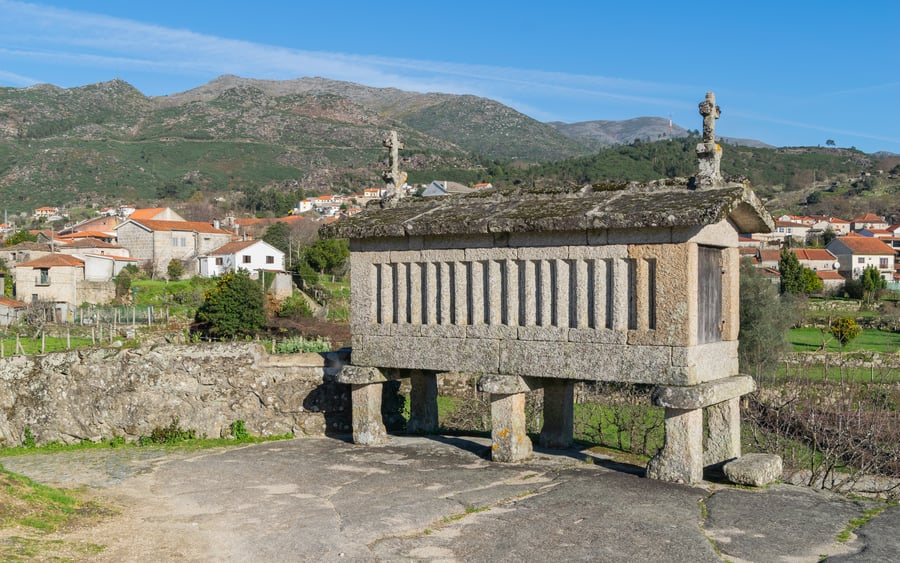
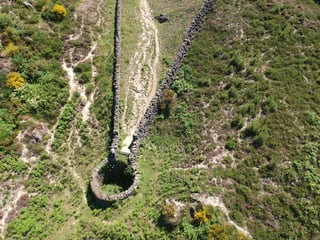
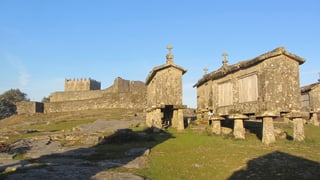
Much of what a visitor sees follows from that. At Soajo twenty-four granite granaries stand together around the village’s shared threshing floor, on a granite outcrop. At Fafião the village herd usually goes up to the high pastures on a Saturday in May, on a day fixed at a meeting held on the first Sunday of the month, and as a rule comes down on 29 September. The community there names a herders’ trail across its common, and a viewpoint over the village and its stone wolf trap. At Pitões das Júnias the oven where households baked by turns has been put back in working order.
This is a trip by car, a range or two at a time. The long drives are between the ranges, not to them, so two or three bases serve better than one: Braga or Ponte de Lima, Chaves, Amarante, Arouca. Many mountain villages have a bus only on weekdays or in school term.
Food
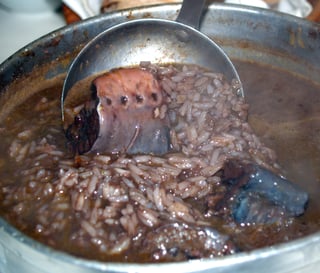
In Ponte de Lima the dish is arroz de sarrabulho: rice cooked loose and brothy with pork and sausage, cumin, bay and cinnamon, and served with rojões, pieces of fried pork. Expresso’s food guide went round the town’s tables in January 2026. A Carvalheira, at Fornelos, has stone walls and the fire lit in winter. Açude, on the river at Arcozelo, charged thirty-two euros for the rice for two. Escondidinho, on Rua do Rosário, is a tasca, a plain eating house, and pours red vinho verde, the Minho’s own wine, into a bowl; the guide gives the wine its local name, pinta-beiços (lip-stainer).
The dish began at the household pig kill, went onto restaurant menus early in the twentieth century and from there to the fair stalls, weddings and births, by the account Nuno Vieira Brito and Joana Santos, coordinators of the Minho’s gastronomic reference, gave Expresso. The brotherhood that keeps the recipe dates its registration with the European Union as a traditional speciality to January 2025 and listed fifteen certified restaurants in the town in November 2026. One weekend in late January is given over to it. Up on the Barroso plateau the pork is smoked instead.
Fifteen houses certified for sarrabulho, the smoked-pork producers' office in Montalegre market on weekdays, and lamprey from January to April on the Minho and the Lima
Ponte de Lima -- sarrabulho all year; the dish's own weekend in late January. The brotherhood's site lists the fifteen certified restaurants (Confraria do Arroz de Sarrabulho, Ponte de Lima -- Portuguese translated to English ). The certificate covers the recipe and how a kitchen makes it, and Expresso reports that the register stays open to any house that applies. In 2026 the weekend ran from 23 to 25 January. Each house keeps its own closing days.
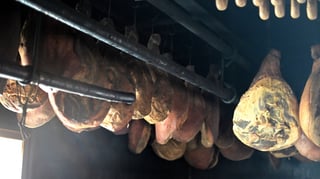
Montalegre -- the producers' office, Monday to Friday, nine to five; the fair over four days in late January. The association of Barroso's smoked-pork producers has its office at shop 2 of the municipal market, on Rua Dr. Vitor Branco, and sells through its web shop; its site names fifty-six producers by village. The national register of traditional products ties the taste of the chouriça, a smoked pork sausage, to the weather: in a cold, dry climate every house keeps its hearth lit, and the sausage hangs ten to fifteen days in a slow smoke, mostly of oak. The rules have it made and packed in this one municipality. The salpicão and the alheira have protected names as well.
At shop 3, next door, the Taverna do Mercado serves a drink and a piece of regional bread over the counter.
Caminha to Melgaço -- lamprey at weekends, mid-January to early April; Santa Marta de Portuzelo from January. Six municipalities of the Minho valley, from Caminha at the river mouth up to Melgaço, put lamprey on their restaurant tables together every weekend of the season, under the name Lampreia do Rio Minho, Um Prato de Excelência (Discover Melgaço, Melgaço -- Portuguese translated to English ); in 2026 that was 15 January to 5 April.
On the Lima, at Santa Marta de Portuzelo outside Viana do Castelo, Camelo keeps its own lamprey tank. In the Michelin Guide's entry for Camelo (MICHELIN Guide, Camelo, Viana do Castelo), the guide's inspectors point to its lamprey dishes "in season (from January onwards)". The guide lists it closed on Mondays.
Cachena beef at Soajo ordered ahead, Maronesa by the fire at Mondim de Basto, and roast Arouquesa veal at Arouca
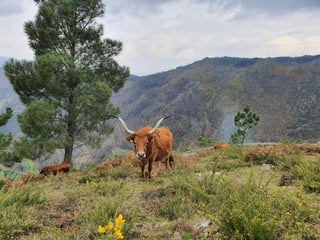
Soajo -- cachena, ordered ahead; cash only. Four of the region's cattle breeds have protected names: Barrosã, Cachena da Peneda, Maronesa and Arouquesa. The register's entry for the Cachena records that the animals of several owners usually graze together, and that an owner minds his neighbours' animals with his own. At Saber ao Borralho, on Avenida 25 de Abril (Estrada Nacional guide, Soajo -- Portuguese translated to English ), the reviewer João Cruz in February 2024 found the beef "melting in the mouth at every forkful", with a bean rice "that could be a dish on its own". The dish is slow to make, he wrote, and "when it runs out, it has run out"; the house takes no cards.
Mondim de Basto -- Posta Maronesa, at lunch or dinner; confirm the closing day before going. Maronesa is the beef of the Marão, Alvão and Padrela ranges. At Adega Regional 7 Condes, on Travessa do Escourido (Estrada Nacional guide, Mondim de Basto -- Portuguese translated to English ), Francisco Varella of the same guide sat in the lower room beside the fire in February 2024 and was brought fritters made to order, home-cured ham and then the posta, a thick-cut steak, "that seemed like butter", with oven rice.
Arouca -- roast Arouquesa veal; lunch every day but Wednesday, by the paper's listing of November 2025. South of the Douro the breed is the Arouquesa, whose meat the register calls particularly suited to roasting over embers. At Parlamento, on Travessa da Ribeira (Jornal de Notícias, Arouca -- Portuguese translated to English ), the critic Fernando Melo wrote that he had never failed to order the veal roasted the regional way: "very tender, it almost falls apart in the mouth." The house white vinho verde goes with it, by his account, and the meal can end on the morcela of Arouca, a convent sweet of bread, cinnamon and almonds turned in a dry pan.
The wine buried in cellar floors at Boticas, honey on the rabanadas at Vilarinho Seco for a table of ten, and in Chaves a veal pastry and a street fountain running at 76 degrees
Boticas -- Vinho dos Mortos, the cellar by appointment; the harvest usually on the first weekend of October. By the town's own account its people buried their wine under the cellar floors ahead of French troops during the second Napoleonic invasion, and dug it up a palhete (a pale red wine) with a little natural gas in it; the name means wine of the dead, and the town keeps a museum of it (Câmara Municipal de Boticas, Boticas -- Portuguese translated to English ). Público found in 2023 that one family, the Sousa Pereira, still made it, burying the bottles for six to eight months in the cellar's gritty soil. "Boticas sits in a hollow," Nuno Pereira told the paper; "it can snow on the serra and not snow here."
At Vilarinho Seco, in the same municipality, Casa do Pedro lists as its specialities Barroso stew, sausages, rye bread and rabanadas, slices of bread soaked, fried and sweetened, with Mel do Barroso, as the portal writes the name of the plateau's honey. It is one of the village taverns of the Alto Tâmega network (Portal do Alto Tâmega, ADRAT, Chaves -- Portuguese translated to English ), and it opens only for groups of ten or more, booked a day ahead.
Chaves -- the Fonte do Povo, free; pastéis at the town's counters. The town hall gives the temperature of the springs on the right bank of the Tâmega as 76 degrees. At the Fonte do Povo a spout delivers the water hot and free, and the Repsol guide's writer, in a piece updated in September 2025 (Guia Repsol, Chaves -- Portuguese translated to English ) watched residents fill bottles to take home.
The Pastel de Chaves is a half-moon of flaky pastry filled with minced veal, and its protected name is limited to the municipality. Of the counters the same writer tried, he called D'Chaves "perhaps the best of all", its layers "so thin they could almost fly off in the wind".
Culture
On the plateau of Castro Laboreiro, at the northern end of the national park, a family kept two houses. The branda stood on the high ground and the inverneira in a sheltered valley below, and the household moved between them twice a year with its animals, down before Christmas and up again around Easter. In February 2023 the Diário do Minho reported that Leonor Rodrigues and her mother, Isalina, had made the move from Padresouro to Cainheiras before Christmas, and called them the last women of the parish to keep it. “I like to spend Christmas here and Easter up there,” Leonor told the paper. She gave the reason the others had stopped: “Now there are fewer animals and a lot of hay. On bad days the animals stay in the byre and feed on hay.”
The paired villages are still there to visit. The museum in the village of Castro Laboreiro shows the brandas, the inverneiras and the plateau, with a house beside it furnished as a local home of the later twentieth century. It opens Tuesday to Sunday and costs three euros. The village is reached by car from Melgaço.
The museum at Castro Laboreiro and the two women's account, the herders' trail on the common land of Fafião, and bull contests at Montalegre up to an August final
Castro Laboreiro -- Tuesday to Sunday, 9.30 to 1 and 2 to 6, closing at 5 from October to March; three euros. The museum is in the former Caravelos chocolate factory, and its page lists the days it closes (Núcleo Museológico de Castro Laboreiro, Melgaço -- Portuguese translated to English ), with a ticket for Melgaço's four museums at eight euros.
The newspaper report, by Andrea Cruz of the Lusa agency, is the two women's own account of the move (Diário do Minho, Braga -- Portuguese translated to English ). It records that a third woman, Raquelinda Gonçalves, gave the move up in 2021.
Fafião -- the herd goes up on a Saturday in May and comes down by 29 September; the village festival in July. At Fafião, in the parish of Cabril on the Montalegre side of the national park, the common land covers a little over two thousand hectares. The community's page names the trails across it (Comunidade Local dos Baldios de Fafião, Montalegre -- Portuguese translated to English ), the Trilho da Vezeira (the herders' trail) among them, and a viewpoint from which the village and its wolf trap are both seen. The municipality's sheet on the custom gives the calendar. A meeting on the first Sunday of May fixes the day of the climb, by custom a Saturday, and the herd of goats and cattle comes down as a rule on 29 September. In July the community holds a festival, Aldeia de Lobos (village of wolves).
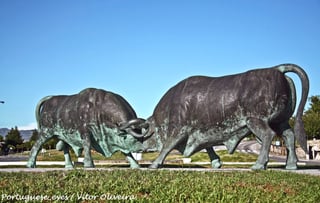
Montalegre -- bull contests; the 2026 final was on 6 August. A chega sets two bulls of the Barrosã breed head to head until one gives way. A feature in the paper of a Lisbon journalism school (Diário LX, Lisbon -- Portuguese translated to English ) traces the contest to the Boi do Povo, the village bull, a breeding animal chosen and kept by the community: the contest between the best bulls helped confirm the quality of the bull that would sire the herds. The village bull has gone, the feature says, and the tradition "changed function, became an organised show and passed into the hands of private breeders". The 2026 championship ended with its final during the municipality's festival.
Wool woven by hand at Campo Benfeito in the Montemuro, black pottery at Bisalhães outside Vila Real, and a loom to try at Limões, Tuesday to Saturday
Campo Benfeito, Castro Daire -- the workshop in the old village school; hours by telephone. Four women of the Montemuro range run a cooperative begun in 1987: Ester Duarte, Henriqueta Félix, Engrácia Félix and Isabel Duarte. Their own page (Capuchinhas, Castro Daire -- Portuguese translated to English ) says they make clothing in burel, linen and wool, woven on hand looms, and that their name comes from the capucha, the cape shepherds wore against cold and rain. They began, they write, with a dressmaking course in the 1980s, "a decade in which emigrating was almost the only option". In November 2026 their shop priced a black burel bag at 87 euros and a blue coat at 228. The page gives no opening hours; the workshop's telephone is 254 689 160.
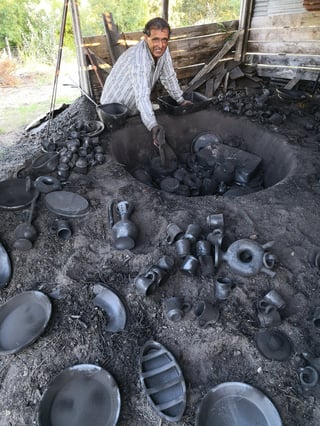
Bisalhães, Vila Real -- made and sold all year at workshops in the village and at the entrance to the city; the potters' fair in Vila Real on 28 and 29 June. UNESCO put the making of Bisalhães black pottery on its list of heritage in need of urgent safeguarding in 2016. The clay is crushed with a wooden hammer in a stone tank, shaped, smoothed with pebbles and decorated with a stick.
Portugal's national inventory explains the colour: the kiln is covered with branches of broom and with earth, so that the pots fire without oxygen. The inventory, in an entry dated 2014, says the craft was down to five potters. It says the ware is sold at workshops at the entrance to Vila Real and in the village, and that the large jars were once used to keep honey or sausages. The ware is much sought by visitors, the inventory adds, and for that reason nearly every piece is decorated.
Limões, Ribeira de Pena -- Tuesday to Saturday, 9.30 to 1 and 2 to 5.30; free. Ribeira de Pena's linen is woven at Cerva and Limões. The municipality's linen museum (Centro de Interpretação-Museu do Linho, Ribeira de Pena -- Portuguese translated to English ) is in the building of the Limões weaving group, in the old centre of the village. The visit follows the working of the flax through to the group's workshop, where, the page says, visitors may watch and try the work at the loom. It closes on public holidays and opens on other days by appointment.
Montalegre's night of witches on every Friday the 13th, Amadeo de Souza-Cardoso's paintings at Amarante, and sculpture in the streets of Vila Nova de Cerveira
Montalegre -- every Friday the 13th; after November 2026 the next is 13 August 2027. Montalegre holds its Noite das Bruxas (night of witches) whenever the 13th falls on a Friday, and the town hall's page for the event (Câmara Municipal de Montalegre -- Portuguese translated to English ) carries the notices for each edition. Its report on the night of March 2026 counted the visitors in thousands. The date follows the calendar, so 2026 had three and 2027 has one.
Amarante -- Tuesday to Sunday; 4.45 euros, free on the first Sunday of the month before noon. The Museu de Arte Moderna Amadeo de Souza-Cardoso occupies a sixteenth-century convent on Alameda Teixeira de Pascoaes. Público's critic Sérgio C. Andrade walked it with the director in 2018 and wrote that, after the Gulbenkian in Lisbon, it holds the largest collection of the painter's work; his account of the visit (Público, Lisbon -- Portuguese translated to English ) has the director on the painting "A casa de Manhufe", of about 1913, which "already announces cubism". The museum reopened in December 2025 after a closure, and its visiting page (Museu Amadeo de Souza-Cardoso, Amarante -- Portuguese translated to English
) gives hours of 9.30 to 12.30 and 2 to 5.30 from October to May, 10 to 12.30 and 2 to 6 in summer. It closes on Mondays, public holidays and 8 July.
Vila Nova de Cerveira -- sculpture in the streets, free, all year. The first Bienal Internacional de Arte de Cerveira ran from 5 to 12 August 1978, under the motto of taking art to the street. The history the Bienal publishes (Fundação Bienal de Arte de Cerveira -- Portuguese translated to English ) includes a text of 2011 by Eurico Gonçalves, which lists the sculptors whose work stands about the town, José Rodrigues, Clara Meneres and Zadok Ben-David among them. The Convento de São Paio is the house-museum of José Rodrigues, in that text the first artist to discover Cerveira, where he settled.
Natural History
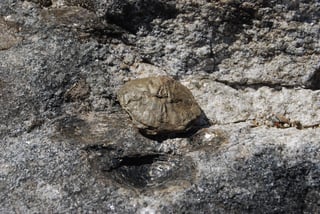
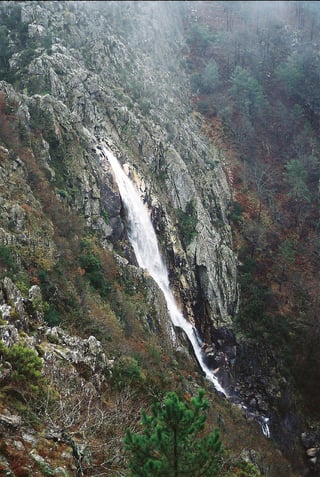
At Castanheira, a village on the Freita plateau above Arouca, the granite is full of dark discs. They are nodules of biotite, a black mineral, each shaped like a lens and between one and twelve centimetres across, and the outcrop that holds them covers a square kilometre around the village. As the granite weathers, the nodules come away from it. People who found them lying loose, the Arouca geopark writes, had no way of knowing the cause, and named the rock pedras parideiras (stones that give birth). The geopark dates the granite to between 320 and 310 million years ago.
The outcrop has been a local natural monument since 2022, and the interpretation centre in the village opens every day, from 9.30 to 12.30 and from 2 to 5. A circular walk of seventeen kilometres leaves Castanheira for the plateau. From the village the Frecha da Mizarela is in view, where the Caima river falls more than sixty metres.
The centre at Castanheira and its guided visits, the Mizarela falls from the viewpoint, and the Paiva walkways, open in November 2026 from Areinho to Vau
Castanheira, Arouca -- every day, 9.30 to 12.30 and 2 to 5; guided visits booked two days ahead. The geopark's page on the nodular granite of Castanheira (Arouca Geopark -- Portuguese translated to English ) describes the walk, the PR15, which goes into the interior of the Freita plateau. The interpretation centre's page (Visit Arouca -- Portuguese translated to English
) gives its address on Rua de Santo António and asks for forty-eight hours' notice, by email, for a guided visit, an audio guide or a bicycle. It prints no entry price.
Mizarela, Arouca -- the viewpoint by the village; all year. At the Frecha da Mizarela granite meets schist. Schist is the less resistant rock, the geopark explains, and the river cut a deep valley into it, which made the drop. The fall is seen from the viewpoint near the village of Mizarela, from Castanheira, and from the PR7 trail along the escarpment, where two oaks grow, the common oak and the Pyrenean oak.
The Paiva gorge, Arouca -- every day but 25 December; November to March 9 to 5, last entry at 3; booked ahead. The wooden walkways along the Paiva run 8.7 kilometres one way, and the municipality's ticket page (Câmara Municipal de Arouca -- Portuguese translated to English ) allows two and a half hours and rates the difficulty high. In November 2026 it carried a notice: the Espiunca entrance was closed, and the stretch from Areinho to Vau was open.
Above the gorge is the 516 Arouca footbridge (516 Arouca -- Portuguese translated to English ), 516 metres long and 175 metres over the river at its highest point. An adult ticket was twelve euros in November 2026, sold online only, and covers the walkways on the same day.
In the national park: the oak wood of Albergaria with the Roman road through it, wolves and wild goats, and the Gerês iris in flower in May and June
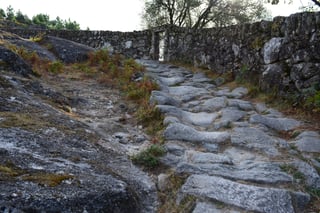
Mata de Albergaria, Terras de Bouro -- a vehicle fee in summer; ask the park before driving in. Terras de Bouro describes the Mata de Albergaria (Município de Terras de Bouro -- Portuguese translated to English ) as one of the most representative oak woods of the national park, of common oak and Pyrenean oak, with a stretch of the Roman road running through it, the ruins of its bridges and a group of milestones. An order of 2007 sets a daily access fee for motor vehicles from 1 June to 30 September; the rules for driving through are in the park's own notice. In November 2026 the municipality was paving the forest road, with temporary limits on traffic, by Braga TV's report of 10 November.
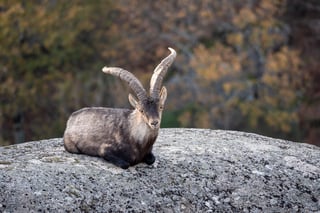
The national park -- animals by chance, at dawn and dusk. The park's own account of its wildlife says the Iberian wolf has here its highest density in the Iberian Peninsula, and names the roe deer as the park's emblem. The wild goat, by the same account, was extinct in Portugal from 1890; it was released 109 years later in the Spanish park across the border, and has spread into this one. Mike Unwin walked from Soajo for the Guardian in April 2025 and found wolf droppings on the trail. "It's thrilling to know they're here," he wrote, and of the open ground: "Dartford warblers scold from the heather."
Gerês, Amarela and Peneda -- the iris in May and June; the Mourela plateau in late spring. Iris boissieri is the lírio-do-Gerês (the Gerês iris). The botanic garden of the university at Vila Real (Jardim Botânico UTAD -- Portuguese translated to English ) gives its range as the north-west of the Iberian Peninsula, and within Portugal the mountainous north-west alone, and its flowering as May to June.
On the Mourela plateau, in Montalegre, the park records the only known breeding place in Portugal of the whinchat, a small bird of open moor.
The Olo falling over quartzite at Ermelo in the Alvão, the lagoons four kilometres from Ponte de Lima, and the riverside path at Vila Nova de Cerveira for winter birds
Ermelo, Mondim de Basto -- a marked trail; half a day with the village. At the Fisgas de Ermelo the Olo river drops through a band of quartzite in a run of falls. Mondim de Basto's page on the falls (Município de Mondim de Basto -- Portuguese translated to English ) dates the rock to about 480 million years and says a walking trail, the PR3, opened in 2016. Above and below the falls are piocas (natural pools). The park's management plan puts the falls on the line between its high ground and its low ground.
Bertiandos, Ponte de Lima -- every day, 9 to 12.30 and 2 to 5.30. The lagoons of Bertiandos and São Pedro d'Arcos are a protected landscape four kilometres from Ponte de Lima, and on the Ramsar list of wetlands of international importance since 2005. The interpretation centre (Lagoas de Bertiandos e São Pedro d'Arcos, Ponte de Lima -- Portuguese translated to English ) is on Rua da Lagoa de São Pedro d'Arcos and keeps the same hours at weekends and on holidays.
Vila Nova de Cerveira -- the riverside path, all year; water birds from late October to early March. The Caminho do Rio (Câmara Municipal de Vila Nova de Cerveira -- Portuguese translated to English ) follows the Minho for about thirteen and a half kilometres, and the town's page names heron, cormorant, kingfisher and otter along it. The nature agency's plan for the estuary says wintering water birds are most numerous from the end of October to the start of March. It also says the Minho is one of two river basins in Portugal where salmon still occurs, in extremely low numbers.
Built Heritage
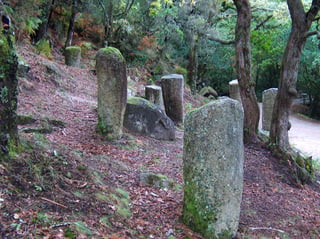
Around the year 80 Rome finished a road from Braga to Astorga, in what is now Spain, across the Gerês mountains. The Portuguese call it the Geira. The road still has its milestones: for its Portuguese section the municipality of Terras de Bouro gives 140 inventoried and 102 standing where they were set, most of them inscribed. The road passes through the oak wood of Albergaria. Mike Unwin, who walked it for the Guardian in 2025, described “a two person-wide granite contour path that winds south through deep woods of oak and pine”.
The museum at Campo do Gerês was built for the road and opened in 2013. It shows how Roman roads were made and what travelled on them. It opens Tuesday to Sunday and costs two euros. For the road itself the municipality offers a free mobile app.
The Geira's museum at Campo do Gerês, the Roman bridge at Chaves with the baths under the square, free, and the bridge Ponte de Lima is named for
Campo do Gerês, Terras de Bouro -- Tuesday to Sunday, 9.30 to 12.30 and 1.30 to 5, last entry 4.30; two euros. By the municipality's account of the road (Município de Terras de Bouro -- Portuguese translated to English ), it was begun under the emperor Vespasian and continued under Titus and Domitian, and ran 240 Roman miles. The stretch between miles fourteen and thirty-four has been a national monument since 2013. The museum's page (Museu da Geira, Terras de Bouro -- Portuguese translated to English
) lists its closed days, Mondays, 25 December, 1 January and Easter Sunday. One euro more admits to the two other parts of the site, among them the museum of Vilarinho da Furna, a village flooded by a reservoir.
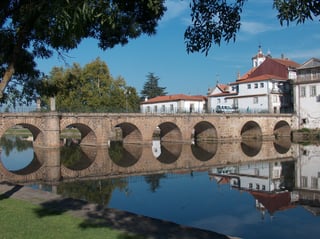
Chaves -- the bridge always open; the baths museum free. The Roman bridge over the Tâmega is about 140 metres long on sixteen round arches. Two columns on it carry Latin inscriptions, and the town's heritage site (Câmara Municipal de Chaves -- Portuguese translated to English ) reads them: one records that the people of the town built the bridge in the time of Trajan, the other names ten peoples of the region.
The museum of the Roman baths is on the Largo do Arrabalde. An earthquake in the last decade of the fourth century brought down the vaults, the site says, and buried the bathers under them. The museum's own page (Museu das Termas Romanas, Chaves -- Portuguese translated to English ) has it closed on Mondays; the town hall's page, updated in November 2026, has it open every day.
Ponte de Lima -- a footbridge in the town; always open. The bridge is Roman in origin, though of that period little more is left than two arches by the right bank. In the second half of the fourteenth century it was built again almost from nothing, and the town's culture site (Município de Ponte de Lima -- Portuguese translated to English ) gives the likely cause, land clearance that changed the riverbed, and quotes the historian Almeida: the Lima had moved a little to the south, and the old bridge no longer crossed it. The medieval bridge has eighteen pointed arches, three of them buried under the Praça Camões. For centuries it was the only crossing of the Lima on foot.
On the riverside sand the town holds its fair every other Monday; the Alto Minho's association of municipalities calls it the oldest fair on record in Portugal, named in the town's charter of 1125.
Lindoso's castle and sixty-four granaries, the terraces of Sistelo held by decree, and the monastery below Pitões das Júnias
Lindoso, Ponte da Barca -- the threshing floor is open ground; telephone for the castle's museum. The castle (Câmara Municipal de Ponte da Barca -- Portuguese translated to English ) was built about 1250 under Afonso III to defend the frontier, and has been a national monument since 1910.
Below it, by the municipality's count, sixty-four granite granaries (Câmara Municipal de Ponte da Barca -- Portuguese translated to English ) stand together on a communal threshing floor, built between the eighteenth and twentieth centuries. Neither page prints opening hours; the number given for the castle is 258 578 141.
Sistelo, Arcos de Valdevez -- an open village and its terraces. The landscape of Sistelo was classified as a national monument in 2018. The national register (Património Cultural, Lisbon -- Portuguese translated to English ) sets out how the valley was arranged: the sunniest ground for the granaries, the riverbank for the mills, the slopes for narrow terraces and water channels where maize has been grown since the sixteenth century, and near the top of the range the pastures of the herds that move with the season, with their shelters and pens. An order of the same year fixed what may be built. It bars plastic window frames, sandwich-panel roofs and stone cladding, and requires work on walls, terraces and paths to keep their character.
Pitões das Júnias, Montalegre -- an open site below the village. The monastery of Santa Maria das Júnias was probably built on a hermitage of the ninth century. An inscription on the outside of the church gives the date 1185, and the Cistercian route's page (Rota de Cister -- Portuguese translated to English ) says the house was Benedictine at first and Cistercian from 1248. Three round arches of the Romanesque cloister are standing, with the church's Romanesque doorway and a later bell-gable. It has been a national monument since 1950. The page gives a contact number, 966 563 939.
Walled apiaries at Ermelo and a beekeeper's guided walk, the castle above Castro Laboreiro twenty minutes on foot, and the convent museum at Arouca, Tuesday to Sunday
Ermelo, Mondim de Basto -- a guided honey walk, booked by message. The Alvão and Marão ranges have silhas (walled apiaries). Mondim's parish council describes the walls (Junta de Freguesia de Mondim de Basto -- Portuguese translated to English ) as large stone enclosures on slopes and on knolls that are hard to reach, built to protect the colonies, and presumes the main predators were the badger and the brown bear. The local operator Por'Trilhos sells a honey trail (Por'Trilhos, Mondim de Basto -- Portuguese translated to English
): the walls and the hives, the beekeeper and the extraction of the honey, and a tasting of comb, honey and propolis with bread from a wood oven. The page gave a price from 37.50 euros in November 2026 and takes bookings by WhatsApp.
Castro Laboreiro, Melgaço -- every day, free; twenty minutes on a rough path. The castle stands on a summit above the village. Melgaço's page (Castelo de Castro Laboreiro, Melgaço -- Portuguese translated to English ) says to leave the car at the Miradouro do Castelo and follow the path up. The national register, which classified it in 1944, describes a second, larger enclosure on the south side, entered by a single gate, that served to gather cattle and goods in times of invasion. The register says the feature appears to be unique in Portugal, and takes it as proof of how much the medieval hill communities lived by their herds.
Arouca -- Tuesday to Sunday, mornings 9.30 to 12; three euros for the museum, the church free. The convent of Arouca is documented from the tenth century and was a house of women only from 1154. It grew after Mafalda, daughter of King Sancho I, entered it in the thirteenth century; she is buried there. The state's culture page (Cultura Portugal -- Portuguese translated to English ) dates the church to 1704 to 1730, to a design by Carlo Gimac, and calls the museum of sacred art in the convent "one of the best of its kind in the whole Iberian Peninsula". The afternoon hours differ: the state's page gives 2 to 5, and the brotherhood that runs the museum 3 to 6.
I want to dig deeper
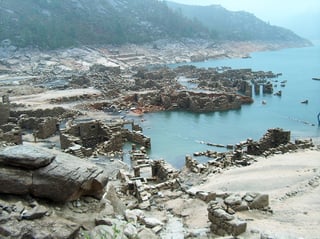
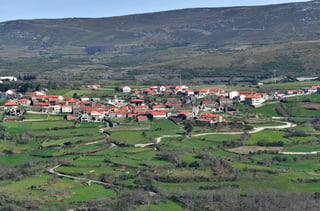
Three things here take longer. The villages that went under the reservoirs of the Cávado scheme, the last of them in 1972, one of which has houses and walls that can be seen again when the water is low. The length of the national park on foot, nineteen stages from Castro Laboreiro to Tourém, or six days of it from Soajo with the bags sent ahead. And the Barroso plateau one village at a time, through the small museums its two municipalities keep in a bull’s stable, a captain’s house and a wolfram mine.
The drowned villages and when Vilarinho da Furna stands clear of the water
The drowned villages -- the ruins show when the reservoir is low; by car in summer only, on foot the rest of the year. Vilarinho da Furna, in Terras de Bouro, was submerged in 1972 by a dam built to make electricity. About fifty-seven families were moved in 1969 and 1970 and paid for their fields and houses, and no new village was built for them. The figures are from André Pereira's study of Portugal's submerged villages (Análise Social, Lisbon -- Portuguese translated to English ), published in 2025.
It names two earlier villages of the same hydroelectric scheme: Venda Nova, in Montalegre, flooded in 1951, and Vilar da Veiga, flooded in 1954 by the Caniçada dam. By Pereira's account Venda Nova was probably the first displacement in Portugal to be given a new village, designed by the architect Januário Godinho and never wholly built.
When the dam is emptied for cleaning, or the level drops in a drought, the houses, lanes and walls of Vilarinho can still be seen, by the municipality's page on the village (Município de Terras de Bouro -- Portuguese translated to English ). The way in is a dirt track for the private use of the former inhabitants. Cars are sometimes let through in the summer months, on a fee paid to their association, A Furna, and for the rest of the year the track is walked. A drought early in 2022 brought the ruins out, the study records. The visit depends on the water level, and no date can be given for it.
The village's own things are at Campo do Gerês. Late in 1968 the people of Vilarinho, the parish council and Manuel Azevedo Antunes gathered its farm tools and household objects to keep them, and the museum that holds them (Museu Etnográfico de Vilarinho da Furna, Terras de Bouro -- Portuguese translated to English ) was built by the municipality from 1981 with material brought from the village, and opened on 14 May 1989. It keeps the hours of the Geira museum beside it, Tuesday to Sunday, for two euros. The Vilarinho exhibition is on the first floor, which the page says cannot be reached by visitors with reduced mobility.
The national park on foot from Soajo or from end to end
The national park on foot -- May, early June, late September and October; ask about fire closures stage by stage. The GR 50 crosses the whole park in the mountains: about 190 kilometres in nineteen stages, from Ameijoeira at Castro Laboreiro to Tourém, by Soajo, Lindoso, Brufe, Campo do Gerês and Pitões das Júnias. The route's own page (ADERE Peneda-Gerês -- Portuguese translated to English ) lists each stage and offers the map and the track for a phone. It also prints the bank details of the local communities that own the land the route crosses.
Mike Unwin of the Guardian walked six days of this country in mid-April 2025, fifty-five miles from Soajo to the monastery of Santa Maria do Bouro, with nights at Soajo, Lindoso, Brufe and Campo do Gerês. On the way he climbed to the Casarotas wolf trap: "two dry-stone walls that descend a steep hillside in a V-shape, converging on a hidden pit". The walk ends at a twelfth-century Cistercian monastery that is now a hotel. His account names the operator, On Foot Holidays, and a price from 940 pounds for seven nights as published in May 2025, with bed and breakfast, lunches, luggage transfers, maps and a navigation app. The months in the label are the ones he gives as among the best.
Barroso village by village through its free museums
Barroso village by village -- any season; each village museum keeps its own days. In 2018 the United Nations' food agency listed the farming of Barroso among its agricultural heritage systems, and its page describes the order a visitor sees in every village. Nearest the houses are the vegetable gardens and the hay meadows. Further out are the fields of winter cereal and potato, usually watered by rain alone. On the outskirts is the hill land, usually common, under scrub that is cut for cattle bedding. In winter water is run over the meadows, and the page gives the reason: running water is always above freezing, so the grass is kept from the ice. Beekeeping, the page adds, is part of the system.
The Ecomuseu de Barroso is the place to start. Its seat is in Montalegre, by the castle, with a model of the district marked with more than a thousand points of interest, and the regional portal's list of museums (Portal do Alto Tâmega -- Portuguese translated to English ) gives it as free and open Tuesday to Sunday, 10 to 1 and 2 to 6. "This is not a museum where people come in, look and go home," Fátima Fernandes, then the town's councillor for education, told the Diário do Minho in 2018. "This is a living museum. It is a way of sharpening curiosity, the appetite for people to set off into the territory ..."
The same list gives the village sites and their hours, and marks five of the Montalegre ones free.
- At Pitões das Júnias the museum is in the Corte do Boi (the stable of the village bull), open at weekends from 3 to 5.30, and a route from it passes the oven, still in use, a mill, a granary and a sundial.
- Tourém's, also in a bull's stable, is given to the birds of the district and is the start of three trails, one named for smuggling.
- At Salto a captain's house holds more than a thousand objects, and the Borralha mine, worked for wolfram from 1902 to 1986, opens every day.
- Fafião's is on the herd and the mountain.
- In Boticas the Museu Rural opens Tuesday to Friday, and the Quinta do Cruzeiro at Covas do Barroso in July and August.
The Honey of the Barroso Northwest Mountains
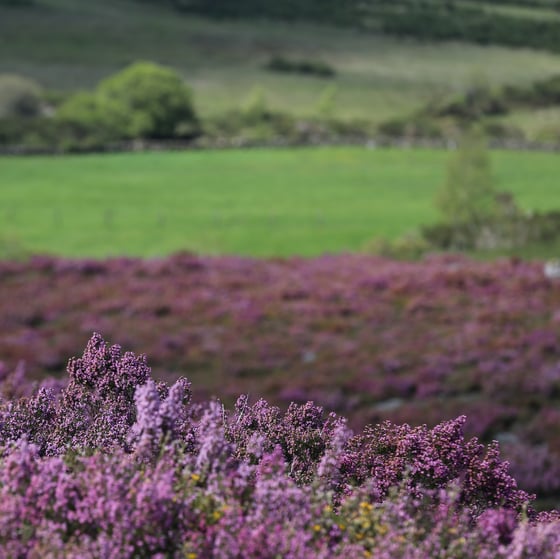
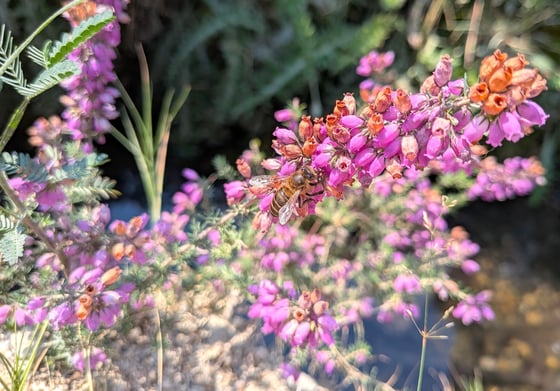
The honey is made on the heath. In Barroso the producers’ group, the Boticas farm cooperative CAPOLIB, describes Mel de Barroso (CAPOLIB, Boticas – Portuguese translated to English ) as a dark honey made mostly from heathers by the Iberian honeybee on the higher ground of the plateau, and takes it from the hives between 15 July and 15 September. The name is protected for Boticas, Chaves, Montalegre and Vila Pouca de Aguiar, with two parishes of Murça, and was entered in the European Union’s register in June 1996. In the agriculture directorate’s lists for 2020 to 2025 the cooperative is the only body that prepares honey under the name, at its honey house at Carreira da Lebre.
Mel de urze (heather honey) is sold under that plain name across these ranges, from the Freita and the Montemuro to the hills above Melgaço. Barroso also has melada (honeydew honey), which bees make from a sugary liquid they collect on the oaks and not from flowers; sellers name it in their descriptions, and it is sold inside a jar labelled mel de montanha (mountain honey). Chestnut honey comes from the Alvão, the Marão and the Lima valley, and eucalyptus honey from the valleys and the coast. In the Alto Minho honeys are sold under the names of the ranges and rivers they come from: Mel da Serra d’Arga, Mel da Serra do Soajo, Mel Serra da Labruja, Mel do Vez.
A second protected name, Mel das Terras Altas do Minho, covers nineteen municipalities and parts of five more, some of them outside the ranges on this page. The agriculture directorate’s lists show no honey marketed under it in any year from 2020 to 2025, so the honey of that area is sold under its makers’ own names.
The state’s farm-payments agency publishes the beekeeping declarations by region (IFAP, Lisbon – Portuguese translated to English ). For 2025 its table gives the Norte about 259,000 colonies in some 12,000 apiaries, a third of the country’s colonies. The Norte is wider than the ranges on this page, and the search for this page found no government count for a smaller area after 2020. The agriculture directorate listed twenty-one operators under the Barroso name in 2025.
The written record is old. A parish book of Ermelo from 1707 obliged the parishioners to pay tithe on wax, swarms and hives. The arms of Boticas carry a bee, and so, by the cooperative’s account, do those of Vila Pouca de Aguiar.
The road below has five legs, one for each group of ranges, and no single centre. Barroso, Amarante, Arcos de Valdevez and Arouca have shops with posted hours. On the Gerês side and on the Montemuro most sellers publish no timetable, so telephone first. The one named honey route found for this page is in Amarante.
The Honey Road
Five legs, each a day or two from its own base town: the cooperative's shop on the Barroso road, a named bee walk and two hive days around Amarante, the valley shops and an apiary visit in the Alto Minho, three sellers to telephone on the Gerês side, and Arouca's weekday counter with the Montemuro beyond it.
Boticas and Montalegre -- the cooperative's shop Wednesday to Sunday, the producers' office on weekdays; the honey taken from mid-July to mid-September
Start where the Barroso honey is extracted. At Carreira da Lebre, on the road that joins Boticas to Ribeira de Pena and Montalegre, the cooperative's honey house stands by its Loja Rural de Produtos de Montanha (CAPOLIB, Boticas -- Portuguese translated to English ). The shop sells the honey beside smoked pork, bread, Barrosã beef, nuts, cheese and local craft, and the page gives it as open Wednesday to Sunday, 10.30 to 12.30 and 2 to 6.30. The cooperative offers no public visit to the honey house.
Find it in Google Maps
North of Boticas at Vilarinho Seco, Casa do Pedro lists rabanadas with Mel do Barroso among its specialities, for tables of ten or more booked a day ahead.
Find it in Google Maps
In Montalegre the smoked-pork producers' association has its office at shop 2 of the municipal market, open on weekdays from 9 to 5. Its list had three honeys in November 2026, Mel de Pitões among them; ring 276 009 144 first to ask whether jars can be bought there. The Taverna do Mercado at shop 3 serves a drink and bread.
Find it in Google Maps
The year's honey fair is at Pedras Salgadas, in Vila Pouca de Aguiar: the Feira do Mel e do Artesanato (Município de Vila Pouca de Aguiar -- Portuguese translated to English ) was held in the spa park on 14 to 16 August in 2026, its twenty-fifth edition.
Find it in Google Maps
This leg as a driving route in Google Maps: Start Loja Rural, Carreira da Lebre; A Casa do Pedro, Vilarinho Seco; End Mercado Municipal de Montalegre.
Amarante and Mondim de Basto -- the Rota das Abelhas on any day, the market on Wednesday and Saturday; the hive days by booking
Amarante has a named honey route. The Rota das Abelhas (Amarante Tourism -- Portuguese translated to English ) is an easy walk of 2.1 kilometres through the town centre, with points that a phone picks up by Bluetooth signal. Among them are the Dolmen shop, where the page says several kinds of honey are sold; the municipal market, open on Wednesdays and Saturdays, with honey, pollen and royal jelly; a garden of nectar plants; and the roof of the Amadeo museum, where swarms settle in spring. Among the page's other points are a working apiary on the Marão and an old walled one. The page dates from 2024, so ask at the tourism office whether the signals still work.
In Google Maps: the Dolmen shop; the municipal market.
At Vila Meã, west of the town, the Casa da Abelha e do Mel runs Apicultor por um Dia (beekeeper for a day) (Casa da Abelha e do Mel, Vila Meã -- Portuguese translated to English ). It begins at 8.30 with a breakfast tasting of honeys, goes on to the kinds of hive, breaks for lunch at the visitor's own cost, and ends at 5.30 after a walk to the apiary to open a hive and find the queen. In November 2026 it cost 123 euros an adult and 61.50 a child up to twelve, for groups of four to twelve aged seven and over, in Portuguese.
Find it in Google Maps
At Mondim de Basto the Por'Trilhos honey trail, described under Built Heritage, goes to the walled apiaries and a beekeeper's house, and the Adega Regional 7 Condes is the lunch.
Find it in Google Maps
The road goes on to Ermelo and the falls of the Olo.
This leg as a driving route in Google Maps: Start Mercado Municipal de Amarante; A Casa da Abelha e do Mel, Vila Meã; B Adega Regional 7 Condes, Mondim de Basto; End Ermelo.
Ponte de Lima, Arcos de Valdevez and Melgaço -- the Arcos shop on winter afternoons, Wednesday to Sunday; the apiary visit by booking, best from March to October
At Feitosa, outside Ponte de Lima, the farmers' cooperative runs the Mercado Agrolimiano (Coopalima, Ponte de Lima -- Portuguese translated to English ), a counter for goods chosen online or on the spot and collected on weekdays, 9 to 12.30 and 2 to 5.30. One of its sellers is Mel Serra da Labruja, made in the parish of Labruja by Alberto Cunha, a soldier for thirty years who now keeps bees full time. He lists eucalyptus honey, heather honey and heather honey in a traditional pot.
Find it in Google Maps
In Arcos de Valdevez the wine growers' association keeps a shop, the Espaço Vinhos e Sabores, and the town's tourism page (Visit Arcos, Arcos de Valdevez -- Portuguese translated to English ) lists what it sells: local wines, honey, jams, sweets, biscuits, sausages and liqueurs. The winter hours are Wednesday to Saturday from 1 to 7 and Sunday from 1 to 6; the page prints no summer hours. The honeys on the association's web shop in November 2026 included Apivez and Mel do Vez.
Find it in Google Maps
Up the valley, Soajo has the granaries and the cachena at Saber ao Borralho, ordered ahead.
In Google Maps: the granaries; Saber ao Borralho.
At Cousso, above Melgaço, Abelhas do Paulo shows its apiary by appointment, and gives March to October as the best season; its visit page (Abelhas do Paulo, Melgaço -- Portuguese translated to English ) sets out an hour to an hour and a half: open hives, the laboratory where queens are inseminated, and honey eaten from the comb. It cost 30 euros a person in November 2026, children free, booked on 936 536 780, and visits are put off in heavy rain or below 14 degrees. The bees are Buckfast, a bred strain, where the two protected names admit the local bee alone, and the jar is sold as Mel de Urze.
Find it in Google Maps
In Melgaço town the shop of the Solar do Alvarinho sells honey with the wine.
This leg as a driving route in Google Maps: Start Mercado Agrolimiano, Feitosa; A Espaço Vinhos e Sabores, Arcos de Valdevez; B Saber ao Borralho, Soajo; C Solar do Alvarinho, Melgaço; End Abelhas do Paulo, Cousso.
Vieira do Minho, São Bento da Porta Aberta and Covide -- telephone first; Terras de Bouro's honey contest in mid-November
Vieira do Minho's town hall writes that the municipality's honey comes from heather, gorse and oak among other plants, that it is poured over rabanadas and cheese, and that several local producers sell it at the tourist office. Its page prints no hours.
Find it in Google Maps
At the sanctuary of São Bento da Porta Aberta a family business, Infusões da Serra do Gerês, sells tea and honey from a stall. Its own page gives 936 501 503 and no timetable.
Find it in Google Maps
At Covide the Loja do Parque, on Rua de Sá, sells products of the Gerês-Xurés biosphere reserve, honey among them. Its site prints opening times beside placeholder text, so telephone first, on 911 798 707.
Find it in Google Maps
At Campo do Gerês a marked trail of five kilometres, the Trilho da Silha dos Ursos, goes to two silhas, the walled apiaries described under Built Heritage. By the municipality's page for the trail (Município de Terras de Bouro -- Portuguese translated to English ), the first is a small stone wall built on top of a boulder in the fifteenth or sixteenth century to keep the cork hives out of reach of bears, and the second a circular wall of the sixteenth or seventeenth. The page allows three hours and rates the walk of medium difficulty. Ask at the park's office at Campo do Gerês whether the waymarks are in good order.
In Google Maps: the start of the trail at Casa da Junceda.
Terras de Bouro judges its own honey each November at the São Martinho fair: the ninth Concurso de Mel das Terras do Gerês (Câmara Municipal de Terras de Bouro -- Portuguese translated to English ), open to producers with apiaries in the municipality, was set for 14 November 2026.
Lunch is at O Abocanhado at Brufe, on the Serra Amarela.
This leg as a driving route in Google Maps: Start Posto de Turismo, Vieira do Minho; A São Bento da Porta Aberta; B Loja do Parque, Covide; End O Abocanhado, Brufe.
Arouca and the Montemuro -- weekday mornings; the honey contest and the chestnut festival in late October; one hive visit a year, in late May or early June
Arouca's Mercado Local (Arouca Agrícola, Arouca -- Portuguese translated to English ), in the bus station building on Rua D. João I, sells the produce of the municipality's farmers on weekday mornings from 10 to 1.30, and on Tuesday and Thursday afternoons from 3 to 6. Its online catalogue in November 2026 listed heather honey and multifloral honey from ApisFreita, an Arouca beekeeper. Whether the jars are on the counter was not confirmed, so ring 256 940 259.
Find it in Google Maps
Opposite the monastery, the Casa dos Doces Conventuais sells the convent's sweets and lists an Arouca honey on its web shop. It publishes no hours; the number is 256 946 066.
Find it in Google Maps
Arouca judges its honey in three classes, heather, eucalyptus and multifloral. In 2026 the contest was on 22 October in the Terreiro de Santa Mafalda, the day before the three-day chestnut festival (Câmara Municipal de Arouca -- Portuguese translated to English ) opened in the old centre. Parlamento is the lunch.
Find it in Google Maps
Once a year the geopark takes a small group to one of ApisFreita's apiaries. In its programme for 2025 (Arouca Geopark -- Portuguese translated to English ) the visit was on Saturday 24 May, from 10 to 1.30, meeting at the chapel of Senhora da Mó, at 7.50 euros a head for six to twelve people booked two days ahead. Notícias de Aveiro gave 6 June for the 2026 visit. No date for 2027 had been published in November 2026.
Find it in Google Maps
Across the range at Mezio, on the EN2 in Castro Daire, the herb grower Ervital sells an organic heather honey of the Serra do Montemuro for collection at its premises, on 254 689 596.
Find it in Google Maps
The Típico do Mezio, a restaurant run by an ethnographic association, has honey in the shop beside its dining room.
This leg as a driving route in Google Maps: Start Mercado Local, Arouca (bus station); A Casa dos Doces Conventuais; B Parlamento, Arouca; C Capela da Senhora da Mó; D Ervital, Mezio; End Típico do Mezio.
Getting Here
The region is entered through Porto. Francisco Sá Carneiro airport lies north of the city, and by road every place on this page is within about two and a quarter hours of it: Amarante and Ponte de Lima about an hour, Montalegre and Castro Laboreiro a little over two. The metro runs from the terminal to the city centre and to Campanhã, the station for trains and coaches.
This is a trip by car. Trains from Porto reach Braga, and Viana do Castelo and Valença on the lower Minho; the times are on the railway’s timetable page. No railway enters the mountains. Buses reach the main towns, but on the timetables read for this page many mountain villages have one only on weekdays or in school term. Arouca is the exception: a daily bus from Campanhã allows a day there without a car.
Under a law of 2024 no toll has been charged since 1 January 2025 on the A24 or on the A4 through the Marão tunnel and beyond it, and the national road company’s toll page (Infraestruturas de Portugal – Portuguese translated to English ) lists both at zero. Most other motorways out of Porto charge. Some toll points have no booth and read the number plate, and a foreign-registered car must have a means of payment activated before it uses them. The toll operators’ visitor site sets out the choices. For a hired car, ask at the desk how tolls are billed.
The long drives are across the region, not to it, so two or three bases serve better than one: Braga for the national park and Ponte de Lima, Chaves for Boticas and Montalegre, Vila Real for Amarante, Mondim de Basto and Castro Daire, Arouca for the Freita.
Seasonal Events Not to Miss
Dates are the organisers’ as read in November 2026. Where next year’s are not yet published the last edition’s are given; confirm each on its own page before travelling.
- Feira do Fumeiro, Montalegre – 21 to 24 January 2027. Four days, Thursday to Sunday, at which the Barroso’s smoked pork is sold by its producers; the 2027 fair is the thirty-sixth. The 2026 fair ran under snow, and the town hall reported afterwards that more than four fifths of the fumeiro brought in was sold. The town hall’s notice of the 2027 dates (Câmara Municipal de Montalegre – Portuguese translated to English
) is the page to watch for the programme.
- Lampreia do Rio Minho, the Minho valley – weekends from mid-January to early April; 15 January to 5 April in 2026. The season in which restaurants in the six municipalities of the Minho valley, from Caminha to Melgaço, serve lamprey in traditional recipes and new ones, organised since 2010 by the valley’s development association; 2026 was the seventeenth. The organiser asks that tables be booked with the restaurants directly, and its page for the 2026 season (ADRIMINHO, Valença – Portuguese translated to English
- Entrudo, Pitões das Júnias – Carnaval; 14 to 17 February in 2026. At Pitões farrapões (masked figures in coloured rags) go through the granite streets without notice, and the village holds a show of local produce, cured sausages, preserves and honey among it, the sixteenth in 2026 by the regional channel’s report (Canal N – Portuguese translated to English
- Entrudo, Melgaço – Carnaval; 14 February in 2026. In Melgaço the procession left at half past nine on the Saturday night in 2026 and ended at the Largo Hermenegildo Solheiro with the burning of the Santo Entroido, a figure dressed in old clothes; the town hall’s notice (Câmara Municipal de Melgaço – Portuguese translated to English
- São Bento da Porta Aberta, Rio Caldo – 21 March, 11 July and 10 to 15 August. The three fixed pilgrimages to the sanctuary above the Caniçada reservoir, the August one called the Grande Romaria Popular by the sanctuary. Pilgrims come from across the country, some on foot, and leave salt, eggs, olive oil and wax figures; the sanctuary’s calendar (Santuário de São Bento da Porta Aberta, Terras de Bouro – Portuguese translated to English
- Festas do Junho, Amarante – the first weekend of June. The town’s feast for São Gonçalo, its patron: the pilgrims’ parade on the Sunday morning, the procession that afternoon and carnations thrown from the Varanda dos Reis of the monastery, with drum contests, folk groups, food stalls, fireworks and the marches on the other days, by the town hall’s standing page (Câmara Municipal de Amarante – Portuguese translated to English
- Vaca das Cordas, Ponte de Lima – the eve of Corpus Christi; 3 June in 2026. A cow led on ropes is run through the town from six in the evening. The custom is older than 1646 on the town hall’s account and has her taken three times round the parish church, then to the Largo de Camões and the sand by the river. The event page (Câmara Municipal de Ponte de Lima – Portuguese translated to English
- Corpo de Deus and the Coca, Monção – Corpus Christi; 4 June in 2026. After the procession through the town, Saint George fights the Coca, a figure of a dragon, in the open-air amphitheatre of the Souto, with the crowd in a ring around them. The national heritage institute’s account has him win only when he has cut off one of its ears, and the fight was entered in the national inventory of intangible heritage by an order of 27 May 2026. The municipality’s standing page (Município de Monção – Portuguese translated to English
- Sexta 13, Montalegre – every Friday the 13th; the next is 13 August 2027. The town’s night of witches. In November 2026 it opened at thirteen minutes past one in the afternoon, with performers as witches and demons in the streets, and a fire show on the castle stage at eleven at night; the town hall’s page for the event (Câmara Municipal de Montalegre – Portuguese translated to English
- Feira do Mel e do Artesanato, Pedras Salgadas – three days in mid-August; 14 to 16 August in 2026. The honey and craft fair of Vila Pouca de Aguiar, held at the spa village and in its twenty-fifth year in 2026. The municipality counts about 150 exhibitors, against some fifty at the start, and the activities run from eleven in the morning to midnight on the Friday and Saturday and to eight on the Sunday; its notice of the 2026 fair (Câmara Municipal de Vila Pouca de Aguiar – Portuguese translated to English
- Senhora d’Agonia, Viana do Castelo – 15 to 23 August in 2026. On the evening of the 19th the streets of the Ribeira quarter are laid with flower carpets, and on the 20th the procession goes out to sea, with more than a hundred decorated boats on the organiser’s count. The organiser also counts a thousand women in the parade in full costume and gold. Bands play against each other in the church square and there are fireworks over the Lima at midnight; the municipal programme (Câmara Municipal de Viana do Castelo – Portuguese translated to English
- São João d’Arga, Serra d’Arga – 28 and 29 August. The pilgrimage to the monastery in the mountain above Caminha. In 2026 the programme ran from an opening mass on the afternoon of the 27th to a closing mass on the 30th, with processions on the afternoon of the 28th and the morning of the 29th; the municipal programme for 2026 (Câmara Municipal de Caminha – Portuguese translated to English
- Senhora da Peneda, Gavieira – 31 August to 8 September. Nine days at the sanctuary in the national park, free, ending on the feast of the Nativity of Mary. In 2026 the bishop of Tui said mass in Spanish on the 5th after a concert of hand-rung bells from Galicia, concertinas were blessed at the sanctuary at nine on the evening of the 6th and paraded to the dance ground, and the candle procession was at nine on the 7th; the municipal programme (Câmara Municipal de Arcos de Valdevez – Portuguese translated to English
- Feiras Novas, Ponte de Lima – 9 to 14 September in 2026. The town’s fair, held since 1826 by its own programme and kept through the night as well as the day, with concertinas in the streets. The two-hundredth year had a historical parade, the procession of Nossa Senhora das Dores at half past four and livestock judging at the Expolima ground, the Garrano horse among the classes. The municipality gives the fair as national intangible heritage; its event page (Câmara Municipal de Ponte de Lima – Portuguese translated to English
- Feira das Colheitas, Arouca – 24 to 27 September in 2026. The harvest fair. The Saturday afternoon has a contest of rams and then one of bulls, and at ten that night maize is husked on the Terreiro de Santa Mafalda, with a dance after. On the Sunday at three the parade passes with ox carts and baskets of produce; the municipality’s standing page (Câmara Municipal de Arouca – Portuguese translated to English
- Melhor Mel de Arouca and the Festival da Castanha, Arouca – late October; 22 October and 23 to 25 October in 2026. The municipality’s honey contest is judged on the Terreiro de Santa Mafalda the day before the chestnut festival opens, heather and eucalyptus honeys in the morning and multifloral in the afternoon, and the winners are announced there at seven on the festival’s first evening. The festival, the fifteenth in 2026, is for the chestnut, honey and mushrooms, and had a beekeeping seminar on its first afternoon; the municipality’s notice (Câmara Municipal de Arouca – Portuguese translated to English
- Feira-Mostra de São Martinho, Terras de Bouro – 13 to 15 November in 2026. Three days of food stalls, chestnut roasts, folk groups and music, the twenty-fifth in 2026. The programme has the ninth Concurso de Mel das Terras do Gerês on the Saturday morning at the fairground, a horse race, a maize husking and singers who answer each other in improvised verse; the town hall’s notice (Câmara Municipal de Terras de Bouro – Portuguese translated to English
Where to Buy Honey
Hours and listings are the sellers’ own as read in November 2026. A crop can sell out before the next harvest, so call ahead, or go knowing the jar may not be there.
- Loja Rural de Produtos de Montanha, Carreira da Lebre, Boticas – Wednesday to Sunday, 10.30 to 12.30 and 2 to 6.30. The shop of the Boticas cooperative, CAPOLIB, the only preparer of Mel de Barroso in the agriculture directorate’s lists for 2020 to 2025, opened with the municipality in December 2016 beside the honey house. The cooperative’s web shop lists the honey in jars from 165 grams to a kilo, one of them organic; the shop page names honey among its goods without saying which jars are on the shelf; the cooperative’s page for the shop (CAPOLIB, Boticas – Portuguese translated to English
Find it in Google Maps - Smoked-pork producers’ association, Mercado Municipal, Montalegre – the office, Monday to Friday, 9 to 5; ring first. Shop 2 of the market on Rua Dr. Vitor Branco is the office of the association that organises the Feira do Fumeiro with the town hall, and it sells through its web shop. In November 2026 its list of other products (Associação dos Produtores de Fumeiro da Terra Fria Barrosã, Montalegre – Portuguese translated to English
Find it in Google Maps - Espaço Douro & Tâmega, Amarante – weekdays 10 to 1 and 2 to 6; weekends and holidays 10 to 12.30 and 2 to 5. The local development association Dolmen keeps this shop at Avenida General Silveira 59, one of four centres that between them carry the goods of about two hundred producers and craftspeople, honey and jams among them; no honey is named. Telephone 255 100 025; the association’s page for its shops (Dolmen, Amarante – Portuguese translated to English
Find it in Google Maps - Mercado Agrolimiano, Feitosa, Ponte de Lima – collection on weekdays, 9 to 12.30 and 2 to 5.30. The farmers’ cooperative’s counter at Rua da Feitosa 1722: order online or choose on the spot, then collect. Alberto Cunha’s Mel Serra da Labruja lists eucalyptus honey and a heather honey he describes as multifloral with heather predominant, in jars and in a traditional pot. Apiários do Lima lists chestnut, eucalyptus, heather and multifloral, with some sizes sold out in November 2026. Telephone 937 793 924; the market’s how-to-buy page (Coopalima, Ponte de Lima – Portuguese translated to English
Find it in Google Maps - Espaço Vinhos e Sabores, Arcos de Valdevez – in winter Wednesday to Saturday 1 to 7, Sunday 1 to 6; no summer hours published. The wine growers’ association’s shop at Avenida Recontro de Valdevez, Loja 2. Its web shop in November 2026 listed Apivez, Mel do Vez and Mel Dolce Gaio. Telephone 934 901 967; the town’s tourism page for the shop (Visit Arcos, Arcos de Valdevez – Portuguese translated to English
Find it in Google Maps - Solar do Alvarinho, Melgaço – October to March, weekdays 10 to 6, weekends and holidays 10 to 1 and 2 to 6; April to September to 7. The house of the Alvarinho wine route on the Rua Direita keeps a shop for local goods: the wine, smoked pork, honey and craft. No honey is named on its page. Entry is free; telephone 251 410 195; the municipality’s page for the house (Discover Melgaço, Melgaço – Portuguese translated to English
Find it in Google Maps - Abelhas do Paulo, Cousso, Melgaço – by order; telephone on weekdays, 9 to 6. The apiary of the Honey Road’s booked visit sells its Mel de Urze in jars of 250 grams, 500 grams and a kilo by telephone or message on 936 536 780, and posts them. Its pages do not say that jars are sold at the apiary, so ask when booking the visit; the apiary’s own site (Abelhas do Paulo, Melgaço – Portuguese translated to English
- Posto de Turismo, Vieira do Minho – hours not published on its page. The municipality’s tourism portal says that several producers in the municipality sell their honey at the tourist office, and that the honey comes from heather, gorse and oak. It names no producer; the portal’s page on local produce (Município de Vieira do Minho – Portuguese translated to English
Find it in Google Maps - Infusões da Serra do Gerês, São Bento da Porta Aberta – no timetable; telephone 936 501 503. A family business that sells herb teas and honey of the Serra do Gerês from a stall at the sanctuary. It has no website and gives the sanctuary as its address, so the map link is to the sanctuary itself; ring before making the trip for the honey alone.
Find it in Google Maps - Loja do Parque, Rua de Sá 143, Covide – opening times on its site sit beside placeholder text, so telephone first; closed 12 to 26 November 2026 by its own notice. The shop for products of the Gerês-Xurés biosphere reserve listed an organic heather honey from Montalegre in a 250-gram jar, in stock in November 2026, its producer not named. Telephone 911 798 707 first; the shop’s listing for the honey (Loja do Parque, Covide – Portuguese translated to English
Find it in Google Maps - Mercado Local, Arouca – Monday to Friday 10 to 1.30, and Tuesday and Thursday 3 to 6. The geopark association’s shop in the bus station building on Rua D. João I. Its online catalogue in November 2026 listed the Arouca beekeeper ApisFreita’s heather and multifloral honeys, pollen and propolis, and two other labels, Quinta do Lobo and Ribeira Mel. The page does not confirm what is on the counter, and ApisFreita’s own web shop showed its heather honey sold out that month, so ring 256 940 259; the shop’s page (Arouca Agrícola, Arouca – Portuguese translated to English
Find it in Google Maps - Casa dos Doces Conventuais, Arouca – no hours published; telephone 256 946 066. The convent-sweets shop opposite the monastery lists a Mel da Serra da Freita from the Arouca producer Casa das Chãs on its web shop, in eucalyptus, chestnut and multifloral, in half-kilo and kilo jars. Whether the jars are on the counter is not stated; the shop’s listing for the honey (Casa dos Doces Conventuais, Arouca – Portuguese translated to English
Find it in Google Maps - Ervital, Mezio, Castro Daire – collection at the premises; no hours published; telephone 254 689 596. The organic herb grower at Rua de Santo António 31 lists an organic heather honey of the Serra do Montemuro in 250 and 500 grams and an organic multifloral, ordered online and collected. It was out of stock on 12 November 2026; the grower’s listing for the honey (Ervital, Castro Daire).
Find it in Google Maps - Típico do Mezio, Mezio, Castro Daire – a restaurant’s shop on the EN2; ask in the dining room. The restaurant, run by an ethnographic association, has honey in the shop beside its dining room, by the account of Expresso’s Boa Cama Boa Mesa guide in 2025.
Find it in Google Maps