Photo: Krzysztof Ziarnek (Kenraiz), Wikimedia Commons | CC BY-SA 4.0
Pennyroyal on the Odra floodplain, Poland
Pennyroyal, Mentha pulegium, flowering on wet ground at Bielinek on the Odra river in western Poland.
Mint grows all over the world, yet mint honey is a lucky find. The mint the bees
make honey from grows wild on wet ground: pennyroyal across the Iberian
south-west and the grasslands of Buenos Aires province, water mint through
the Danube Delta, wild mint on Croatian wet pasture and the Turkish uplands.
Fifteen countries sell a mint honey.
Most cultivated mint is grown for its oil or its leaf and is cut as it
comes into flower, which leaves little nectar for the bees. So mint honey
is usually found where mint grows wild. Where a crop is left to flower,
as at Pancalieri in Piedmont, it gives honey as well.
The find carries a flavour of its own. The honey runs amber to dark with a
reddish cast and smells strongly of mint, and on the tongue it is
assertive, lightly sweet and sharpened by an acid edge.
Characteristics
Photo: HoneyTraveler | CC BY-SA 4.0
Spearmint honey
Spearmint honey poured into a glass.
Mint honey runs amber to dark amber with a reddish cast, and pales as it sets
to white, beige or cream. The one study to rank seventeen European single-flower honeys by colour put mint second darkest after buckwheat, at L* 44.2 on twelve
Croatian samples whose spread its authors call wide. The nose is intense and
unmistakably of mint; the taste is not. It runs assertive rather than sweet,
with an acid edge, a plum aftertaste and a light cooling finish. Setting speed
is local, quick for Piedmont’s growers and slow on Spain’s sheet.
Click to Display — The Details: botanical origin, sensory profile, pairings, health and what gives it its character
Botanical Name: Mints (Mentha spp.)
Botanical Family: Lamiaceae
Bee Species:
Every mint honey with a plant behind it is the work of Apis mellifera, the
Western honey bee: the Croatian studies and bee-stomach work, Spain’s
reference sheet, the Romanian samples and the Russian, Ukrainian and Chilean
literature on honey plants all describe that bee.
The one exception is Vietnam’s Elsholtzia honey. The production method
registered for Vietnam’s protected mint honey admits Apis cerana alone, the
Asian hive bee, so no jar worked by the Western bee can carry the
designation.
Color:
Amber to dark amber, usually with a reddish cast, and dark brown at the deepest; straw to pale gold in the Polish and Iranian jars; white, beige or cream once set
Flavor Profile:
Assertive and aromatic, lightly sweet, with an acid edge, a salty note on Spain’s reference sheet, and a plum aftertaste on the Italian descriptions
Tasting Notes:
The fullest description of this honey is one Italian competition taster’s card: golden with reddish highlights when liquid, white to
beige when set, a very intense odour whose most diagnostic element is mint
itself, and an assertive, not-very-sweet, slightly tart flavour with a plum
aftertaste. A Piedmont grower who sells the honey names plum too, on a second
Italian voice that is not a copy of the first.
Sweetness is where one village disagrees: two Piedmont producers call it
barely sweet and the grower who grows the mint calls it sweet, while Spain’s
reference sheet gives sweet with acid and salty notes, the salt belonging to
no other source here. Low to moderate sweetness with an acid edge is as far
as the evidence goes.
The finish is long and lightly cooling, which the Russian trade turns into a
buyer’s test: if the chill is strong, something was added. Chinese beekeeping
writing calls the mouthfeel relatively poor, against an Italian competition
that has twice awarded the same honey a Goccia d’Oro, a drop of gold.
Aroma:
Very intense and recognisably of mint; floral with the pennyroyal’s clear mentholated note on Spain’s reference sheet, with hotrienol and linalool the compounds measured, with malted notes from holm-oak honeydew in Iberia
Defining Compounds:
One chemical characterisation of a Mentha honey has been published: six
Croatian honeys off combs set in wild
stands of water mint and pennyroyal, analysed against the stomach contents of
seventy bees returning from the flowers. Four plant-derived compounds came out of it.
Methyl syringate
is the most abundant compound of every solvent extract at 38 to 56 per cent
and vomifoliol the second at 7 to 27 per cent; both were in the bees'
stomachs, so both come from the nectar.
Hotrienol dominates the
headspace
at 31 to 38 per cent, forming from terpendiol I as the honey ripens.
All four compounds occur in other honeys too, as the paper says: methyl syringate turns up in ten others and peaks in asphodel.
Menthofuran, the leading compound of water mint’s own oil, appears at 0.0 to
0.4 per cent of the extract.
The phenolics are reported by named compound. Chrysin, apigenin and
p-coumaric acid are the most abundant individual phenols in all five Croatian
samples measured for them, and lithospermic acid, which the authors call
specific to three Mentha species, appears in three of the five. Mint led on gallic
acid among six Italian honeys of its own family and on ferulic acid among
twelve honeys from four countries, whose authors say their data do not let
the honey’s activity be attributed to it; the same Romanian jar came second
last of the twelve on two antioxidant assays, so a lead on one phenolic acid
is not evidence of a strong antioxidant honey. And the whole corpus rests on
about twenty-three Croatian samples.
Forage Origin:
The bees take floral nectar from mint flowers. Mentha is a cosmopolitan
genus of the mint family, Lamiaceae, in the tribe
Mentheae.
Every species and natural hybrid in it carries an essential oil, and mints
grow on every continent but Antarctica.
Most jars name the honey simply as mint. Four species carry a
honey sold under a name of their own: pennyroyal, Mentha pulegium, in Portugal
and Argentina; water mint, M. aquatica, in the Danube Delta; horse
mint, M. longifolia, in Iran and one Polish apiary; and peppermint,
M. x piperita, behind Piedmont’s honey. Everywhere else the jar says only
mint, Croatia’s state specification included, which reads med od metvice
(Mentha spp.).
Mint’s whole subfamily carries
hexacolpate
pollen, and routine light microscopy reports the finding at family level, so
the species behind a mint-honey label is an inference from what was in
flower. The genus is unstable too: of more than three thousand names
published in it since 1753, perhaps ninety-five per cent are synonyms or
illegitimate, because the mints hybridise easily.
Pennyroyal in flower across a river foreland in Gelderland, the Netherlands, running down to shallow water.
What is printable is the ground. Croatian beekeeping writing calls marsh mint
the genus’s most important plant for beekeeping, on floodplain and wet ground
beside rivers and ponds, and calls peppermint a cultivated plant grown for
oil. Spain’s reference sheet gives the production zone as damp meadows fringed
with scrub.
Mint gives a hive much nectar and little pollen, and every threshold found
for this honey sits low. Croatia and Serbia both set twenty per cent of
Mentha pollen in law, which the Croatian ordinance writes into its own table
as an exception to the forty-five per cent it otherwise asks of a
unifloral
honey, and Spain’s guide sets twelve. Five Croatian mint honeys bought direct
from their producers measured 21 to 28 per cent, all just over the line, and
their authors draw the consequence: when a mint honey can be a fifth mint
pollen, what the other four fifths came from is an open question. The other
measured shares run from 18 per cent in twelve Croatian samples to 65 in ten
Romanian ones their producers label peppermint, each figure a country’s
and not the genus’s.
Photo: Gary Halvorson, Oregon State Archives, via Wikimedia Commons | Attribution
Mint field in flower near Imbler, Oregon
A mint field in flower along Highway 82 north of Imbler, Union County, Oregon, with wheel-line irrigation behind.
The oil fields are the exception. Five agricultural authorities put the oil
cut between a tenth and a half of the
crop in flower, and what moves the figure inside that window is a procurement
clause rather than the plant: Californian contracts once required
menthofuran
below 2.5 per cent, and because the compound concentrates in the flowers
growers cut in the early bloom stages to meet it; after 2000 the contracts
dropped the ceiling and growers began to delay harvest for leaf. Mint grown for dried leaf or herb is mown at the bud stage or before, ahead of the flowers.
Honey with mint added is a different product, and on an English-language shelf it is the commoner one: a retail sweep returned clover or wildflower honey
with mint leaves or peppermint oil added, several jars titled Peppermint
Honey with no mention of an infusion. The test is the ingredient line, and two
markets draw it in their own words: Italian separates miele di menta, the
single-flower honey, from miele alla menta, the flavoured one, and Polish
separates miód miętowy, from mint nectar, from miód z miętą, honey with mint,
the same houses selling both. On a German label, Minzhonig means the infusion.
Several honeys carry a mint word over another plant, one plant each. United
States horsemint honey is Monarda, of mint’s own tribe, and so is the one
current Russian jar, sold as mint honey (Мятный мёд, myatnyi myod).
Australia’s peppermint honeys are eucalypts and its coastal peppermint is
Agonis flexuosa, named for the bark and not the flavour. A Tenerife jar
reading miel de poleo is Bystropogon origanifolius; an Argentine one is
Lippia turbinata, a verbena; one Iranian jar carries a mountain-pennyroyal
name, عسل پونه کوهی (asal-e pooneh-kuhi), over Vitex agnus-castus, which its
seller’s own sheet calls chaste tree honey; and Florida pennyroyal is
Piloblephis rigida.
The commonest confusion is not with a mint at all: across seven countries the
convergent descriptor for
linden honey
is menthol or mint, and the German beekeepers’ own sheet calls its smell and
taste mentholartig, menthol-like.
One honey from another plant is sold as mint honey plainly, and with a
state behind it. Vietnam’s mật ong bạc hà is named for bạc hà, the ordinary
Vietnamese word for mint, and carries
geographical indication
No. 00035; the plant is an
Elsholtzia
whose species is contested three ways between the registration dossier,
recent chemistry and one paper.
Mint itself is grown for flavour, and the flavours are chemical rather than
botanical: peppermint rests on menthol and menthone, spearmint on carvone, a
pennyroyal odour on
pulegone.
The one Mentha honey analysed builds its mint note from compounds of its own.
Pairings:
Piedmont’s producers sell it first for sweetening tea, herbal teas and
infusions, where its own aroma carries rather than disappearing, and one
Italian honey magazine puts it next on strawberries and berries and over
vanilla or dark chocolate ice cream.
Origin Story
The plant has about 2,400 years of documentary record and the honey has about
130.
The Natural History of Pliny, trans. Bostock and Riley, Vol. IV (1856), Internet Archive | Public domain
Pliny on mint, Natural History, Book XIX
Pliny the Elder on mint, in the 1856 Bostock and Riley translation: "no less fond of a humid soil than parsley".
Mint enters the written record as a garden crop. Theophrastus, about 300 BC,
reports growers who dried and sowed mint seed and got no germination, and says
they are wrong, and in Matthew 23:23 mint is one of three tithed herbs, a
reckoned and taxable crop. Dioscorides calls it a
well-known little herb and gives the juice with honey and water for earache.
Pliny writes the first practical mint husbandry, and
two of his sentences still hold: mint is no less fond of damp ground than
parsley is, and once planted it lasts a long age. Peppermint
belongs to none of it, a hybrid unknown in the wild and described by Linnaeus
in 1753, so nothing ancient can be about it.
Antiquity records mint in the garden and balm in the apiary. Columella, Varro, Virgil and Pliny set down what bees should be given – Columella’s bee pasture runs to thirteen plants and Pliny’s to fifteen – and the herb they put in a beekeeper’s hand is balm. Columella
has beekeepers rub the hives with it so the scent stays in the wood, and
Varro has them fumigate the hive and set balm and thyme close by.
The plant’s one story is a nymph’s, and the two writers who tell it disagree.
Strabo, writing first, gives it as a note on a mountain near Pylos named
after Minthe, concubine of Hades, trodden down by Persephone and turned into
garden mint. Oppian, three centuries later, has a different agent: Minthe
boasted she was the fairer, and Demeter in anger ground her to dust underfoot
– told inside a manual on fishing, to explain why a fisherman kneads mint
into his bait.
The honey’s own record opens in the beekeeping press. The earliest dated
report of a honey called a mint honey is from January 1893, and the plant is
the Florida namesake. The earliest entry for a true Mentha
is one clause long, in the 1917 A B C and X Y Z of Bee Culture: “Mint
(Mentha). – Honey amber-colored.” Pellett in 1920 reports naturalised
spearmint yielding a honey in one California county. That 1917 notice says
amber, and it describes a different honey from the dark, red-cast European
jars since measured.
The oil trade decides where the honey is made.
Mitcham in Surrey had above a hundred acres of peppermint in 1792, and the
clone that came out of it still carries the parish’s name as the standard
United States commercial peppermint and in Pancalieri’s own specification.
Kitami in Hokkaido held about seventy per cent of the world mint market
around 1939 and closed its mint factory in 1983, and the Hokkaido Beekeeping
Association’s honey-source survey names seven principal plants for the island
and no mint. India, a menthol-mint country of its own, cuts its crop as it comes into flower: its national standard has the crop cut when it commences bearing flowers and
its agricultural research council recommends the flower-initiation stage, which keeps its mint an oil crop.
The one place an oil landscape was also a bee
pasture is in the Soviet literature: the Soviet beekeeping encyclopaedia
records that on specialised farms peppermint provided a marketable honey crop,
and a present-day Russian beekeeping trade site reports that mint is
practically not cultivated now and the fields are gone.
Cultural Context
The cultural record this honey has is the plant’s. Thomas Tusser’s husbandry
verses of 1580 list twenty-one strewing herbs for a floor and put pennyroyal
and red mints among them, while his kitchen herbs include mints at all times
and his list of herbs to distil in summer names mints again.
Rome used it differently. Pliny
has mint welcome as cushion stuffing and running its scent over the tables at
country feasts, and reports Varro’s judgement that a garland of pennyroyal
suited a bedchamber better than one of roses.
Harvest & Forage
Mint flowers late and the windows move with the species. Pennyroyal flowers
from July to October and in a dry year can be over in twenty to thirty days;
in Iberia it is an end-of-summer honey.
Peppermint flowers from July to September, reaching full bloom towards the
middle of August at Pancalieri and a tenth of bloom in early to mid-August in
the Pacific Northwest.
By country the picture is late almost everywhere. Croatia’s state
specification, the only state-published season for a mint honey anywhere,
gives nectar in July and August and the honey taken off in September.
Romania’s is the last nectar harvest of the beekeeping year, taken in autumn after the
sunflower. The earliest crops are Piedmont’s cultivated peppermint in June
and July and Iran’s rangeland mint from late May; Vietnam’s is the latest of
all, harvested in November and December.
Every documented window is northern, and neither Argentina nor Chile states a
season.
What dilutes a mint crop is whatever else is in flower beside it. A Romanian
study found mint honey and raspberry honey alike on the standard
physicochemical measurements, and the jars are told apart on their pollen. In the Danube delta the
beekeeper who takes the water-mint honey names two other wet-ground flowers
beside the mint, gypsywort and purple loosestrife, and sells the result as a
mint-led blend. In Iberia the bees gather
honeydew
from the holm oak, the evergreen oak of the Iberian woodland, in the same
weeks, and it gives the aroma its malted note.
Counting the pollen, by
melissopalynology,
identifies mint to family or genus.
And the crop comes in the years the mint runs strong. The Spanish producer writes that it is harvested in the years the season allows; the Dutch beekeeper’s permit to forage wild mint is
granted once in three years. Poland’s current jar is from the 2026 crop. One retailer puts it down to
distribution: mint grows like a weed, and it is still hard to find enough of
it in one place to satisfy a colony of bees.
Beekeeping Context
The pattern is a hive brought to a wild stand, not a hive carried onto a
crop. A Croatian beekeeper from Petrinja takes his bees into the forest near
Slunj, where a hundred-hectare pasture grazed by about two hundred cattle
comes up in self-sown mint, and took 850 kilograms of honey in a season. The
Turkish producer sets his own hives among the wild mints of the Zorkun
plateau, and the Dutch apiary has one site and a permit. Moving hives onto a mint field is the rarer pattern, described by a Washington beekeeper in 2014.
Where the oil crop does give a honey, it is because the grower and the
beekeeper are the same party. At Pancalieri the house that grows and distils
the peppermint describes the sequence: in the flowering the bees take their
own harvest, and in the
balsamic period
of summer the cut happens.
What a mint bloom does to the bees is reported from one country only, as the
Croatian trade’s account and not a measurement. On mint the bees turn
irritable and are prone to swarming and to replacing their queens. It is good forage for building up a colony, but the same source rates it a store for a mild winter, which decides whether the beekeeper takes the honey off.
Yield figures come from the trade and the handbooks, which run from about 100 to 500 kilograms a hectare. The figure a beekeeper would recognise is
the Croatian trade’s: the largest yields on mint run to three kilograms a
hive, and only rarely four or five, which is a single harvest and the reason the same trade counts the honey the bees keep for winter as part of a good year.
What a producer gets for declaring the flower is a class to enter. Portugal’s
national honey competition runs Mel de Poejo as a category of its own, and
the Torres Vedras house took the gold in 2022 and a bronze in 2011; the class
did not recur in 2023. The Dani meda - Zlatna pčela at Topusko, which its
organisers call the oldest honey event in Croatia, judged 133 samples at the
University of Zagreb’s agriculture faculty in February 2026 across nine
categories, metvica (mint) among them, and published the medal totals without
naming a winner in each class. Spain’s national single-flower honey competition awarded a
Premio miel de menta poleo in 2022, that type’s prize rather than the overall
one, and its gate is pollen: only honeys the organisers’ laboratory confirms as single-flower honeys are admitted.
Packers buy it at the going rate. For July 2021, crop 2021
and earlier, the United States Department of
Agriculture priced Washington mint honey in lots of ten thousand pounds and
over at 2.08 dollars a pound in both the amber and the dark grade, the same as
Washington buckwheat that month, so a producer selling into a packer’s lot has
no premium to collect.
Source Regions
Italy, Piedmont – Mentha x piperita: mint honey (Miele di Menta), harvested off the Pancalieri peppermint crop in June and July by the growers themselves.
Spain, Zamora – Mentha spp.: mint honey (Miel de Menta), from the Sierra de la Culebra, awarded as menta poleo, harvested in good mint years.
Portugal, Torres Vedras – Mentha pulegium: pennyroyal honey (Mel de Poejo), one of the country’s monofloral honeys; its own competition class, gold 2022.
Croatia, Lonjsko polje and Moslavina – Mentha spp.: mint honey (Med od metvice), a dark reddish honey of wet lowland pasture, extracted in September.
Romania, Danube Delta and floodplain – Mentha spp.: mint honey (Miere de mentă, izma), the season’s last flow, extracted in autumn after the sunflower.
Bulgaria – Mentha spp.: mint honey (Ментов мед, mentov med), gathered from stands of wild mint by the one farm selling a Bulgarian-origin jar.
Poland, Kujawy and Roztocze – Mentha x piperita and M. longifolia: mint honey (Miód miętowy), from herb plantations; the Roztocze jar pale and mild.
Netherlands, Friesland – Mentha spp.: wild mint honey (Wilde munthoning), one apiary’s jar from a single site the beekeeper forages under permit.
Turkey, Osmaniye – Mentha spp.: mint honey (Nane balı), from the seller’s own hives among the wild mints of the Zorkun plateau.
Iran, Isfahan – Mentha longifolia: mint honey (عسل نعناع, asal-e na’na’), a scarce single-plant honey of light amber, harvested from late May to July.
United States, Oregon and Washington – Mentha spp.: mint honey, from hives moved onto the Pacific Northwest mint-oil crop; no seller prints a species.
Argentina, Tapalqué – Mentha pulegium: mint honey (Miel de Menta), from the Buenos Aires grasslands; the producer’s own analysis gives 53 per cent mint pollen.
Chile, Araucanía – Mentha spp.: pennyroyal honey (Miel de Poleo), produced at Lumaco and sold crystallised and pale amber by Chilean specialty shops.
China, Jiangsu and Anhui – Mentha spp.: mint honey (薄荷蜜, bòhe mì), from a July-to-September flow in the lower Yangtze provinces.
Vietnam, Tuyên Quang (former Hà Giang) – Elsholtzia: mint honey (mật ong bạc hà), from bạc hà on the Đồng Văn plateau, November and December.
Regional Variants
Photo: Romi Galeota Lencina, iNaturalist | CC BY 4.0
Pennyroyal in Buenos Aires province, Argentina
Pennyroyal in flower at Longchamps, Buenos Aires province, Argentina.
Pennyroyal honey (Mel de Poejo, Miel de Poleo, miel de menta poleo) – Mentha pulegium in Portugal and Argentina – Portugal, Spain, Chile and Argentina: pennyroyal was a strewing herb for the floor in Thomas Tusser’s 1580 husbandry, and Pliny records Varro’s choice of a pennyroyal garland for the bedchamber. Its honey is the wild-ground mint honey, and the one that stays liquid. Spain’s reference guide gives the honey amber to dark amber, often with reddish tones, a floral aroma carrying the pennyroyal’s clear mentholated note and frequently malted notes from holm-oak honeydew, a taste sweet with acid and salty edges, and a slow set, a description written for Spain’s honey. It comes off damp meadows fringed with scrub in the Iberian south-west, at Lumaco in Araucanía and on the Tapalqué grassland of Buenos Aires province. Portugal sells it as Mel de Poejo, which holds its own class at the national honey competition; Spain as Miel de Menta, awarded as menta poleo; Argentina as Miel de Menta; and Chile as Miel de Poleo, sold under the plant’s common name.
Photo: Agnieszka Kwiecień (Nova), Wikimedia Commons | CC BY-SA 4.0
Water mint at Oława, Poland
Water mint, Mentha aquatica, flowering at a river edge in Oława, Poland.
Water mint honey (Miere de mentă, izma; мʼятний мед, miatnyi med) – Mentha aquatica – Romania and Ukraine, the Danube Delta and floodplain: water mint is one of peppermint’s two parents, with spearmint, and the mint of pond and canal edges across Europe. Its honey is the delta honey of the strong mint years. Romanian sellers describe the honey reddish-brown to light brown, intensely minty in nose and aftertaste, and slow to set. Romanian mint honey measures 74.3 millimetres on the Pfund colour scale, the darkest of six national types in the study that measured it, which found it alike to raspberry honey on the standard physicochemical measurements. The sellers name the jar by the year: in years when the marsh carries plenty of mint the honey is sold as miere de mentă, and in other years the same hives give miere de baltă, marsh honey. On the Ukrainian side at Vylkove the autumn mint honey came off wild water mint with gypsywort and purple loosestrife until the war; in the beekeeper’s words the mint sort has temporarily become history, the seaward delta being closed.
Photo: aga_l_, iNaturalist | CC BY 4.0
Horse mint at Krempna, Poland
Horse mint, Mentha longifolia, in flower at Krempna in the Beskid Niski, Poland.
Horse mint honey (عسل نعناع, asal-e na’na’; Miód z mięty długolistnej) – Mentha longifolia – Iran (Isfahan) and Poland (Roztocze): horse mint is the upland mint, at home on wet alpine meadows and stream banks above about 300 metres. Its honey is the pale, mild mint honey, and the one sold under a mint species’ own name. The Polish seller prints straw-coloured and light gold, a very gentle and delicately sweet taste, and a subtle aroma with a light note of mint, at the far end of the range from the dark, sharp Croatian and Romanian honeys. The Iranian jar, light yellow to light amber, comes off Isfahan rangeland in 450-gram packs from a small harvest, and its seller prints the binomial on the jar. A Japanese importer sells an Argentine honey it names as horse mint.
Peppermint honey (Miele di Menta) – Mentha x piperita – Italy, Piedmont, the Pancalieri mint island:
Photo: Alex Abair, iNaturalist, via Wikimedia Commons | CC BY 4.0Peppermint in flower, OregonPeppermint, Mentha x piperita, flowering in a farmed field in Oregon.
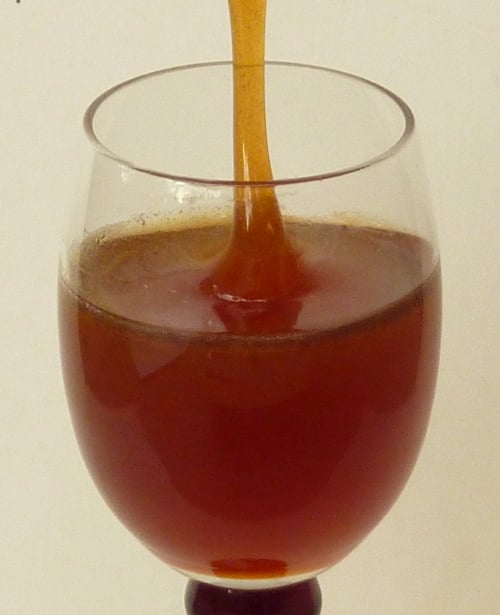
Photo: HoneyTraveler | CC BY-SA 4.0Peppermint honeyPeppermint honey from Piedmont, poured into a glass.
Pancalieri grows the Mitcham clone, named for the Surrey parish that had above a hundred acres of peppermint in 1792, and the Regione Piemonte’s sheet for the oil calls it Menta Italo-Mitcham. Its honey is taken off the oil crop while it is in full bloom. One producer gives the honey amber with reddish highlights, very fragrant, aromatic and lightly sweet, setting some months after the harvest to a fairly compact mass of medium or fine crystals, while the Pancalieri grower who sells it calls it sweet, with plum notes, and quick to set. Three named Piedmont houses sell it as Miele di Menta, and a fourth jar reaches the shelf through a Piedmontese packer.
Mèo Vạc mint honey (mật ong bạc hà) – an Elsholtzia of the mint family – Vietnam, the Đồng Văn stone plateau: H’mông households keep the bees for it, and Vietnam registered the name in 2013 as geographical indication No. 00035, the one registered designation this research found for a honey sold as mint honey. The registry specifies red-yellow to lemon-yellow, a colour that holds with keeping, and a taste sweet, cool and mild; Vietnam’s agricultural academy describes the same honey as catching in the throat, so the two state bodies differ. It is thick-flowing, setting after long keeping, and comes off a wild annual that flowers from October. The registered production method admits the native bee Apis cerana alone. It is sold across Vietnam and exported as mint blossom honey, at 400,000 to 500,000 dong a litre at the farm gate in the 2025 season.
Translations
See all 16 Translations
miele di menta – Italian
miel de menta – Spanish
Mel de Poejo – Portuguese
med od metvice – Croatian
Metvičin med – Croatian, a producer’s jar
miere de mentă – Romanian
mentaméz – Hungarian
Ментов мед (mentov med) – Bulgarian
miód miętowy – Polish
munthoning – Dutch
nane balı – Turkish
عسل نعناع (asal-e na’na’) – Persian
мʼятний мед (miatnyi med) – Ukrainian
miel de poleo – Spanish, Chile
薄荷蜜 (bòhe mì) – Chinese
mật ong bạc hà – Vietnamese
Festivals and Fairs
Viverbe – Pancalieri, Piedmont, Italy (the third week of September; the 45th edition ran 18-22 September 2026): the Piedmontese exhibition of nurseries and medicinal herbs, held in Piazza San Nicolao and the Piazza delle Erbe beside the village’s mint museum, in the village whose peppermint crop gives this page’s Italian honey. The organiser’s own 2026 programme lists apicoltura (beekeeping) among the fair’s sectors and the Regione Piemonte fairs register lists mieli e derivati (honey and honey products) among the goods on sale; neither names a mint honey. (Italian translated to English )
Certifications
Mèo Vạc geographical indication, No. 00035 – Vietnam’s first honey designation, granted on 1 March 2013, protects mint honey from named communes of four districts on the Đồng Văn stone plateau. What it guarantees is the wild bạc hà nectar plant of that ground, the native bee Apis cerana alone, extraction only once the comb is almost fully capped, and a colour and taste the registry writes down. (Vietnamese translated to English )
Dokazana kvaliteta – Croatia’s voluntary national proven-quality label, recognised for honey on 6 October 2023 on the Croatian Beekeepers’ Association’s application, the eighth sector to get it. Its goal is to let a buyer trust a declared quality above the legal minimum, and the honey specification lodged under it names med od metvice (Mentha spp.) among the lowland types and sets what a labelled jar must be. (Croatian translated to English )
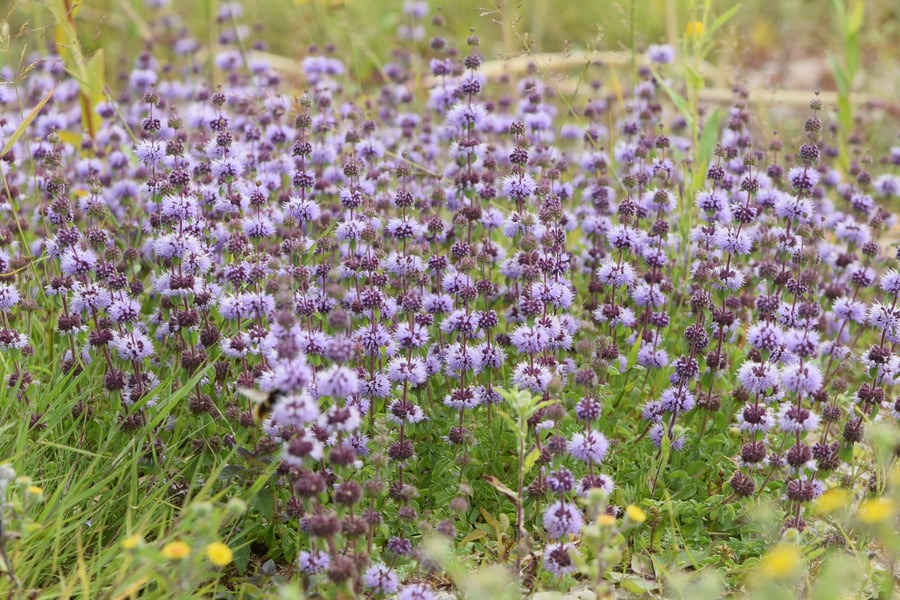
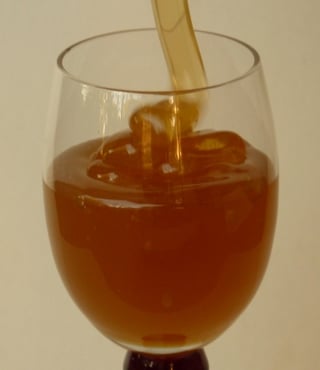
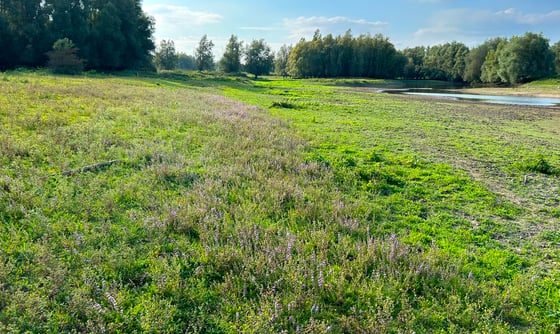
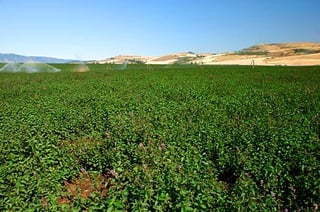
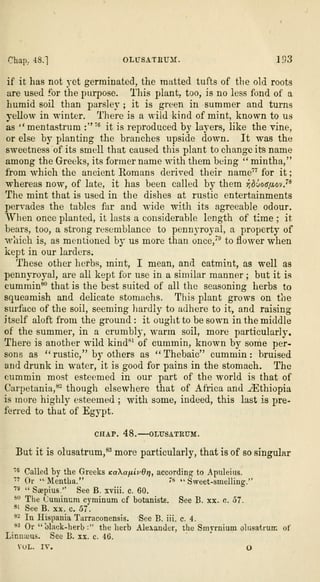
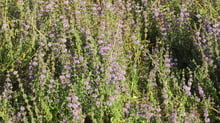 Photo: Romi Galeota Lencina, iNaturalist | CC BY 4.0Pennyroyal in Buenos Aires province, ArgentinaPennyroyal in flower at Longchamps, Buenos Aires province, Argentina.
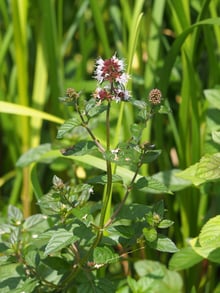 Photo: Agnieszka Kwiecień (Nova), Wikimedia Commons | CC BY-SA 4.0Water mint at Oława, PolandWater mint, Mentha aquatica, flowering at a river edge in Oława, Poland.
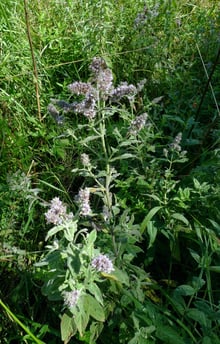 Photo: aga_l_, iNaturalist | CC BY 4.0Horse mint at Krempna, PolandHorse mint, Mentha longifolia, in flower at Krempna in the Beskid Niski, Poland.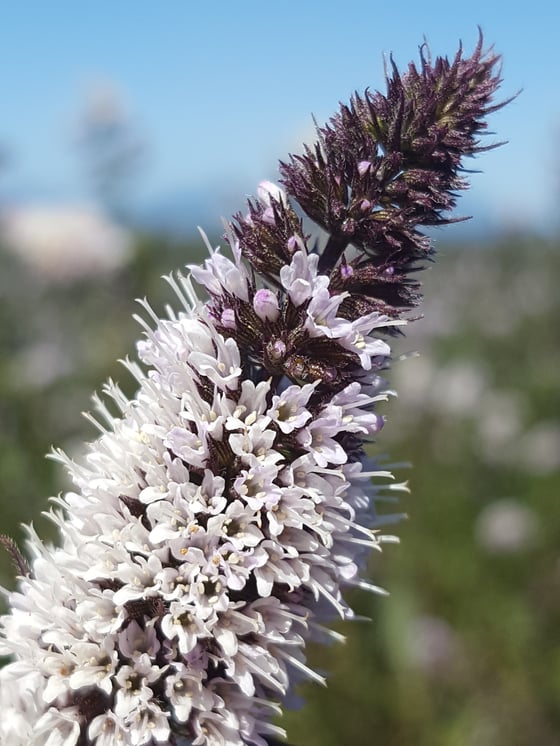
)
 Mèo Vạc geographical indication, No. 00035 – Vietnam’s first honey designation, granted on 1 March 2013, protects mint honey from named communes of four districts on the Đồng Văn stone plateau. What it guarantees is the wild bạc hà nectar plant of that ground, the native bee Apis cerana alone, extraction only once the comb is almost fully capped, and a colour and taste the registry writes down. (Vietnamese translated to English