Ellen Levy Finch (Elf), via Wikimedia Commons | CC BY-SA 3.0
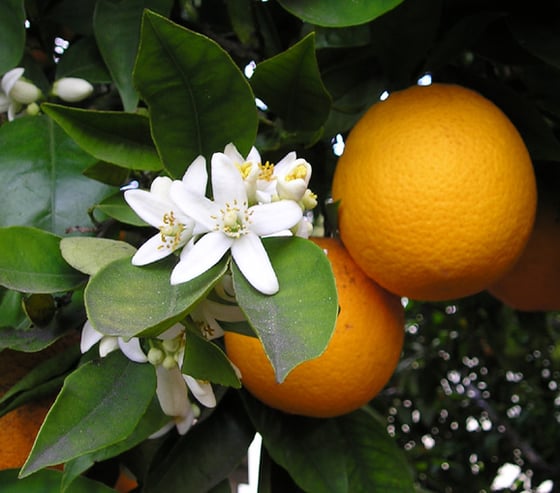
Orange blossom
Orange blossom and ripe oranges on the same branch.
The orange is known for the fruit bowl, the juice glass and the marmalade
jar, and its flower for a bottle of orange-flower water. Each spring the
same blossom fills with nectar, and the honey the bees make from it is very
pale, with the scent of the flower in the jar.
The name on the jar is the orange’s, and the honey inside is a citrus
honey. Lemon, mandarin, clementine and grapefruit flower in the same spring
weeks, often in the same orchards, and the bees work them all. Their
honeys are hard to tell apart, and most jars hold several. The
International Honey Commission puts every citrus in one class on its
reference sheet, because their honeys measure alike, and Italy’s national
sheet for the honey names it for the genus, miele di agrumi (citrus honey),
because the species read alike in its analyses and the honeys are very
often mixed in fact.
The Spanish name covers the genus too. The regulator of the Málaga designation
defines azahar as the white, scented blossom of the citrus trees, lemon,
mandarin, orange and grapefruit, and as the name of the honey from all of
them.
A few citrus honeys are sold under their own fruit’s name: lemon honey
from Spain to Argentina, satsuma honey from Croatia to Japan, clementine
honey in Corsica and southern Italy, and bergamot honey in Calabria.
Citrus grows through the warm world, and its honey comes from where the
orchards are large and flower within a defined period, which is how
Italy’s beekeepers’ federation explains the honey’s map. Thirty-nine countries produce
and sell it, from Spain and Italy round the Mediterranean to Florida, Mexico, Brazil,
South Africa and China. The same federation counts it among the best-known
single-flower honeys in the world, and puts its appeal down to a pale
colour, a scent of flowers and a sweet taste.
Characteristics
Photo: HoneyTraveler | CC BY-SA 4.0
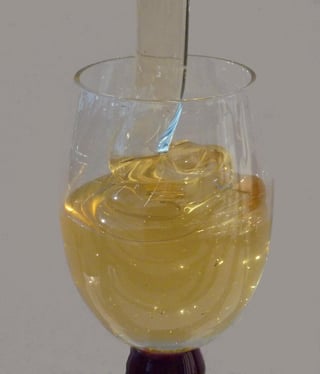
Orange blossom honey
Liquid orange blossom honey, pale gold, in a tasting glass.
Orange blossom honey is very pale, almost colourless to straw yellow when
liquid and about 15 mm on the
Pfund
scale, which the United States grades call extra white; of the nineteen
honeys in the European reference table only rhododendron and black locust
run paler. The nose is floral and fresh and the taste sweet; the
registers differ on its acidity. It sets some months after harvest, white to pale beige, often in
coarse, sandy crystals, Italy’s honey observatory says; the beekeepers'
federation puts a coarse grain down to a slightly moist honey kept warm
while it sets. With heat or long storage, the federation says, the scent moves
toward orange marmalade.
Click to Display — The Details: botanical origin, sensory profile, pairings, health and what gives it its character
Botanical Name: Citrus trees (Citrus spp.)
Botanical Family: Rutaceae
Bee Species:
Orange blossom honey is a Western honey bee honey. Every producing country
whose sources name a bee names Apis mellifera or one of its local races.
The one documented exception is in China, where the Asian hive bee, Apis
cerana, also takes a citrus crop. The national agricultural encyclopaedia
puts a colony of it at about 10 kilograms in one bloom, against about 20
for a colony of the Italian race of the Western bee.
Color:
Very pale: almost colourless to straw yellow when liquid, about 15 mm Pfund (USDA extra white); white to pale beige, sometimes pearly, once set
Flavor Profile:
Sweet, from medium to very sweet depending on the register; the registers differ on its acidity and on the length of its finish
Tasting Notes:
The registers that describe this honey find the nose floral and fresh,
with a fresh-fruit note, and differ on its strength: medium on the
international sheet, Italy’s national sheet and the honey observatory’s,
intense for Italy’s beekeepers’ federation, very intense on the Málaga
regulator’s sheet. The International
Honey Commission’s sheet gives the aroma in the mouth as fresh, of anise,
and the Croatian designation’s 2023 specification records the same anise
for its satsuma honey. Italy’s beekeepers’ federation adds
honeysuckle, hawthorn and yellow melon.
On sweetness the registers split. The international sheet says medium;
Italy’s national sheet says normally to very sweet, and the Málaga
designation very sweet; the Italian federation says normally sweet.
On acidity three bodies differ. The Granada designation’s regulator calls
the flavour very persistent and acidic. The Italian federation finds a
light acidity. The Corsican appellation’s specification gives its spring
honey, the range that takes the clementine orchards, no particular acidity
or a slight one.
The finish is short to medium on the international and Croatian rows and
fairly persistent on Italy’s national sheet.
Aroma:
Floral and fresh, of citrus blossom, with fresh-fruit and anise notes; honeysuckle, hawthorn and yellow melon in the Italian beekeepers’ federation’s description
Defining Compounds:
Methyl anthranilate is a typical component of citrus honey, proposed as its
chemical marker since the 1930s, and it fails as a test of purity. In a
2008 Italian study of 46 citrus honeys its levels in the honeys judged
single-flower by tasting, pollen, colour and
conductivity
largely overlapped with the rest, and the minimum some European
laboratories apply, the figure Germany’s food code also sets, would have
rejected 17 of the 28 honeys the authors judged genuine by every other
test. The compound also fades as a honey ages, earlier studies report.
Hesperetin has held up better. A 1993 Spanish study found this
flavonoid
in every citrus honey tested and absent from a long list of other honeys,
and traced it to hesperidin, the main flavonoid of orange nectar, which the
bees’ own enzymes, the authors propose, split into hesperetin. A 2001
survey of 52 European single-flower honeys confirmed it as the citrus
marker. Telling one citrus from another takes a research laboratory: a 2011
Spanish model correctly classed 98 per cent of the lemon and orange honeys
it was built on, and 97 per cent on cross-validation, using 37 aroma
compounds with diastase, conductivity and colour readings.
The scent itself is
linalool
and its relatives: linalool oxides, the
lilac aldehydes
and methyl anthranilate recur across laboratories as citrus honey’s floral
markers. The honey keeps the flower’s ratio between linalool’s two
mirror-image forms, and that ratio holds through storage and packing while
the amounts vary, which a 2014 study proposes as a check of authenticity.
Satsuma honey adds compounds of its own. A 2016 Croatian study traced
three markers from the satsuma nectar into the jar, 1H-indole,
1,3-dihydro-2H-indol-2-one and phenylacetonitrile, none of them reported
in earlier studies of other citrus honeys, and the Croatian designation
writes them into its specification as marks of a satsuma origin.
Two European allowances apply to this honey: a higher sucrose ceiling and
a lower enzyme floor. Citrus honey may hold up to 10 grams of sucrose in
100 grams, where 5 applies to honey in general, though only 2 samples in
the international reference data passed 5: a reading between 5 and 10 is
lawful. The EU honey directive also names citrus honeys as its example
of a honey low in natural enzymes, accepting a diastase of 3 on the
Schade
scale, where 8 applies to other honeys, if
HMF
is at most 15 mg/kg. A 2018 review reports an earlier study in which 7 of
61 fresh citrus honeys, 11.5 per cent, already held more than 10 mg/kg of
HMF, so that a little processing, blending or storage could take them past
the 15 the allowance permits.
Forage Origin:
The bees take nectar from the flowers of citrus trees, the genus Citrus in
the rue family, Rutaceae, native from the Himalaya to southern Japan and the
south-west Pacific. Nearly every cultivated citrus is a hybrid of three wild
ancestors, the citron, the pummelo and the mandarin. The same trees are
grown for fresh fruit and juice, for sour orange marmalade, for
orange-flower water, and for perfume oils, neroli from the flowers and
bergamot oil from the rind.
Scott Bauer, USDA Agricultural Research Service, via Wikimedia Commons | Public domain
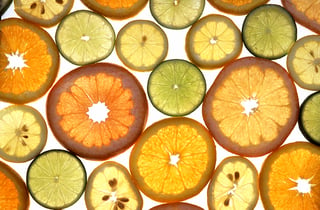
Citrus fruits
Slices of oranges, grapefruit, lemons and limes.
The orchards are mixed, and so is the honey. Sweet orange is the
main source almost everywhere; satsuma, mandarin, lemon, clementine,
bergamot, pomelo, grapefruit, kumquat, citron and bitter orange each reach
a jar under their own name somewhere, and most jars carry several. Italy’s
beekeepers’ federation writes that the citrus honeys form a family of
rather similar products, whose differences come more often from the
accompanying flora or the production methods than from the citrus the bees
worked. The Málaga designation’s regulator names that flora: clover, wall
rocket and dandelion-type daisies between the trees, olive and rockrose at
the orchard edges. In English the honey is sold as orange blossom honey or
as citrus honey, and in New Zealand the Gisborne producers sell it as
citrus honey alone. Japan’s satsuma honey has its own page, Japan Mikan Honey.
Forest and Kim Starr, via Wikimedia Commons | CC BY 3.0 US
Navel orange flower
A Washington navel orange flower on Maui, Hawaii.
A citrus honey carries little citrus pollen. The flower starts its nectar
early: China’s agricultural encyclopaedia records the
nectary
secreting three to five days before the petals open. Many varieties shed
little pollen: Spain’s dominant Navel oranges were selected for pollen
sterility so that the fruit would be seedless, and Croatia’s satsuma has sterile
anthers,
a property of those varieties, since South Africa’s national botanical
institute finds most citrus varieties fertile. And the bees come for the
nectar, on 94 per cent of visits across three seasons in a Brazilian
sweet-orange orchard. In the international reference set citrus pollen
averaged 18.6 per cent, most samples falling between 2 and 42, and the
authors of a Spanish study write that a honey of undisputed citrus
character can be unfairly rejected on the microscope alone.
Citrus nectar also carries caffeine, at doses below the bees’ bitter-taste
threshold. In a 2013 study honey bees rewarded with it were three times as
likely to remember a learned floral scent, and the authors connect that
memory to the bees’ fidelity to the bloom.
Forest and Kim Starr, via Wikimedia Commons | CC BY 3.0
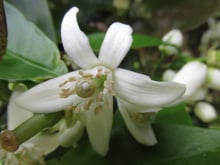
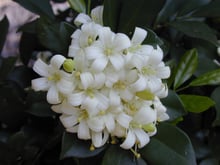
Orange jessamine
Orange jessamine, Murraya paniculata, a citrus relative in the rue family, in flower.
Three other honeys carry citrus names. An Ethiopian seller’s orange honey
from the Borana Zone is harvested, in its words, from wild orange
blossoms, and wild orange is an English name for Strychnos innocua, a tree
of another plant family that grows in Ethiopia. In Britain lime blossom
honey is one of the country’s own honeys, and Britain’s lime tree is
Tilia. And orange jessamine,
Murraya paniculata, is a citrus relative in the same family whose honey, in
the words of the Valencia botanic garden’s citrus monograph, has a
distinctive and highly esteemed taste.
The jar to read closely is the flavoured one. Codex Alimentarius, the
international food standard, requires anything sold as honey to be honey
alone, and orange-blossom-water confections, citrus-infused honeys and
honey preserves share the shelf under similar names; in Japan a Kyoto
specialist’s yuzu jar holds yuzu peel and juice in honey. A buyer tells
them apart by the ingredient line.
Pairings:
Italy’s national honey observatory says only that this honey goes with
almost every
sweet food. Italy’s
beekeepers’ union proposes it, conditionally, for lighter
bloomy-rind
cheeses. The Málaga beekeepers’ association lists herbal infusions,
unripened dairy such as yoghurt and fresh cheese, white meat and chicken,
fried sweets, desserts made with oil or butter, and ice cream. In a 2017
consumer trial pairing Andalusian goat cheeses with three honeys, orange
blossom honey sat in the preferred group on fresh, semi-cured and
oil-cured cheese alike, in the same group as eucalyptus, the top scorer.
As an ingredient it goes on at the end. In the Málaga association’s recipe
for fritters the honey is drizzled over the fritters once they are fried
and plated. A French meadery also makes a sparkling mead from it.
Health Uses:
An Iranian seller describes this honey taken with a tisane of the same
blossom for calm and sleep, and the reputation belongs to the blossom
too: in Tunisia, the United Nations industrial development agency records,
orange-flower water from the Cap Bon bitter-orange harvest is a
traditional remedy for sleeplessness.
Origin Story
The plants behind this honey reached the Mediterranean one species at a
time, and the order of arrival dates the honey’s names. The citron came
first, through Persia and the southern Levant, and grew in a Persian royal
garden near Jerusalem in the fifth and fourth centuries BC. The lemon
reached Rome around the turn of the era. The sour orange, the lime and the
pummelo came in the tenth century AD, after the Islamic conquest. The sweet
orange, the honey’s main source today, arrived in the second half of the
fifteenth century, probably by the Genoese trade route, and the mandarin in
the early nineteenth century. A 2017 study of ancient plant remains reads
the citron and the lemon as elite products, and the rest as fruit that most
probably spread for economic reasons.
The two Mediterranean words for the blossom come from the Arabic for
flowers (زهر, zahr).
Spanish azahar, the Real Academia Española records, came through Andalusi
Arabic and means a white flower and, above all, that of the orange, the
lemon and the citron. Sicilian and Italian zagara means, in Treccani’s
dictionary, the flower of the citruses, especially orange and lemon.
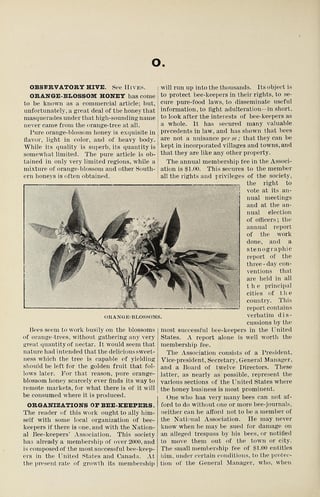
A. I. Root, The ABC and XYZ of Bee Culture (1910), Smithsonian Libraries copy, via the Internet Archive | Public domain
The ABC and XYZ of Bee Culture, 1910
The entry for orange-blossom honey in the 1910 edition of A. I. Root's The ABC and XYZ of Bee Culture.
The honey as a named article is far younger. In 1872 a New York company
set up one of Florida’s first commercial apiaries of any significance in a
lemon and orange grove at present-day Daytona Beach, and sailed north each spring with a cargo of fruit and honey.
By 1910 the standard American reference work, The ABC and XYZ of Bee
Culture, could open its entry: “Orange-blossom honey has come to be known
as a commercial article; but, unfortunately, a great deal of the honey that
masquerades under that high-sounding name never came from the orange-tree
at all.”
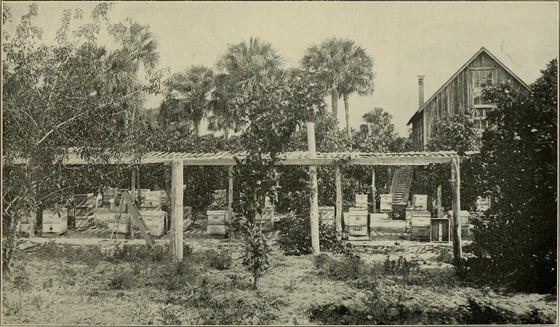
Gleanings in Bee Culture (1911), Internet Archive Book Images, via Wikimedia Commons | Public domain
A Florida bee-shed, 1911
W. S. Hart's bee-shed at Hawks Park on Florida's east coast, with orange trees in the foreground, in Gleanings in Bee Culture, 1911.
In 1920 the survey American Honey Plants described the Californian
flow
as “extremely rapid”, the nectar at times so abundant “that men and horses
working in the orchards are saturated with it”, for about three weeks. In
1919 it ran 23 days in Tulare County. One yard of four hundred colonies, the
survey adds, averaged more than 60 pounds of orange honey each. Many
beekeepers moved
their bees long distances for the flow, some taking them first to the
February almond bloom to build them up.
David Hall, USDA Agricultural Research Service, via Wikimedia Commons | Public domain
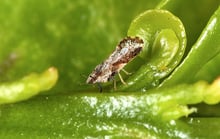
Asian citrus psyllid
An adult Asian citrus psyllid, the insect that spreads citrus greening, on a young citrus shoot.
Growers have kept moving the orchards. Florida’s freezes
of the 1970s and 1980s pushed its citrus south. Citrus greening, a disease
spread by the
Asian citrus psyllid,
reached the state’s commercial groves in 2005, and by the 2023/24 season
Florida’s orange production had fallen about 92 per cent from 2003/04, on
the federal Economic Research Service’s April 2024 estimate. In the Lower
Rio Grande Valley of Texas, citrus fell from nearly 70,000 acres in the
early 1980s to 12,000 after the freezes of 1983 and 1989 and was back to
about 30,000 by 2017, and the bees brought into the valley now come mainly
to pollinate watermelons and seed crops, with orange honey a by-product,
the state beekeepers’ association testified in 2018. In Brazil, with
greening in 48 per cent of the São Paulo belt’s orange trees in the 2026
survey, growers are clearing the worst districts and planting in lower-risk
ones.
Cultural Context
Italy’s beekeepers’ federation puts citrus honey second only to acacia on
Italian shelves and in honey buyers’ preferences. For the beekeepers of
the south, a Sicilian beekeeper said in a 2021 interview, zagara is the
most important honey for quality and quantity, in Sicily, Calabria,
Campania and Puglia, as acacia is the main bloom in parts of the north.
Spain’s agriculture ministry tracks its price. In the 2024/2025 campaign
bulk azahar honey at origin ran from 4.14 to 4.32 euros a kilo, against
3.14 to 3.48 for multifloral and 3.96 to 4.08 for eucalyptus, while packed
azahar,
at 7.54 to 8.08 euros a kilo, sat level with packed eucalyptus and rosemary.
Italy’s honey observatory counts citrus, with acacia, among the great
spring blooms now tied to short windows of good weather, and its 2026 guide
calls the season another poor one for citrus honey, with the single
exception of Puglia.
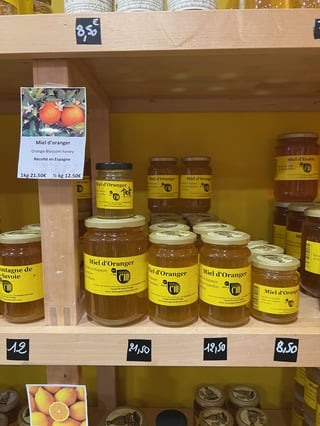
Photo: HoneyTraveler
Spanish orange blossom honey in Paris
Orange blossom honey harvested in Spain, on the shelf of a Paris honey shop, September 2026.
In 1910 the American reference work recorded pure orange-blossom honey
seldom reaching distant markets. Packers now sell it across borders under
its name: Italian and Spanish jars on French shelves, a Spanish mandarin
honey in a Japanese specialist’s range. Since 14 June 2026 European Union
rules have required a blend of honeys from more than one country to name
its countries of origin on the label in descending order, with each one’s
percentage.
Italy and Spain judge citrus honey as a class of its own
Italy's national honey competition judges citrus honey as a class of
its own, agrumi, by tasting and by physical, chemical and pollen analysis.
The competition, Tre Gocce d'Oro (Three Drops of Gold), was founded in 1981
and has been held by the national honey observatory since 2003. In 2026 a citrus honey took the top award,
which the rules give only where at least eight beekeepers enter the class,
and the winning honey was made at Massafra in Puglia, the season's
exception. Lemon honey has
a separate spring class in the same rules.
Spain's Concurso Nacional de Mieles, held at the Valencian honey fair in
Montroi, judges azahar as its own class beside rosemary and multifloral.
The London International Honey Awards score every honey on one scale and
ask each entry to arrive with a laboratory certificate that includes its
pollen spectrum, the breakdown of the honey's pollen by plant.
A Cape Peninsula beekeeper, interviewed by HoneyTraveler in December
2025, speculated that another beekeeper's gold award for citrus honey owed
something to what else the bees worked near the orchard: "What was growing
nearby that was also attractive to the bees that is now woven into the
orange blossom? It may be predominantly orange blossom, but there's other
factors. A few weeds, and interesting weeds, and so on that just marry with
that orange blossom and it's a total fluke of nature."
Harvest & Forage
Across the producing countries this page draws on, citrus blooms in
spring, roughly March to May in the north and September to November in the
south, and in Arizona from February to March. China’s agricultural
encyclopaedia gives a stand of trees some twenty days of flowering but an
effective nectar flow of about ten, and a single flower yields most of its nectar on its first
morning: a 2026 study of blood orange measured 42 microlitres a flower on
the first day, 20 on the second and under 1 on the third.
The nectar comes with warm, humid weather: South Africa’s national
botanical institute records dry heat dropping the flowers, and China’s
encyclopaedia records rain washing nectar out of the blossom. In 2021 a
Sicilian beekeeper put the zagara crop down 80 per cent on average across
Sicily, and under a kilo a hive on the Piana di Catania, as the eastern
Sicily farmers’ confederation also reported, against the 25 kilos a hive
that the Slow Food Foundation gives for zagara and
millefiori
in the best years in the nearby Iblei hills.
The species and the climate shift the calendar. The lemon flowers almost
all year, January to December on Italy’s national sheet. Where winters are
warm, the citrus crop starts in winter: a Mosul beekeeper trucks his hives
south in December to Balad and Tarmiyah, where it is warm, to make
citrus-blossom honey (عسل القداح, asal al-qaddah) in February and March,
and a Turkish Cypriot beekeeper makes a spring and citrus honey from
February to the end of May.
Leonardo Rapisarda, via iNaturalist | CC BY 4.0
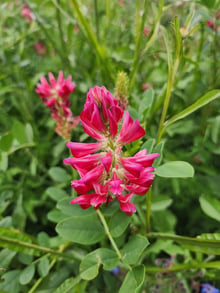
Sulla in flower
Sulla, Hedysarum coronarium, in flower near Catania, Sicily.
What dilutes a citrus crop grows in the same districts. In southern Italy
and the islands it is
sulla,
whose honey Italy’s national sheet says can be confused and blended with
citrus honey. A laboratory separates them with two bench tests:
diastase
usually under 15 units and total acidity usually under 20
milliequivalents
a kilogram in citrus honey, above both in sulla.
Spraying is timed round the bloom. Florida’s special labels for the
neonicotinoids
used against greening restrict applications during bloom, and Valencia,
where hives are allowed near citrus and spraying cannot be avoided,
requires bee-safe formulations applied outside the bees’ foraging hours.
Within a mile of citrus plantings of an acre or more in Fresno, Kern and
Tulare counties, California’s regulator closes the declared bloom, from a
tenth of the blossoms open until three-quarters of the petals on the north
side of the trees have fallen, to pesticides labelled toxic to bees, with
exemptions, and bars
carbaryl
from first bloom until complete petal fall.
Citrus pollen floors run from 3 to 20 per cent, counted on different bases
A pass on the pollen rule describes a country's standard as much as
the honey. Where a country writes a minimum citrus pollen share into its
honey rules, the figure runs from 3 to 20 per cent, counted on two bases:
some rules first take the pollen of non-nectar plants out of the count,
others count all pollen, and some do not state the basis.
Counted on nectar-plant pollen: Greece's Food Code, Article 67a, where
the type is named for the orange, sets 3 per cent, with a ceiling of
70,000 pollen grains in 10 g; Croatia's Dalmatinski med designation sets
more than 5 per cent for its satsuma type.
Counted on all pollen: Croatia's and Serbia's national rules set 10 per
cent, or 5 where the honey shows its plant's smell, taste and colour; the
Málaga designation and Portugal's Mel do Alentejo set 15 per cent.
With no counting basis stated: Argentina's national rule, Resolución
274/95, sets 10 to 20 per cent. The Granada designation sets more than 15
per cent, or 5 to 15 where the honey carries
methyl anthranilate
at 1.2 mg/kg or more. Germany's Leitsätze für Honig, for sweet orange
only, sets 20 per cent, with methyl anthranilate at 2 mg/kg or more as a
further condition. Italy sets 10 per cent, and so do Turkey's Food Codex
and, as a 2015 Valencian laboratory study reports it, Spain's Valencian
quality mark.
The Codex standard sets no percentage: it asks that
a honey sold under a plant's name come wholly or mainly from that plant and
show the matching sensory, chemical and microscopic properties. United
States guidance lets a jar name a blossom where that blossom is the chief
floral source, and China and Australia define their honey by
composition.
Beekeeping Context
Hives come to the orchard for the bloom, and the colony gains as much as
the crop. Valencian beekeepers, quoted in a University of Valencia economics
paper, call a citrus orchard in flower a “paradise” for bees, and the hives
leave the spring bloom stronger for whatever they work next. Moving
colonies into the groves is the norm wherever the honey is made, and the
specifications of both Andalusian designations record the coast-and-valley
transhumance
of their beekeepers.
A Western Cape honey house, interviewed by HoneyTraveler in December 2025,
makes its orange blossom honey from citrus farms “like 300 kilometers
away”, and its product page gives the harvest as Citrusdal. It has always
made it (“Not recently, we’ve always done that”), and asked whether the
honey is all orange, the owner answered, “Very orange.”
For a citrus grower the bees bring a gain and a cost. Bee visits give more and
bigger fruit, South
Africa’s national botanical institute records, and they also add seeds: in
a 2013 study of one seedless mandarin, Afourer, nets that kept the bees out
left 98 to 99 per cent of the fruit seedless.
Valencia bans the hives, California legislates coexistence, and elsewhere the bees are brought in
Valencia limits cross-pollination between citrus plantations by keeping
the hives away from them in bloom: it bans hives within four kilometres of
citrus plantations from 2 March to 31 May in 2026. Its government's own preamble
records that beekeepers whose living was citrus honey had to move their
hives out, giving up honey of that origin in the Valencian Community, and
the same text now reopens the orchards step by step on a published
cross-pollination risk map, with a 2028 horizon set by the sector
agreement it cites.
California passed a Seedless Mandarin and Honeybee Coexistence Working
Group Act in 2007, which protects the right of owners in the citrus belt to
farm honey beside their citrus and lets its regulations put fees on the
seedless-mandarin growers.
South Africa's national botanical institute reports a recommendation
of two and a half colonies a hectare for the soft-citrus mandarins and
tangelos
that need cross-pollination. Chongqing issued a code of practice for
honeybee pollination of citrus, numbered DB50/T 1008-2020, and withdrew it
in July 2025, in a repeal of 408 local standards; China's agricultural
encyclopaedia credits bee pollination with raising citrus yields one- to
threefold against trees shut off from insects.
Where greening is established, beekeepers and the growers spraying
against it work the same trees. Florida’s regulator writes that suppressing the psyllid may
need more insecticide, much of it toxic to bees, and asks beekeepers to talk to growers
about hive placement and the treatment schedule; in Brazil’s citrus belt,
the trade press reports growers spraying against the insect every week.
Source Regions
See all 39 countries
Italy, Sicily and Calabria – Citrus spp.: citrus honey (miele di agrumi), sold mixed or as zagara d’arancio, and made in five further regions.
Spain, Valencia, Murcia and Andalusia – Citrus spp.: orange blossom honey (miel de azahar), with two protected designations naming the genus; lemon honey sold separately.
Portugal, the Algarve and Alentejo – Citrus spp.: orange blossom honey (mel de flor de laranjeira), Algarve jars, and a protected Mel do Alentejo type.
France, Corsica – Citrus x clementina: clementine honey (miel de clémentinier), from the one cultivated crop the island’s honey appellation admits.
Greece, Argolida, Laconia and Arta – Citrus sinensis: orange blossom honey (μέλι πορτοκαλιάς, meli portokalias), about a tenth of Greek honey (EFET, 3 June 2019).
Cyprus, Paphos and the Morphou (Güzelyurt) plain – Citrus sinensis: orange blossom honey (μέλι πορτοκαλιάς, meli portokalias), one of the island’s two main honeys.
Turkey, Mersin, Muğla and Antalya – Citrus spp.: citrus honey (narenciye balı), a food-codex type; Antalya’s 2015 crop, worked through winter, was in by May.
Croatia, Neretva delta – Citrus unshiu: satsuma mandarin honey (med od mandarine), a Dalmatinski med type from Europe’s northernmost commercial satsuma growing, says its specification.
Malta – Citrus spp.: orange blossom honey, the April honey in one Maltese beekeeper’s calendar of single-flower crops, as reported in 2013.
Albania – Citrus sinensis: orange honey (mjaltë portokalli), listed in 2026 by two Albanian brands, one of them stating Albanian origin.
Morocco, the Souss and the Gharb – Citrus spp.: orange blossom honey (miel de fleur d’oranger), sold on the agriculture ministry’s own terroir marketplace.
Algeria, the Mitidja – Citrus spp.: orange blossom honey (miel de fleurs d’oranger), a main source of single-flower honey in a 2015 study.
Tunisia, Cap Bon – Citrus spp.: orange blossom honey (miel de fleurs d’oranger), sold by a Tunisian shop as honey of the Cap Bon.
Egypt – Citrus spp.: citrus honey (عسل الموالح, asal al-mawalih), made by an Egyptian house in its own apiaries from orange, lemon and mandarin blossom.
Israel, Emek Hefer – Citrus spp.: citrus honey (דבש הדרים, dvash hadarim), gathered in spring from orange, lemon, clementine, pomelo and grapefruit orchards.
Lebanon, Tyre and the south – Citrus spp.: citrus blossom honey (عسل زهر الليمون, asal zahr al-laymun), one of three honeys, the Lebanese Army writes.
Jordan, the northern Jordan Valley – Citrus spp.: citrus honey (عسل الحمضيات, asal al-hamdiyat), an April crop on a Jordanian producer’s own page.
Syria – Citrus spp.: citrus honey (عسل الحمضيات, asal al-hamdiyat), sold inside Syria in 2026 on a Damascus-based shopping platform.
Iraq, Balad and Tarmiyah – Citrus spp.: citrus blossom honey (عسل القداح, asal al-qaddah), made in February and March on hives brought down from Mosul.
Iran, Mazandaran – Citrus spp.: citrus honey (عسل بهار نارنج, asal-e bahar narenj), named for the bitter orange, used for honey of every citrus.
Palestine – Citrus spp.: citrus honey (عسل الحمضيات, asal al-hamdiyat), a spring honey, first in the national news agency’s list of Palestinian honeys.
United States, Florida, California, Arizona and Texas – Citrus spp.: orange blossom honey; federal guidance lets a jar name its chief floral source.
Mexico, Nuevo León – Citrus spp.: orange blossom honey (miel de azahar), harvested February and March; Tamaulipas began work toward an indication in 2026.
Brazil, São Paulo – Citrus sinensis: orange blossom honey (mel de laranjeira), a federally inspected single-flower honey of the sweet orange.
Argentina, Tucumán – Citrus spp.: citrus honey (miel de citrus), sold as citrus, orange and lemon honeys by one house, the Tucumán lemon honey protected.
Chile, the central zone – Citrus spp.: orange blossom honey (miel de azahar), from citrus orchards of central Chile, on one house’s jar.
Uruguay – Citrus spp.: orange blossom honey (miel de azahar), one of three single-flower honeys in Uruguay’s national export catalogue, sold in a Uruguayan shop.
South Africa, Citrusdal, Western Cape – Citrus sinensis: orange blossom honey, also sold as citrus honey and Cape Citrus; the botanical institute ranks oranges first.
Ghana – Citrus spp.: orange blossom honey, one of two honeys in an Accra house’s undated trade-portal listing, which cites national food and standards certification.
India, the Khasi Hills of Meghalaya – Citrus reticulata: orange blossom honey from the Khasi mandarin, sold in English as a single-origin honey.
Pakistan, Punjab’s Sargodha citrus belt – Citrus sinensis: malta honey (مالٹے کا شہد, malte ka shahad), named for the sweet orange, from March-April citrus bloom.
China, Chongqing, Hubei, Hunan and Sichuan – Citrus spp.: citrus honey (柑橘蜜, ganju mi), harvested in spring, from Asian as well as Western honey bees.
Taiwan, Yunlin – Citrus spp.: citrus honey (柑橘蜜, ganju mi), taken once a year when Gukeng’s sweet orange flowers, also sold as sweet-orange honey.
Japan, Wakayama and Ehime – Citrus unshiu: mikan honey (みかん蜜, mikan mitsu), covered in full on its own page, Japan Mikan Honey.
South Korea, Jeju – Citrus unshiu: mandarin blossom honey (감귤꽃꿀, gamgyul-kkot-kkul), made and sold on Jeju, one seller a honey-farming cooperative.
Vietnam, Bắc Giang – Citrus spp.: orange blossom honey (mật ong hoa cam) of March to May, with a pomelo blossom honey sold beside it.
Georgia, Adjara – Citrus unshiu: mandarin honey (მანდარინის თაფლი, mandarinis tapli), sold by an Adjaran house from its own hives.
Australia, the Riverina, Murray Valley and Riverland – Citrus spp.: orange blossom honey, covered in full on its own page, Australian Orange Blossom Honey.
New Zealand, Gisborne (Tairāwhiti) – Citrus spp.: citrus honey, a spring crop from the district’s orchards, sold by its producers as citrus honey.
Regional Variants
אברהם שלמה אופנבכר, via Wikimedia Commons | CC BY-SA 4.0
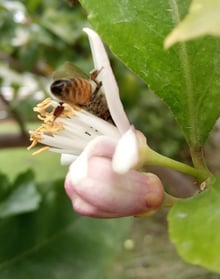
Honey bee on lemon blossom
A honey bee in a lemon flower at Hashmonaim, Israel.
Lemon honey (miel de limón, miele di limone, limon çiçeği balı) – Citrus x limon – Spain (Alicante, Murcia, Andalusia), Italy (Sicily), Turkey (Mersin), Argentina (Tucumán): Argentina registered a lemon honey as a geographical indication in 2023, and its dossier gives the reason the honey is single-flower: Tucumán grows lemon over wide areas where other provinces grow it among oranges and mandarins. The Iberian reference guide keeps lemon as a single-flower honey of its own and draws it tighter than azahar: colour to 35 mm Pfund against 45, conductivity to 0.40 mS/cm against 0.55, and a faint floral aroma with notes of methyl anthranilate, where azahar’s floral aroma carries a clear, intense and persistent methyl anthranilate note. A Spanish reference book calls it markedly paler than the rest of the family. Tucumán’s registered description reads clear, with a weak floral aroma, sweetness from weak to moderate with a trace of acidity at the finish, and very fine crystals that feel creamy on the tongue. The guide places its Spanish production in Alicante, Murcia and parts of Andalusia. Italy sells it as miele di limone or Miele Zagara di Limone, and its national competition judges lemon as its own spring class; a Mersin house sells it as limon çiçeği balı beside its orange blossom honey.
Matsuoka.A, via Wikimedia Commons | CC BY-SA 4.0
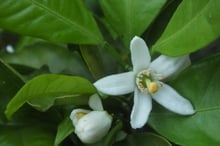
Satsuma blossom
A satsuma mandarin flower, Citrus unshiu.
Satsuma mandarin honey (med od mandarine; 감귤꽃꿀, gamgyul-kkot-kkul; მანდარინის თაფლი, mandarinis tapli) – Citrus unshiu – Croatia (Neretva delta), South Korea (Jeju), Georgia (Adjara), Japan (Wakayama, Ehime): a citrus honey with aroma compounds of its own. A 2016 Croatian study that followed the nectar of four satsuma varieties into the jar found three compounds not reported in earlier studies of other citrus honeys, which its authors call particular to satsuma honey, and Croatia’s Dalmatinski med protected designation of origin names the species and writes those compounds into its specification. The designation’s sensory row reads light yellow to orange; a medium-intensity nose of orange-blossom perfume and orange marmalade; medium sweet and weakly to medium persistent, with acidity weakly expressed; and an aroma floral, fruity and of anise. Its pollen floor, more than 5 per cent once the pollen of non-nectar plants is set aside, is the lowest in the designation, because satsuma anthers are sterile, and it alone may show a diastase as low as 4 where HMF stays at or under 10 mg/kg. Croatia sells it as med od mandarine under the Neretva name, South Korea as gamgyul-kkot-kkul from Jeju, and Georgia as mandarinis tapli from Adjara. Japan’s satsuma honey has its own page, Japan Mikan Honey.
Krzysztof Golik, via Wikimedia Commons | CC BY-SA 4.0
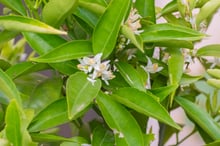
Clementine blossom
Clementine, Citrus clementina, in flower.
Clementine honey (miel de clémentinier, miele di clementine) – Citrus x clementina – France (Corsica), Italy (Puglia, Basilicata): the Corsican appellation Miel de Corse - Mele di Corsica has six seasonal ranges, and its spring range takes the clementine orchards, with their mimosa and eglantine, as one of its two floral associations. The appellation’s syndicate describes that spring range as pale to golden and softly floral. In Paris the Corsican honey is sold as Miel de Clémentinier, the dearest French honey on a specialist’s price card in September 2026. In Italy a house sells clementine honey from Puglia and Basilicata as a standing product, describing a full, aromatic taste of clementine, and Italy’s national honey observatory names clementine among the single-species citrus lots it rarely sees.
Franz Eugen Köhler, Köhler's Medizinal-Pflanzen, via Wikimedia Commons | Public domain
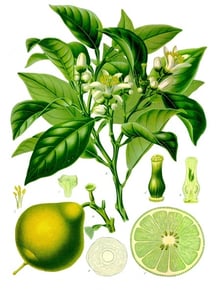
Bergamot
Bergamot, Citrus bergamia, in flower and fruit, from Köhler's Medizinal-Pflanzen.
Bergamot honey (miele di bergamotto) – Citrus bergamia – Italy (Calabria): bergamot is grown mainly in Calabria for the essential oil of its rind, one of the perfume industry’s most used, the Valencia botanic garden’s citrus monograph records, and a retailer gives the honey’s source as the Ionian and Tyrrhenian coasts of the province of Reggio Calabria. Its standing is commercial: the one Calabrian citrus honey on Italy’s traditional-products register is an orange honey. One jar of Calabrian bergamot honey read at source lists bergamot honey as its only ingredient and describes a honey almost colourless to straw when liquid, pearly white to light beige once set in a very fine grain, sweet, fine and creamy, with a delicate scent of bergamot flowers. Italy’s national organic beekeepers’ cooperative warns in its consumer guide that jars labelled bergamot honey rarely if ever match the nectar they declare, because the tree gives the bees very little, and it separates a honey of a flower from a honey with a flower’s essence added after harvest. On a Calabrian shelf the ingredient line is the test: bergamot honey alone.
Translations
See all 56 Translations
miele di agrumi – Italian, citrus honey; the national sheet’s name
miele di arancio – Italian, orange honey
miele di limone – Italian, lemon honey
miele di zagara – Italian and Sicilian, citrus-blossom honey
miele di bergamotto – Italian, bergamot honey
miele di clementine – Italian, clementine honey
miele di mandarino – Italian, mandarin honey
u meli di zagara – Sicilian, citrus-blossom honey
miel de azahar – Spanish, citrus-blossom honey
miel de naranjo – Spanish, orange-tree honey
miel de limón / miel de limonero – Spanish, lemon honey
miel de cítricos – Spanish, citrus honey
miel de mandarino – Spanish, mandarin honey
mel de taronger / mel de flor de taronger – Catalan and Valencian, honey of the citrus blossom
mel de flor de laranjeira / mel de flores de laranjeira – Portuguese, orange-blossom honey
mel de laranjeira – Portuguese, orange-tree honey; the commoner Brazilian form
miel de fleur d’oranger – French, orange-blossom honey
miel d’oranger – French, orange-tree honey
miel d’agrumes – French, citrus honey
miel de citronnier – French, lemon-tree honey
miel de mandarinier – French, mandarin-tree honey
miel de clémentinier – French, clementine-tree honey
mele di clementine – Corsican, clementine honey
Orangenblütenhonig – German, orange-blossom honey; the food code’s name
Orangenhonig – German, orange honey
Μέλι πορτοκαλιάς (meli portokalias) – Greek, honey of the orange tree
Sagra del Miele – Sortino, Siracusa, Sicily, Italy (late September; the 44th edition was held on 25-27 September 2026): the honey festival of a town in the Iblei hills, where zagara and millefiori out-yield the hills’ thyme, by the Slow Food Foundation’s account. A single ticket is offered for the town’s museums, a Sicilian beekeepers’ association runs teaching sessions, and stands offer tastings of the winning honeys of a Sicilian millefiori competition, so citrus honey is one honey among several here. (Italian translated to English )
Narenciye Balı Hasat Şenliği – Mezitli, Mersin, Turkey (held on 19 April 2024): the Citrus Honey Harvest Festival, held for the season’s first citrus honey harvest in Kale Mahallesi, with the provincial governor, the agriculture and forestry directorate and the Mersin beekeepers’ union. Its subject is this honey itself. (Turkish translated to English )
Certifications
DOP Miel de Granada – Guarantees honey of Granada province and, in its regulator’s words, protects the producer against similar honeys from other regions. Its naranjo o azahar (orange tree or citrus blossom) type is named to the genus, Citrus sp., and it accepts a lower citrus pollen share where the honey carries enough of citrus honey’s chemical marker. (Spanish translated to English )
DOP Miel de Málaga – Its citrus type, miel monofloral de naranjo o azahar (single-flower honey of the orange tree or citrus blossom), named to the genus, Citrus sp., is one of Málaga’s single-flower honeys. Its specification gives the type the aroma of azahar, a very sweet taste with acid notes and slow crystallisation. (Spanish translated to English )
DOP Mel do Alentejo – Guarantees honey of the Alentejo made by the local Iberian bee, and registers four single-flower types, laranjeira (orange tree) among them. A mel de laranjeira must show the orange tree in its pollen, and citrus is also one of the plants that can qualify the designation’s multifloral type. (Portuguese translated to English )
AOP Miel de Corse - Mele di Corsica – Guarantees honey of Corsica and excludes honey from cultivated plants, with one exception written into its specification, citrus plantations, so citrus is the one orchard crop a Corsican honey may come from. (French translated to English )
PDO Dalmatinski med – Guarantees eight honeys from four Dalmatian counties, one of them med od mandarine (mandarin honey), a satsuma honey named to the species, Citrus unshiu, with the honey’s own aroma compounds written into its specification as the marks of a satsuma origin. (Croatian translated to English )
IG Miel de Azahar de Limón de Tucumán – Argentina’s geographical indication for lemon honey, granted in 2023, covers eleven departments of the Tucumán citrus belt. It guarantees the forage: the hives stand where lemon is the main nectar plant within 1,000 metres, a rule its dossier ties to the local bees’ short foraging range. (Spanish translated to English )
Miele di arancio calabrese – A listing on Italy’s national register of traditional agri-food products, which records Calabrian orange honey as a traditional product of the region; two other entries on the same register cover citrus honey, a Sicilian entry naming agrumi and Basilicata’s single honey entry, Miele lucano (r’miel), which counts citrus among its single-flower types. It is a heritage record, distinct from a designation with a control body and a mark on the jar. (Italian translated to English )
 אברהם שלמה אופנבכר, via Wikimedia Commons | CC BY-SA 4.0Honey bee on lemon blossomA honey bee in a lemon flower at Hashmonaim, Israel.
 Matsuoka.A, via Wikimedia Commons | CC BY-SA 4.0Satsuma blossomA satsuma mandarin flower, Citrus unshiu.
 Krzysztof Golik, via Wikimedia Commons | CC BY-SA 4.0Clementine blossomClementine, Citrus clementina, in flower.
 Franz Eugen Köhler, Köhler's Medizinal-Pflanzen, via Wikimedia Commons | Public domainBergamotBergamot, Citrus bergamia, in flower and fruit, from Köhler's Medizinal-Pflanzen.
)
 DOP Miel de Granada – Guarantees honey of Granada province and, in its regulator’s words, protects the producer against similar honeys from other regions. Its naranjo o azahar (orange tree or citrus blossom) type is named to the genus, Citrus sp., and it accepts a lower citrus pollen share where the honey carries enough of citrus honey’s chemical marker. (Spanish translated to English
  IG Miel de Azahar de Limón de Tucumán – Argentina’s geographical indication for lemon honey, granted in 2023, covers eleven departments of the Tucumán citrus belt. It guarantees the forage: the hives stand where lemon is the main nectar plant within 1,000 metres, a rule its dossier ties to the local bees’ short foraging range. (Spanish translated to English