Macadamia Honey
The Story
The macadamia is the only native Australian plant the world farms as a major food crop – and the world learned it from Hawaii, where it is still widely assumed to belong. The tree is Australian. In 2019, DNA work traced almost the entire global industry, Hawaii’s orchards included, to wild rainforest trees on a single hillside near Gympie, Queensland – perhaps to a single tree. Seeds left for Hawaii in 1882, were bred into an industry there, and came home in the 1960s as named Hawaiian varieties. The orchards that make this honey stand in the tree’s own native country: the subtropical coast from Bundaberg in Queensland south past Byron Bay in New South Wales.
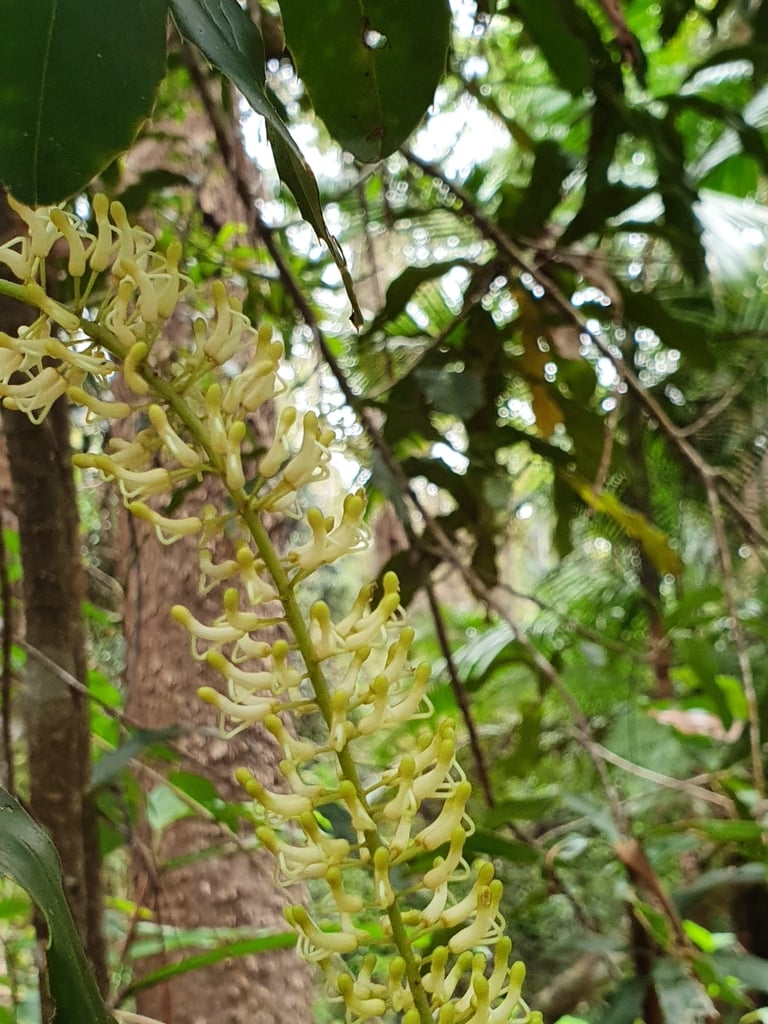
The flowering starts at Bundaberg at winter’s end and rolls south along that coast through September. The flowers open in hanging sprays of a hundred or more, and the industry’s own word for their scent is honey. Hives go into the orchards because the macadamia needs them – most varieties set a full crop only when bees carry pollen from tree to tree – and the honey comes off the same weeks as the fruit is set.
The tree carries older names than Macadamia. To Bundjalung people of the Northern Rivers it is gumbar gumbar; the nuts were roasted in fire ashes, traded between nations, and given at ceremonies, and the stones that cracked them survive on country. The honeybee gathers nectar from the macadamia blossoms during its season. This produces monofloral macadamia honey. The stingless bee also gathers nectar from the macadamia, but too little to harvest. Even from nectar gathered all year long from a variety of plants, including macadamia, a stingless bee hive only produces about a kilogram a year.
Characteristics
A honey in the malty middle of the Australian range: light gold to medium amber, intensely sweet at the front, with toffee and caramel through the body and a finish producers consistently describe as savoury. The aroma follows the flavour – malt and caramel over blossom. It crystallises naturally and does so finely, setting to a small, creamy grain rather than a hard candy; several producers flag the crystallising on the label as a mark of the honey rather than a fault. A sensory panel has profiled it across fourteen attributes – rare treatment for an Australian varietal.
Click to Display — The Details: botanical origin, sensory profile, pairings, health and what gives it its character
Nectar Contributors:
- Primary: Macadamia (smooth-shelled) (Macadamia integrifolia)
- Secondary: Rough-shelled macadamia and hybrids (Macadamia tetraphylla)
Bee Species:
The jar is the European honey bee’s (Apis mellifera). But the macadamia’s flowers have a native worker with an older claim: the stingless bee Tetragonula carbonaria, the maker of sugarbag, whose country covers the whole macadamia coast. In field experiments, flowers caged so that only stingless bees could reach them set as many nuts as flowers open to everything – the native bee is the introduced bee’s equal on this blossom, and it mainly carries pollen, which is exactly the job the crop needs done. Orchards now install stingless hives alongside the honey bee boxes. A stingless hive yields about a kilogram of honey a year, gathered across the seasons, and no one bottles a macadamia sugarbag.
Color:
Light gold to medium amber
Flavor Profile:
Malty, with toffee and caramel notes and a savoury finish
Tasting Notes:
The producers’ descriptions agree on the centre and differ at the edges. The centre is malt, toffee and caramel – “complex flavours of malt and caramel… finishes with savoury tones” from one varietal specialist, “vanilla-toffee hints” from a Queensland orchard brand, “toffee caramel aftertaste” from two others. The edges are stranger and worth knowing: one Tasmanian honey shop adds “light soy sauce” to the malt and caramel, and another producer finds “notes of chocolate and a delicious citrus tang.” A University of Queensland sensory panel profiled macadamia honey across fourteen attributes and found that how the honey is taken from the hive shifts the flavour – comb-drained honey scored more floral, with a cleaner aftertaste, than honey extracted with heat and spinning. In an Australian range it sits between the delicate blossom honeys and the dark eucalypts – sweeter than ironbark, with the malt where ironbark has depth.
Aroma:
Fragrant and sweet; malt and caramel over blossom
Forage Origin:
Primary: macadamia (Macadamia integrifolia, family Proteaceae). The bees collect nectar from orchard bloom. The trees flower from late August into September in sprays – the botanists’ word is racemes – of a hundred or more small cream flowers, up to a couple of thousand sprays on a mature tree, of which fewer than one flower in a hundred becomes a nut. Each flower yields only a little nectar, mostly in the morning; the crop comes from the sheer number of flowers. About three-quarters of Australia’s plantings are Hawaiian-bred varieties of this one Australian species, grown on the subtropical coast the wild trees came from. The wild trees themselves survive as rainforest remnants, and all four wild macadamia species are now listed as threatened. The family is Proteaceae – the same family as banksia, which makes the two honeys botanical cousins on opposite ends of the flavour scale.
Secondary: rough-shelled macadamia (Macadamia tetraphylla, Proteaceae). The second commercial species, sweeter in the kernel and rougher in the shell, planted in the older Northern Rivers orchards – the world’s first commercial macadamia orchard, at Rous Mill near Lismore in the 1880s, was tetraphylla – and surviving in hybrids and garden trees through the same country. Where old plantings stand near hives, its nectar joins the blend.
Pairings:
The trade positions it as a dessert honey: over ice-cream, into yoghurt, with cream cheese – the malt-and-toffee register doing the work sugar would. Cooks push it further: a Tasmanian honey house recommends it in marinades, where it caramelises red meat on the barbecue, and the chef canon runs to macadamia-honey tarts and a macadamia honey and ginger panforte cooked, fittingly, on a Northern Rivers macadamia farm. Its strongest second life is fermented: mead makers prize the malty base – one meadery compares its dry macadamia mead to “a baked Chardonnay” – and an award-winning Adelaide nougat house works macadamia honey into its nougat. One reassurance worth stating: the honey comes from the flower’s nectar, not the nut, so it carries no tree-nut kernel – producers note only trace pollen.
Origin Story
The tree entered science in Melbourne: Ferdinand von Mueller described the genus Macadamia in a paper read in 1857 and published in 1858, naming it for John Macadam, the chemist who served as secretary of the institute that heard it – and who, the industry’s own historian concedes, likely never tasted the nut. That same year Walter Hill, first superintendent of the Brisbane botanic gardens, planted a seedling from bush near Gympie. It was the first macadamia anyone had cultivated, and it is still alive – a National Trust-listed tree in Brisbane’s City Botanic Gardens, still bearing nuts at more than a hundred and sixty years old.
The commercial story began at both ends of the tree’s range almost at once. In the 1880s Charles Staff planted about a hundred and fifty rough-shelled macadamias at Rous Mill, near Lismore – the first commercial macadamia orchard in the world. And in 1882 William Purvis carried seeds to Hawaii, where a handful of trees – one later collection amounted to perhaps six, planted in a Honolulu backyard – became the foundation stock. Hawaii did what Australia had not: from 1936 its experiment station worked through twenty thousand bearing trees, released its first five named varieties in 1948, and built the industry that taught the world the word macadamia.
Australia bought its own nut back. From 1963 the sugar company CSR secured land at Bundaberg and planted Hawaiian selections at scale; the Hawaiian varieties became the Australian orchards. Australian production passed Hawaii’s in 1997, and though South Africa has led the world since the 2010s, the crop’s whole genetic story still runs through one Queensland hillside.
That story is now walkable. The Walter Hill tree stands in Brisbane. At Amamoor, in the Mary Valley south-west of Gympie, a signposted forest walk opened in 2022 through country holding most of the region’s known wild trees, with guided walks led by a Gubbi Gubbi, Wakka Wakka and Kullilli custodian. The wild species themselves went onto the international threatened list in 2020 – about nine in ten wild trees stand on private land – and a citizen-science hunt now registers century-old backyard macadamias for DNA sampling, because the world’s orchards are built on a gene pool narrow enough to need the backyards.
Cultural Context
The nut carried names across its whole native range long before it had a Latin one. Queensland’s heritage register records boombera as the common name in New South Wales, burrawang among the Pine River groups, and kendel or kindal kindal through most of Queensland; to Bundjalung people of the Northern Rivers it is gumbar gumbar. The Butchulla people of the Mount Bauple country tell the Legend of the Baphal – retold in 1993, with permission, by senior Elder Olga Miller – in which a cockatoo scatters the nuts around the mountain to feed an injured man, and the nuts became Baphal’s nuts. The record of use is rich: nuts roasted in fire ashes, traded between nations, given as ceremonial gifts, cracked on incised anvil stones that survive on country; a Yugambeh Elder describes them planted along travelling routes to feed the people coming after. The Bundjalung chef Mindy Woods remembers it at house scale: “sitting underneath my Nan’s house in North Lismore as a child cracking open macadamia nuts with heavy stones.”
The same food history has a harder edge, stated plainly in the scholarship: the fertile country that grew the nuts drew the settlement that dispossessed the people who named them.
Today the districts celebrate the crop in season. Taste Bundaberg runs for ten days each September – inside the bloom window – with a picnic staged under the macadamia trees themselves; the Northern Rivers’ autumn Harvest Festival sets its long-table lunch in a working macadamia orchard at Alstonville. And the honey has found its trophy shelf in an unexpected room: it has never medalled at an Australian honey show, but as mead it has taken gold at the Ekka, at national mead competitions, and at a European meadmakers’ judging in Krakow – where the maker had to explain that the honey carried no nuts at all, “just the honey from the pollination of the macadamia trees.”
Hawaii, meanwhile, still bottles the same blossom: Big Island producers sell macadamia nut blossom honey that runs dark amber with hints of chocolate – the same flower, read in a different accent, an ocean from home.
Harvest & Forage
The window is short and moves. Flowering opens at Bundaberg at the end of August and rolls south through September, and the harvest off it is not guaranteed: the state’s own pollination research recorded hives that stored no surplus macadamia honey at all in some orchards, while reliable reports put good years at ten to fifteen kilograms of surplus a hive. The difference lies in the season and in the trees themselves – macadamia varieties differ in how attractive their flowers are to bees, so the same hives in a different block can come away with a different crop.
The orchard is a working farm in its most intensive weeks. Industry guidance asks growers to keep sprays off the bloom – to spray in the evening if they must spray at all – and pollination agreements now put chemical notification in writing; most orchards run professional pest scouts.
The supply base is also moving. Macadamia prices collapsed from record highs in 2020 to below the cost of production in 2023, and the Northern Rivers – where most of Australia’s macadamia farmers are – pulled out nearly five hundred hectares of trees in a single recent year while Bundaberg’s larger orchards kept expanding. The small-farm country that supplies the farm-gate honey layer is thinning.
Beekeeping Context
The macadamia cannot make its crop without the bees: most varieties set fruit only when pollen crosses between trees, and orchards stock five to eight hives a hectare through the bloom. Yet macadamia is the cheapest paid pollination among Australia’s big bee-reliant crops – about $50 a hive against $225 for avocados – because the beekeeper is paid twice, once in fees and once in honey. Many hives arrive from the Victorian almond orchards, where the work pays well but yields no honey; the macadamia bloom is where the year’s first real crop comes in.
In the Northern Rivers the arrangement ran even cheaper: the district holds so many feral honey bees that many orchards never hired hives at all – the bush pollinated the crop for nothing. The varroa mite reached Lismore and the surrounding district in 2024, and beekeepers there expect it to remove nearly all of the feral bees within a decade. The free pollination is ending, and orchards are turning to managed hives – and to native bees.
Source Regions
- Bundaberg, Queensland (largest producing region)
- Northern Rivers, New South Wales (Lismore, Ballina, Byron hinterland)
- Gympie and the Sunshine Coast hinterland, Queensland
Festivals and Fairs
- Taste Bundaberg Festival – Bundaberg QLD (ten days, early-mid September): the biggest macadamia region’s food festival, running inside the bloom window – the orchards flower while the festival cooks. Its recurring flagship is a picnic staged under the macadamia trees at a family orchard whose farm-gate shop sells the estate’s own macadamia honey.
- Northern Rivers Harvest Festival – Ballina/Byron hinterland NSW (May): a self-drive harvest trail through the small-farm macadamia country, closing with a long-table lunch set inside a working macadamia orchard at Alstonville, cooked from produce grown within fifty kilometres.