Australian Orange Blossom Honey
The Story
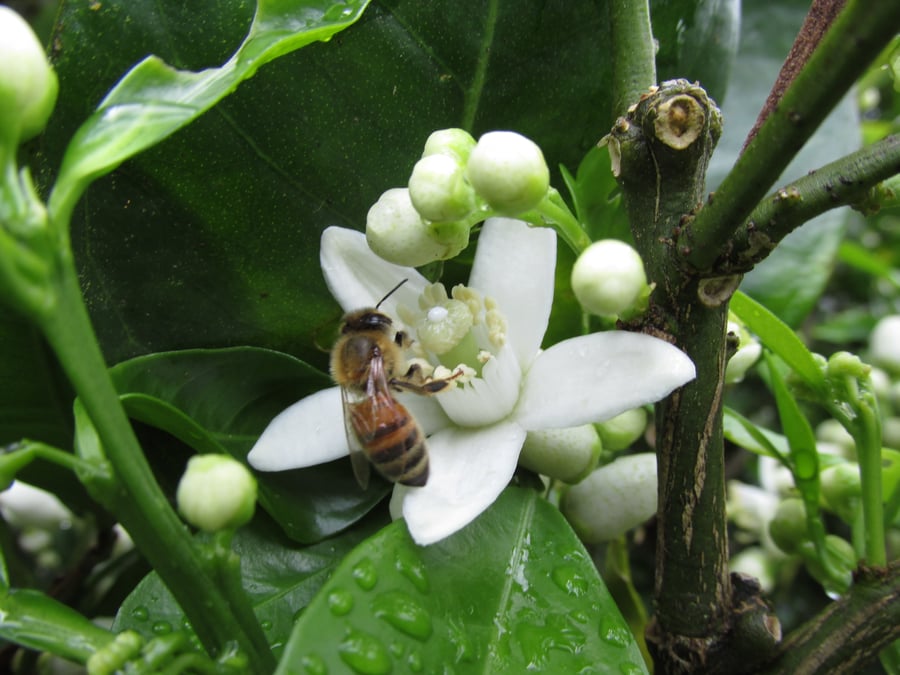
Australian orange blossom honey comes from the dry, flat inland of the continent’s south-east, where the Murray River – Australia’s longest – runs between three states on its way to the sea south of Adelaide. This is mallee scrub and saltbush country that carried no orchards until engineers put river water on it. Two Canadian brothers named Chaffey laid out the first irrigation settlements on the Murray in 1887; a government canal scheme opened in 1912 on the Murrumbidgee, one river to the north. The irrigation towns those channels made – Mildura and Renmark on the Murray, Griffith and Leeton on the Murrumbidgee – now grow about two-thirds of Australia’s citrus. Each spring, in September and October, the groves flower, and beekeepers truck hives in among the rows for the weeks the blossom lasts.
An irrigated orchard flowers every spring, because the water arrives every spring. Most Australian honey comes from native trees that flower on multi-year cycles and may not flower at all in drought; orange blossom is the harvest beekeepers can plan on. In 2019, a season South Australian beekeepers described as their worst, those who moved hives onto the orange groves after almond pollination took their only honey of the year there.
At the 2023 Sydney Royal Easter Show a Riverina orange blossom was judged Champion Commercial Honey – blind, against about five hundred entries. The flowering itself is on the same scale as the industry: a visitor driving into Griffith one October described the smell of citrus blossom in the air across the entire city.
Characteristics
Among the palest honeys Australia produces – graded extra white to pale amber in CSIRO’s national colour survey – and slow to crystallise; when it finally sets, it sets in granules of varying size. The aroma is of orange blossom, fragrant and fruity, with a note food chemists trace to methyl anthranilate, the compound that also scents the flower itself. The flavour is sweet even by honey’s standards – producers rank it among their sweetest jars – delicate and floral, finishing on light citrus. With age the honey darkens and the aroma deepens toward marmalade.
Click to Display — The Details: botanical origin, sensory profile, pairings, health and what gives it its character
Nectar Contributors:
- Primary: Sweet orange (Citrus sinensis)
- Background: Grapefruit (Citrus paradisi)
- Background: Mandarin (Citrus reticulata)
- Background: Lemon (Citrus limon)
Bee Species:
The European honey bee (Apis mellifera) exclusively. Australia’s native stingless bees are not recorded in the dry inland where the citrus districts sit; their published range hugs the warmer coasts. The varroa mite reached all three districts between 2023 and 2025 – detections at Euroley in the Riverina and Euston in Sunraysia in 2023, then South Australia’s first detection at Pooginook in the Riverland in 2025. National eradication has ended, and beekeepers now manage the mite as an established pest.
Color:
Pale gold to nearly white when fresh, darkening slowly with age
Flavor Profile:
Sweet, delicately floral, with a light citrus finish
Tasting Notes:
The oldest tasting note on record is from 1897, from a visitor to a pioneer apiary near the Nepean River: “a pale amber in colour, beautifully clear and with a rich delicate flavour that strongly suggested the perfume of the blossom.” The modern trade says the same thing more briefly – “fragrant and sweet with a delicate citrus taste” from one Riverina producer, “just a hint of citrus” from another, and Capilano rates its jar two on a five-point flavour-strength scale. In an Australian range it sits at the delicate end, beside yellow box rather than the dark eucalypts.
Aroma:
Orange blossom perfume; fruity, floral notes
Defining Compounds:
Methyl anthranilate. The marker compound of citrus honey worldwide: it carries the fruity side of the blossom’s perfume, and analysts use its concentration to confirm a citrus origin – confirmed orange blossom honeys in Florida average around three parts per million.
Caffeine. Citrus honey carries a trace of natural caffeine from the nectar, a documented oddity of the class. The amount is small – under four milligrams in a kilogram of honey, less than decaffeinated coffee.
Hesperetin. A citrus flavonoid found in citrus honeys and absent from honeys of other floral origins, proposed as a second fingerprint.
No Australian laboratory profile of orange blossom honey is published; the figures above come from the international literature on citrus honeys.
Forage Origin:
Primary: sweet orange (Citrus sinensis, family Rutaceae). The bees collect nectar from orchard bloom. Australian plantings run to two main types – Valencia oranges, grown mostly for juice, and navels, sold as eating fruit – and the Riverina holds about two-thirds of the nation’s Valencia area. Citrus flowers open in September and October and yield nectar freely, and because the trees are watered from the river, they bloom every spring, wet year or dry. Australia has six native citrus species of its own, desert lime and finger lime among them, eaten as fruit for thousands of years – but no honey is recorded from any of them, and the honey in the jar is entirely an orchard product.
Background: grapefruit (Citrus paradisi, Rutaceae). The Riverina is Australia’s biggest grapefruit region and the groves stand among the oranges, so citrus nectars mix wherever bees range across mixed plantings. Australian law sets no pollen threshold for calling a honey orange blossom, and citrus pollen is scarce in the honey even when its nectar dominates, so the name on the jar records the orchard the hives stood in.
Background: mandarin (Citrus reticulata, Rutaceae). Mandarin blocks flower alongside the oranges, but the newest plantings are Afourer, a variety growers net against bees to keep the fruit seedless – netted blossom is closed to the hive.
Background: lemon (Citrus limon, Rutaceae). Lemons flower over a longer stretch of the year than oranges; where they stand near orchard hives, their nectar joins the blend.
Pairings:
The trade’s suggestions run to baking and breakfast: producers recommend it in batters, biscuits and cakes, on buttered toast, and – Beechworth’s standing suggestion – whipped into cream for scones. Confectioners use it by name: an Adelaide nougat house has won national awards for roasted-almond nougat made with orange blossom honey. Mead makers buy it by the pail – a Melbourne brewing supplier sells it for light aromatic meads, and an Adelaide producer ferments two-thousand-litre batches of Renmark orange blossom honey into mead because the crop returns every year. In Middle Eastern baking, where syrups are perfumed with orange blossom water, the honey appears in Australian baklava recipes alongside the water it echoes.
Origin Story
The honey is older than the orchard districts. Colonial newspapers were carrying retail advertisements for “Pure Orange Blossom Honey, 6d per lb” by 1891, and the earliest known tasting note was written in 1897 at a pioneer apiary near Emu Plains, in the old orange country west of Sydney – decades before the inland irrigation schemes existed. By 1912 Albert Gale’s Australian Bee Lore and Bee Culture listed orange blossom among the country’s named honeys.
Then the orchards moved inland, and the honey followed the water. The irrigation settlements on the Murray and Murrumbidgee planted citrus from their first years, and the growers who made the plantings succeed were substantially Italian: migrants began arriving at Griffith in 1913, and by 1954 at least half the district’s orchards were Italian-run. As the coastal orange belt disappeared under Sydney’s suburbs, the honey’s geography became the irrigation map, and it has stayed there since. The old belt keeps one memorial: the Hills district, where Australia’s commercial orange growing began, still holds an Orange Blossom Festival every September, though the orchards it celebrates are gone.
The honey has occasionally been asked to carry more than the districts could supply. Around 1973 a leading Japanese importer visited Sunraysia, sampled the orange blossom honey, and asked district beekeepers to produce more than a thousand tonnes of it if his samples were accepted. The record does not say whether the shipment was ever made.
The orchards themselves have been through harder arithmetic. Australia’s juice-orange plantings fell by a third between 1994 and 2014 as imported concentrate undercut them and drought cut water allocations; the eating-orange plantings that replaced them have since grown strongly. Through the swings the honey has held its place as a named line – a Riverland orange blossom took Champion Honey at Melbourne’s fine food awards in 2014 – sold under the same name it carried in the 1890s.
Cultural Context
For a century of Australian weddings, orange blossom was the bridal flower. The custom followed Queen Victoria’s 1840 wreath; country newspapers ran their wedding columns under the standing heading “Orange Blossom,” and brides wore coronets of it from the 1900s into the 1950s – usually wax, kept as heirlooms and lent between families. When Margaret Dovey married Gough Whitlam, later prime minister, in 1942, her veil was held by gardenias and orange blossom. The same pages record a Leeton bride in 1938, in the middle of the irrigation-area orchards, married under a coronet of tulle and orange blossom.
The groves have their own place in Australian letters: John Shaw Neilson’s “The Orange Tree,” written from the orange groves at Merbein outside Mildura and published in 1921, became one of the most widely anthologised Australian poems. It opens:
The young girl stood beside me. I
Saw not what her young eyes could see:
-- A light, she said, not of the sky
Lives somewhere in the Orange Tree.
The rest of the poem -- nine more stanzas, and the fruit is never mentioned
-- Is it, I said, of east or west?
The heartbeat of a luminous boy
Who with his faltering flute confessed
Only the edges of his joy?
Was he, I said, borne to the blue
In a mad escapade of Spring
Ere he could make a fond adieu
To his love in the blossoming?
-- Listen! the young girl said. There calls
No voice, no music beats on me;
But it is almost sound: it falls
This evening on the Orange Tree.
-- Does he, I said, so fear the Spring
Ere the white sap too far can climb?
See in the full gold evening
All happenings of the olden time?
Is he so goaded by the green?
Does the compulsion of the dew
Make him unknowable but keen
Asking with beauty of the blue?
-- Listen! the young girl said. For all
Your hapless talk you fail to see
There is a light, a step, a call,
This evening on the Orange Tree.
-- Is it, I said, a waste of love
Imperishably old in pain,
Moving as an affrighted dove
Under the sunlight or the rain?
Is it a fluttering heart that gave
Too willingly and was reviled?
Is it the stammering at a grave,
The last word of a little child?
-- Silence! the young girl said. Oh, why,
Why will you talk to weary me?
Plague me no longer now, for I
Am listening like the Orange Tree.
John Shaw Neilson (1872--1942). "The Orange Tree", first published in The Bookfellow, 15 February 1921; text from Collected Poems of John Shaw Neilson (1934). Public domain.
A century later, Beechworth Honey ran a label competition that drew more than five hundred entries and put twenty-three artists’ works on its orange blossom jars, with the proceeds going to bee research.
Every October, Griffith builds sculptures from more than a hundred thousand locally grown oranges and grapefruit along its main street. The idea arrived in the 1990s when a local celebrant saw the lemon festival of Menton, France, in a magazine; the town’s garden club wrote to Menton, and Menton wrote back granting permission and explaining the method. Griffith says it is the only place in Australia allowed to do it.
The districts stand on Aboriginal country – Wiradjuri along the Murrumbidgee. The published record of Wiradjuri plant use in the catchment includes the old method of finding a wild hive of sugarbag: catch a bee, follow it home. Orange blossom honey itself carries no Aboriginal tradition – the tree and the bee are both introductions – but the orchards are part of Wiradjuri working history: Stan Grant has written of his grandfather bringing the family to the irrigation-area orchards for work off the mission.
Harvest & Forage
The flow is short and set by the calendar of the fruit industry. Orange blossom opens in September and October and lasts weeks, not months; producers call the flowering season very short, and a cold or wet spring cuts the harvest. The reliability that defines the honey has edges: the trees flower every year, but the honey still depends on where hives can actually stand.
That ground is shrinking in one specific way. The seedless mandarins that anchor new plantings – the Afourer variety – set seedy fruit if bees bring them pollen from other citrus, so growers in the Riverland and Sunraysia net whole blocks specifically to keep bees out. The numbers behind the nets are stark: in the study that established it, only 7 to 34 per cent of open-pollinated Afourer fruit came out seedless, against 98 to 99 per cent under anti-bee netting. A national study found hives working under protective covers come out weaker than hives in the open. As netting spreads, the orchard area open to hives gets smaller.
An orchard is also a working farm, and hives share it with a spray program. New South Wales’ agriculture department asks growers to give beekeepers 48 hours’ notice before spraying and to mow flowering ground cover first; beekeepers place hives around the program and pull them out when it starts.
The water is the deepest dependency. The groves flower because irrigation water arrives. When allocations collapsed in the long drought of the 2000s, Riverland growers let trees die and pulled orchards out – reporters described bonfires of dead citrus at Waikerie in 2008 – and every orchard removed leaves the district’s beekeepers less blossom. Warming Riverland winters now bring fewer of the cool days orange trees need to set flower buds, a pressure the industry is beginning to measure.
Beekeeping Context
Orange blossom sits inside a migratory year. The beekeepers who work the citrus mostly run their hives to the almond orchards first – almonds flower at winter’s end on pollination contracts that now pay around $200 a hive; the citrus bloom follows in September, and the hives roll from one crop to the other. Almond plantings along the Murray grew more than ninefold between 2000 and 2016, so the two crops bracket an inland beekeeper’s spring: paid pollination in the almonds, then the year’s first honey in the oranges.
The arrangement in the groves is the reverse of the almond weeks. Most orange varieties set fruit without bees, so the hives stand among the trees for the honey, not on contract – the grower gains little from the bees, and the beekeeper takes the crop.
Source Regions
- Riverina, New South Wales (Griffith and Leeton districts)
- Murray Valley / Sunraysia, Victoria and New South Wales (Mildura district)
- Riverland, South Australia (Renmark, Berri, Loxton, Waikerie)
Festivals and Fairs
- Griffith Spring Fest – Griffith NSW (October, two weeks): the citrus capital’s festival, built around sculptures assembled from more than 100,000 locally grown oranges and grapefruit along Banna Avenue – a method licensed from Menton in France, and Griffith says it is the only place in Australia permitted to use it. The district’s orange blossom honey sells through it: the Riverina producer behind the 2023 Sydney Royal champion launched its first orange blossom harvest at Spring Fest and stocked four Griffith retailers the same week.
- Sydney Royal National Honey Show – Sydney Royal Easter Show (annual): Australia’s honey competition, judged blind on a colour guide rather than by variety. In 2023 a Riverina orange blossom took the Phillip Carter Memorial Trophy for Champion Commercial Honey Exhibit with a score of 97 from 100 – the fact behind this page’s summary line.