
Prairies Honey
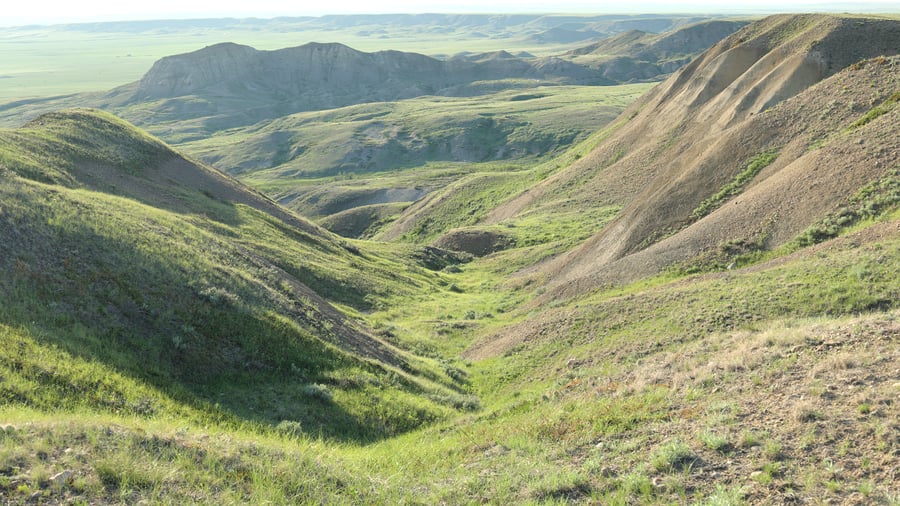
The prairie is the southern band of three provinces – Alberta, Saskatchewan and Manitoba – which run a long way north of it into boreal forest and Shield rock; the prairie is the part they share. To the west the Rocky Mountain foothills; to the south the American border; to the east Lake Winnipeg and the rock of the Canadian Shield; to the north the parkland, a belt of aspen groves thickening among the fields until the grass gives way to forest. Between the foothills and the lake the land steps down twice – off the high Alberta plain near the Saskatchewan border, and off the Manitoba escarpment onto the floor of a vanished glacial lake. Five hours north of Edmonton the forest opens again into a second, smaller prairie in the valley of the Peace River, and that country belongs here too. The towns on it are rail towns. In any one of them, on a Sunday afternoon in October, you might find a poster in the co-op window: FALL SUPPER, ADULTS $25. Anyone may buy a ticket at the hall door. Inside, volunteers serve turkey, mashed potatoes, cabbage rolls, perogies – filled dumplings – and pie, at long shared tables, and a town of fifteen hundred has been known to sell a thousand tickets.
There are two prairies here. One is the familiar one: fields yellow to the horizon for three weeks of July, and a wooden grain elevator where the rail line meets the town – once one every eight to ten miles along the line; Saskatchewan alone had 3,035 of them in 1950 and 197 licensed by 2004. From 1871 the survey marked the whole of it into square-mile sections, and from 1872 the government handed the sections out a quarter at a time – 160 acres, a quarter of a square mile, for a ten-dollar fee – and went on doing so until 1930. Every grid road a traveller drives today is a line of that survey.
The other prairie is the grass that was here first, and it is kept in a few named places. In Saskatchewan, by the Prairie Conservation Action Plan’s estimate, between 17 and 21 per cent of the original native prairie remains; of Manitoba’s tall-grass prairie, Environment Canada’s ecologists put it at less than one per cent. Parks Canada’s own sentence is that few people have ever seen a native mixed-grass prairie. You can, at Grasslands National Park in Saskatchewan’s far south, where plains bison were put back in December 2005, and in the Cypress Hills, which stood above the ice sheets and still carry grass on the plateau. The yellow prairie surrounds both, and is the one crossed to reach them.
The year here runs to the week. Winnipeg’s average January day is 16 below and its average July day just under 20 above, by Environment Canada’s 1991-2020 normals. In the last week of April tens of thousands of garter snakes come up out of limestone dens north of Winnipeg, and the province posts the state of the dens every few days. The canola is yellow from late June into July. The geese leave Oak Hammock Marsh from the middle of September, as many as a hundred thousand at the peak; more than a hundred whooping cranes stand on the stubble around Leask in the second week of October; and from late September into November the towns put on their suppers in the halls. In February, Winnipeg’s French quarter holds its winter festival. Each of these runs for a week or three, and the trip is built around the week you choose – and in August, for one month, the beekeepers’ farm gates sell the new crop by the pound or the pail.
Food
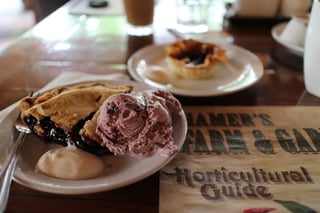
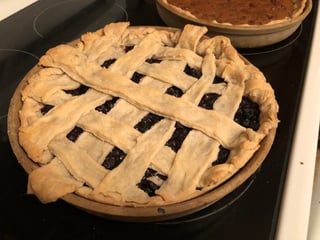
Seven miles south of Saskatoon on Valley Road, The Berry Barn serves a single-crust saskatoon pie on a patio above the South Saskatchewan River, and in July, when the berries come in, sends you into the orchard with a pail for the fruit itself – a native prairie berry the size of a blueberry that the Alberta food writer Margaret Bose Johnson finds “slightly floral with hints of almond.” The pie, says the menu, “is what you came for.” The prairie eats like that: one fruit, one lake fish, one sauce, one sausage, each with a counter where it was made famous. Four counters in four cities follow; the fifth is a December morning in a line.
Pickerel and honey dill under one roof at The Forks, free chuckwagon pancakes on Stephen Avenue, a ring of Mundare kielbasa, and a perogy drive-thru
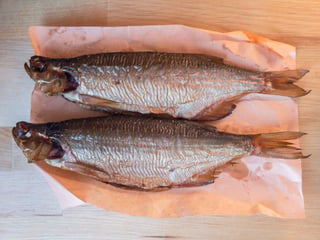
The Forks Market, Winnipeg -- year-round. Manitoba is a lake province inside a grassland, and its official fish, the pickerel, comes beer-battered at a counter that has bought Lake Winnipeg pickerel from local fishers since 2004 (Fergie's Fish'n Chips, The Forks Market); the Winnipeg travel writer Donna Janke calls the flesh sweet, mild and flaky, and a Tripadvisor reviewer who grew up in Gimli, the lake's fishing town, calls Fergie's "the best hands down." The lake's other fish, goldeye, is smoked in Winnipeg and bought whole from Gimli Fish Market's three shops, not ordered off a menu. Across the hall, Zorba's has served chicken fingers with honey dill sauce since the market opened in 1989 -- honey, mayonnaise and dill, the sauce a national grocery chain dropped after ten months because it sold nowhere but Manitoba. Shirley Eng, whose restaurant Mitzi's made it famous before closing in 2024, used to tell out-of-towners it was "an acquired taste, kind of like our weather." The market runs eleven to ten, later at weekends.
Calgary -- Stampede week, 9 to 18 July 2027. Every Stampede morning a chuckwagon crew serves free pancakes and bacon at Fluor Rope Square on Stephen Avenue, a habit begun on the same street in 1923 that spread across the city in the 1950s, when churches, malls and companies began breakfasts of their own. The city's other invention is ginger beef: in the 1970s at the Silver Inn, opened in 1975, a cook cut his Peking-style beef like fries, fried it crisp for diners who wanted Alberta beef tender, and sauced it with chili; the diners tasted ginger and renamed it. The Silver Inn closed in 2022; in 2020 the CBC's critic Elizabeth Carson ranked a Szechuan house on Spiller Road (Kam Han Szechuan House, Calgary) second in the city for "a nice kick spice level, not too sweet" -- check its hours.
Mundare and Edmonton's 118 Avenue -- Stawnichy's eight to five, closed Sundays. Eighty kilometres east of Edmonton, in a town settled by Ukrainian homesteaders, Stawnichy's sells its garlic kielbasa under a giant sausage replica; a customer who drove from Lamont to fill an Orthodox Easter basket told Global News, "Nobody can top their kielbasa. Nobody -- the best in Alberta." In the city, the company's Mundare Sausage House and the Green Onion Cake Man stand on the same avenue, 118 Avenue, a few kilometres apart -- where Siu To, who arrived in 1978 and made the flat, layered northern-Chinese cake Edmonton's festival food, still fries them at his counter. "People thought cake meant dessert," he told the Rat Creek Press; the city's own guide calls them "salty, buttery bites of heaven."
Baba's Homestyle Perogies, Saskatoon -- drive-thru; check hours. At 720B 51st Street East, twenty people hand-pinch five to eight thousand perogies a day -- twelve thousand in December -- and sell them through what the owner says is the country's only perogy drive-thru, in seven fillings from potato-and-cheddar to saskatoon berry, with a mushroom dill sauce. Rob Engel told the CBC they "taste like home. They taste like love." On Tripadvisor one visitor found a thirty-dollar plate "expensive and not memorable" and another called the mushroom sauce "delicious." The cheaper way in is a church basement: Holy Family Ukrainian Catholic in Winnipeg sells a plate of six for ten dollars, cash, on dated Fridays.
Four hundred pounds of Lumsden Valley honey, a line at minus 35, and a Regina pub that opens its doors at eleven on a Saturday in December
Bushwakker Brewpub, Regina -- 5 December 2026, doors at 11. Once a year the brewpub on Dewdney Avenue releases a blackberry mead made from Lumsden Valley honey -- the Qu'Appelle valley half an hour north of the city -- and thousands of bottles go before lunch; each batch starts from 400 pounds of honey and 84 of blackberries, and one year the bottles were gone in an hour and forty-five minutes. The Leader-Post's CJ Katz has watched the line run along the front of the building, around the corner and down Cornwall Street; the bar manager, Grant Frew, remembers a morning at "about minus 35 and minus 50 with wind chill" -- "and still people waited," Katz wrote. The date moves -- 2025's was the second Saturday -- so check the pub's own events calendar (Bushwakker Brewpub, Regina); the mead is on tap through December, no minors.
Culture
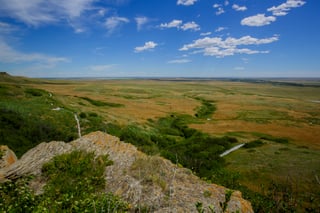
Every Wednesday in July and August, at eleven and again at half past one, Blackfoot dancers and drummers perform for free on the outdoor plaza at Head-Smashed-In Buffalo Jump, under a sandstone cliff their ancestors drove bison over for nearly six thousand years; the Elder is there to meet, and the guides who interpret the site are, in UNESCO’s words, Blackfoot speakers “engaged exclusively.” The Nations’ places here are the Nations’ own to show; the settler blocs each kept a town, a hall and a festival; and the winter has a festival of its own. The summer’s open doors, the maker and the market are in the second accordion.
A Wednesday on the Blackfoot plaza, a bison herd above Saskatoon, the Métis Nation's July at Batoche, and caribou in an ice glass on the frozen Red
Head-Smashed-In and Blackfoot Crossing, Treaty 7 country -- Wednesdays in July and August; the centre open year-round. Eighteen kilometres west of Fort Macleod, about an hour and three-quarters from Calgary, the interpretive centre is built seven storeys into the cliff; adult admission is $18, summer hours daily ten to five, and the Wednesday plaza programme (Head-Smashed-In Buffalo Jump, Government of Alberta) runs chicken dances and warrior dances, indoors if the weather turns. Tripadvisor's 794 reviewers rate it 4.7. An hour east of Calgary on the Bow, Blackfoot Crossing Historical Park stands on the ground where Treaty 7 was made in September 1877: the Siksika Nation's own building, its four tipi-pole supports fifty feet high -- open Monday to Friday only, adult $22. The treaties are not history here: the annuity they promised, $5 a person, is still paid out in person each summer at the Nations' Treaty Days.
Wanuskewin Heritage Park, Saskatoon -- daily 9:30 to 5; dancers Saturday and Sunday afternoons from September to May. Five kilometres north of the city, the Opimihaw Creek valley has been a gathering place of the Northern Plains peoples, the park says, for more than 6,400 years; by Tourism Saskatchewan's count nineteen pre-contact sites -- bison jumps, tipi rings, a medicine wheel -- lie along seven kilometres of trail, with a herd of plains bison below a viewing platform and a restaurant serving First Nations cuisine. Canada put the valley on its World Heritage Tentative List in 2017. Adult admission $16; one Tripadvisor reviewer, among 54 who rate it 4.8, calls it the "best Indigenous history, cultural and art museum I have seen." Check the access road, closed for pipeline work into late 2026.
Batoche, on the South Saskatchewan -- site open May to September; Back to Batoche Days each July. Eighty-eight kilometres north-east of Saskatoon, the Métis river-lot village where Louis Riel and Gabriel Dumont made their last stand in 1885 is, in Parks Canada's words, "a symbol of Métis resilience and cultural renewal," and every summer the Métis return to it. Métis Nation-Saskatchewan calls Back to Batoche Days (Métis Nation-Saskatchewan) the largest outdoor Indigenous festival in Canada: four days of jigging and fiddling, horse races and a Métis artisan market, and its invitation is open -- "whether you are returning for another year or joining us for the first time." Buy a gate pass. The Métis of the three provinces have governments Canada recognises; the Manitoba one signed the country's first Métis self-government treaty in November 2024.
Saint-Boniface, Winnipeg -- the Festival du Voyageur, 12 to 21 February 2027. Across the Red River from downtown, the French-speaking quarter founded on an 1818 mission has held a fur-trade winter festival every February since 1970: ten days in Whittier Park around the rebuilt North West Company post of Fort Gibraltar, with more than 150 performers in heated tents, a snow-sculpture symposium, and caribou -- the wine-and-whisky drink -- served, as the CBC puts it, "chilled in an ice glass." The Manitoban's arts and culture editor, at a first festival in 2023, noticed "the smell of smoke and the beautiful echoes of fiddling from various tents," climbed the fort's rampart for the view, ate bannock with whipped butter in the fort's brasserie, and left "with the strong scent of smoke in my hair." Riel is buried in the cathedral cemetery a few streets away.
Forty-five pavilions in Winnipeg's halls, a Ukrainian festival under a giant egg, bread at a Doukhobor prayer service, Vikings on the Gimli harbour, a $45 bus into a Hutterite colony, and a bootmaker who measures you for eight to twelve weeks
The bloc settlements' summer -- June to August. Each settlement that came in a block kept a town and a festival. Vegreville, a hundred kilometres east of Edmonton, holds its Ukrainian Pysanka Festival on the first weekend of July -- free grounds, grandstand shows, dance competitions, a Yarmarok market, and ticketed zabavas (evening dances). At Veregin, north of Yorkton, the National Doukhobor Heritage Village keeps Peter's Day on 29 June with an eleven o'clock prayer service commemorating the burning of arms of 1895 -- the pacifists' destruction of their own weapons in Russia -- and "traditional Doukhobor bread baked fresh at every function"; the village opens 15 May to 15 September, adult $10. Gimli, ninety kilometres north of Winnipeg on the lake, has held Íslendingadagurinn (the Icelandic festival) since 1932: the August long weekend, a Viking village on the harbour hill, and a pillow-fight over the harbour water the festival calls Islendingadunk.
The doors -- Folklorama, two weeks in August; the Galt's colony tour, one summer Saturday. Folklorama is the bloc settlements as a city-wide open house: forty-five community-run pavilions in Winnipeg's halls and schools over two weeks, each with a show, a kitchen and a souvenir table -- the Ukraine-Kyiv pavilion and the Pavillon canadien-français among them; nobody needs to know anyone to walk in. The way into a Hutterite colony is through an institution: the Galt Museum in Lethbridge runs a $45 bus tour into the Wilson Colony south of Coaldale, founded in 1918, with lunch cooked by the colony and vegetables and goods to buy after; bring cash, register ahead, and check the museum's events page for the year's date.
The maker and the market -- Alberta Boot Company, Calgary, weekdays and Saturdays; St. Norbert, Saturdays. At 121 10th Avenue SE in Calgary, the Alberta Boot Company, making western boots in its own workshop since 1978, measures a foot for a custom pair from about $1,200 and posts them eight to twelve weeks later, or sells a stock pair from the same rooms -- cutting, sewing, lasting, finishing -- where Ben Gerwing, the founder's grandson, runs the business. The object to carry home from a market is at St. Norbert on a Saturday: Michael Lemer Pottery's stoneware barrel mug, $28 in the market's own gift guide, from a stall among the honey and the bread.
Natural History
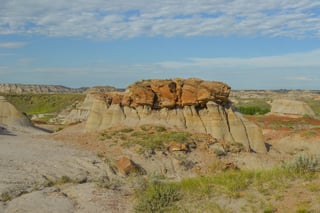
An hour and a half east of Calgary on Highway 9 the wheat ends at a rim, and a canyon of grey, brown and coal-black badlands opens below it – the sea floor and river delta of seventy-five million years ago, cut open by meltwater since the ice left. In the valley floor at Drumheller the Royal Tyrrell Museum keeps the dinosaurs the badlands give up, and two hours further east, Dinosaur Provincial Park keeps the ground they come out of. The native grass itself – Grasslands and the Cypress Hills – has its own section further down the page.
Timed tickets in the badlands and a bus into a fossil preserve, the seed herd of the plains bison, tens of thousands of snakes on a May weekend, and a hundred whooping cranes in one municipality
The Red Deer River badlands -- the museum year-round, the park's programmes late April to Thanksgiving. The Royal Tyrrell Museum (Government of Alberta, Drumheller) is open nine to nine daily from mid-May to the end of August, shorter hours and closed Mondays in winter; adult admission $25, timed entry, and the museum's own advice is two hours for the galleries -- "one of the world's largest displays of dinosaurs," it says -- before the interpretive trail out the back door into the badlands. Dinosaur Provincial Park, a UNESCO site since 1979, lies 48 km north-east of Brooks and about two hours from Drumheller: twenty-six kilometres of striped hills that have given up, Alberta Parks says, more than 150 complete skeletons. The public loop trails are open all year; the interior is reached only on park programmes, from a two-hour bus tour to a day's guided excavation, late April to mid-October, and they sell out.
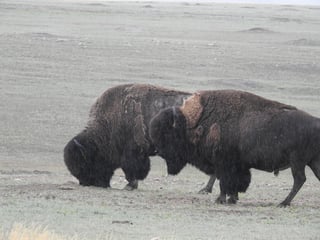
Elk Island and Riding Mountain -- all year; bison at dawn and dusk. Thirty-five kilometres east of Edmonton on the Yellowhead, Elk Island National Park (Parks Canada) holds what Parks Canada calls a seed source of plains bison: when fewer than a thousand were left on the continent the government bought one of the last herds and, between 1907 and 1912, shipped more than 700 wild bison here by train, and the park's disease-free animals have since gone to herds across North America, including the 71 sent to Grasslands in 2005. In Manitoba, three hours north-west of Winnipeg, Riding Mountain National Park sits on top of the escarpment: the road up from the East Gate climbs through a strip of eastern hardwood forest onto a plateau that UNESCO's biosphere programme places "at the junction of the grassland and boreal forest biomes" and where, as Parks Canada puts it, boreal forest, aspen parkland and rough fescue grassland meet, with a display herd of bison at Lake Audy and the resort town of Wasagaming on Clear Lake.
The Interlake -- Narcisse late April to the third week of May, Oak Hammock mid-September to Thanksgiving. Six kilometres north of Narcisse on Highway 17, an hour and a half from Winnipeg, four limestone dens below the frost line -- the reason, the province says, the area suits the snakes -- give up "tens of thousands of red-sided garter snakes" every spring, mating in balls of up to a hundred males around one female beside a free three-kilometre trail. The province posts the dens' activity (Manitoba Natural Resources) every few days; the peak is usually Mother's Day weekend, when, as one regular tells Tripadvisor, arriving at noon means parking on the highway. On a cold Mother's Day in 2026 the CBC's Arturo Chang found about a hundred people on the trail and a twelve-year-old, Liam Warren, who had counted 59 snakes: "I liked how their scales look." Thirty-five kilometres north of Winnipeg, Oak Hammock Marsh -- a restored marsh on the Ramsar list of wetlands of international importance, where migrating geese "may reach 100,000" -- keeps its interpretive centre open until dusk Thursday to Sunday from 17 September to 12 October 2026; adult $14, the dyke trails free.
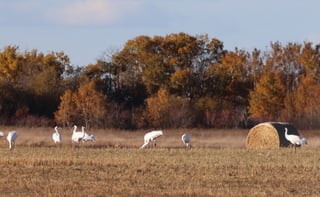
The whooping cranes near Leask -- late September to late October, peak the second week of October. The only wild, self-sustaining flock of whooping cranes in the world, 557 birds at the last winter count, breeds in the far north and spends up to six weeks each autumn on the stubble fields and sloughs -- the prairie's shallow ponds -- of central Saskatchewan before flying to Texas; in 2024 the highest counts, more than a hundred birds at a time, were in the Rural Municipality of Leask, an hour north-west of Saskatoon, peaking in the second week of October. The birds feed on private stubble and are watched from public grid roads, at a distance; the species is protected under federal law.
Bare dunes inside the wheat belt, a spring pool at the bottom of a sand sink, and a winter wind that can raise the temperature 27 degrees in two minutes
The dunes -- late spring to fall. Twenty kilometres south of Sceptre, on the highway between Leader and Swift Current, the Great Sand Hills are a landscape of native grass and aspen with bare, moving dunes in it, reached across private ranch land on gravel and then sand, with no water, no facilities and, Tourism Saskatchewan warns, no fires or camping; the interpretive centre in Sceptre gives directions. In Manitoba, 180 km west of Winnipeg in Spruce Woods Provincial Park, the Spirit Sands are the last bare four square kilometres of the delta the Assiniboine built into glacial Lake Agassiz -- dunes with pincushion cactus and hognose snakes, and beside them the Devils Punch Bowl, which the park describes as "an eerie blue-green oasis of spruce trees and a spring-fed pond" at the bottom of a sink; a Manitoba park vehicle permit is $9.50 a day.
The chinook -- November to March, southern Alberta. Warm, dry westerly winds come down off the Rockies into the plain between Pincher Creek and Calgary and take the snow off the ground in hours: the Canadian Encyclopedia records a rise of 27 degrees in two minutes, and in south-western Alberta one winter day in three is a chinook day. The sign is the arch -- a straight-edged bank of cloud along the western sky with clear blue beneath it -- seen best from the open plain east of the foothills, on the Highway 2 and 3 corridor.
Built Heritage
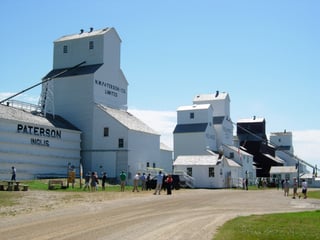
At Inglis, Manitoba, on Highway 83 between Riding Mountain and the Saskatchewan border, five peak-roofed wooden grain elevators stand in a row beside the track, painted with the names of the companies that built them between 1922 and 1941, their machinery still inside; Parks Canada calls them “slope-shouldered sentinels,” and one visitor told Tripadvisor the guide’s tour “flew by” and made every elevator seen afterwards mean something. There were 5,758 of them across the West at the peak in 1933, one every eight to ten miles along the line. The forts where the treaties were made, the grain city’s stone and the buildings that have changed hands follow.
A row of five wooden elevators kept whole, the stone fort where Treaty 1 was made and the police post Sitting Bull's people camped beside, twenty blocks of grain-trade Winnipeg, and a railway station that became an Indigenous centre
Inglis Grain Elevators, Manitoba -- Friday to Sunday noon to four in July and August; tours by appointment year-round. The row closed in 1995 and a local committee kept it; Parks Canada designated it as "perhaps the last example of a large row from the 'golden age' of elevators remaining in Manitoba," and the operator calls it the last complete vintage row in Canada. The row's visitor centre and tour booking (Inglis Grain Elevators National Historic Site) is on Railway Avenue, north of Russell on the Yellowhead; outside the summer days, tours are by phone. The CPR gave free trackside sites to anyone who built a standard 25,000-bushel elevator with a "leg," the cup-belt that lifts the grain and gives the building its height, and the farmers' Wheat Pools built hundreds more; consolidation and the end in 1996 of the Crow Rate, the subsidised freight rate for grain, took most of them down.
Lower Fort Garry and Fort Walsh -- May to September. Thirty-two kilometres north of Winnipeg on Highway 9, Lower Fort Garry is the Hudson's Bay Company's stone fort of 1831-48, "one of the finest collections of early stone buildings in western Canada" in Parks Canada's words, and the place where Treaty 1 -- the first of the Numbered Treaties -- was made in August 1871, with more than two thousand Anishinaabe (Ojibway) and Swampy Cree people camped on the grounds. In the Cypress Hills, south-west of Maple Creek, Fort Walsh was built by the North-West Mounted Police in 1875 after the massacre of Nakoda people two kilometres south; about five thousand Lakota who had left the United States after the Little Bighorn camped nearby from 1876, the force's headquarters moved from here to Regina in 1882, and the buildings now standing were put up by the RCMP in the 1940s. Open Tuesday to Saturday, ten to four-thirty, mid-May to mid-September. At Fort Battleford, Parks Canada's own history records the hanging of eight Indigenous leaders on 27 November 1885, "the largest mass hanging in Canadian history," and names each of them.
Winnipeg's stone -- year-round, on foot. The Exchange District is twenty blocks and some 150 buildings of the 1880-1913 grain-and-wholesale boom, walkable and free, and at Main and Market, across from City Hall, stands "Bloody Saturday" (2019), which its makers describe as "a steel and glass ghost" of the streetcar that strikebreakers drove into a silent protest on 21 June 1919 and the crowd tipped and burned -- "so much that defines Winnipeg," the artists say, "was forged on Bloody Saturday." The Legislature gives free guided tours, on Fridays and Mondays in the fall and winter schedule, booked ahead. Across the river the 1906 limestone facade of Saint-Boniface Cathedral stands open to the sky, the church of 1972 by the Franco-Manitoban architect Étienne Gaboury built inside the walls the 1968 fire left, and Louis Riel lies in the cemetery in front of it.
Buildings that changed hands. Thousands of immigrants to Western Canada walked through Winnipeg's CPR station of 1904-06 on Higgins Avenue; since 1992 it has been the Neeginan Centre, an Indigenous hub of education and services and a working building, with the old waiting hall as its rotunda. Eighty-five kilometres west on the Trans-Canada, at the edge of Portage la Prairie, the 1914 brick residential school that held children from the surrounding Nations until 1975 passed to Long Plain First Nation in 1981 under its treaty land entitlement -- the reserve land the treaty promised and the Nation had never received -- and is kept, in Parks Canada's words, "as a place of commemoration and resilience," with the National Indigenous Residential School Museum on its main floor; tours run Monday to Friday, by phone. And at Fort Qu'Appelle, seventy kilometres north-east of Regina, the Treaty Four Governance Centre stands on the lakeshore ground where Treaty 4 was signed in 1874, its council chamber built in the form of a tipi, the site of the Treaty 4 Gathering each September.
The 1914 gas plant where Alberta's oil began, a potash mill beside the Trans-Canada, a concrete aqueduct three kilometres long, and a railway bridge its engineers' society calls the highest of its kind in the world
What lies under the wheat -- Turner Valley Saturdays and Sundays, mid-May to early September. Sixty kilometres south-west of Calgary on the Cowboy Trail, the Turner Valley Gas Plant is where the Dingman No. 1 well found gas on 14 May 1914 -- Alberta's first major oil and gas discovery, and the province's "birthplace" of its petrochemical industry; the plant ran until 1985 and gives ninety-minute guided tours at weekends, adult $12, cash only, closed-toe shoes. Fifty kilometres west of Regina on Highway 1, the Belle Plaine potash mill is, in its owner's regulatory filing, "the oldest and largest potash solution mine in the world," producing since 1964 from the salt of a sea that dried up some 380 million years ago; it stands just north of the highway and there is no public access.
The water and the wind -- year-round. Eight kilometres south-east of Brooks, the Brooks Aqueduct is a reinforced-concrete flume 3.2 km long on legs, built by the CPR between 1912 and 1914 to carry Bow River water to fifty thousand hectares of dry land, in use until 1979 and now a historic site with no published hours, beside the irrigated green it made. At Lethbridge the CPR's High Level Bridge of 1909 carries the railway 1.6 km across the Oldman River valley on 33 steel towers, 96 metres above the river bed -- "the highest and longest steel railway bridge of its type in the world," the Canadian Society for Civil Engineering states, with its track set between the girders rather than above them for shelter from the wind.
I want to dig deeper
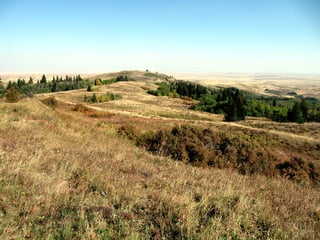
Three things here take longer, or take you further: the native prairie south of the Trans-Canada, from Val Marie to the Cypress Hills, where the grass was never ploughed because it was ranched and the night sky is the darkest class there is; the Peace, a second prairie five hours north of Edmonton where the boreal forest opens without warning onto canola and the town that calls itself the Honey Capital of Canada; and the bison, followed from the cliff the Blackfoot drove them over to the fenced island that has seeded herds across the continent.
One road through the unploughed south with a Bortle-1 sky at the end of it, a second prairie beyond the forest with a honey house you can watch through a window, and the bison from the jump to the seed herd
The Palliser south -- the dry south-west named for the 1850s expedition that mapped it -- from Val Marie to the Cypress Hills; May to October, with a moonless night for the sky. Start at Val Marie, three hours south-west of Regina and 120 km from Swift Current, fuel up, and take Grasslands National Park's 20 km Ecotour Scenic Drive through the Frenchman River Valley in the late afternoon -- prairie dogs barking at pull-off 2, the old ranch sites on the Larson trail at pull-off 6, bison kept at a hundred metres -- "the horizon a sweep of greys and greens, browns and tans," in Karen Pinchin's Canadian Geographic account, where a Parks Canada manager tells her why it exists: "If this hadn't been ranched, this wouldn't be a park today."
Five kilometres south on Highway 4 and five east on gravel, walk the 2 km 70 Mile Butte loop at sunset, then camp at the Frenchman Valley Campground under what Parks Canada calls "one of the largest and darkest" Dark Sky Preserves in Canada -- "a cosmic chandelier of light," Matt Duguid wrote for Tourism Saskatchewan from the East Block, 166 km away and a second day if you take it. Boots and snake gaiters are the park's advice.
Then west on the Trans-Canada to Maple Creek, where the Friday market sells the Cypress Hills' own honey, and up the gravel into the hills: over 1,460 metres, above the ice sheets that flattened everything around them, a Dark Sky Preserve since 2004, with Fort Walsh in the west block and Elkwater on the Alberta side an hour south of Medicine Hat. A hundred kilometres south-east of Lethbridge, on the way to or from the foothills, the Milk River valley at Writing-on-Stone / Aisinai'pi -- hoodoos of pale sandstone carrying, in UNESCO's words, "thousands of rock art images" left by the Blackfoot, inscribed in 2019 -- is walkable from the visitor centre, with the rock art itself seen on guided tours.
The Peace, the parkland's northern island -- June for the festival, July for the yellow, August for the honey house. Highway 43 runs north from Edmonton through hours of forest -- Peace River town is 486 km by its own measure -- and then the trees stop and a second prairie begins, canola and grain to the horizon under the long June light, with, in 2024, some 54,000 producing colonies in the region by the province's beekeepers' survey. Grande Prairie is the hub: twenty minutes west, Saskatoon Island Provincial Park, a bird sanctuary since 1948 where trumpeter swans land in early April and raise cygnets on Little Lake through the summer; and an hour and a half north the highway drops into the broad Peace River valley at Dunvegan.
East on Highway 49, "drive with your windows open in mid-summer," Alberta Open Farm Days writes, "and you can't miss the sweet aromas of blooming clover": this is Falher, the bilingual Smoky River town that has held a honey festival on the second weekend of June since 1990 and stands a 1990 bee statue it calls, in its own quotation marks, the "World's Largest Bee."
Down in the Smoky River valley at Watino, the Paradis family's Valley Bee Cafe has a window onto the extraction room, an observation hive, a mural of seven generations of beekeeping and honey on the menu -- open roughly May to autumn; call for hours before you drive.
The bison, from the jump to the seed herd -- Head-Smashed-In's plaza on Wednesdays in July and August; Elk Island all year; Grasslands May to October. Follow one animal across the three provinces. At Head-Smashed-In, west of Fort Macleod, the Blackfoot drove bison over the cliff for nearly six thousand years, and the deep bone beds under it are why UNESCO listed it. At Wanuskewin, north of Saskatoon, nineteen sites of the same hunting culture lie along a creek valley where a conservation herd grazes again below a viewing platform.
At Elk Island, east of Edmonton, is the seed herd described above, whose disease-free animals have gone to herds across North America. Seventy-one of them went to Grasslands in 2005, after 120 years without bison there; the park manages 400 to 500 now, seen from the Ecotour road. And at Riding Mountain, on the Manitoba escarpment, a fenced display herd grazes at Lake Audy.
The Honey of the Prairies
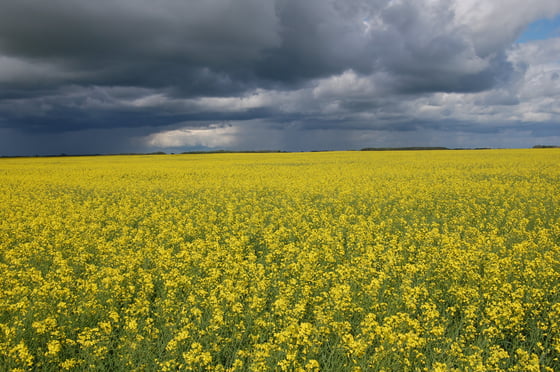
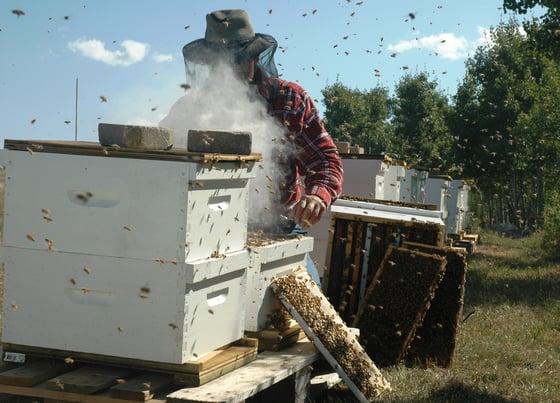
The yellow prairie of July is a honey crop. Bees put onto the canola, the sweet clover along the grid roads and the alfalfa of the seed fields make, in Manitoba’s own accounting, about 170 pounds a colony in the six weeks between the end of June and the middle of August, and Statistics Canada says that over four-fifths of the honey produced in Canada in 2024 came from the three prairie provinces – in 2025, by its table, Alberta alone made 34 million pounds and the three together 67 million of the country’s 84. Nearly all of it is the pale honey sold as clover, as canola or simply as white; Manitoba adds a dark buckwheat honey and a late-summer sunflower one, the Hutterite colonies sell theirs by the pail, and the Peace’s is sold under its river’s name. Most of it leaves – less than a fifth of Manitoba’s crop stays in the province – much of it through the beekeepers’ own co-operative. What stays is at the Saturday markets and, in August, at the farm gate by the pound, and the road below runs from Calgary into the Cypress Hills.
The Honey Road
One road, west to east, from a city rooftop to a foothills market to the hills the ice went around; the market days set the calendar, and the honey is the reason to go.
Calgary -- year-round; hive tours in July and August (city gateway)
Start where the honey is sold rather than made. At Balzac on the city's north edge, KB & DIA's counter in the New Horizon Mall pours free tastings Wednesday to Sunday -- a retailer whose jars say "Canada", so read the label for the region -- and at Crossroads Market, Friday to Sunday nine to five, Henry & Helen's Honey House sells honey by the jar. The two hive-openings on this road are both here and both summer-only, booked ahead: Spruce Cliff Honey's rooftop tour (Spruce Cliff Honey, Calgary) on the Delta hotel downtown, a dozen people in suits at one o'clock on a handful of July and August dates, and The Confluence's two-hour weekend workshop in the garden where the Bow meets the Elbow, run by Eliese Watson of ABC Bees. Next year's dates appear on their own pages.
Millarville and High River -- market Saturdays June to October; the winery Wednesday to Sunday, April to October; the farm gate Tuesday and Thursday mornings, and August Saturdays
Highway 22X west and 22 south, forty-five minutes, to the Millarville Racetrack: a Saturday market, nine to two, with the front ranges of the Rockies filling the west, Greidanus and Spirit Hills Apiaries among the stalls, and lunch from the food vendors. Ten minutes south, past the Three Point Creek bridge, a blue highway sign still says Honey Winery: a booked winery tour and tasting of wines made from honey and foothills flowers (Spirit Hills Flower Winery, Millarville) -- the bees are told as the story; it is not an apiary visit. Then east to High River and the field stop: a farm gate with fill-your-own-bucket Saturdays in August (Greidanus Honey Mill, High River), the family's since 1973, sells at the gate Tuesday and Thursday from nine to noon, freezes its honey rather than creaming it, and on every Saturday in August lets you fill your own bucket from nine to three. "The flowers you see in July and August all make it into our honey," the family says; canola, clover and alfalfa. The road home passes Okotoks, where Chinook Honey's old store on Highway 7 is closed; keep driving.
Maple Creek and the Cypress Hills -- market Fridays, 8:45 to 1; Fort Walsh Tuesday to Saturday, mid-May to mid-September
The Trans-Canada east through Medicine Hat to Maple Creek, where the Friday market is where Cypress Hills Honey Farm sells -- the Brodericks, beekeeping five minutes out of town since 1981, a light clover-and-alfalfa honey and a late-summer amber; the farm door is by phone, and Papa Joe's Smokehouse in town stocks the jar and does lunch, or Rafter R Brewing does. South of town the gravel climbs into the Cypress Hills Interprovincial Park: the plateau that stood above the ice, a Dark Sky Preserve since 2004, and Fort Walsh in the west block, the Mounted Police post of 1875, open ten to four-thirty. The Alberta side, Elkwater, is an hour south of Medicine Hat if the loop runs the other way.
Swift Current to Moose Jaw and Caron -- market Saturdays June to mid-September; meadery tours Wednesday to Saturday, May to October
East again on Highway 1: at Swift Current, Market Square on a Saturday morning, nine to two, is Prairie Field Honey's stall, the Epp family's mild alfalfa honey. Further east, Moose Jaw keeps the road's last tasting room, a meadery's tasting room in a Main Street hotel, and its winery tours (Prairie Bee Meadery, Moose Jaw and Caron), and twenty minutes west at Caron the meadery itself runs its Honey Wine Highway tour at eleven, one and three, Wednesday to Saturday from May to October, booked from its page: a production-room walk and a tasting of meads made from local honey. Phone for the tasting room's hours; they have moved.
Getting Here
Five international airports open onto the prairie, one to a city, and the region is driven between them: Calgary (YYC) for the badlands and the foothills, an hour and a half each, and the Cypress Hills, four and a half; Edmonton (YEG) for Elk Island, under an hour, and the Peace, four and a half to five hours north; Saskatoon (YXE) for Wanuskewin, twenty minutes, Prince Albert National Park, two and a half hours, and Grasslands, four; Regina (YQR) for Grasslands, three hours, and the Cypress Hills, four and a half; Winnipeg (YWG) for St. Norbert, fifteen minutes, Narcisse, an hour and a half, and Riding Mountain, three and a half. Regional airports shorten the drive to the region’s edges – Lethbridge and Medicine Hat in the south, Grande Prairie and Peace River for the Peace, Brandon and Dauphin for Riding Mountain. VIA Rail’s transcontinental train serves Winnipeg and Edmonton; beyond the cities a car is essential, and Parks Canada names shuttles only for the Rockies. The Trans-Canada (Highway 1) crosses the south from Winnipeg through Regina, Swift Current and Medicine Hat to Calgary; the Yellowhead (Highway 16) crosses the parkland from Winnipeg through Saskatoon to Edmonton; Highway 43 runs north from Edmonton to the Peace. Winter driving is its own skill here – Saskatchewan’s driver handbook has a plain winter driving chapter (SGI, Saskatchewan) – and Parks Canada’s fees applied again from 8 September 2026 after a summer of free admission under a federal programme that may not recur.
Seasonal Events Not to Miss
Dates are the operators’ as read in September 2026; confirm each on its own page before travelling.
- Narcisse snake emergence, the Interlake – late April to the third week of May, peak around Mother’s Day. Tens of thousands of garter snakes come up from four limestone dens north of Winnipeg to mate; free, a three-kilometre trail, and the province posts the dens’ activity every few days (Manitoba Natural Resources). Go early on a sunny day.
- Falher Honey Festival, the Peace – the second weekend of June. The Honey Capital of Canada’s own festival since 1990: a pancake breakfast, a parade, a market, and the bee beard at the arena on the Saturday afternoon; the 2026 edition ran 12 to 14 June and the festival’s site (Falher Honey Festival) carries each year’s programme when it is posted.
- Peter’s Day, Veregin – 29 June. An eleven o’clock prayer service at the National Doukhobor Heritage Village commemorating the 1895 burning of arms, with bread baked fresh for the day (National Doukhobor Heritage Village); check the office for times.
- Vegreville Ukrainian Pysanka Festival – the first weekend of July. Three days under the giant egg east of Edmonton: grandstand shows, dance competitions, the Yarmarok market, free grounds and ticketed evening dances; the festival’s site (Vegreville Pysanka Festival) has the year’s dates.
- Winnipeg Folk Festival, Birds Hill Provincial Park – 8 to 11 July 2027. Four days on a glacial esker – a gravel ridge left by the ice – north-east of the city; the folk festival’s line-up and tickets (Winnipeg Folk Festival) are posted in the spring.
- Calgary Stampede – 9 to 18 July 2027. Ten days of rodeo, chuckwagons, the Elbow River Camp of the Treaty 7 Nations, and free chuckwagon pancake breakfasts across the city every morning; the Stampede’s dates page (Calgary Stampede) runs several years ahead.
- Back to Batoche Days – four days in mid-July. The Métis Nation’s return to Batoche: jigging, fiddling, chuckwagon races and the artisan market, open to anyone with a gate pass; the Nation’s event page (Métis Nation-Saskatchewan) carries the year’s dates.
- Íslendingadagurinn, Gimli – the August long weekend. The Icelandic festival on Lake Winnipeg’s shore: a Viking village on the harbour hill, the Viking battle each afternoon, live music at the harbour stage; the festival’s site (Icelandic Festival of Manitoba).
- Folklorama, Winnipeg – two weeks in early August. Forty-five community pavilions in halls and schools across the city, each with a show, a kitchen and a souvenir table; plan a visit (Folklorama) by week and pavilion.
- Open Farm Days – the third weekend of August in Alberta (21 and 22 August 2027), the second in Saskatchewan. The one weekend the extracting rooms open: honey farms, wineries and colonies host free visits; Alberta’s list (Alberta Open Farm Days) is posted in early summer.
- The fall suppers – late September into November. Turkey, cabbage rolls, perogies (filled dumplings) and pie in church basements and community halls across all three provinces, sold by ticket at the door; Travel Manitoba publishes a dated list each September (Travel Manitoba), and Saskatchewan’s run to a Facebook master list.
- The geese and the cranes – mid-September to late October. Up to 100,000 geese lift off Oak Hammock Marsh at dusk, and the interpretive centre stays open until dusk on migration weekends (Oak Hammock Marsh Wetland Discovery Centre); whooping cranes stand on the stubble around Leask, Saskatchewan, in the second week of October.
- Canadian Western Agribition, Regina – November. The livestock show of the cattle country, a week in the city’s exhibition grounds; the schedule (Canadian Western Agribition).
- Bushwakker Blackberry Mead Day, Regina – 5 December 2026, doors at 11. The year’s release of a mead made from Lumsden Valley honey, and the line that forms in the snow to buy it; the pub’s events page (Bushwakker Brewpub).
- Festival du Voyageur, Saint-Boniface – 12 to 21 February 2027. Ten days around Fort Gibraltar on the frozen Red: fiddle in heated tents, snow sculptures, sleigh rides and caribou in an ice glass; the festival’s site (Festival du Voyageur).
Where to Buy Honey
These are the producers and counters that sell the prairie’s honey to a walk-in, with their hours as read in September 2026. Honey is a crop: a jar sold out in August may not return until the next season, so every entry below asks you to call ahead, and a listing is intention to sell, not stock on a shelf. A producer here is a farm or apiary; a market or shop is where you buy.
Alberta
- a foothills honey farm’s gate, with fill-your-own-bucket Saturdays in August (Greidanus Honey Mill, High River) – producer; Tuesday and Thursday 9 to 12, every Saturday in August 9 to 3, and the Millarville market Saturdays June to October. Raw foothills honey from canola, clover and alfalfa, frozen rather than creamed; call ahead.
- a farm that fills your own container with raw honey every August (Nixon Honey Farm, Red Deer County) – producer; in August, Monday to Saturday 10 to 4, by the pound, cash; other months by contact. Creamed white honey the rest of the year; call ahead.
- a farm store west of Edmonton with samples on the counter (Good Morning Honey, Parkland County) – producer; Monday to Friday 10 to 5; creamed clover honey is the house jar; call ahead.
- a beekeeping family’s cafe and shop beside its extraction room (Hive Hero / Paradis Valley Honey, Watino) – producer’s cafe and shop in the Smoky River valley, roughly May to autumn; Peace raw honey and pollen; call for hours.
- the beekeepers’ co-operative’s own doors (BeeMaid Bee Supplies, Spruce Grove, Winnipeg and Tisdale) – packer’s outlets; Monday to Friday 8 to 5 at all three; the co-op’s prairie honey where it is packed at Spruce Grove and Winnipeg, and at its Tisdale door; call ahead.
- a foothills Saturday market on a racetrack (Millarville Farmers’ Market, Foothills County) – market; Saturdays 9 to 2 from late June to early October, Greidanus and Spirit Hills Apiaries among the stalls; check the season’s dates.
- a year-round weekend market with a honey counter (Crossroads Market, Calgary) – market; Friday to Sunday 9 to 5; Henry & Helen’s Honey House and, from mid-June to October, the New Dale Colony’s tent; call ahead.
- Edmonton’s Saturday market in Old Strathcona (Old Strathcona Farmers’ Market, Edmonton) – market; Saturdays 8 to 3 and Sundays 11 to 3; Meadow-Sweet Apiaries and Beanstalk Honey at the stalls; check the day’s vendors.
Saskatchewan
- a Cypress Hills beekeeping family’s honey, at the Friday market (Cypress Hills Honey Farm, Maple Creek) – producer at the Maple Creek Farmers’ Market, Fridays 8:45 to 1; the farm door by phone. Light clover-alfalfa honey and a late-summer amber; call ahead.
- a Swift Current family’s alfalfa honey, at the Saturday market (Prairie Field Honey, Swift Current) – producer at Swift Current’s Market Square, Saturdays 9 to 2 from late June to mid-September; mild alfalfa honey; confirm the stall on the day.
- a meadery that sells its own honey beside its meads (Prairie Bee Meadery, Caron and Moose Jaw) – producer; honey and mead in the shop, tours at the Caron winery Wednesday to Saturday, May to October; the tasting room in Moose Jaw’s Grant Hall Hotel keeps hours that have moved; call ahead.
- a shop of Saskatchewan-made goods with the province’s small honey producers on its shelf (SaskMade Marketplace, Saskatoon) – shop; Monday to Saturday 10 to 6, Sunday 10 to 5; Three Foragers and Tu-Bees among the jars; call ahead.
- Regina’s twice-weekly market, outdoors in summer and indoors in winter (Regina Farmers’ Market) – market; Wednesdays and Saturdays 9 to 1 outdoors from May to early October, Saturdays 10 to 2 indoors in winter; Kellers Bee Happy and BR Honey among the stalls; check the day’s vendors.
- Saskatoon’s weekend market on Koyl Avenue (Saskatoon Farmers’ Market) – market; Saturdays 8 to 2 and Sundays 10 to 3; the honey stalls change, so ask at the door.
Manitoba – the province whose buckwheat honey is the prairie’s dark honey
- Winnipeg’s Saturday market at St. Norbert, founded in 1988 (Le Marché St. Norbert Farmers’ Market, Winnipeg) – market; Saturdays 8 to 2 from mid-May to Thanksgiving, 10 to 2 in winter; Phil’s Honey (a vendor since 1990) and Reger Honey Farm; check the day’s vendors.
- a Parkland honey farm’s office door, since 1954 (Podolski Honey Farms, Ethelbert) – producer; Monday to Friday 9 to 5, call for pickups; raw, creamed, liquid and buckwheat.
- a south-eastern Manitoba honey farm sold at St. Norbert and in some fifty stores (Reger Honey Farm, Marchand) – producer; at St. Norbert on Saturdays; clover, wildflower and buckwheat; call ahead.
- a Swan Valley beekeeper’s stall at the Thursday market (Pretty Valley Honey, Minitonas) – producer; Thursdays 4 to 6:30 from mid-July to the start of October; canola, clover, wildflower and comb; call ahead.
- a honey and mead producer’s gift shop south-west of Winnipeg (Bee Boyzz Honey & Meadery, Oak Bluff) – producer; creamed Manitoba honey and mead; construction on the property in 2026; call for hours.
- the co-operative’s Winnipeg door (BeeMaid Bee Supplies, Winnipeg) – packer’s outlet; Monday to Friday 8 to 5, to 7 on the second Tuesday of the month; call ahead.