
Quebec Honey
St-Viateur Bagel on rue Saint-Viateur Ouest has been baking since 1957. The dough is rolled by hand, boiled in honey water, and baked in a wood-fired oven; Fairmount, a few streets away, opened in 1919, never closes, and works the same way. Sesame is about seventy percent of what both shops sell, which is why the sesame ones are almost always straight from the oven. They are sold by the half-dozen in a paper bag, unsliced. Straight from the oven they are too hot to hold, and most are eaten on the sidewalk within a minute of being handed over, with nothing on them.
Québec covers 1,667,712 square kilometres by the Institut de la statistique du Québec’s measure, roughly three times metropolitan France, and 22 percent of that surface is fresh water. Nine million people live in it at an average of seven per square kilometre, though the average describes almost nobody: 1.87 million live on the 498 square kilometres of the island of Montréal, while about forty thousand hold the 43 percent of the territory that lies north. Forest covers 761,100 square kilometres, close to half the province. The road network stops well before the province does.
The St Lawrence runs 3,260 kilometres through it and carries 12,600 cubic metres a second past Québec City. At Trois-Rivières the tide raises the water less than thirty centimetres; downstream at Île aux Coudres it raises it 7.1 metres. The tide, not the clock, sets the hours when snow geese are visible at Cap Tourmente and the moment the ice-canoe crews push off at Québec City. Below Tadoussac the seabed drops into a glacial trough, and blue whales feed within sight of the shore.
Everything that grows here works inside a short year. The sugar season runs four to six weeks and has no fixed dates, because it needs nights below freezing and days above; producers watch the forecast. Lobster off the Îles-de-la-Madeleine is landed in a season capped at fifty-four days. Bees forage for four to five months. The colour in the maples holds from late September to mid-October, and and in 2025 the tourist train through Charlevoix doubled its service more than fifteen times across the colour season. The province’s seasonal honey farms open on 24 June, the weekend of the national holiday, and close in early September.
Food
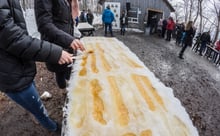
At the Cabane à Sucre Au Pied de Cochon on the rang de la Fresnière at Mirabel, boiling syrup is poured in a line onto fresh snow and wound onto a stick as it sets; at about -6C it firms in twenty seconds. Martin Picard’s shack takes reservations from 1 December at 9h00 and they go; the autumn harvest sittings run 11 September to 1 November at $98. On 11 April 2021 the Conseil du patrimoine culturel du Québec designated the temps des sucres as intangible cultural heritage, naming the objects that carry it down to the carved moulds and the wooden paddle used to stir the boiling syrup. A kilometre along the same rang, Intermiel opens its hives to visitors from 1 May: the province’s best-known maple table and its largest honey farm share one country road.
Cheese aged in a church nave, the 1989 invention of ice cider at Dunham, a village street with three food addresses, and where the maple syrup is sold by the can
Fromagerie du Presbytère -- Sainte-Élizabeth-de-Warwick, seven days, 9h to 17h, and to 21h on Friday
The family bought the village presbytery in 2005 and later the church, and ages its Louis d'Or wheels nine months to four years in the nave, with the small chapel left in place. Friday is the day to come: the shop stays open into the evening for the Vendredis, when people bring their own tables and chairs into the village and eat among kiosks and musicians. The cheese counter around it is younger than it looks: MAPAQ tightened raw-milk norms in July 2008, inspectors seized stock from small fromageries and some 150 retailers that September, and raw-milk production fell sharply afterward. The raw-milk cheeses sold in Québec today come from the makers who continued.
Ice cider -- Dunham and the Montérégie orchards
Christian Barthomeuf pressed the first one at Dunham in 1989. It became a protected designation on 30 December 2014, and the rules are narrow: apples pressed only between 1 December and 1 March, sugars concentrated by natural cold alone, every batch passed by an approval committee before it can carry the name. The state's own aroma vocabulary for it runs fruity, floral, cooked apple, sugar, honey, cassonade, apricot and fig. The pressing is a deep-winter job and nobody watches it; the tasting is a summer one. At Dunham, Union Libre pours from late May to 1 November, Wednesday to Sunday, 11h to 17h.
Avenue Morel -- Kamouraska
Three addresses on one street of a St Lawrence village: the boulangerie, the fish smokehouse, and Café-bistro Côté Est in the former presbytery. Summer only for most of it, and the tide here already runs in metres.
Le Marché des Saveurs du Québec -- Marché Jean-Talon, Montréal, Monday to Saturday 9h to 18h, Sunday to 17h, year round
At 280 place du Marché-du-Nord, stocking some 400 producers, this is where the single-producer maple syrup is bought by the can rather than the bottle. Two aisles over at kiosk 88, Les Jardins Sauvages sells dried boreal forage from François Brouillard's four-generation practice.
Culture
On the third Saturday of the month from October to April, the Centre du Plateau on boulevard Saint-Joseph Est opens at 19h00 and runs a beginners’ initiation at 19h30, half an hour before the dancing starts. No partner is required; partners are found on the floor. A calleur shouts the figures as the sets run, and the last waltz is around midnight. Admission is $22, $16 for students, free under 14 with a parent. The veillée has run without interruption since 1981, and the Répertoire du patrimoine culturel du Québec, which lists the call of traditional dances as heritage in its own right, names this hall as one of the places the skill is still exercised.
A museum that closes every 4 October, a festival on the ground of a demolished residential school, and eighteen painted walls open all night
Musée des Abénakis -- Odanak, daily 10h to 17h from June to September, Tuesday to Sunday the rest of the year
The first Indigenous museum in Québec, opened in 1965, housed in the community's own former Catholic school. The permanent exhibition is built for sight, touch and smell. It closes every 4 October in memory of the Rogers Raid of 1759.
Festival Innu Nikamu -- Uashat mak Mani-utenam, the first weekend of August
The festival is staged on the ground of the Mani-utenam residential school, which was demolished; the Innu took the site back and put a music festival on it. Three days. Earlier in the summer, embers from the Feu de l'amitié at the Solstice des Nations on 21 June are carried to light the Fête nationale bonfire on 23 June.
Eighteen walls in Sherbrooke, and two murals in Montréal
Sherbrooke's trompe-l'œil murals are outdoors and open at any hour, free. Montréal has two Leonard Cohen murals, and a Globe and Mail critic rates the Saint-Laurent one the better of the two on the grounds that it stands on Cohen's own ground.
Natural History
The Laurentian Channel, a glacial trough running most of the length of the gulf, ends at Tadoussac. A two-layer circulation carries krill back up the trough and the tide pins them against its end wall, which is why the largest animals on earth feed within sight of the shore here: blue whales in the season, and the beluga population that stays year round. Canada put its first marine park here for that reason. The whales are present from May and peak in September and October, and the ferry across the Saguenay runs ten minutes, free, around the clock.
Two World Heritage fossil sites listed twenty-four years apart, the daily goose counts at Cap Tourmente, a fir stand unburned for five thousand years, and the gannet colony off Percé
Anticosti, and Miguasha on the Baie-des-Chaleurs
Québec has two natural World Heritage sites and both were inscribed for fossils under the same criterion, twenty-four years apart. Miguasha, listed in 1999, holds the Devonian beds that document the origin of four-limbed land animals. Anticosti, listed in 2023, is the most complete record anywhere of the first mass extinction, 447 to 437 million years ago, with more than 1,400 species described. Miguasha is open 1 June to 12 October, daily 9h to 17h, and can be done in an afternoon. Anticosti is a working expedition: the season runs 20 June to late August and the aircraft from Mont-Joli goes every fifth day, so stays are sold in five-night blocks.
Cap Tourmente -- late September into October
Snow geese stop here on the tidal marsh. Environment and Climate Change Canada records daily peaks of twenty thousand to fifty-two thousand birds on site, out of a flyway population near 428,000, and runs a conservation hunt inside the reserve to keep the marsh from being eaten by its own flagship species. The reserve keeps clock hours, 8h30 to 17h; its own advice is to check the tide table, because at high tide the geese come in close.
The Vallée des Fantômes -- Monts-Valin
A balsam fir stand that has not burned in more than five thousand years, reached on maintained trails. Québec has 256 legally classified exceptional forest ecosystems, and the ministry that classifies them says plainly that old forests here are not necessarily attractive to look at: the interest is the age and the continuity, not the look of the stand. The wild blueberry barrens on the other side of the same lake pull more than half the province's hives north every June, the largest movement of bees in Québec.
Île Bonaventure, off Percé -- mid-May to August
A northern gannet colony reached by boat from Percé and then walked to across the island. The birds return from Central America in April and are gone by September, so the cliff is empty either side of that window. Counts run from forty-five to sixty thousand nesting pairs depending on the year and the counting body, and sources disagree on whether it is the largest such colony in the world or the second. Tens of thousands of pairs nest on a cliff reached on foot.
Built Heritage
At Sainte-Geneviève-de-Berthier, 3.5 kilometres of the rang du Fleuve are still unpaved and carry no poles or wires, which makes them among the few stretches of eighteenth-century road surface a driver can use. They run through the seigneurial rang: long narrow lots cut at right angles to the water, so that every farm reached the river. The geometry is still legible from the road and from the air. It is how the land was divided in the 1600s, and how it is still farmed and addressed.
The chemin Royal, circling Île d'Orléans since 1744; the most complete fortified colonial town north of Mexico; the woodcarving village of Saint-Jean-Port-Joli; and the thirty-three Mohawk ironworkers killed building the Québec Bridge
Île d'Orléans -- twenty minutes from Québec City
Declared a heritage territory in 1970, with about 3,600 buildings, nineteen of them individually classified, and roughly 95 percent of the island still farmed. The chemin Royal has circled it since 1744, is open in every season, and shows the rang system from a car. Félix Leclerc lived here, and the Espace Félix-Leclerc at Saint-Pierre, run by his own foundation, opens daily 10h to 17h from 21 June to 31 August and on a shorter schedule into mid-October.
The walls of Old Québec
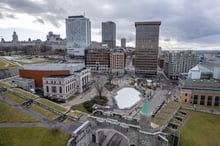
UNESCO's citation is the narrow one: this is the only city in North America to have preserved its ramparts, and by far the most complete fortified colonial town north of Mexico. About 4.6 kilometres of wall, four gates and three Martello towers, walkable free of charge year round. The wall standing today is the third built to defend the same ground.
Saint-Jean-Port-Joli
Québec's designated national capital of sculpture, where the woodcarving tradition and the parish church are one object. At Le Vivoir on avenue de Gaspé Est, André-Médard Bourgault has been carving for close to sixty years; a piece such as "L'ete", a standing figure cut directly in oak, runs about CA$550. Most ateliers in the village shut at 17h.
The Québec Bridge, and Kahnawà:ke
It still holds the longest cantilever span in the world. The collapse came at 5.36 in the afternoon of 29 August 1907, two minutes after the shift whistle, and killed thirty-three Mohawk ironworkers from Kahnawà:ke among seventy-six men. Their graves in the village are marked with crosses made of steel girders, two six-metre steel crosses stand at the village entrances, and a memorial dedicated on the centenary of the date plants thirty-six trees, thirty-three for the dead and three for the survivors. The community's women decided afterward that the men would never again work one job together, and the dispersal that followed is how Kahnawà:ke ironworkers came to build high steel across North America.
Why the spires are silver, and what has become of 802 of the province's churches
The spires are tinplate -- tôle à la canadienne, originally made from recycled containers cut open and flattened, adopted because it does not burn.
The buildings under them are in the middle of the largest change in their history. Of 2,751 places of worship inventoried in 2003, 802 have since been sold, repurposed, demolished or closed, 145 of them demolished in two decades, 230 are now in private hands, and 165 municipalities own at least one.
A silver spire on a village skyline is no longer a reliable sign of a church. It may be a library, a concert hall, a climbing gym, or the cheese cellar at Sainte-Élizabeth-de-Warwick.
I want to dig deeper
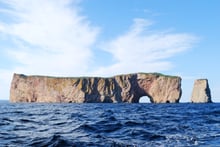
Drive Route 132 anti-clockwise and the light stays behind the Rocher Percé all afternoon; it takes seven to ten days to close the loop. The other two go deep instead: a region whose farms sit on the floor of a meteor crater, and a hotel that melts every spring and is redrawn from scratch each winter.
An 885-kilometre loop, a crater with a lamb designation and an apiary in it, and a hotel rebuilt from scratch every winter
Tour de la Gaspésie, 885 km on Route 132 -- seven to ten days, June to October
The only closed loop in the province, and Tourisme Gaspésie's own line is that the road is part of the holiday. Seven to ten days is the standard allowance, driven counter-clockwise so the light stays behind the Rocher Percé. Somewhere around Mont-Joli the St Lawrence stops being a river and is fully salt. The loop threads Parc national de la Gaspésie, Forillon and the walk out to Cap-Gaspé, Percé and the gannets on Île Bonaventure, and Miguasha's fossil beds at the far end. Two things to know before committing. The caribou herd in the Chic-Chocs is the last south of the St Lawrence, and the October 2024 survey counted eleven animals, so the herd is not a reason to come. And at Maria on the Baie-des-Chaleurs, Rucher des Framboisiers keeps a certified-organic apiary with a free interpretation centre and a glazed hive, open weekdays only.
Charlevoix in deep time -- year-round, with the farm route running summer and autumn
The whole region sits inside an impact structure 54 to 56 kilometres across; the mountain in the middle of it, Mont des Éboulements at 780 metres, is the crater's central uplift, and shatter cones from the strike can be found in the field. Published dates for the impact range across a hundred million years; the size is the settled figure. The Charlevoix Seismic Zone is the most earthquake-prone region of eastern Canada with more than 200 tremors a year, and the landslide from the 1663 quake built the shelf of land that Saint-Joseph-de-la-Rive stands on. The impact is also why the valleys farm: post-glacial flooding laid marine clays in the valleys the impact made, and the MRC's own agricultural plan traces today's farming to them, including the lamb that carries a protected designation. UNESCO made it a Biosphere Reserve in 1988. The Route des Saveurs, the first agrotourism route in Québec, links some eighty of the farms and tables that work this ground, and the honey among them is sold at Baie-Saint-Paul.
A night in the Hôtel de Glace -- 4 January to 13 March 2027
Twenty minutes north of Québec City at Saint-Gabriel-de-Valcartier stands the only ice hotel in North America, and it is a different building every year. It melts in spring, and each winter a new one is drawn to a new plan and rebuilt, the twenty-sixth since 2001. Construction can start once the temperature has held below zero for about a week, and takes roughly fifty people six weeks: thirty on production, fifteen sculpting, working 3,000 blocks of ice into a structure six metres high across 53,000 square feet. Inside it holds between -4C and -5C whatever the weather does outside. The day visit covers the grand hall, the chapel that couples marry in, the ice slide and the ice bar, where the cocktail comes in a glass of ice. The overnight is a separate booking into one of about thirty suites: the bed is ice blocks under a wooden base and a mattress, the sleeping bag is rated to between -15C and -30C, and guests keep a warm room at the Hotel Valcartier the same night for luggage and a shower, with the ice room theirs from 21h and the spas and saunas open until 9h. Unitours runs a shuttle from Old Québec for anyone without a car.
The Honey of Québec
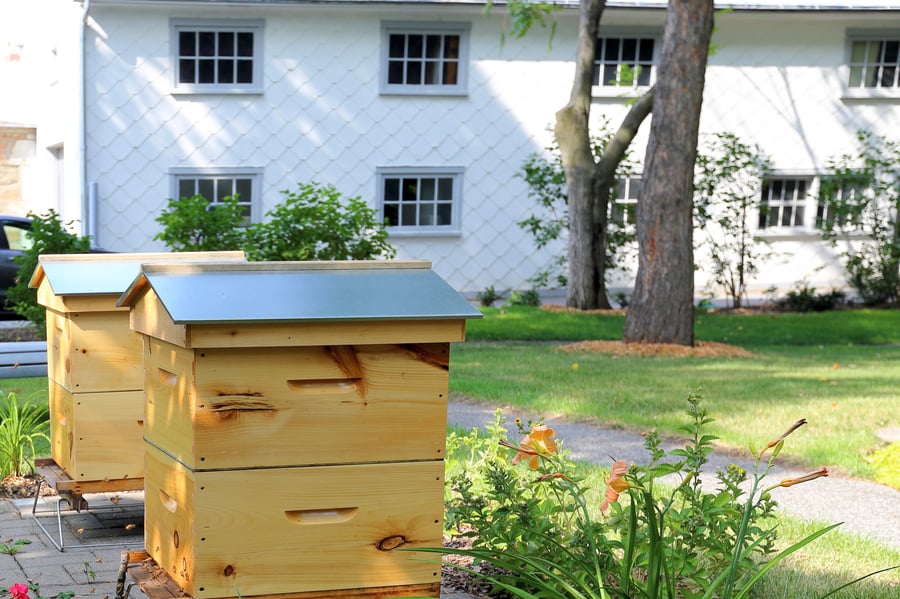
The short year that governs the sugar shack and the lobster boat governs the hives too: four to five months of forage, and a honey that is glucose-rich and sets fast, which is why creamed honey – miel baratte – became the province’s ordinary form. Québec keeps about 62,000 colonies and makes roughly four percent of Canada’s honey, and most of what it makes is sold under a floral or a seasonal name. Spring, summer and autumn are bottled apart; Desrochers D describe treating them as grape varieties (cépages). Linden comes off a bloom that lasts a few days in early July, goldenrod off the fall flow, buckwheat only where somebody farmed buckwheat that year, and blueberry off the Lac-Saint-Jean barrens, where more than half the province’s hives are trucked each June. Three things stand behind those names: pollen counts run at the Deschambault research station, two Québec honey sommelières certified on Italy’s national register of sensory experts, and, at Abeilles et Filles in Kamouraska, honey from six villages jarred separately and never blended.
The Honey Road
One itinerary, about 150 kilometres, Wednesday to Sunday between late June and early September.
Québec City -- year round (city gateway)
Le Grand Marché on the exhibition grounds has two permanent honey kiosks trading year round, and the Lac-Saint-Jean blueberry stall stands under the same roof as honey from the same region: the bees trucked north each June pollinate those barrens. Two hours of free parking.
Saint-Roch, Québec City -- tour, year round, Wednesday to Sunday
Apikol runs a sixty-minute tour from bee to bottle with a tasting at the end, in the middle of the city, and it is the only Québec honey experience sold through the international booking platforms. Closed Mondays and Tuesdays. It is the one stop on this road reachable without a car.
Île d'Orléans -- farm gate, daily 11h to 16h, from 24 June
The chemin Royal begins at the bridge. Les Ruchers de l'Île d'Orléans works from 71 chemin des Chalands at Saint-Laurent, 8.3 kilometres round on the island's south shore, so the honey stop sits inside the loop drive: farm stands, blackcurrant (cassis) producers and bakeries the whole way round. The island's tourism office posts the daily hours; the producer's own contact page asks for an appointment, so ring ahead.
The road between -- about ninety minutes' driving
Route 138 runs the flat battures of the Côte-de-Beaupré past Sainte-Anne-de-Beaupré and the Cap Tourmente marsh, then climbs at the point where the Laurentians meet the river. The long descent at the far end is the crater rim: the road enters the Charlevoix impact structure a few kilometres before Baie-Saint-Paul and drops into the bowl the town sits in. The tourist office at 444 boulevard Monseigneur-de-Laval is a halte routière on the lip of it, 335 metres up, looking over the bay, the rivière du Gouffre and Île aux Coudres.
Baie-Saint-Paul -- tour and shop, Économusée, 49 rue Saint-Jean-Baptiste, daily 10h to 20h
Hydromel Charlevoix became an Économusée in February 2026, which means the making happens in front of the visitor: fine honey alcohols, walk-in tastings, guided tours by reservation, and a shop on the main street of a town whose other business is galleries. This is the last stop. The roadside miellerie at Les Éboulements that gave the crater its own apiary closed in 2022, and its honeys are sold here now. Lunch is hard to get on the Charlevoix stretch: the mielleries do not serve it, and the Route des Saveurs tables keep restaurant hours -- La Buvette gentille, the town's Michelin Bib Gourmand, does not open until 17h30. The Bistrot des Artistes at 25 rue Saint-Jean-Baptiste, a few doors along the same street from the Économusée, runs its kitchen 11h to 15h every day.
Getting Here
Two airports carry almost everything. Montréal-Trudeau is the main gateway and the only air link to Nunavik; Québec City is the practical start for Charlevoix, the Côte-Nord, the south shore and the Honey Road above. Mont-Joli is the regional airport for anyone starting the Gaspésie loop rather than driving to it.
Montréal to Québec City is about 250 kilometres, two and three-quarter to three hours on the A20. Québec City to Baie-Saint-Paul is 100 kilometres and about ninety minutes; to La Malbaie, 150 kilometres and two hours. Québec City to Tadoussac is roughly 210 kilometres and ends with a ferry. Reaching the start of the Gaspésie loop from Montréal is a full driving day before the loop itself begins, and the loop’s longest single stretch, Matane through Sainte-Anne-des-Monts to Gaspé, is about 360 kilometres and five and a half hours.
The Québec City to Windsor corridor carries the province’s frequent passenger service. The Train de Charlevoix runs seasonally and opened its 2026 season on 5 June across about 150 operating days. There is no passenger train to the Gaspésie: VIA’s own plan is a partial relaunch as far as New Carlisle by spring 2028, so the loop is a driving trip.
Two ferries matter. Tadoussac to Baie-Sainte-Catherine is not a detour but a segment of Route 138, about ten minutes, free, running around the clock all year. The Îles-de-la-Madeleine are reached by a five-hour crossing from Souris on Prince Edward Island, two provinces away.
Winter is a full season here. The veillées run October to April, the ice hotel opens in January, and Gaspésie roads are ploughed and open; Québec 511 is the provincial road-condition service.
Seasonal Events Not to Miss
Winter at Québec City – the Hôtel de Glace 4 January to 13 March 2027, Carnaval 5 to 14 February 2027. The ice hotel stands twenty minutes north at Saint-Gabriel-de-Valcartier for about ten weeks and is rebuilt to a new plan every year; the season and access details are published by the city’s tourism board. The Carnaval fills the city in the middle of that window with an ice palace, two night parades and the bain de neige. The sharpest thing to time is the ice canoe race on 7 February at 13h00 from Pointe-à-Carcy, a four-hundred-year-old river crossing turned sport, with teams starting at high tide and rowing through a tide change.
Le temps des sucres – four to six weeks, mid-March into late April. No fixed dates: the run needs nights below freezing and days above, so the shacks announce on short notice and the season moves by a fortnight from one year to the next.
Fête nationale du Québec – 23 and 24 June. Fixed by statute, so it does not drift. The same week carries twenty-five traditional veillées across the province, and it is the weekend most honey farms open for the season. (Programme and regional listings – French translated to English )
Festival Innu Nikamu – first weekend of August, Uashat mak Mani-utenam. Alcohol-free since 1984 and staged on the ground of the former residential school. The organisers publish the weekend, and the year’s programme carries the dates. (Festival programme and history)
Festival du Bleuet, Dolbeau-Mistassini – late July into the first days of August. The blueberry country whose barrens draw more than half the province’s hives north each June. (Dates and programme – French translated to English )
Snow geese and the colour – mid-September to mid-October. The reserve at Cap Tourmente is open daily 8h30 to 17h through 1 November, with autumn bird programming from 11 September to 18 October, and the maples turn in the same weeks. Part of the La Falaise trail is closed for landslide risk, with a 200-metre detour in place. (Opening hours, trails and the current closure notice – Environment and Climate Change Canada, French translated to English )
Where to Buy Honey
Two permanent honey kiosks trading year round, at 220 boulevard Wilfrid-Hamel, with the first two hours of parking free. Miel des Ruisseaux pours free tastings through the summer and keeps its kiosk open Monday to Friday 9h to 18h, weekends 9h to 17h. Several producers stand side by side, which is the quickest way to compare them. (Le Grand Marché de Québec – French translated to English )
The market where Intermiel has held a kiosk for twenty-eight years, at 7070 avenue Henri-Julien, Monday to Saturday 8h to 18h and Sunday to 17h; the aisles go pedestrian Thursday to Sunday from June to October. (Marché Jean-Talon, Montréal – French translated to English )
A sixty-minute tour from bee to bottle, with a tasting at the end, at 627 boulevard Charest Est in Saint-Roch, Wednesday to Sunday and closed Monday and Tuesday. Adult rates run about $21 to $28 depending on the booking channel. (Apikol, Québec City – French translated to English )
Guided visits at 11h, 13h and 15h with no reservation taken, at 10291 rang de la Fresnière, Mirabel: weekends and holidays from 1 May, daily from 24 June to 30 August, then weekends and holidays again through to 25 October; $20 for adults. The boutique and the free Musée API stay open year round, seven days, 9h to 17h. (Intermiel, Mirabel – French translated to English )
A boutique, an observation hive and a farm canteen in the Hautes-Laurentides, at 111 rang 2 de Gravel, Ferme-Neuve: open daily, with summer hours of 9h to 17h Sunday to Wednesday and to 20h Thursday to Saturday. The Cantine Pollens et Nectars runs June to August, and the Buvette au champ Wednesday to Sunday, 11h to 16h, from mid-June to late August without reservation. The site states plainly that it offers no guided tour of the apiary. (Miels d’Anicet, Ferme-Neuve – French translated to English )
Honey wines and spirits made on the main street, with walk-in tastings, at 49 rue Saint-Jean-Baptiste, Baie-Saint-Paul, daily 10h to 20h; guided tours by reservation. It became an Économusée in February 2026 (Artisans a l’oeuvre – French translated to English ), which is what puts the making in front of the visitor. (Hydromel Charlevoix, Baie-Saint-Paul – French translated to English
)
A self-serve counter open around the clock, every day of the year, at 302-A rue Industrielle, Lac-Etchemin, paid in cash, by Interac transfer, or through a QR code on the wall. (Douceurs des Appalaches, Lac-Etchemin – French translated to English )
Abeilles et Filles keeps about eighty hives across six Kamouraska municipalities – Mont-Carmel, Saint-Onésime, Saint-Pacôme, Saint-Denis, Saint-André and Saint-Pascal – and jars each village separately, so the label names the parish the honey came from. There is no shop at the miellerie: the jars are sold through Kamouraska stockists and at the public markets of Saint-Pascal and Kamouraska.
The provincial retailer’s own honey-alcohol category lists Québec meads, liqueurs and honey spirits, which is where to find them outside the producing regions. (SAQ – French translated to English )