
Pine Honeydew Honey
The Story
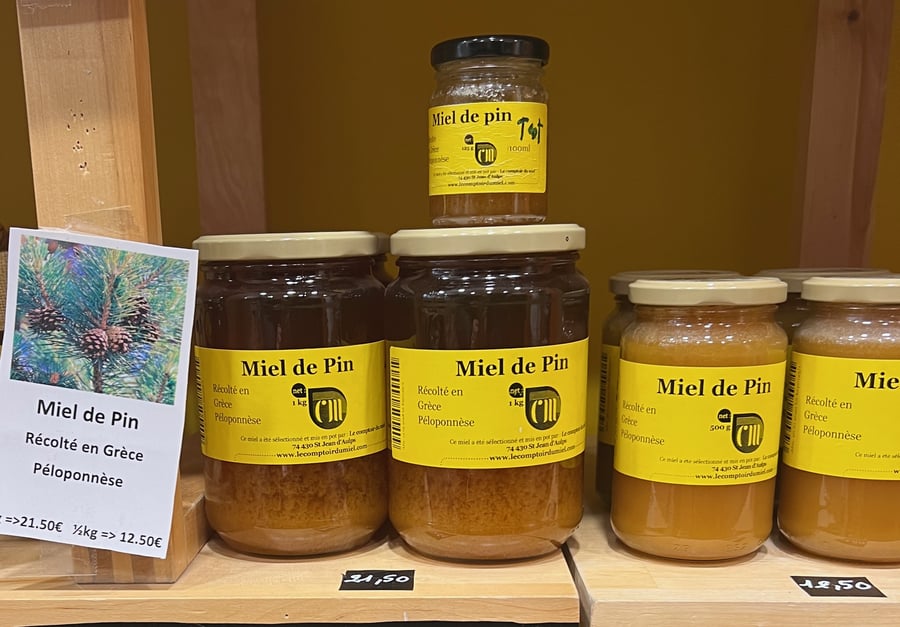
When Andreas Thrasyvoulou came home to Greece in 1982, he found pine honey sold cheap and often under another name. The 1971 food code ranked it below blossom honey, and many beekeepers wrote “blossom honey” on the jar. At the national beekeeping congress in Athens in 1983 he told some 2,000 beekeepers that it was as good as any honey they made, and he remembers the absolute silence that followed. The honey he defended is made by bees from the sweet liquid that a scale insect gives off as it feeds on the pines of the Aegean.
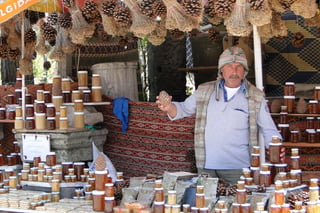
In Greece and Turkey it is sold simply as pine honey: πευκόμελο (pefkomelo) on Greek jars and μέλι πεύκου (meli pefkou, honey of the pine) in Greek law, çam balı in Turkey, where the food code makes that the name and leaves the words honeydew honey optional beside it. Spanish and French jars say pine honey too, while Italian and Slovak sellers lead with the honeydew word. In Crete the pine honeydew is sold blended with thyme under its own protected name, which the thyme honey page carries. What honeydew honey is, and how it differs from the honey of flowers, is told on its own page.
Characteristics
Pine honeydew honey runs from light brown to very dark brown and is thick and slow to pour, with a woody, resinous smell and a mild, soft sweetness. It stays liquid for a long time: pure Greek pine honey keeps fluid for more than a year and a half, while its blends with heather, cotton or sunflower honey set in two to five months. The spring honey is lighter and clearer than the autumn crop. Laboratories know it by its high electrical conductivity, the measure of a honeydew honey’s minerals, and tell it from fir honeydew under the microscope, where the spores of a pine rust fungus, Coleosporium, turn up in pine honey and not in fir.
Click to Display — The Details: honeydew source, sensory profile, pairings, health and what gives it its character
Honeydew Sources:
- Primary: Giant pine scale insect (Marchalina hellenica). Host: Turkish pine (Pinus brutia), on the Aegean and Mediterranean coasts of Turkey, Muğla above all, and in Greece
- Primary: Giant pine scale insect (Marchalina hellenica). Host: Aleppo pine (Pinus halepensis), in Greece
- Secondary: Pine tortoise scale insect (Toumeyella parvicornis). Host: Stone pine (Pinus pinea), in Lazio, Italy, chiefly near the coast
- Supporting: Giant pine scale insect (Marchalina hellenica). Host: Stone pine (Pinus pinea), in Turkey
- Supporting: Pine aphids (Aphididae). Host: Pines (Pinus spp.), the maritime pine (P. pinaster) on the Var coast among them, in Spain, Provence and Slovakia
Nectar Contributors:
- Background: Flower nectar from what blooms near the pines, varying by site and unmeasured (Multiple species, undocumented)
Bee Species:
The western honey bee, Apis mellifera, in every country where this honey is made. No subspecies is tied to the honey at source. The Marmaris register describes the bee of its district as dark and calm, a good winterer that eats little of its honey and gathers much propolis, the tree resin bees use to seal the hive.
Color:
Light brown to very dark brown; the spring honey lighter and clearer than the autumn crop
Flavor Profile:
Resinous and woody, mildly sweet, soft in the throat
Tasting Notes:
Thick and slow to pour, and easily told from blossom honey by tasters. Greek researchers describe no sharp taste or aroma; the Marmaris register describes a honey less sweet than blossom honey that does not catch the throat.
A beekeeper in the hills behind the Côte d’Azur describes his mountain pine honey as long and round in the mouth, with notes of chocolate and liquorice, and a French retailer describes a Greek pine honey as little sweetened, with a slight bitterness and a thick texture.
Aroma:
Woody, resinous and balsamic, sometimes fruity or waxy
Defining Compounds:
Its minerals, read as electrical conductivity, mark it as a honeydew honey: Greek pine honeys average about 1.1 millisiemens per centimetre and Turkish ones about 1.4, against the 0.8 the European rule asks of honeydew honey, and Greek law and the Turkish registers set a floor of 0.9, raised to 1.09 for Marmaris. Muğla’s application to the European Union adds two markers of its own, potassium of at least 1,900 milligrams a kilogram and two pine-scented compounds, alpha- and beta-pinene, among its aroma compounds, higher in Muğla’s honey than in Antalya’s or the northern Aegean’s.
Forage Origin: 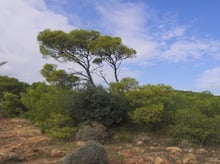
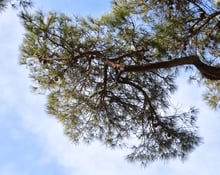
Pine here means the genus Pinus. Two of its species carry nearly all of this honey: Turkish pine, which covered about a quarter of Turkey’s forest area at a 2004 count, and Aleppo pine, its western counterpart around the Aegean. The European forest atlas records that in Greece and Turkey the honeydew released on these pines by the giant pine scale insect is still used to make honey. Stone pine, the umbrella pine of the Italian coast and the tree of the pine-nut groves, carries the same insect in Turkey and a different one in Italy.
The giant pine scale insect, Marchalina hellenica, lives in the bark crevices of the lower trunk, under tufts of white waxy wool, with its mouthparts in the tree’s sap stream. Only the nymphs feed and give off honeydew; the adult has no mouthparts. One generation a year, hatched from eggs laid in April in Greece, feeds through the summer and autumn and gives the flow.
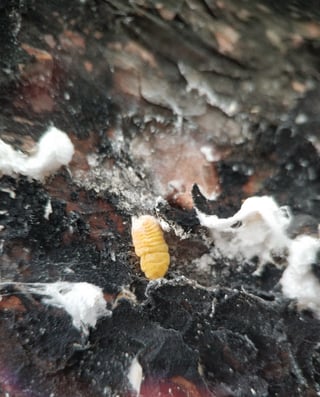
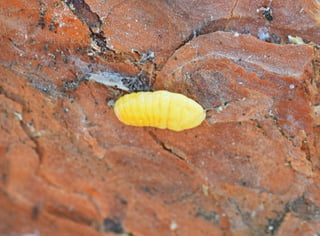
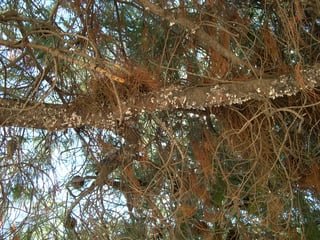
The nymphs stop feeding for a few days while they moult in early autumn, so the flow dips and returns two to three weeks later. Overwintered nymphs give a second flow in spring, which ends when the adults appear. How much the insects give depends on their size and age, cold February days set up the spring flow, and under a warming climate the cycle is expected to shorten sharply, which is why the harvest months vary from year to year.
Greece encouraged beekeepers to spread the insect through its pine forests from 1996 to 2000 and has banned the practice in Attica since 2005 and near towns and in protected forests since 2008, while forest scientists still differ over how much it harms the trees.
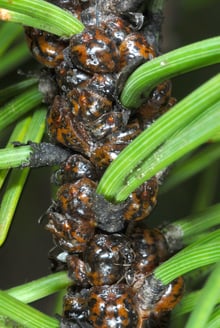
Italy’s pine honeydew comes from another insect, the pine tortoise scale insect, Toumeyella parvicornis, a North American species now on Italy’s stone pines. Its nymphs and adult females feed on the twigs, with at least three overlapping generations a year in Campania, and the later stages give off honeydew in large amounts; Lazio’s beekeepers now take a pine honeydew from it, mostly near the coast.
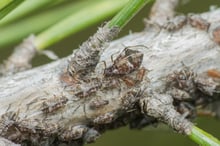
In Spain, Provence and Slovakia the pine honeydew is an aphid honeydew, and the sellers name only aphids. A German association of honeydew watchers says the insects on pine seldom or never build up in the masses a flow needs; a beekeeper in the hills behind the Côte d’Azur gathers his mountain pine honey about once in ten years, and a Slovak one makes his in the years the aphids multiply. Greece and Turkey make the scale-insect honey in quantity; Italy, Spain, France and Slovakia are listed here because beekeepers there take and sell a honeydew from pines made by other insects, in smaller and less regular crops.
The same words go on syrups boiled from pine shoots or cones with sugar, made without bees; a Bulgarian maker of borov med says on its own page that its jar is a preserve and not honey. In Crete the pine honeydew runs naturally into the thyme honey harvested beside it, which is how the island’s protected blend arises. A little nectar comes in with the honeydew: Greek pine honeys carry chestnut, heather and legume pollen, much of it stored spring pollen washed out of the combs at extraction, the spring honey carries pine pollen, and Turkish honeys hold a scatter of pollen from the daisy, heather, carrot and rockrose families.
Pairings:
Sellers pair it with aged cheeses, roast and game meats, duck and spice bread, and stir it into herbal tea and warm milk; Turkish packers also offer it for desserts made without refined sugar.
Origin Story
Near Milas, on Turkey’s Aegean coast, late in 1881, the Greek agronomist Panagiotis Gennadius found a pine forest whose trees looked recently burned, black with sooty mould and white with the insect’s cottony wax, and wrote that the sweet liquid oozing from the insect’s body was “the main food of the many bees the peasants keep there”. Gennadius gave the Milas insect one scientific name and the one he found in Attica another, and in 2005 entomologists showed the two to be a single species; Milas lies inside Muğla’s pine-honey designation today, and the Muğla register traces trade in the province’s pine honey to 1909.
At the century’s end the Greek state promoted the insect itself. From 1996 to 2000 beekeepers were encouraged to spread the insect through the pine forests, a programme that ran with European co-financing, as a member of the European Parliament put it to the Commission in 2007. Spreading the insect was banned in Attica in May 2005 and, in August 2008, near towns and in protected forests across the country, the agriculture ministry having blamed the uncontrolled inoculations of 1996 to 2000 for the insect’s outbreak in the pines of Athens and its suburbs.
The same insect reached Ischia, in the Bay of Naples, most probably in the 1960s, was first recorded there in 1984 and is treated as a pest, under a compulsory control order from 1996 until its repeal in 2021. On the mainland a North American scale insect reached the stone pines of Naples in 2014, and by 2023 Lazio’s beekeepers had a new pine honeydew from it; one of them told an interviewer that the pest had at least one good side, a new honey.
Turkey registered the honey instead: Muğla’s designation of origin in 2018, Marmaris’s in 2019, a looser national mark, an indication of source, for ten provinces from Antalya to Edirne in 2025, and an application for European Union protection of the Muğla name published in the Union’s Official Journal in January 2026.
Cultural Context
In Greece the insect’s names are a beekeeper’s: the worker (εργάτης, ergatis) and the cotton one (βαμβακάδα, vamvakada), for the white wax it hides under. Athenians know its honeydew another way, as the sticky film that settles on cars parked under the city’s pines. Thrasyvoulou recalls that in 1982 Greeks held pine honey cheap while German buyers paid well for the same kind, and that a blind tasting of consumers, reported in 1994, put fir and pine honey at the top of the Greek honeys. In Muğla the harvest is a public occasion: the beekeepers’ union has held an international pine-honey congress every two years since 2008, and in 2025 the provincial capital held its first pine-honey harvest festival.
Harvest & Forage
In Greece and Turkey the insect’s life cycle sets the months. Its honeydew is worth collecting from mid-August; the flow dips while the nymphs moult in September, returns a fortnight or so later and runs until the weather grounds the bees, usually in late November, and a smaller spring flow comes in March and April, which the beekeepers take in some years. Muğla’s register sets the season at 15 August to 30 November, with a first take usually in September, a second in October and a third in November, and the national Turkish indication allows a spring take in some years. One Macedonian house harvests its pine honey on Chalkidiki and Thasos in August and September.
The first take is the mixed one. Hives come down to the pines from the summer pastures with blossom honey still in their combs, so Marmaris’s inspectors leave the first harvest alone and check the second and third; the rules for the registered Turkish honey also require clean empty frames put on for the flow and no feeding while it lasts. In Greece whatever earlier honey is left in the combs is harvested with the autumn pine honey.
Elsewhere the crop is a summer one and an uncertain one. On the Var coast the maritime-pine honeydew is taken from July to September, in Spain at the end of summer; in Slovakia it comes in the years the aphids multiply; in Lazio the 2023 crop was put at ten to twelve kilograms a hive after a better 2022.
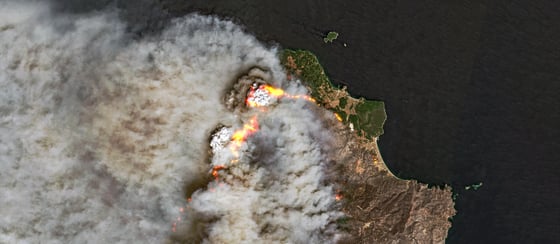
The year-to-year swing is large. Greek researchers reported in 2009 that extreme heat had unsettled the flow in recent years, a 2023 study found the honeydew markedly reduced in recent years, and a 2026 review calls recent quantities unreliable for reasons still unclear. Fire takes whole districts out. The 2021 fires in Muğla burned about 13 percent of the pine-honey area, Marmaris worst of all. The August 2021 fires on Evia, which a 2025 study calls one of Greece’s most important beekeeping regions, destroyed about 30 percent of the island’s pine forest, and the study’s authors expect the island’s honey to stay low for years, since a pine needs 20 to 25 years before it can carry the insect and longer again before it gives a full flow. Beekeepers who had worked Evia’s pines looked to Chalkidiki and Thasos instead; one told a Kavala paper that only those were left to them.
Beekeeping Context
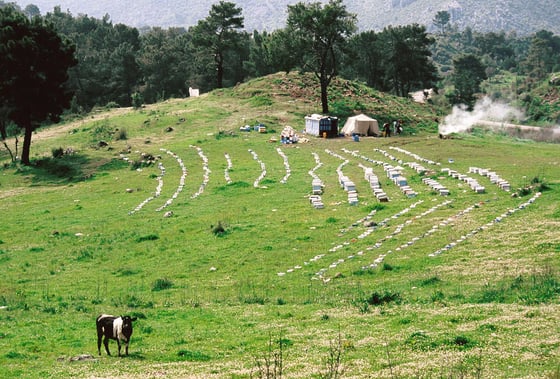
Migratory commercial beekeeping onto the coastal pine forests in late summer and autumn, which beekeepers in both countries plan their year around. The Marmaris register describes the Turkish year: local flowers from mid-February to mid-May, provinces with a later spring to mid-July, then the pines, where beekeepers bring their colonies into the district and, with a permit, winter them on the mild coast; unregistered outsiders may not site hives. In Muğla the registered honey is sold strained, in the comb, or as karakovan comb, cut from traditional fixed-comb hives and never strained. Turkey’s agriculture ministry said in May 2026 that about 90 percent of the world’s pine honey is Turkish and most of it from Muğla.
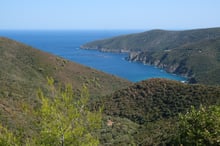
In Greece the Evia beekeepers’ association expected more than 10,000 beekeepers from the Peloponnese, Thessaly, central and western Greece on the island’s pines in August 2021, and a beekeepers’ cooperative on Chalkidiki describes nomadic keepers bringing their hives back to the peninsulas each autumn. Greek pine honey goes into blends as well as jars of its own, its traits described by Greek researchers as desirable in both.
Turkish beekeepers have moved the insect themselves, tending to carry it to uninfested trees to raise their crop, and the ministry’s district directorate at Dalaman inoculated pines in 2014. In Lazio, Spain, Provence and Slovakia the honeydew is a small lot sold by the beekeeper who made it.
Source Regions
- Greece, Chalkidiki, Thasos, Evia, Rhodes – Pinus brutia, P. halepensis: pine honey (πευκόμελο, pefkomelo), about 60 percent of Greece’s honey by a 2025 estimate.
- Turkey, Muğla and the Aegean and Mediterranean coasts – Pinus brutia: pine honey (çam balı), under three Turkish registrations, much of it from migratory hives.
- Italy, Lazio – Pinus pinea: pine honeydew honey (melata di pino), new since the pine tortoise scale insect reached Rome’s stone pines in 2018.
- Spain, the Iberian mountain pinewoods – Pinus: pine honey (miel de pino), a honeydew taken at the end of summer and sold by Spanish beekeepers.
- France, Provence – Pinus pinaster: pine honey (miel de pin), a summer honeydew of the Var coast’s maritime pines, inland only about once a decade.
- Slovakia – Pinus: pine honeydew honey (medovicový med z borovice), made when aphids multiply in Slovak pine stands, sold with the honeydew word leading.
Regional Variants
- Muğla pine honey (Muğla Çam Balı) – Pinus brutia – Turkey, Muğla province: The pine honey of the province the Turkish ministry names as the source of most of the country’s crop, whose register traces trade in it to 1909. Registered by Turkey in 2018 as designation of origin No. 379, on an application the Muğla beekeepers’ union made in 2007, the name covers twelve of the province’s districts; Marmaris, registered separately, is not among them. The register describes a honey made between 15 August and 30 November from the honeydew of the basra böceği, the giant pine scale insect, on Turkish pine; the first take usually comes in September, the second in October and the third in November, and the colonies are not fed while the flow lasts. A jar carrying the name must reach an electrical conductivity of at least 0.9 millisiemens per centimetre, and the register describes a honey that stays a long time without crystallising. An application to register the name as a European Union protected designation of origin was published in the Union’s Official Journal in January 2026; its product description gives a dark honey with a woody, resinous, fresh-pine smell, a mild taste and a slow set, and puts about 12 percent of the Turkish-pine forest in the twelve districts under the insect.
- Marmaris pine honey (Marmaris Çam Balı) – Pinus brutia – Turkey, Marmaris district, Muğla: The pine honey of a single district, registered in 2019 as designation of origin No. 469 in the name of the Marmaris chamber of commerce. Its register points to the Ottoman income-tax books of 1840 to 1845, which show nearly all of Marmaris’s people keeping hives. It follows the insect through the season: numbers build from the second half of July and peak in the second half of August, when beekeepers bring their colonies into the district, and in a good season three takes follow by the end of October. The first take is not inspected, because hives arriving from the summer pastures carry blossom honey in their combs and the two mix. The register calls its honey darker and thicker than other pine honeys, and sets its own conductivity floor, at least 1.09 millisiemens per centimetre against the national floor of 0.8; its mild winters let colonies stay from November to January. Its holder said in September 2026 that it had filed for European Union registration.
- Lazio pine honeydew honey (melata di pino) – Pinus pinea – Italy, Lazio: A honey new to Lazio, made by a different insect, the pine tortoise scale insect (Toumeyella parvicornis), a North American species found in Europe for the first time on the stone pines of Naples in 2014. Italy’s national honey observatory recorded pine honeydew as newly appeared in Lazio in its 2023 season report: an unexpected and often abundant crop, mostly on the coast, put at 10 to 12 kilograms a hive that year. A few beekeepers sell it in small lots, in the Veio park north of Rome among other places, one under the plain name melata, honeydew honey, with no pine word on the jar; the Lazio beekeepers’ association runs a European Union-funded campaign to make the region’s pine honeydew known.
Translations
- Çam balı – Turkish, the name on the jar and in law
- Πευκόμελο (pefkomelo) – Greek, the name on the jar
- Μέλι πεύκου (meli pefkou) – Greek, the legal name
- Melata di pino – Italian
- Miel de pino – Spanish
- Miel de pin – French
- Medovicový med z borovice – Slovak
- Kiefernhonig – German, on imported jars
- Miód spadziowy sosnowy – Polish, a market name
- Borovicový medovicový med – Czech, a market name
- Dennenhoning – Dutch, on imported jars
- عسل الصنوبر (asal al-sanawbar) – Arabic, on imported jars
- 松の木蜂蜜 (matsu no ki hachimitsu) – Japanese, on imported jars
Festivals and Fairs
International Muğla Beekeeping and Pine Honey Congress – Marmaris, Muğla, Turkey (every two years; the ninth, 19 to 22 November 2026): the Muğla beekeepers’ union’s congress, held since 2008 to make Muğla pine honey known at home and abroad, with trade stands, a honey contest and free entry. (Turkish translated to English
)
Muğla Pine Honey Harvest Festival – Menteşe, Muğla, Turkey (first held in October 2025): a harvest festival in the provincial capital’s town square, held by the beekeepers’ unions with the provincial agriculture directorate; the link is a press report of the first edition. (Turkish translated to English
Certifications
 Muğla Çam Balı, designation of origin No. 379 – Turkey’s designation of origin registered in August 2018, protected from September 2007, for the pine honey of twelve Muğla districts made between 15 August and 30 November, held by the Muğla beekeepers’ union; its application for European Union protected designation of origin status was published in the Official Journal in January 2026. (Turkish translated to English
 - Marmaris Çam Balı, designation of origin No. 469 – Turkey’s designation of origin registered in November 2019, protected from January 2017, for the pine honey of Marmaris district, with a conductivity floor of 1.09 millisiemens per centimetre, held by the Marmaris chamber of commerce. (Turkish translated to English
- Türk Çam Balı, indication of source No. 1756 – Turkey’s mahreç işareti (indication of source), a national geographical indication registered in July 2025, protected from May 2022, for the pine honey of ten provinces from Antalya to Edirne, held by the Aegean Agricultural Research Institute. (Turkish translated to English