Carob Honey
The Story
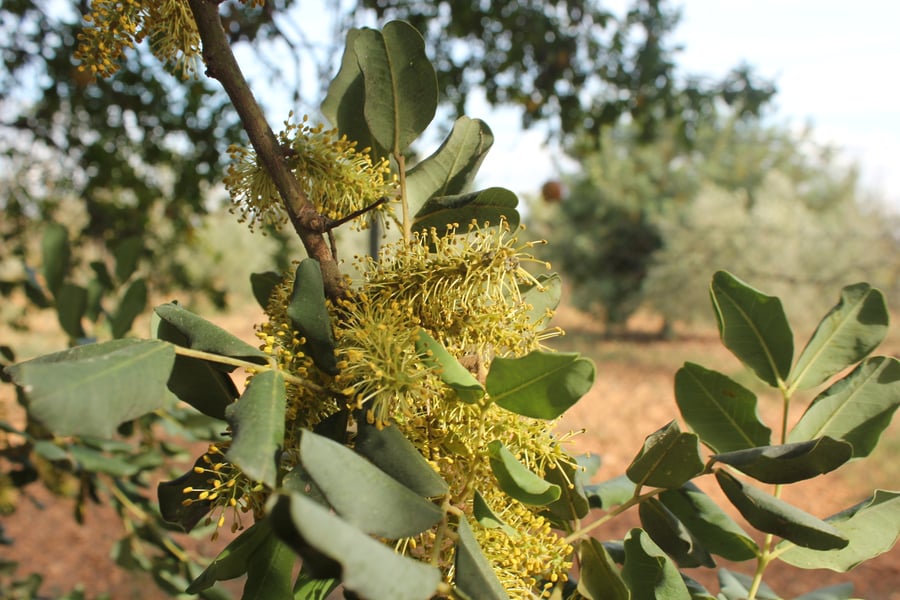
When it comes to honey, carob does not play second fiddle to chocolate. Its pods are ground into a flour used in place of cocoa, and its flowers give bees a honey of their own. The carob is one of the Mediterranean’s old crop trees: carbonised pods survive at Vesuvius from after AD 79, Greeks carried the tree to Greece and Italy and Arabs to North Africa, Spain and Portugal, and the jeweller’s carat is named for it. The pods are the St John’s bread of the English name, after the food John the Baptist is presumed to have eaten.
Carob honey comes at the end of the beekeeping year. The carob tree, Ceratonia siliqua, is in the words of the plant-genetic-resources monograph on the species “the only Mediterranean tree with the main flowering season in autumn”, and its nectar reaches the hives from September into December, when little else is in flower. Beekeepers from the Balearics to the Galilee count on that flow to rebuild their colonies before winter. Italy’s national register of honey sensory experts records that the honey is only rarely extracted and far more often left in the hive as the bees’ winter stores.
When beekeepers do take it, the crop is small and irregular, and heavy rain can cost the whole of it. What reaches the shelf ranges from amber to dark brown and carries a heavy mineral load, enough to take some Mallorcan honey past the conductivity limit the European Union sets for most honeys, a limit with no exception for carob.
In Cyprus the name carob honey has also meant a syrup made from the pods since at least the 1930s. The bees’ honey is the one made from the flowers. Italy’s sensory register finds it toasted, with a note that can recall the carob pod, and a Turkish panel found caramel leading its odour.
Characteristics
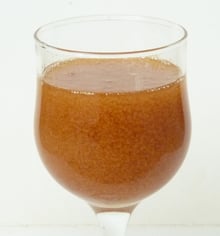
Amber to dark brown: light amber in Sicily, dark red in Crete, dark brown in Malta. Its aroma is medium to intense, toasted and woody with a vegetal, celery-like note, and its taste is sweet with a salty, bitter or astringent finish that leaves the palate rough. Sources disagree on crystallisation. The Iberian guide reports it fast and coarse, and a Sicilian study found it usually sets within three to four weeks; a Balearic study found little or no crystallisation where carob pollen dominates. The editor’s glass of carob honey, photographed in September 2010, shows fine crystals suspended through a reddish-amber body, part-set.
Click to Display — The Details: botanical origin, sensory profile, pairings, health and what gives it its character
Botanical Name: Carob (Ceratonia siliqua)
Botanical Family: Fabaceae
Bee Species: 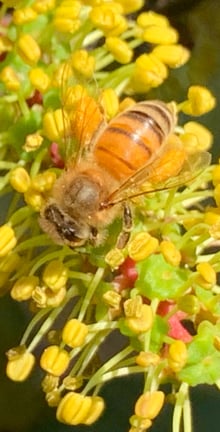
Western honey bee (Apis mellifera). The honey bee is also the main visitor to the carob’s flowers: 62.8 percent of visits in a study at Grazalema in southern Spain, and the most frequent visitor to male and female trees alike in Cyprus. A 2025 study of Mallorcan orchards notes that honey bees are usually the main pollinators of the autumn crop, when wild pollinators are scarce. Those visits also set the pods: in Cyprus, insect visits raised pod set four to sixteen times over wind alone.
Color:
Amber to dark brown by region: light amber in Sicily, amber to dark amber in Morocco, dark red in Crete, dark brown in Malta
Flavor Profile:
Sweet, with a salty, bitter or astringent edge; caramel, liquorice, toasted
Tasting Notes:
Tasting descriptions differ from one region to the next. Italy’s national register of sensory experts finds a medium to intense odour, vegetal and toasted at once, with a celery note and an aroma that can recall the carob pod. A Balearic study, using a published sensory method, described it as sweet and a little salty, with a touch of bitterness and notes of caramel, liquorice, mushrooms and forest, and a retronasal aroma that clears the nose. In a trained Turkish panel of twelve, caramel led the odour of the carob honey, while floral notes led every other honey tested.
The Iberian laboratories’ guide records a clear astringency, a rough palate “as after eating unripe quince or persimmon”, and ties the salty note to honeydew and the bitter one to heather gathered with the carob. The Greek food magazine Gastronomos gave its top score in a 2020 blind tasting to a carob honey from the producer Korys, which its tasters found spicy, with coffee notes and slightly smoky.
Producers and sellers in Spain, Portugal, Malta, Algeria and Tunisia describe a chocolate note, and HoneyTraveler’s editor noted a chocolatey aroma in carob honey from a jar bought around 2010.
Aroma:
Medium to intense; toasted, woody, vegetal with a celery note, liquorice and caramel; recalls the carob pod
Defining Compounds:
Carob honey’s aroma chemistry is led by linalool oxides, which make up 64.2 percent of the volatiles, the aroma compounds, in Balearic carob honey, with hotrienol at 10.4 percent. Linalool oxides are also among the main scents of the carob flower’s nectary disc. Portuguese carob honeys show the same linalool oxides, and Turkish and Italian studies find linalool derivatives leading.
Its mineral load sets its electrical conductivity. In Mallorca, carob honey carries more calcium, potassium, magnesium and sodium than the island’s other honeys, and potassium is the main mineral in Moroccan samples. Mallorcan carob honey averages 1.17 millisiemens per centimetre (mS/cm), and Balearic autumn honeys reach 1.78; a university study puts that conductivity down to a large mineral content, potassium above all, and not to sea salt, and the island’s research institute relates it to the botanical origin and the calcareous soils. The Iberian laboratories’ guide sets a maximum of 0.80 mS/cm for carob honey and notes that Balearic carob honey can reach 1.6.
The European Union sets 0.8 mS/cm as the maximum for most honeys, with a minimum of 0.8 for honeydew and chestnut honeys and exceptions for strawberry tree, heather, eucalyptus, lime, ling heather, mānuka and tea tree honeys; the voluntary annex of the Codex Alimentarius, the international food standard, sets the same. Carob is not among the exceptions. In December 2024 the Balearic director of agri-food quality told the Mallorcan newspaper Última Hora that his government had asked the Spanish ministry for an exception for carob honey and had not yet obtained one.
Forage Origin: 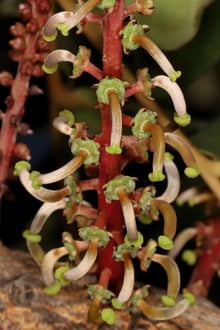
Carob is an evergreen legume of the Mediterranean rim, grown in dryland orchards among olives, almonds, vines and barley and growing wild. Most trees are either male or female: every flower starts as a hermaphrodite, but most become functionally one sex, and female trees dominate in cultivation because they bear the pods. Each small flower centres on a broad nectary disc, and flowers of all three sexes secrete nectar there.
The mix of sexes changes how much carob pollen reaches the jar. A Balearic study puts carob’s high pollen counts down to the stamens sitting beside the nectar disc, while a Sicilian study that set its carob threshold at 15 percent suggested the opposite case: the orchards of the Iblei hills are mostly female trees. The main bloom runs from late August or September to November or December, peaking in October; female trees flower for two to four months, male trees for about one.
Several other honeys and products share the carob’s names. In Argentina “algarrobo” names mesquite trees (Prosopis), and Argentine miel de algarrobo is a Prosopis honey, as is Hawaiian kiawe honey, from the tree also called algarroba. Carob-pod syrups are sold under honey words: Greek and Cypriot χαρουπόμελο (charoupomelo), Turkish keçiboynuzu pekmezi and Arabic دبس الخروب (dibs al-kharrub), and Cypriot syrups are printed “Carob Honey” in English. The Turkish Cypriot Chamber of Industry registered the north’s pod syrup as Kıbrıs Harnup Pekmezi in 2016, a name that may also carry keçiboynuzu, the word in the Turkish name for the honey. Honey stirred with carob syrup or powder is also sold as carob honey; Slow Food’s entry for Crete notes that such a blend “is often confused with the original carob honey”. Carob’s English names, locust bean and locust tree, overlap with those of two other trees: black locust, whose honey is sold in Europe as acacia honey, and honey locust (Gleditsia).
The carob is better known for its pods and seeds. The pods are eaten, fed to livestock, ground into flour and made into the syrups above; the seeds give locust bean gum, a thickener sold as E 410.
Pairings:
In Crete carob honey is eaten on its own and with gruyère and dried fruit, according to Slow Food’s entry. A Mallorcan beekeeper pairs it with sobrasada, the island’s cured sausage, spread on bread, and a Turkish producer at Datça serves it with tahini, yoghurt, oats and aged cheeses.
As an ingredient it goes into desserts and dry pastries in Crete, and a Western Galilee apiary publishes a recipe for chicken and potatoes in a sauce of carob honey and Dijon mustard. In Sicily it is one of the Iblean honeys distilled into the traditional Acquavite di miele iblea.
Health Uses:
In Malta, local tradition holds that carob honey is good for sore throats and for smokers.
Origin Story
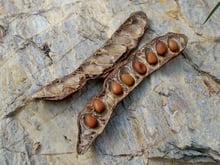
The carob tree is old; its honey is a recent name on the shelf. The tree’s names trace to the Hebrew kharuv (חרוב) and the Arabic kharrub (خروب): algarrobo in Spanish, garrofer in Catalan, carrubo in Italian, caroubier in French, alfarrobeira in Portuguese. The siliqua was a subdivision of the Roman pound, and the carat has varied from 187 to 216 mg and was fixed at 200 mg in 1907. The carob seed is often said to have been used as a weight because its seeds are uniform. A 2006 study found carob seeds vary in weight about as much as other seeds do, and suggested that people choosing similar seeds, not the tree, gave rise to the story.
In the twentieth century the tree became an export crop: in 1937 Cyprus’s normal annual production was more than 40,000 tons of pods, mostly shipped to Britain for animal feeding cake, and by then industry was already extracting gum from the seeds for textiles and cosmetics. World pod production fell from 650,000 tonnes in 1945 to an average of 250,000 tonnes a year over 2000 to 2020, and abandoned orchards and fires have left many old trees standing alone.
The honey’s own record is short. An account of Maltese beekeeping from about 1979 lists “carob honey from the locust tree (Ceratonia siliqua)” among the small honeys extracted by specialists, and a 2013 Balearic study cites scientific descriptions of carob honeys from Turkey, the Iblei hills of Sicily, the Balearics and Morocco published from about 1980 to 2003. Elsewhere the first harvests are recent. At Kranidi in the Argolida, in Greece, a beekeeping business found about two years before a December 2016 newspaper report that the carob honey left as winter stores was far more than expected, harvested it, and sold it through an English supplier of shops outside the supermarkets. In the north of Cyprus, a university bee research centre confirmed a carob honey by pollen analysis for the first time from the 2021 crop. In Israel, the forestry agency’s carob plantings of the 1950s used a Cypriot type grown for fodder that proved poor for bees. During a bee-forage planting project begun in the winter of 1996-97, in which beekeepers plant seedlings from the agency’s nurseries, it emerged that the agency’s carob seed came from those Cypriot plantings, and the seed was replaced with local wild-type carob, which gives the autumn nectar the bees work.
Cultural Context
In Mallorca carob honey is one of the island’s two main honey types, the other being mixed-flower honey, and the government research institute has studied the island’s honey, carob honey among it, as the basis for a protected designation. An 1881 account of the island’s carob varieties, quoted by the institute, describes the variety “De la mel” as sought by bees for its sweet pulp, and gives its second name, Pichdebeya.
Maltese beekeepers label their honey by season, and they understand the autumn honey to come mainly from eucalyptus and carob. Maltese beekeepers call the bee honey għasel tal-ħarrub, and one beekeeper sells it labelled “Carob” in English. Nisget Artna, the Maltese agriculture secretariat’s magazine, calls the November carob and eucalyptus honey the darkest on the island’s market.
In Crete, Slow Food’s Ark of Taste lists the carob honey of small-scale beekeepers around the ancient municipality of Lappa, whose output is limited by the small number of carob trees now on the island. In Sicily, carob honey sits in two entries of Italy’s 2026 list of traditional food products, beside a separate entry for Miele Ibleo. In Libya the honey is known as shibru honey (عسل الشبرو, asal al-shibru), and a Libyan seller offered it under that name in November 2025, glossed as carob. In the north of Cyprus the head of the university bee centre reports that it is known in the honey trade as “chocolate honey”, for a colour close to black.
Harvest & Forage
The carob flow is late and short, and its timing differs by region: October to early November in Mallorca, mid-October to mid-November in Cyprus, September to October in Greece, September to November in Sicily, October to November in Morocco’s carob regions and September to November in Israel. Harvest follows in November and December: a Mallorcan producer describes a tradition of extracting from 1 November, now running to early December or later, Maltese beekeepers take it in November, and a Sicilian producer gives October and November as its months.
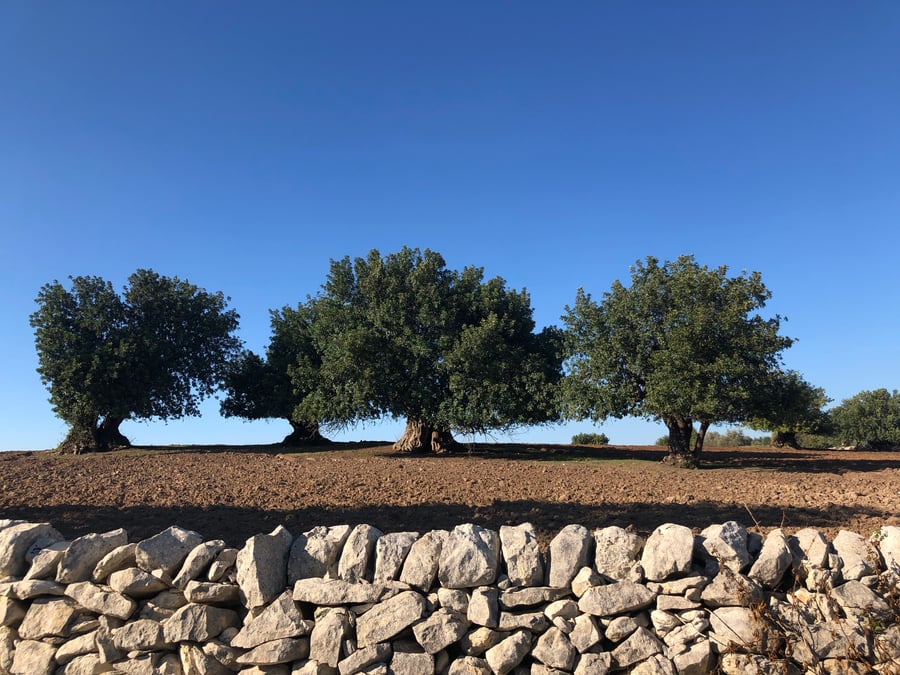
Bees gather other autumn flowers with the carob. In Balearic autumn honeys, carob and winter heather (Erica multiflora) appeared in every sample, ivy and false yellowhead (Dittrichia viscosa) in most, and rosemary in some. In Malta the carob follows the eucalyptus, and some beekeepers take the eucalyptus honey first and the carob honey after, while others harvest once, in late autumn, for a mixed honey. The Iberian guide lists heather, rockroses, legumes and daisies among the pollens found in carob honey and notes honeydew contributions. On Ibiza, carob enters the autumn honey of the Miel de Ibiza protected designation of origin, whose labels may name the season.
Each guide and study sets its own carob threshold. The Iberian guide requires 30 percent carob pollen, Balearic and Algerian studies use the general 45 percent, and a Sicilian study set 15 percent. Italy’s national register of honey sensory experts listed carob in 2022 among the types still awaiting characterisation. Greek law sets identification criteria for eight pure Greek honeys, and carob is not among them. Turkey’s honey regulation lists no ratio for carob and allows the plant’s name where the honey clearly shows that source’s sensory, physical, chemical and pollen character.
Pollen counts show how far declared carob honeys vary. Of 25 Sicilian samples beekeepers declared carob honey, 12 qualified; of Mallorcan autumn honeys harvested in December 2022 and January 2023, 19 of 23 were carob-dominant and three were heather honeys; among Algerian honeys from selected regions, one sample in 138 was carob-dominant. A Turkish study found that not every honey its beekeepers labelled single-flower was, though its carob honeys were.
The crop depends on the weather, in both directions. Italy’s national honey observatory recorded no Sicilian carob honey in 2018, the crop lost to excessive rain, and a Jordanian producer takes a carob crop at Umm Qais only every few years, when early-autumn rain is light. In Mallorca a producer finds the opposite: a much smaller crop when little rain falls, as in the three years before 2025. The late extraction also carries moisture risk: some Mallorcan and Sicilian samples measured above the 20 percent legal limit.
Beekeeping Context
For most beekeepers the carob flow is first a way to carry colonies through the year. It comes when the summer forage has ended, and bee studies across the region describe it in the same terms: in the Balearics, carob, winter heather and ivy are “essential for bee nutrition during autumn”, a season known locally as the “winter spring”; in Cyprus the government pollen atlas credits the autumn flowering of carob and other plants with renewing the colony and securing stores for the winter; a Greek beekeeping text says that in Crete the carob “practically saves the colonies”, worn out by the thyme flow and the summer drought. In Israel the Honey Council rates carob valuable for replacing old queens with young ones and for dividing colonies, work that a 2023 forestry-journal article places in the autumn.
Beekeepers who want the honey move hives to it. In Morocco the Ministry of Agriculture records a transhumance onto carob in October and November in Tadla-Azilal and the Rif; a Western Galilee apiary trucks its hives to stands of wild carob and takes them off at the end of the bloom; a Spanish producer moves part of its apiaries into carob country as summer ends. The lots are small: an Andalusian producer reported 300 kg of carob honey in August 2020, and the producer of the first confirmed carob honey in the north of Cyprus reported 205 kg from the 2021 crop. In 2004 the International Honey Commission rated carob honey of medium importance in Spain and rare in Italy, Greece and France.
Source Regions
- Spain, Valencia, Alicante, Murcia and Andalusia – Ceratonia siliqua: carob honey (miel de algarrobo), autumn honey from dryland carob orchards; Mallorca listed separately below.
- Portugal, Algarve – Ceratonia siliqua: carob honey (mel de alfarroba), harvested in the Barrocal in autumn and early winter.
- Italy, Sicily and Sardinia – Ceratonia siliqua: carob honey (miele di carrubo), chiefly from the Iblei hills; an irregular crop, nil in 2018.
- Malta and Gozo – Ceratonia siliqua: carob honey (għasel tal-ħarrub), labelled Carob, harvested in November after or with the eucalyptus.
- Greece, Peloponnese and Crete – Ceratonia siliqua: carob honey (μέλι χαρουπιάς, meli charoupias), from Argolida, Lakonia and western Crete.
- Cyprus, Limassol district – Ceratonia siliqua: carob honey (μέλι χαρουπιάς), sold as Cypriot Carob Honey beside pod syrups of the same English name.
- Cyprus, north, Kyrenia district – Ceratonia siliqua: carob honey (keçiboynuzu balı), first confirmed by pollen analysis from the 2021 crop.
- Turkey, Mediterranean and Aegean coasts – Ceratonia siliqua: carob honey (keçiboynuzu balı), from Mersin, Adana, Antalya and Datça.
- Morocco, Tadla-Azilal and the Rif – Ceratonia siliqua: carob honey (عسل الخروب, miel de caroubier), after autumn transhumance onto carob.
- Algeria, the eastern coastal plains – Ceratonia siliqua: carob honey (عسل الخروب, miel de caroube), rarely carob-dominant in pollen surveys.
- Tunisia, Kairouan – Ceratonia siliqua: carob honey (عسل الخروب), from apiaries on Jebel Ousselat.
- Libya, Jebel Akhdar – Ceratonia siliqua: carob honey, sold as shibru honey (عسل الشبرو, asal al-shibru).
- Israel, Western Galilee – Ceratonia siliqua: carob honey (דבש חרוב, dvash haruv), from carob flowering from September to November.
- Jordan, Umm Qais – Ceratonia siliqua: carob honey (عسل الخروب), a crop in only some years, when early-autumn rain is light.
Regional Variants
- Mallorcan carob honey (mel de garrover mallorquí) – Ceratonia siliqua – Spain, Mallorca: one of the island’s two main honey types, its conductivity above the EU blossom limit.
Translations
- Miel de algarrobo – Spanish
- Mel de garrover, mel de garrofer – Catalan (Mallorca, Valencia)
- Mel de alfarroba, mel de alfarrobeira – Portuguese
- Miele di carrubo – Italian
- Għasel tal-ħarrub – Maltese (spoken; labelled Carob)
- Μέλι χαρουπιάς (meli charoupias) – Greek
- Keçiboynuzu balı, harnup balı – Turkish
- عسل الخروب (asal al-kharrub) – Arabic
- عسل الشبرو (asal al-shibru) – Libyan Arabic
- דבש חרוב (dvash haruv) – Hebrew
- Miel de caroubier – French
Certifications
 Slow Food Ark of Taste: Carob Honey – Lists the carob honey of Crete, from small-scale beekeepers around ancient Lappa, whose output is limited by the small number of carob trees on the island.
 Prodotti agroalimentari tradizionali, 26th revision – Italy’s 2026 list of traditional food products names Sicilian carob honey in two of the region’s honey entries. (Italian translated to English
 )