
Madeira Cane Syrup (Mel-de-Cana)
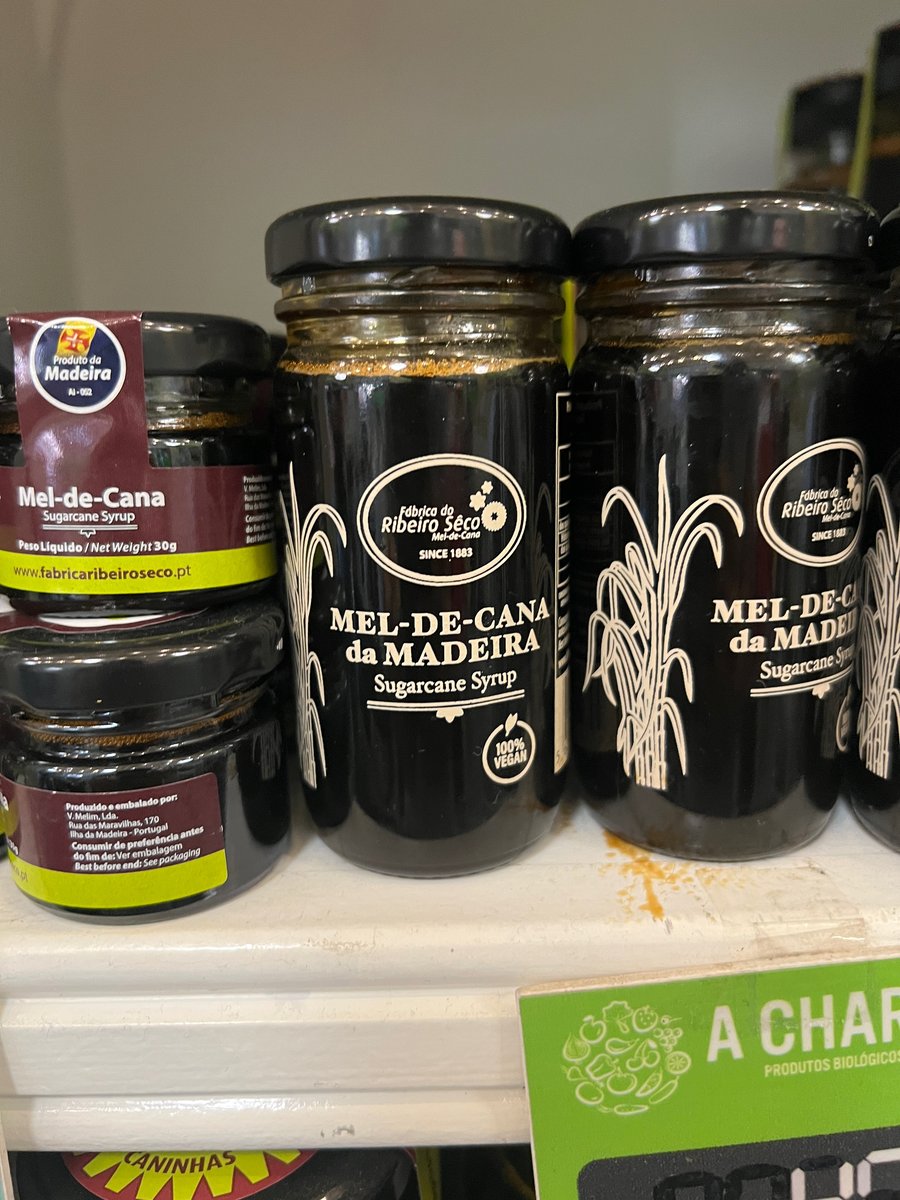
In January 1494 Christopher Columbus wrote from his new colony on Hispaniola to the king and queen of Spain, asking for supplies, and one item on his list came from the Portuguese island of Madeira: fifty casks of miel de azúcar (sugar honey). He called it “the best sustenance in the world and the healthiest.”
What he wanted was a dark syrup from Madeira’s sugar mills. The islanders called their cane syrups mel, the Portuguese word for honey, and they went on doing so for almost six centuries. One of those syrups is still boiled on the island every spring, from cane cut by hand on small terraces, and it is sold today as mel-de-cana (cane honey).
Madeirans spread it on bread, pour it over fried dough at Carnival and bake it into bolo de mel (honey cake), their dark Christmas cake. The honey in that cake’s name is this syrup.
What Madeira’s Mel-de-Cana Is
Mel-de-cana is the juice of sugar cane, cleaned and boiled down to a thick, dark syrup. The producers’ specification, the document that defines the product, names one raw material: sugar cane grown on Madeira. The whole juice is concentrated, and the specification states that the syrup keeps everything the juice held.
The specification describes the syrup as dark brown, from close to black through to a golden brown or amber, showing orange and gold where it runs thin. It gives the taste as sweet at first and caramelised, with a light bitterness and some acidity at the end, and it lists notes of freshly crushed cane, sultanas, vanilla, spice and roasting.
The syrup stays liquid in the jar, and the cause is the acidity of the juice. As the juice heats, its natural acid splits part of the cane sugar into glucose and fructose. Those two sugars resist crystallising, so the specification sets a minimum for them.
The Word Mel on Madeira
For almost six centuries, the specification states, Madeirans called the island’s cane syrups mel, or mel da Madeira.
An Italian nobleman, Giulio Landi, visited the island in the late 1520s and described how its sugar was made. The froth skimmed from the boiling pans was kept in barrels, he wrote, and it was “similar to honey, though a little blacker and more liquid.” The islanders fed it to their horses, mixed with flour and straw. French, Flemish and English merchants shipped it home, where it was used in place of honey.
The name changed, the specification states, when European Union law defined honey as the sweet substance made by bees and kept the word for that product. Madeira’s producers adopted mel-de-cana da Madeira (cane honey of Madeira). The cakes and biscuits made with the syrup were renamed too, and the specification records “great confusion among local consumers and visitors.”
In 2006 three certification marks were created, one each for the syrup, the cake and the biscuits. Since June 2022 the name Mel-de-Cana da Madeira has been protected in Portugal as a designation of origin, and an application for European Union registration was filed the same month. Under the specification every label carries that name.
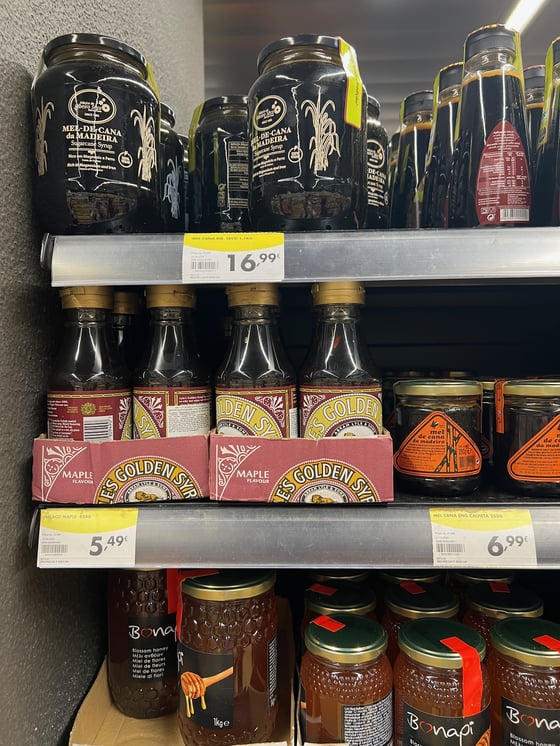
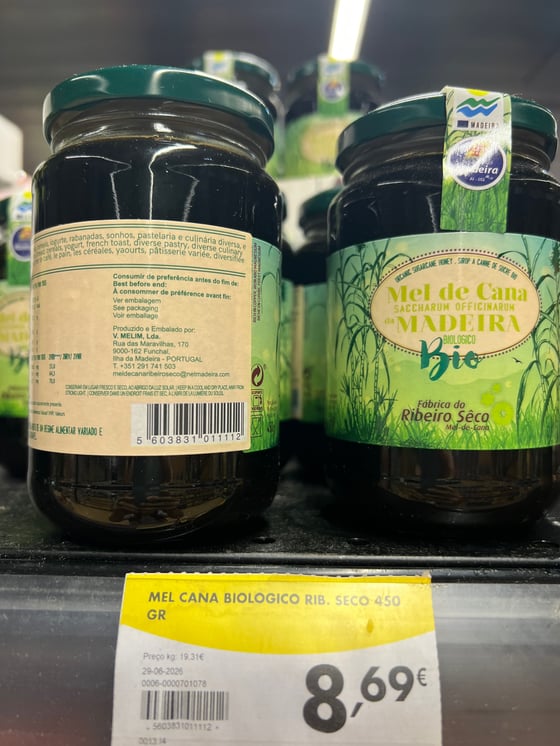
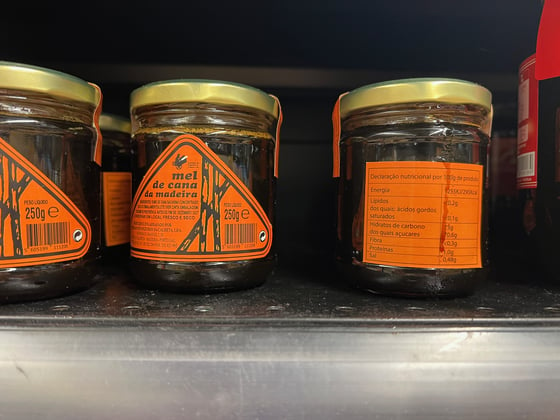
The English on the jars varies. On a supermarket shelf in Funchal in October 2026 I read six jars of cane syrup under three labels. Some carried the English words “Sugarcane Syrup”; one organic jar carried “Organic sugarcane honey.” One jar’s ingredient list was a single line: concentrated sugar cane juice. Chemists at the University of Madeira write “sugarcane honey” in their published papers.
The cane syrups stood on the syrup shelf, and the island’s bee honey stood on the shelf below. That honey has its own page, Madeira Honey.
The Madeira museums’ inventory of living traditions records two other syrups under the name mel, both in the hamlets of Ponta Delgada, a parish on the north coast: mel de figos (fig syrup), and mel de vinho em mosto, a syrup boiled from grape must.
The Cane Terraces of Madeira
Sugar cane on Madeira grows on poios (terraces), small level plots held up by walls of basalt stone and watered by levadas, the island’s irrigation channels. A grower’s whole holding rarely reaches half a hectare, and it is usually split across five or six terraces. The work is done by hand.
The canes are cut between the second half of March on the south coast and the first half of June on the north. The cutter uses a podoa, a short-handled hooked blade, and cuts close to the root. The root stays in the ground and sprouts the next year’s canes, and a field renewed this way can stay productive for 20 to 25 years. The cut canes are tied in bundles and carried out to the road on the workers’ backs.
The growers’ names for their canes are colours and patterns: Amarela (yellow), Roxa (purple), Rajada (striped), Violeta and Canica. The specification traces them to canes brought to the island in the nineteenth century and the first half of the twentieth, from Cape Verde, the Antilles, Mauritius, Java, Louisiana and other cane countries.
By the specification’s figures, about four-fifths of the cane goes to the island’s rum. The rest is boiled into syrup.
Boiling the Syrup in Madeira’s Mills
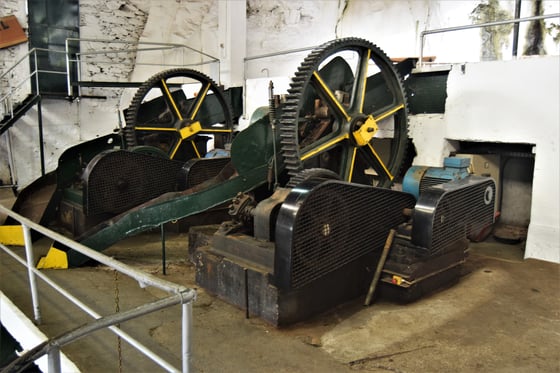
Three engenhos (mills) make the syrup. Madeirans use the word both for the machine that crushes the cane and for the whole works. The Ribeiro Sêco mill in Funchal, founded in 1883, presses its cane for syrup alone, by the specification’s account. Two mills at Calheta, on the south-west coast, make syrup alongside rum: the Sociedade dos Engenhos da Calheta, dating from 1901, and the Engenho Novo da Madeira, opened in 2006.
The steps are the same in each. The canes are crushed and the garapa (fresh juice) runs out. The juice is left to settle or is filtered, then heated slowly, and the impurities that rise as froth are skimmed off. The clear juice is then boiled for many hours, in some mills for a full day, until it has the thickness and colour of the finished syrup. It rests in tanks and is bottled by hand from a tap.
The colour, from a dark brown close to black to a more golden dark brown, depends on how long the syrup cooks.
The bagaço (crushed cane) is left over. The older mills burn it under their steam boilers, so part of the heat that boils the juice comes from the cane.
Dig Deeper: How Madeira's Mills Clear and Thicken the Juice
Fresh cane juice is mostly water, between 70 and 88 per cent, with the sugars, minerals, waxes and plant matter of the cane dissolved or floating in it. The solids are taken out first. The juice settles or passes through a filter, and then it is warmed for between half an hour and three hours, to between 60 and 80 degrees Celsius. Fats, waxes and fine particles clump in the warm, acidic juice and rise as froth, which is skimmed before the juice boils.
The island’s old sugar makers added plant ash or lime at this stage to help purify the juice. The syrup makers use heat alone. The slow warming has a second effect: the juice’s acid inverts part of the cane sugar. The specification puts the floor for glucose and fructose together at 17 per cent of the syrup, the level that keeps a jar from crystallising.
Boiling follows. A mill’s pans may be copper, cement or stainless steel, and the temperature and the time depend on the pan: 100 to 108 degrees, for 10 to 24 hours. The Funchal mill shortens the boil to eight or nine hours and finishes the syrup in a vacuum vessel, where it thickens in twenty to thirty minutes at no more than 50 degrees.
Madeira’s Sugar Centuries
Cane reached Madeira around 1425, soon after the island was settled, when Prince Henry of Portugal had cuttings brought, it is believed from Sicily. Sugar was then a luxury of courts. The island’s terraces and its levadas were built to grow the cane and to water it.
The name mel then belonged to the syrup that drained from the clay moulds as the sugar crystallised, and some households boiled whole cane juice into a syrup for their own use. The specification calls these syrups the most valued product of the trade after sugar. In the sixteenth century the crews of ships calling at Funchal sought them as food for the voyage. Columbus had asked for his fifty casks to feed the healthy and the sick of his colony.
In the second half of that century the crown banned the export of cane syrups. Foreign merchants had been boiling them again into a lower grade of sugar that competed with the island’s own. The syrup stayed on the island, and the convents put it to use.
The Franciscan nuns of the Santa Clara convent in Funchal made sugar preserves and a bolo de mel for the convent and for sending to Brazil, Flanders and the Low Countries. The convent’s accounts for 1813 and 1814 list the cakes and sweets made with the syrup for Advent, Carnival and Christmas.
When sugar from Brazil and other colonies reached the courts of Europe, Madeira’s trade declined and the large mills closed. Households kept small cane plots and went on boiling syrup from the seventeenth century to the nineteenth. Early in the nineteenth century new canes and steam mills arrived, and the boiling of syrup moved from the kitchen to the mill.
Dig Deeper: Madeira's Cane in the Twentieth Century
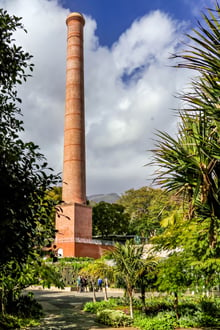
Through the twentieth century the land under cane on Madeira fell from thousands of hectares to fewer than a hundred. A decree of 1911 gave one Funchal factory, the Fábrica do Torreão, known as the Hinton mill, the monopoly on making sugar. Cane had covered as much as 6,500 hectares of the island, by the specification’s figure; zoning rules cut the area back from the late 1930s, and by 1952 the estimate was 1,420 hectares.
The Hinton mill closed in 1985. The next year cane was down to about 120 hectares, and by 1988 to 90. Growers had turned to bananas, other fruit and vegetables, and housing, hotels and roads had been built on the low coastal land where cane had grown.
The specification, written for the 2022 application, puts cane at about 175 hectares and the yearly crop at between 8,500 and almost 11,000 tonnes over the five years before it.
Three mills were working at the end of the twentieth century, at Funchal, Calheta and Porto da Cruz; the fourth opened at Calheta in the first years of this one. The Porto da Cruz mill makes rum only.
Mel-de-Cana on the Madeiran Table
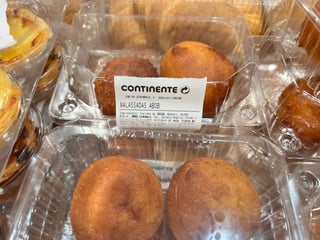
Madeirans use the syrup through the year. It is spread on bread and poured over yam or sweet potato, and it goes into sauces for roast meat. Stirred into Madeira rum it makes macia (a rum liqueur).
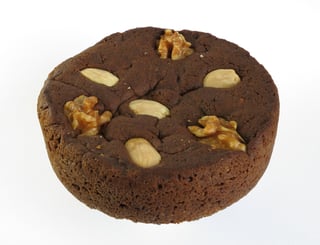
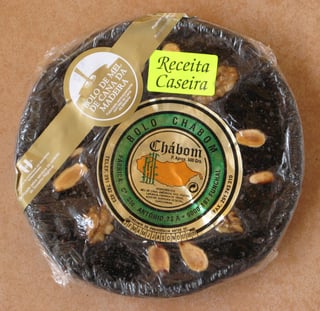
The specification names two seasons of greatest demand, Carnival and Christmas. At Carnival the syrup is poured over sonhos and malassadas, small cakes of fried dough. At Christmas it goes into the family recipes for bolo de mel and for broas, the spiced biscuits baked with it.
Bolo de mel takes its dark colour from the syrup, and the Madeira museums’ record of the cake names cane syrup and spices as its main ingredients. By family tradition it is made on 8 December so that it is ready for Christmas. It keeps for several months, and it is broken by hand.
The Ribeiro Sêco mill bakes its own bolo de mel and broas. At Luz.Doce in Porto Moniz, the mead house of the beekeeper Carlos Pestana, the house’s site lists a cake and biscuits made with mel puro (pure honey).
The mel in poncha, the island’s drink of cane spirit and citrus, is bee honey. A regional order of 2017 describes the fishermen’s poncha, made with sugar, and the traditional poncha, in which the sugar is replaced by bee honey.
Seeing the Cane Season on Madeira
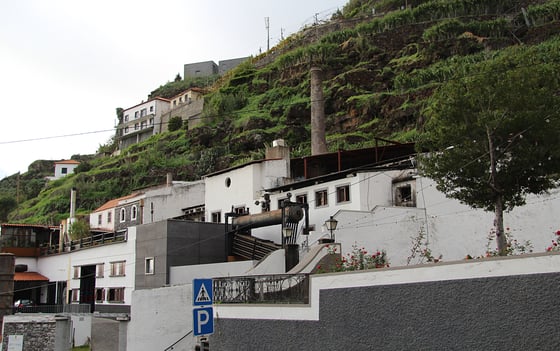
The cane season runs from late March to early June. The regional tourism board’s page, read in November 2026, says the mill in the town of Calheta works once a year, usually after Easter, and that its tasting room and bar can be visited all year.
Each April the parish of Canhas, in Ponta do Sol on the south coast, holds the Feira Regional da Cana de Açúcar, the regional sugar cane fair, which shows the products made from cane and honours the growers and the mills.
The Madeira Honey page lists the island’s four cane mills, the rum mill at Porto da Cruz among them, with their visiting arrangements, in its section on the cane season.